
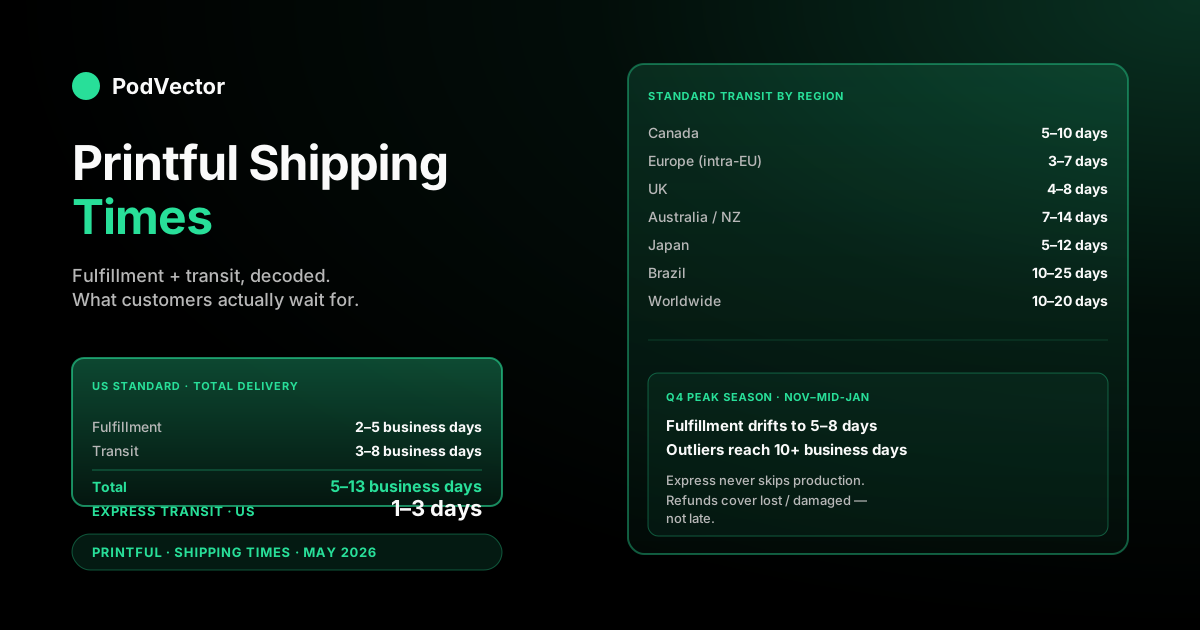
Quick Answer: Printful delivery time has two parts. Fulfillment — printing and packing — takes 2–5 business days. Transit — the carrier leg from facility to door — takes 3–8 business days standard in the US, longer abroad.
Total expected delivery is roughly 5–13 business days for US standard, and 7–25 business days for most international destinations. Express shipping cuts the transit leg to 1–3 business days domestic, but does not speed up fulfillment.
For POD sellers the real number to track is not the average — it is the variance. A 2-day fulfillment swing during peak season triggers a refund request that costs you 20× the shipping fee. The math below is the spec. Watching how your real orders compare is the work.
The two-part delivery time formula
Printful delivery time is never one number. It is fulfillment plus transit, and those two legs run on completely different clocks.
Fulfillment is what Printful does. The order hits the production queue, gets printed, gets packed, and gets handed to the carrier. This is 2–5 business days on average for apparel, and a touch faster for non-apparel like mugs and posters.
Transit is what the carrier does after pickup. Standard US transit is 3–8 business days. International transit can run 5–20 business days depending on the destination region and customs.
Add them together and you get a realistic delivery window. A US t-shirt order placed Monday is most likely delivered between the following Monday and the Wednesday after that. Not faster, unless you pay for express.
This split is the source of most customer-service complaints in POD. Customers see "shipping" and assume 3 days door-to-door. They forget — or were never told — about the production leg in the middle. Communicating both numbers on your product page kills 80% of the "where is my order" tickets before they're written.
For everything in this cluster — rates, regions, the live-rates flow, free-shipping mechanics, the API — see the Printful shipping hub. For the broader Printful library covering pricing, products, and integrations, the Printful topic hub is the index.
Fulfillment times by product category
Printful publishes a 2–5 business day average for fulfillment, but the spread inside that range is wide. Different product categories move through the factory at different speeds.
Typical 2026 fulfillment medians by category, based on Printful's own published averages:
- T-shirts and basic apparel: 2–3 business days
- Hoodies and sweatshirts: 3–4 business days
- All-over print clothing: 4–5 business days (longer cure time)
- Embroidered items: 4–6 business days (manual setup per design)
- Mugs and drinkware: 2–3 business days
- Posters and wall art: 2–3 business days
- Phone cases and accessories: 2–4 business days
Two operational details matter here. First, fulfillment runs in parallel for items printed at the same facility — a two-shirt order does not take twice as long as a one-shirt order. Second, a mixed-category order may split: your shirt and your mug may ship separately if they print at different facilities.
That split matters for customer expectations. The first package arrives on day 7, the second arrives on day 11, and the customer thinks half their order is lost. The fix is making the split visible at order confirmation, not at delivery.
Fulfillment also slows under load. During Q4, Printful's published averages quietly drift toward the high end of the range, and outliers stretch to 7–10 business days. We cover the peak-season effect in its own section below.
US shipping transit times
Once a package leaves a Printful facility, the carrier owns the clock. Printful uses a rotating mix of carriers — USPS, UPS, FedEx, DHL — chosen at the time of dispatch based on cost, weight, and destination. You typically don't get to pick.
Standard US transit times look like this:
- Same-region (e.g., US East Coast to US East Coast): 3–5 business days
- Cross-country (e.g., Charlotte facility to California): 5–8 business days
- Rural / remote ZIPs: add 1–3 business days on top
Printful operates multiple US fulfillment centers — Charlotte, North Carolina; Los Angeles, California; Dallas, Texas — and routes orders to the facility closest to the destination where capacity allows. That routing is invisible to you and to the customer, but it is the main lever keeping transit times reasonable across a wide country.
What it means in practice: your buyer in Florida and your buyer in Oregon often see similar transit times even though they're 2,500 miles apart, because each gets a package from a regional facility. The exception is when load forces routing through a non-local facility, which is a real Q4 effect.
For the rate side of the same shipments, see our guide to Printful live shipping rates — it covers how the carrier choice and weight feed into the per-cart shipping price at checkout.
International shipping transit times
International is where the variance gets ugly. Printful prints internationally too — facilities in Latvia, Spain, Mexico, Canada, Japan, and Australia route orders locally where possible. So a UK buyer often gets a package printed in Latvia, not shipped across an ocean.
Standard transit times by region, fulfillment leg already excluded:
- Canada: 5–10 business days
- Europe (intra-EU): 3–7 business days
- UK: 4–8 business days
- EFTA (Switzerland, Norway, Iceland, Liechtenstein): 5–12 business days
- Australia / New Zealand: 7–14 business days
- Japan: 5–12 business days
- Brazil: 10–25 business days (customs is the variable)
- Worldwide (everywhere else): 10–20 business days, often longer
Brazil and "Worldwide" are the categories that surprise people. Both involve customs holds that are outside any carrier's control. A package can sit in Brazilian customs for 7+ business days with no scan updates and no human you can call.
For a full breakdown of how international shipping works end-to-end — rates, customs liability, regional routing — see our guide to Printful international shipping.
Express shipping: when the premium is worth it
Express transit cuts the carrier leg, not the fulfillment leg. The total saving for a US order is roughly 3–5 business days, at a per-order surcharge of $9.50–$22 depending on weight and destination.
Express transit times:
- US express: 1–3 business days
- Canada express: 2–4 business days
- International express: 3–6 business days for most regions
The mistake POD stores make is offering express as a universal option. On most catalogs, express is profitable only on orders over ~$50 retail — below that, the surcharge eats more margin than the speed earns. And even at $50+, a fraction of buyers actually pick it.
If you offer express, set it up so the customer sees the real cost at checkout via Printful's live rates rather than absorbing it via flat rates. Eating $15 of variable shipping cost on a $25 t-shirt order to deliver in 4 days instead of 8 is not a customer-service win. It's a margin disaster you'll only notice in a quarterly review.
Holiday and peak season impact
Q4 — roughly November through mid-January — is where published averages stop being honest. Printful's public 2–5 day fulfillment window quietly drifts to 5–8 days, and outliers reach 10+. Carrier networks slow in parallel.
What you should plan for in Q4:
- Add 3–5 business days to every estimate you give customers between Black Friday and December 15
- Set order-by dates on your storefront — Printful typically publishes recommended deadlines in early November
- Avoid offering express as a "guaranteed by Christmas" promise — fulfillment delays will break that promise even when transit holds
- Expect a 2–3× spike in "where is my order" tickets compared to baseline
The operational fix is anticipating the surge in your CX response template, not promising speed you can't control. Customers who are told upfront that an order may take 14 business days during peak season rarely complain when it takes 12. Customers told "5–8 business days" and getting 14 always do.
Estimated delivery time and tracking
Printful exposes an estimated delivery time (EDT) at checkout when live rates are enabled, and on the order detail screen in your dashboard for every order. The number is a prediction, not a guarantee.
EDT is calculated as: published fulfillment median + carrier-quoted transit estimate. It does not factor in current facility load, Q4 surge, or customs holds. So during normal periods it tends to be accurate within ±2 days; during peak it tends to underpredict by 3–5 days.
Tracking updates are passed through from the carrier as scans happen. The most common gap — what looks to customers like a "stuck" package — is the 24–72 hour window between the carrier receiving the package and the first transit scan. This is a known carrier behavior, not a Printful issue, and it usually resolves on its own.
Worth knowing: Printful's free returns policy covers lost, misprinted, damaged, and defective orders, but does not cover delays. A package that arrives 5 days late is not eligible for a refund. A package that never arrives is.
Setting expectations on your storefront
The single biggest unforced error in POD shipping communication is publishing the transit time as if it were the total delivery time. "Ships in 3–8 days" makes customers expect their order by next week. Then they get it in 10–13.
The fix is publishing both legs on the product page and in your shipping policy:
- Production time: 2–5 business days
- Shipping time: 3–8 business days (US standard)
- Total expected delivery: 5–13 business days from order date
Add a Q4 banner from late October through mid-January noting the seasonal slowdown. Set a clearly visible order-by date for guaranteed pre-Christmas arrival. Print a reminder in the order confirmation email that the production leg is part of the timeline.
Storefront tools like Shopify's shipping settings let you display estimates per region — use them. The closer the on-site estimate is to reality, the lower your refund rate. We cover the Shopify-specific configuration in our guide to Printful live shipping rates for Shopify.
Costs in context: what does faster shipping cost?
The cost of shipping speed is asymmetric. Standard adds $3.99–$10 to a typical apparel order. Express adds $13–$28. Worldwide standard adds $15–$30. Worldwide express can run $30–$60.
A few reference points on per-item shipping costs to a US address — the rate Printful charges you, not the customer:
- T-shirt: $4.75 standard, ~$15 express
- Hoodie: $8.49 standard, ~$22 express
- Mug (11 oz): $4.95 standard, ~$14 express
- Backpack: $10.49 standard, ~$24 express
The hoodie line is where most stores leak the most margin. The $8.49 first-item rate plus a $20 base product cost means a $40 retail hoodie is already $28.49 before any taxes, transaction fees, or ad spend hit. Express on the same order pushes it to $42+, which is the entire retail price. For the full input cost picture on hoodies, see our Printful hoodie base cost breakdown and the full Printful hoodie cost breakdown for POD sellers.
The margin angle: why slow orders quietly cost you money
The number every POD operator can quote is the shipping fee. The number almost none can quote is the cost of a late order — and that's the one that actually moves quarterly profit.
A "delivered late" order generates one or more of: a refund request, a chargeback, a negative review, a customer service ticket, and a customer who never buys again. Even a partial refund on a $40 order is 10× the shipping fee you "saved" by choosing standard. A chargeback is 30×.
The operator question is not "what's Printful's published fulfillment time" — it's "what's our 90th percentile fulfillment time this month, on the SKUs that drive 80% of our orders, and is it drifting?" That number lives in your order data, not in a public help center article. The same is true for the late-arrival rate by region, the express conversion rate, and the actual blended shipping cost per order.
This is the gap PodVector AI built Victor to close. You ask an AI employee sitting on top of your unified data warehouse — Shopify orders, Printful fulfillment events, ad spend, refund history — questions like "what's my median delivery time this month versus last, broken down by region" or "how much shipping margin did I lose on hoodie orders that shipped express." The numbers come back immediately, against your actual data. No spreadsheet, no waiting for someone to pull a report.
Most POD stores discover their shipping economics two quarters after the fact, when it's too late to act on. The operators who don't are the ones with a live view of fulfillment lag, carrier mix, and per-region delivery variance against their real orders.
FAQs
How long does Printful take to ship an order?
The full timeline is fulfillment plus transit. Fulfillment is 2–5 business days. US standard transit is 3–8 business days. Total: roughly 5–13 business days from order placement to delivery for a typical US order. International runs 7–25 business days depending on region.
Is Printful express shipping worth it?
Express cuts transit by 3–5 business days at a $9.50–$22 surcharge. It's worth it on time-sensitive gifts and high-AOV orders. It rarely makes sense on sub-$50 retail orders, where the surcharge can wipe out per-unit margin. Offer it as a customer-facing live-rate option rather than absorbing it via flat rates.
Does express shipping skip fulfillment?
No. Express only speeds up the carrier leg. The 2–5 business day production time still applies. An express order placed Monday is most likely delivered Friday or the following Tuesday — not on Wednesday.
Why is my Printful order taking longer than the estimate?
The most common reasons: a peak season surge (November–January), a customs hold (international, especially Brazil), a routing decision that sent the package through a non-local facility, or a missing first-mile scan that makes the package look stuck for 24–72 hours. Printful's EDT is a prediction, not a guarantee.
Does Printful refund late orders?
No. Printful's free returns policy covers lost, misprinted, damaged, or defective orders. Delay alone is not a refund condition. If a package never arrives or arrives damaged, you're covered.
How do I track a Printful order?
Tracking numbers appear in the Printful dashboard once the carrier picks up the package and on the order confirmation email your customer receives. Updates are passed through from the carrier — a 24–72 hour gap between pickup and first transit scan is normal.
What's the fastest Printful can deliver?
The realistic best case for a US order with express shipping is 4 business days: 1 day fulfillment + 1–3 days express transit. That's an outlier — assume 5–8 days for express, 5–13 days for standard.
Do mixed orders ship together?
Sometimes. Items printed at the same facility usually ship together. A mixed-category order (e.g., a shirt and a mug) may split if the items print at different facilities, and the two packages can arrive several days apart.
Know what shipping is doing to your margin — every day, not every quarter
Printful's rate card is one number. What it actually costs your store after order mix, region split, late-order refunds, and Q4 fulfillment drift is another number entirely. Most POD operators only see that second number months too late.
PodVector AI's AI employee, Victor, sits on top of your unified data warehouse and answers shipping margin questions in plain English. "What was my median delivery time last month versus this month, broken down by region?" "How much did late orders cost me in refunds this quarter?" Real numbers, against your actual orders, in seconds.
Stop running shipping decisions on published averages. And get a live view of every line that turns "shipping time" into "shipping cost."
Try Victor free