
Quick Answer: A standard US Printful order lands at the customer's door in 5–9 business days from order placement. That's 2–5 business days of fulfillment plus 3–4 business days of carrier transit. Express upgrades only the carrier leg to 1–3 business days, so the realistic floor on any US order is 3 business days.
The single most expensive mistake operators make is reading "shipping time" as a single number. It's two clocks running in series — fulfillment then transit — and customers expecting one figure file tickets when the order sits in production for 4 days.
Quote the full 5–9 business day window on the product page, the cart, and the order confirmation. Calendar-day translation: 7–13 days. That alignment between Printful's clock and the customer's clock is what keeps "where's my order?" volume manageable.
The headline US shipping time number
For a standard US Printful order — apparel, posters, mugs, the bulk of the catalog — the door-to-door window is 5–9 business days. That decomposes into 2–5 business days of fulfillment and 3–4 business days of carrier transit.
Express upgrades only the carrier leg, compressing transit to 1–3 business days. A US express order runs 3–8 business days door to door. The fastest realistic delivery is 3 business days, which lines up only when fulfillment ships same-day and the carrier delivers next-day express.
Calendar-day translation matters because customers don't think in business days. A 5–9 business day window becomes 7–13 calendar days once you factor in the weekend a typical order straddles. That's the number to quote in shipping policy copy.
None of these numbers are sliders the seller can move. Fulfillment routing is automated; transit is the carrier's clock. The only operator lever is communication — what gets quoted, where, and when.
Day-by-day: what's happening to your order
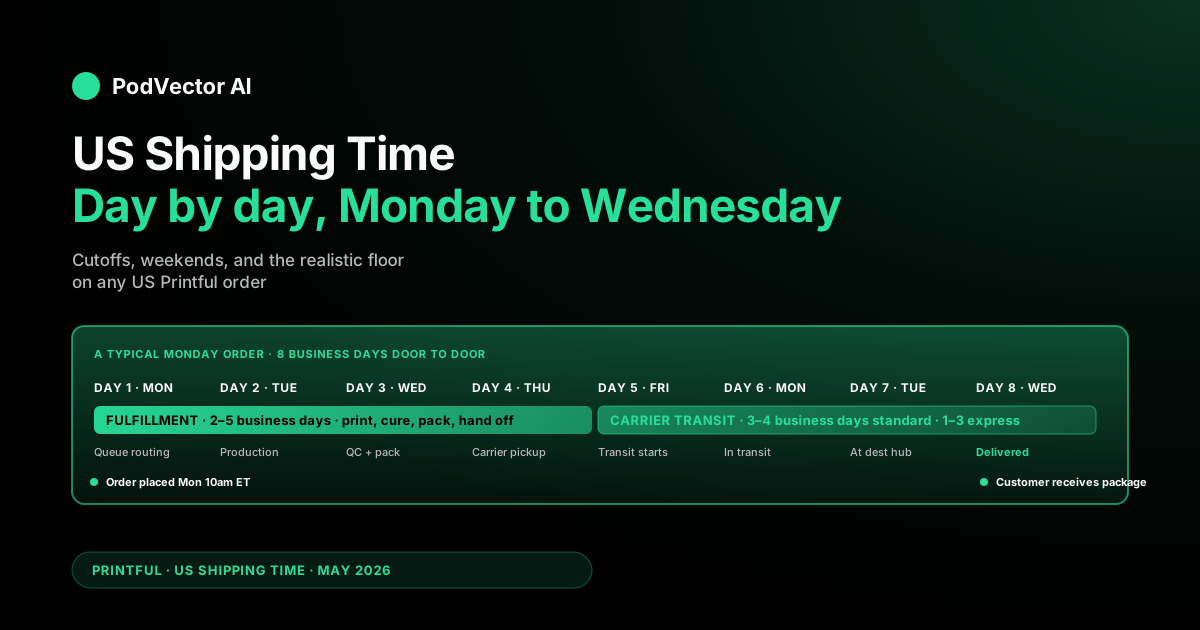
Picture a typical US order placed Monday at 10am Eastern. Here's what each day looks like in Printful's pipeline.
Day 1 (Monday). Order hits Printful's queue. Routing logic assigns it to the closest facility with stock and capacity. Production starts the same day for simple SKUs if the queue is light.
Days 2–3 (Tuesday–Wednesday). Print, cure, quality check, fold, pack. For DTG t-shirts on a normal-volume week, the package is ready for pickup by end of Wednesday. For embroidery or AOP, this stretches another day or two.
Day 4 (Thursday). Package handed to the carrier. The carrier's tracking number generates, the customer gets a "shipped" email, and the transit clock starts. Note: "shipped" in the carrier system often means "label created" before the package physically moves — actual pickup may be the next morning.
Days 5–7 (Friday–Tuesday). Transit. Standard US shipping is 3–4 business days. A package leaving Thursday will typically scan at the destination facility on Tuesday and deliver Tuesday or Wednesday.
Day 8 (Wednesday). Delivery. The customer's Monday order arrives the following Wednesday — 8 business days, 10 calendar days. Right in the middle of the quoted window.
This is the average case on a Monday-to-Monday cycle. Order Friday afternoon and the weekend eats day 1; order during a peak week and add 1–2 days to fulfillment; order to a remote zone and add 2–3 days to transit.
Order cutoffs, weekends, and the 5pm trap
Printful does not publish a hard order cutoff time, but the practical reality is that orders placed before noon Eastern on a business day enter the queue same-day, and orders placed after lose roughly a day to next-morning routing.
The 5pm trap is real. A customer ordering at 4:55pm Friday assumes their order is "in" for the week. From Printful's queue perspective, that order may not start production until Monday — losing the entire weekend plus the late-day delay. The customer-facing clock starts Monday morning, four days after the order was placed.
Weekends do not count as business days for either fulfillment or transit. A Friday afternoon order on a 2–5 business day fulfillment cycle realistically ships the following Wednesday at earliest, with Tuesday-or-later transit.
For US POD operators, this changes what you quote during specific shopping windows. A "ships in 1 week" promise that's safe Monday becomes risky Thursday and a lie by Friday afternoon. The fix is a static, conservative window in shipping policy rather than dynamic estimates that depend on order timing.
When express is worth $9–22 extra
Express shipping on a US Printful order adds $9–22 to the shipping line, depending on weight, dimensions, and destination zone. The transit window drops from 3–4 business days to 1–3 business days. Fulfillment stays the same — 2–5 business days regardless of shipping tier.
The math is straightforward: express buys 1–3 business days off the back end, never off the production end. A buyer who orders Friday hoping to wear a t-shirt to a Saturday wedding cannot be saved by express, because fulfillment alone consumes the window.
Express is worth offering when the customer is making the trade-off knowingly — gift deadlines, replacement orders, event apparel ordered with enough lead time to clear fulfillment. The conversion lift on offering express at checkout is small for everyday apparel buyers and meaningful for time-sensitive purchases. The US t-shirt shipping rates breakdown walks the full rate card, and the USA t-shirt shipping deep-dive covers the volume math for stores running both tiers.
Most US POD stores leave express enabled and let the buyer choose. The few stores that disable express tend to do so because they don't want to absorb the customer-service overhead when an express order misses its window due to fulfillment delays — a real risk during Q4.
The Q4 calendar shift
Every published number on this page is calibrated to a normal production week. From mid-November through end of December, the fulfillment leg stretches noticeably as Printful's facilities absorb peak demand across all merchant accounts.
In peak Q4, plan on 4–7 business days for fulfillment instead of 2–5. Transit times stay roughly stable — the carriers run their own peak playbook — but the combined window can stretch to 7–11 business days for standard shipping, or 9–14 calendar days.
The operational consequence: every US shipping cutoff date Printful publishes for the holidays is conservative because they're solving for the long tail of customers, not the median. A "guaranteed by Dec 23" cutoff might be Dec 10 for standard and Dec 17 for express. Lift those dates onto the storefront prominently — banner, cart, checkout — and customer-service load drops sharply.
For deeper coverage of the rate impact during this window, the general Printful shipping rates guide documents how rates themselves move (they generally don't) versus how the volume and risk profile change.
US region matters more than you think
The carrier transit leg is the swing factor inside the 5–9 day window. Once Printful hands the package over, transit time tracks distance from facility to customer.
- Same-region: 2–3 business days transit (e.g., NC facility to Atlanta customer)
- Adjacent region: 3 business days transit (e.g., Dallas facility to Chicago customer)
- Cross-country: 4–5 business days transit (e.g., NC facility to LA customer)
- Hawaii / Alaska: 5–7 business days transit, often with a small remote-zone surcharge
- Puerto Rico: 6–9 business days transit, surcharge applies
The flat-rate shipping price stays the same across the continental US — a t-shirt to Maine and a t-shirt to Texas both ship at the same rate. What varies is the transit time, not the cost line on the order.
For stores with a concentrated regional customer base — a Southern California brand selling mostly to Southern California — the practical door-to-door average lands closer to 5–6 business days because routing favors the nearest facility. National brands with broader customer geography average 6–7 business days.
Which facility your order ships from
Printful operates US fulfillment facilities in California, North Carolina, and Texas, with specialty operations elsewhere for embroidery, all-over-print, and warehouse fulfillment. The order routing system picks the facility that minimizes total time and cost based on stock availability, queue depth, and carrier zone.
The seller does not pick the facility, and the same SKU may route to different facilities on different days. This is intentional load-balancing — Printful keeps the published 2–5 day fulfillment window stable by spreading volume across locations.
The practical effect for the seller is none, with one caveat. SKUs that only fulfill at a single specialty facility — embroidery is the usual example — see consistently longer transit when the customer is in a distant zone. For most apparel sellers, this is invisible. For embroidery-heavy stores, it's worth knowing.
The cost side of the time question
"How long does it take?" and "How much does it cost?" run together in customer expectations, so the rate card matters here even though this guide is about time.
For US domestic shipping on apparel:
- Standard, single t-shirt: ~$4.69
- Standard, each additional t-shirt: ~$2.20
- Standard, hoodie or sweatshirt: ~$5–8 single item
- Express premium over standard: $9–22 depending on weight and destination
- Remote-zone surcharge (HI, AK, PR): $2–5 added to standard rate
These rates apply to the carrier handoff after fulfillment. They do not change based on which facility Printful routes to internally; Printful absorbs the inter-facility routing variance. They also do not change with order volume — there's no domestic shipping discount baked in for stores that ship more, although Printful's premium membership program includes some product discounting that indirectly improves the time-vs-cost calculus. The premium membership pricing breakdown walks the full ROI math.
For the full updated rate sheet across product types, Printful publishes the live rates on its shipping page, and the categories there match what shows in the API at order time.
What this costs you per order
Time is a margin variable for US POD sellers, not just a customer-service variable. Two angles to think about:
Refund risk. Every business day past the quoted window raises the probability of a refund request, especially on gift-driven SKUs. A 5-day quoted window with a 9-day actual delivery has a meaningfully higher refund rate than a 9-day quoted window with a 9-day actual delivery — same outcome, different expectation. Setting the quote conservatively is cheaper than the alternative.
Customer lifetime value. Repeat-purchase rate on POD apparel is sensitive to the first delivery experience. A buyer who waits 9 days expecting 9 reorders at a normal rate. A buyer who waits 9 days expecting 5 — even if the same 9 days — buys again less often. The shipping policy is a margin lever through CLV, not just a cost line.
Tracking the per-SKU and per-region margin impact of shipping time is the kind of analysis that doesn't fit into a spreadsheet for stores past 100 orders a week. Most operators either ignore the question or run a quarterly report that's already stale by the time it's read. The full shipping section of our Printful coverage threads the cost-and-time questions together across SKUs, regions, and shipping tiers, and the Printful topic index covers the broader operational picture including the cost-and-charges cluster that overlaps with shipping decisions.
FAQs
How long does Printful shipping take in the US?
5–9 business days door to door for standard shipping. That's 2–5 business days of fulfillment plus 3–4 business days of carrier transit. Express compresses transit to 1–3 business days, putting express orders at 3–8 business days door to door.
What's the difference between fulfillment and shipping time?
Fulfillment is the time Printful takes to print, cure, pack, and hand off to the carrier — 2–5 business days. Shipping is the carrier's transit time from facility to customer — 3–4 business days standard, 1–3 express. The two clocks run in series, not parallel.
Can I rush a Printful order?
Sort of. Express shipping compresses the carrier leg from 3–4 business days to 1–3 business days, but fulfillment is fixed at 2–5 business days regardless of shipping tier. There's no way to skip fulfillment from the seller side.
When should I tell customers their order will arrive?
Quote 7–13 calendar days for standard, 5–11 for express. Always include the fulfillment-plus-transit breakdown in product page copy so customers don't read "ships in 3–4 days" as "arrives in 3–4 days." That single copy change cuts where's-my-order ticket volume roughly in half.
Does Printful ship faster to some US states?
Yes, but the price is the same. Continental US flat rate is uniform; what varies is transit time. Same-region (facility within a few states of the customer) runs 2–3 business days transit. Cross-country runs 4–5 business days. Hawaii, Alaska, and Puerto Rico see 5–9 business days transit plus a small remote-zone surcharge.
What happens to shipping times in November and December?
Fulfillment stretches from 2–5 business days to 4–7 business days during peak Q4. Carrier transit stays roughly stable. Combined window can stretch to 7–11 business days for standard, 9–14 calendar days. Printful publishes guaranteed-by dates each year — lift them onto the storefront in mid-November.
Is Printful US shipping reliable?
Printful's published 97.66% within-5-business-days fulfillment metric is system-wide and roughly tracks reality outside Q4 peak. The bigger reliability question on POD is carrier last-mile, which is the same lottery any US ecommerce store deals with — USPS, UPS, and DHL all hit roughly 95–98% on-time domestic.
Can I track a Printful US order in real time?
Yes. Once the package leaves the facility, the carrier generates a tracking number that posts to Printful and your store's order system. Transit-time tracking is standard. Fulfillment-progress tracking inside the facility is not — Printful shows "in production" as a single state until the package ships.
Want shipping-time and margin tracked per order automatically?
Printful's "shipping ate my margin this week" question is hard to answer without an analyst. Spreadsheets go stale fast; per-region, per-SKU delivery-time analysis takes hours; and the answer matters most during Q4 when there's no time to run it.
Victor is the AI employee built for POD sellers. Connect your Printful, your store, and your ad accounts; ask in plain English. "Which states are running 2+ days past my quoted window?" "What did express shipping cost me on conversion versus margin last month?" Live data, no spreadsheets, no waiting on a weekly report.
and ask your first shipping-margin question in under five minutes.
Try Victor free