
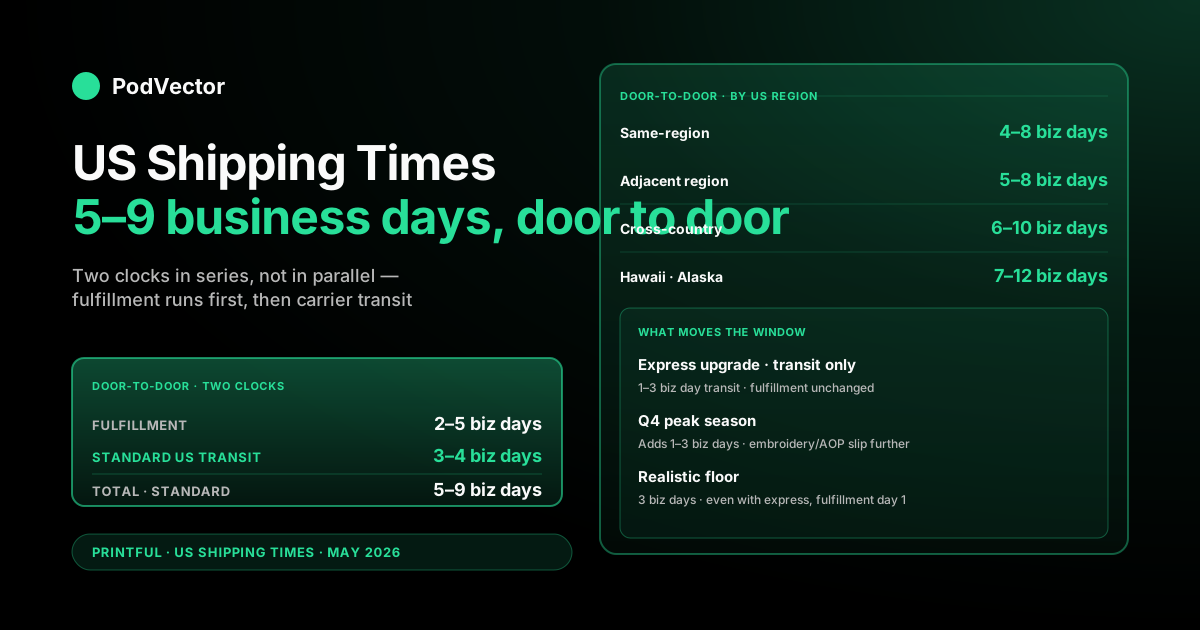
Quick Answer: Plan for 5–9 business days door to door on a standard US Printful order: 2–5 business days fulfillment plus 3–4 business days transit. Express upgrades the transit leg to 1–3 business days but does not change fulfillment. The realistic floor on any US order, even express, is 3 business days.
Printful's own metric — "97.66% of orders within 5 business days" — is fulfillment performance only, not door to door. Customers reading "5 business days" on a Printful marketing page assume delivery; they're actually seeing the time it takes the package to leave the facility.
The single biggest operator mistake is quoting the transit window without the fulfillment window stacked on top. Set the expectation early — on the product page, in the cart, and in the order confirmation — and your "where's my order?" ticket volume drops by half.
The headline number you should quote customers
For a standard US t-shirt or apparel order on Printful, the realistic door-to-door delivery window is 5–9 business days. Best case, on a calm production week with a short carrier route, you'll see 4 business days. Worst case, on a heavy production week with a cross-country carrier route, 10 business days.
Translated to calendar days for customer-facing copy: 7–13 days. That's the number to quote in your shipping policy, on the product page, and in the order confirmation email.
Express upgrades the transit leg only. A US express order runs 3–8 business days door to door (2–5 fulfillment plus 1–3 express transit). The fastest realistic delivery on a domestic Printful order is 3 business days, which only lines up when fulfillment lands on day 1 and the carrier delivers next-day express.
None of this is variable that the seller can change. Printful's fulfillment queue is not adjustable from the store side, and the carrier transit times are what they are. The lever the seller has is what they communicate, when they communicate it, and how they handle the edge cases.
Why "shipping time" is really two clocks
Every Printful order has two timers running in series, not in parallel.
Clock one — fulfillment. The order arrives in Printful's queue, gets routed to a facility, gets printed, cured, folded, and packed. The carrier picks up the finished package. Printful's published window is 2–5 business days for apparel.
Clock two — transit. The carrier moves the package from the facility to the customer's door. Standard US transit is 3–4 business days. The clock only starts when fulfillment ends.
This is the single largest source of customer-service friction on POD orders. A product page that says "Ships in 3–4 days" sets up a customer to file a ticket on day 5 because the order is still listed as "in production." The customer reads "ships in" as "arrives in." Printful reads "ships in" as "leaves the facility in."
Fix the copy: "Standard shipping is 3–4 business days after fulfillment. Fulfillment takes 2–5 business days. Total delivery is 5–9 business days." Add it on the product page, in the cart, and in the order confirmation. Ticket volume on delivery questions drops by roughly half once this is in place across all three surfaces.
The fulfillment floor: 2–5 business days, broken down
The 2–5 business day window is a blended average across SKU types and production techniques. The actual distribution looks roughly like this:
- Standard t-shirts (DTG, single-side print): 2–3 business days typical, 4 on a busy week
- Hoodies and sweatshirts (DTG): 3–4 business days typical, 5 on a busy week
- All-over-print apparel: 4–5 business days typical, 6–7 in peak season
- Embroidered apparel: 4–6 business days typical, 7–10 in peak season
- Posters and prints: 2–3 business days typical, 4 on a busy week
- Mugs and ceramics: 2–4 business days typical
- Phone cases and accessories: 2–3 business days typical
The longer end of every range tends to land in November–December. Printful publishes 97.66% of orders shipping within 5 business days as its system-wide metric. That number compresses the variance across product type — apparel hits the metric more consistently than embroidery, which trails by a day or two on average.
For embroidery specifically, the fulfillment leg dominates the total timeline, and the embroidery shipping time breakdown covers that SKU class in detail. For DTG apparel, the fulfillment leg is short enough that the carrier transit is the bigger swing factor.
The transit leg: standard vs express vs CO2-offset
Once the package leaves the facility, Printful offers three transit tiers for US destinations:
Standard. 3–4 business days transit. USPS, UPS, or DHL handles the last mile depending on package weight and destination. Cost: roughly $4.69 first item, $2.20 each additional for apparel.
Express. 1–3 business days transit. UPS Express or equivalent for most routes. Cost: $9–22 premium over standard, depending on weight and destination. Express compresses only the carrier leg — it does not skip fulfillment. The express shipping breakdown covers when the premium is worth it and the expedited shipping deep-dive walks the margin math on offering it at checkout.
CO2-offset. Same 3–4 business day window as standard, sometimes a fractional cost premium baked into the shipping rate to cover offsetting. Available on most US routes. The transit time itself is identical to standard — the offset is an emissions accounting layer, not a carrier upgrade.
Express is a tactical option, not a default. It costs the customer noticeably more, and most US POD buyers won't pay for it unless there's a clear reason — a gift deadline, a wedding date, a replacement order. Offering all three tiers at checkout and letting the customer choose is the standard configuration.
How US region affects total delivery time
Once the package is in carrier hands, the transit leg varies by destination zone:
- Same-region (East Coast facility to East Coast customer, etc.): 2–3 business days transit, 4–8 days door to door
- Adjacent region (Texas facility to Midwest customer): 3 business days transit, 5–8 days door to door
- Cross-country (East Coast facility to West Coast customer): 4–5 business days transit, 6–10 days door to door
- Hawaii / Alaska: 5–7 business days transit, 7–12 days door to door
- Puerto Rico: 6–9 business days transit, 8–14 days door to door
Printful's flat-rate shipping cost stays the same across the continental US — a t-shirt to Maine and a t-shirt to Texas both ship for $4.69. What changes is the transit time, not the price. Hawaii, Alaska, and Puerto Rico carry small remote-zone surcharges on top of the flat rate plus the longer transit windows.
For multi-state customer bases, the blended door-to-door average tends to land near 6–7 business days. A customer base concentrated in one region (a regional brand, an event-driven store) will see better averages because routing tends to favor local facilities.
Which Printful facility ships your order
Printful operates US fulfillment facilities in California, North Carolina, and Texas (Dallas), with specialty operations in other locations for embroidery, AOP, and warehouse-and-fulfillment products. The system routes each order to the facility that minimizes total time and cost, factoring in product availability, queue depth, and carrier zone.
The seller does not pick the facility. The routing is automated, and a single SKU may fulfill from California one week and Texas the next depending on stock and queue conditions. This is intentional — Printful's system balances load across facilities to keep the published 2–5 day fulfillment window stable.
For most operators, this is a non-issue. The shipping cost doesn't change with the facility (Printful absorbs the variance internally), and the only practical effect is on transit time, which the operator has no control over anyway. The one edge case is when a SKU only fulfills at one facility — embroidery in particular tends to route to specific locations — and customers in distant zones see consistently longer transit on those products.
Printful does not publish a real-time facility-routing map to sellers. The closest a seller can get is checking the order details page after fulfillment, which shows the originating facility and the carrier.
What changes in Q4 — and how to plan for it
The published 2–5 business day fulfillment window holds for roughly 10 months of the year. November and December are different.
From mid-November through late December, Printful's published windows extend by 1–3 business days across all product types. Embroidery, AOP, and complex multi-color prints can run 5–7 days behind standard. The 97.66% fulfillment-within-5-days metric drops several points during peak weeks.
Printful publishes holiday cutoff dates each year — the last order date to guarantee Christmas delivery via standard, express, and economy tiers. These are the operative deadlines for any seller running gift-oriented marketing. Quoting "ships by Christmas" without checking the live cutoff is a recipe for refund volume and chargebacks.
Operator playbook for Q4:
- Add a banner on the storefront 3 weeks before the standard-shipping cutoff. Update the cutoff date as Printful publishes refinements.
- Push express as the default for any order placed within 10 business days of the holiday deadline.
- Stop running gift-themed creative 5 business days before the express cutoff. Once express can't make it, the marketing message has to shift to "order for the new year" or you generate refunds.
- For high-volume sellers, hold a small inventory of bestseller SKUs in a non-POD warehouse for the last 7 days before the holiday — direct-ship from your own stock when Printful's queue is over capacity.
What this means for store operations
Three operational implications most POD operators internalize too late.
Refund window math. Your refund policy probably says "30 days from delivery." But the customer's clock starts at order placement, not delivery. A customer who orders on day 1 and receives the package on day 12 has effectively a 42-day refund window from your operational standpoint. Build the buffer into your accounting and your chargeback dispute window.
Ad spend attribution. A Facebook ad clicked on day 1 that drives an order doesn't deliver the package until day 7–9. Your reporting will show the conversion on day 1, but the customer experience that drives a repeat purchase or a referral happens on day 7. The lag matters for retargeting cadence — sending a follow-up email on day 3 to a customer whose order hasn't arrived yet generates a support reply, not a second purchase.
Bundle marketing. Multi-item orders ship in one package (when fulfilled from one facility), so the bundle's door-to-door window is the same as a single-item order. There's no time penalty for bundling on the customer side, only a small time benefit for the seller on packaging. Lean into bundles in your marketing copy — they're better economics for everyone.
For the full margin and cost picture on top of timing, the Printful pricing plans teardown and the subscription pricing breakdown cover the seller-side cost stack that sits alongside shipping. The Printful shipping cluster covers the rest of the shipping decision tree, and the Printful operator library ties it all together.
When delivery runs past the quoted window
Most late deliveries fall into one of three buckets, each with a different remediation path:
Carrier delays. Package shows tracking activity but stalls in transit — weather, carrier capacity, mis-sorted package. Printful's policy is to wait for the carrier's "lost" classification (typically 14 business days for domestic) before issuing a replacement. Tell the customer the package is in transit and you're monitoring it; offer a partial discount or replacement only after the carrier marks it lost.
Fulfillment delays. Package is still listed as "in production" past the 5-business-day window. Contact Printful support with the order ID — they can prioritize the order in the queue or, if there's a stock issue on the SKU, suggest a substitute. The customer gets an update with the new ETA.
Delivered but missing. Carrier marks the package as delivered but the customer didn't receive it. Most common with USPS in apartment complexes. Printful's policy: replacement only if the carrier reverses the delivery status. Most sellers eat the cost and reship rather than fight USPS on a $15 t-shirt.
The realistic late-delivery rate on Printful US apparel is roughly 1.5–3% of orders, which lines up with the 97.66% on-time fulfillment metric. Budget for this rate in your unit economics: a $24.99 retail t-shirt with a 2% late-delivery replacement rate carries about $0.40 in implicit replacement cost per order on average.
FAQs
How long does Printful take to ship to the US?
Plan for 5–9 business days door to door on a standard US order: 2–5 business days fulfillment plus 3–4 business days transit. Express orders run 3–8 business days door to door. The fastest realistic Printful US delivery is 3 business days, achieved on a calm production week with next-day express transit.
What's the difference between fulfillment time and shipping time?
Fulfillment is the time Printful takes to print and pack the order before handing it to the carrier — 2–5 business days for most apparel. Shipping (transit) is the time the carrier takes to deliver the package after pickup — 3–4 business days for standard US, 1–3 days for express. Total delivery time is fulfillment plus transit. Most "where's my order?" tickets come from customers reading shipping time as door-to-door time.
Does Printful offer same-day or next-day shipping in the US?
No. The 2–5 business day fulfillment floor makes both physically impossible. The fastest realistic next-day-style delivery on a Printful order is 3 business days door to door, which requires fulfillment to land on day 1 and next-day express to land on day 2. For true next-day delivery, hold inventory in a non-POD warehouse or partner with a same-day fulfillment provider for those specific SKUs.
Why is my Printful order still in production after 5 days?
Either the SKU has a longer fulfillment window (embroidery, AOP, custom-branded packaging often run 4–7 days), or Q4 peak demand has stretched the queue beyond the published window. Check the SKU's product page for the fulfillment estimate — if it's past the published window, contact Printful support with the order ID and they can prioritize the order or suggest a substitute.
How accurate is Printful's estimated delivery time on the order confirmation?
The EDT is calculated as estimated fulfillment plus estimated shipping, and lands within the actual window roughly 95% of the time for standard US orders. The 5% miss rate is driven by carrier surprises (weather, mis-sorts) and Q4 production capacity squeezes. Treat EDT as a confident estimate, not a guarantee — Printful does not refund shipping if the actual delivery slips a day or two past the estimate.
What's the fastest Printful US shipping option?
Express shipping. Transit drops from 3–4 business days standard to 1–3 business days express, but fulfillment stays at 2–5 business days. Express adds $9–22 to the shipping line depending on product weight and destination. Worth it for gift deadlines, replacement orders, and event merch with hard dates. Not worth it as a default category-wide promise.
Does Printful ship to all US states?
Yes. All 50 states plus DC, Puerto Rico, US Virgin Islands, and most US territories. Hawaii, Alaska, and Puerto Rico carry small remote-zone surcharges and longer transit windows (5–9 business days transit, vs 3–4 for the continental US). Printful does not ship to US embargo destinations or restricted addresses (P.O. boxes for some carriers, military APO/FPO with carrier-specific restrictions).
What does Printful's "97.66% within 5 business days" metric actually mean?
It's the percentage of orders that complete fulfillment (printed, packed, picked up by carrier) within 5 business days of order placement. It is not a door-to-door delivery metric. Customers reading "5 business days" on a Printful marketing page often assume delivery, but the metric only covers the production leg. Door-to-door takes 5–9 business days for a standard US order even when fulfillment lands within the 5-day metric.
How do Q4 holiday shipping deadlines work on Printful US orders?
Printful publishes cutoff dates each year for standard, express, and economy shipping — the last order date to guarantee pre-Christmas delivery via each tier. Mid-November through late December typically adds 1–3 business days to the published fulfillment window, and embroidery and AOP run further behind. Build a 7–10 day buffer into customer-facing Q4 deadlines and update marketing copy as Printful's published cutoffs land.
What should I tell customers about Printful shipping time on my product page?
The exact full window. Something like: "Standard shipping: 5–9 business days door to door (2–5 fulfillment + 3–4 carrier transit). Express: 3–8 business days." Repeating it on the product page, in the cart, and in the order confirmation reduces "where's my order?" tickets by about half. The single most common operator mistake is quoting only the transit window without the fulfillment window stacked on top.
Shipping time is the fastest-rising support cost in POD — and the hardest to attribute back to a SKU, region, or marketing claim.
Printful tells you when each order shipped and when it delivered. It doesn't tell you which SKUs are consistently breaching the published fulfillment window, which states are seeing the worst transit variance this month, or which carrier handles the bulk of your late-delivery refund requests.
Victor connects to your Printful and store accounts, pulls fulfillment timestamps, carrier handoff times, and delivery confirmations into a live data warehouse, and answers questions like "which SKUs slipped past 5 days this week?" or "how is shipping time correlating with my refund rate?" in plain English. No spreadsheet reconciliation, no end-of-quarter surprise.
Try Victor free