
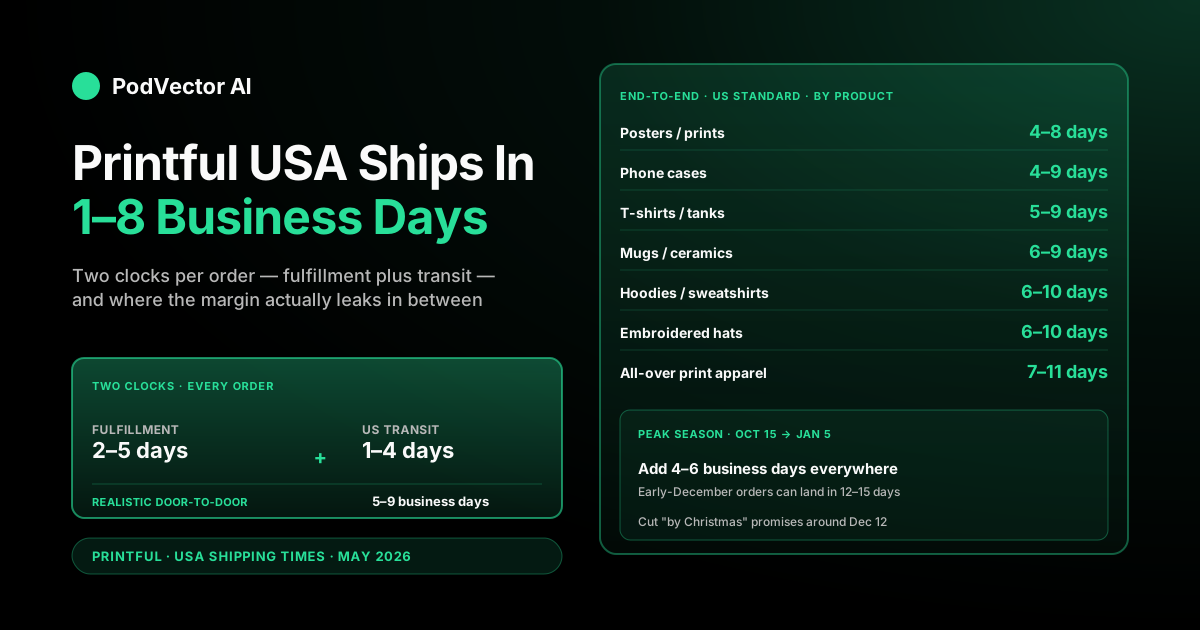
Quick Answer: Printful's published USA delivery window is 1–8 business days, split between 2–5 days of fulfillment and 1–4 days of transit. Realistically, most US orders land in 5–9 business days door-to-door.
Standard shipping starts at $3.99 for a single t-shirt and adds about $2.20 per extra item. Express adds roughly $9–$15 per order and pulls transit down to 1–3 business days.
What actually drifts your POD margin isn't the headline rate — it's the per-order shipping cost across your real product mix, plus the late-order refunds nobody sees in the Printful dashboard.
The two halves of Printful USA shipping time
Every Printful order has two clocks running. They don't start at the same time, and they don't always run at the same speed.
The first clock is fulfillment. That's the time from "order placed" to "label printed." Printful averages 2–5 business days here, depending on the product and how busy the facility is. Their reported number is 97.66% of orders fulfilled within five business days.
The second clock is transit. That starts when the package leaves the facility and ends when it hits the doormat. For US domestic Standard, that's typically 3–4 business days. For Express, 1–3 business days.
Add them together and Printful's published window for USA delivery is 1–8 business days. The low end is rare — that assumes same-day fulfillment plus next-day transit. The realistic number for most operators is 5–9 business days end-to-end on Standard.
This split matters because customer complaints almost always land on the transit half ("why isn't it here yet?") while operator margin pain almost always lives in the fulfillment half (the longer it sits in queue, the higher your refund risk).
Standard USA shipping times by product
Printful quotes "2–5 days fulfillment" as a single number, but the real fulfillment time varies a lot by product. The print method, the warehouse the item lives in, and seasonal demand all shift it.
Here's what each product category typically runs, end-to-end on US domestic Standard:
| Product category | Fulfillment | Transit (US Standard) | Total business days |
|---|---|---|---|
| T-shirts and tanks (DTG) | 2–5 days | 3–4 days | 5–9 days |
| Hoodies and sweatshirts (DTG) | 3–6 days | 3–4 days | 6–10 days |
| All-over print (AOP) apparel | 4–7 days | 3–4 days | 7–11 days |
| Embroidered hats and apparel | 3–6 days | 3–4 days | 6–10 days |
| Mugs and ceramics | 3–5 days | 3–4 days | 6–9 days |
| Posters and prints | 2–4 days | 2–4 days | 4–8 days |
| Phone cases and accessories | 2–5 days | 2–4 days | 4–9 days |
DTG (direct-to-garment) is the fastest print method. All-over print is the slowest — it's a multi-stage sublimation process and the queue is shorter, so a small spike in demand stretches it the most.
One quirk worth knowing: items printed in different facilities ship in separate packages. A two-item order with a DTG t-shirt and an embroidered hat will arrive in two boxes, on different days, with two tracking numbers. Customers read that as "they shipped half my order and forgot the rest," which drives a measurable share of "where is my order" tickets.
Express USA shipping and when it's worth it
Express is Printful's faster US domestic option. The transit half compresses to 1–3 business days. The fulfillment half does not change.
Pricing varies by product and weight, but a useful rule of thumb: Express adds roughly $9–$15 to a single-item shipment over the Standard rate. On a $25 t-shirt order, that's a 35–60% lift on shipping cost, which is rarely worth eating yourself.
Where Express does work: you offer it as a paid upgrade at checkout. The customer chooses to pay for speed, you pass through the cost plus a small markup, and you get to advertise "fast delivery available" without taking the margin hit on every order.
Express is only available on US domestic orders to addresses Printful can verify as ship-to-residential or ship-to-business. PO boxes and APO/FPO addresses fall back to Standard automatically — which can surprise customers who paid for the upgrade.
What USA shipping actually costs
The headline numbers most operators quote come from Printful's official shipping page. For US domestic Standard, the first-item rates start around:
| Product | First item | Each additional |
|---|---|---|
| T-shirt / tank | $3.99–$4.75 | $2.20 |
| Hoodie / sweatshirt | $5.99–$8.49 | $2.50 |
| Hat / beanie | $3.99 | $1.50 |
| Mug (11oz) | $4.99 | $2.65 |
| Poster (small) | $3.99 | $1.50 |
| Backpack | $10.49 | $4.50 |
| Phone case | $3.99 | $1.20 |
Express runs roughly 2–3× the Standard rate per order on apparel, and is not available on every product or to every US address.
The number that actually matters is your blended shipping cost per order — total shipping paid to Printful divided by total orders shipped, across your real product mix. That's almost always higher than the rate card suggests because of multi-pack orders (the +$2.20 stacks fast on a 3-pack family order) and Express upgrades you eat to recover from a delayed shipment.
For a deeper teardown of how shipping rates compose against real orders, the Printful live shipping rates breakdown walks through how the rate engine actually quotes at checkout, including the WooCommerce-specific quirks in the live shipping rates for WooCommerce setup.
US shipping zones and why two customers wait different times
Carriers price and route US domestic packages by zone — Zones 1 through 8 — measured from the origin facility to the destination ZIP code. Printful ships most US apparel orders from its Charlotte, NC and Dallas, TX facilities, with a smaller California operation handling the West Coast.
A customer in Atlanta is Zone 2 from Charlotte. A customer in Seattle is Zone 8 from Charlotte. Same product, same shipping rate at checkout, same "3–4 business days" estimate. The Atlanta order shows up in 2 days; the Seattle order takes 5.
What Printful does not show you is which facility actually printed your order. When demand is balanced, the Tijuana, Charlotte, and Dallas plants pick up orders by routing rules nobody publishes. A West Coast customer might get a Charlotte fulfillment one week and a California fulfillment the next, with transit times that differ by 3 business days.
For US POD operators, the practical consequence: your "average delivery time" is not actually average. It's a bimodal distribution — fast orders from the closest facility, slow orders from the farthest one — and your customer experience tracks that variance more than the mean.
Peak season: what changes from October to January
Printful's published timelines assume normal volume. Q4 is not normal volume.
From roughly October 15 through January 5, fulfillment queues extend. The 2–5 business day fulfillment window stretches to 4–8 business days on apparel, and All-over print can hit 10+. Transit windows also extend on the carrier side — UPS and USPS both deprioritize standard-rate parcels during the holiday surge.
The combined effect: a "5–9 business day" October order can land in 12–15 business days when shipped in early December. That's a customer-service problem if your shop messaging still says "ships in under a week."
Operators who survive Q4 well do three things. They update their store's shipping-time copy to the peak-season window in mid-October. They cut off "guaranteed by Christmas" promises around December 12 instead of December 18. And they pre-stock zero inventory — that's the whole point of POD — but they do increase their per-order shipping budget by 15–20% to absorb the Express upgrades they'll buy to rescue late orders.
When an order is late — what Printful covers and what you eat
Printful's shipping policy guarantees fulfillment within their stated windows, not delivery. If your order misses the 5-business-day fulfillment SLA, you can request a reshipment or refund. If the package then gets lost in transit, Printful will reship at their cost on most carriers and most destinations.
What is not covered: delays caused by the carrier hitting a 3-day weather hold, a wrong address the customer typed at checkout, a porch theft after the package was marked delivered, or a customs hold (which doesn't apply to US domestic but is a major issue on international orders).
In practice, here's how the cost actually splits on a late US order:
- Carrier delay: you usually eat it. Most operators offer a $5–$10 store credit to retain the customer.
- Fulfillment delay past SLA: Printful covers the reship. You still eat the customer goodwill (response time, support handling).
- Lost in transit: Printful reships. The original customer waited 14+ days and is unlikely to buy again.
- Wrong address: you eat it. Same with porch theft.
If you're not tracking these by category, "shipping cost" in your P&L is missing 10–20% of its true number. The Printful invoice shows you what you paid the platform. It does not show you what the late orders cost in refunds, store credit, and lifetime-value impact.
How USA shipping quietly eats POD margin
POD operators tend to model shipping as a flat per-order cost, then forget about it. The cost is rarely flat, and the variance is where margin goes.
Three places shipping quietly eats your POD margin in the US:
1. Mix shift. A 3-pack t-shirt order doesn't cost 3× a 1-shirt order on the customer side, but it does cost roughly $8.39 to ship on the Printful side ($3.99 + $2.20 + $2.20) vs. $3.99 for one. If your AOV climbs because of a successful bundle promo, your shipping-cost-per-order climbs too — and if your free-shipping threshold didn't move with it, you just compressed gross margin without noticing.
2. Product mix. Adding hoodies to a t-shirt store almost always lifts AOV and almost always drops gross margin percent, because hoodie shipping costs roughly 2× tee shipping. The revenue number looks healthier; the cash flow doesn't.
3. Late-order rescue costs. Every Express upgrade you buy to make a customer whole is a margin hit that doesn't sit in any Printful report. It's a Stripe charge against your account days after the original order. Most operators don't tag these, so they show up as "miscellaneous" or "shipping" in QuickBooks and never get attributed back to the original POD order.
The fix isn't lowering the rate Printful charges. The fix is seeing each order's true shipping cost — base rate plus your share of the rescue, refund, and reship costs that order generated — against the revenue it brought in. That's the number that actually drives margin decisions.
Most POD operators don't have this view because their order data, refund data, and fulfillment data live in three different systems. Stitching them together every month in a spreadsheet is the right idea, but it doesn't survive contact with a busy shop.
This is exactly the question Victor — PodVector AI's AI employee — was built to answer. You connect your store, Printful, and ad accounts; Victor maintains a live data warehouse of every order, every shipping charge, every refund, and every reship, and answers "how is USA shipping eating my margin this week?" against the actual numbers instead of last month's averages.
For more on how Printful's regional pricing fits into the bigger picture, the full Printful shipping countries list walks through what each region costs and how country mix shifts margin. The shipping cluster hub indexes the rest of the teardown. If you're weighing whether a paid Printful plan changes the math, the Printful topic hub links every plan and cost teardown — including the Printful Plus membership review and the Printful Premium membership cost teardown for the discount tiers that shift per-order economics.
FAQs
How long does Printful take to ship in the USA?
1–8 business days end-to-end on Standard shipping. Fulfillment takes 2–5 business days, then transit takes 1–4 business days. Most US orders realistically land in 5–9 business days.
Does Printful offer same-day or next-day delivery in the USA?
No. Printful does not offer same-day or next-day delivery. Express is the fastest option and compresses transit to 1–3 business days, but fulfillment still takes 2–5 business days on top.
How much does Printful USA shipping cost?
Standard shipping starts at $3.99 for a single t-shirt and adds $2.20 per extra item. Hoodies start at $5.99, hats at $3.99, mugs at $4.99, backpacks at $10.49. Express runs roughly 2–3× the Standard rate.
Why is my Printful order taking longer than the estimate?
Three common reasons: the product type has a longer print queue (All-over print, embroidery), your customer's address is on the opposite coast from the fulfillment facility, or you're shipping during peak season when both fulfillment and carrier queues extend.
Does Printful ship to Hawaii, Alaska, Puerto Rico, and APO/FPO addresses?
Yes. All ship at US domestic rates. Transit times are longer — typically 7–14 business days for Hawaii and Alaska, longer for APO/FPO. Express is not available to APO/FPO addresses.
Can I track my Printful order?
Yes. Tracking is automatic and sent to the customer's email when the package ships. Multi-facility orders generate separate tracking numbers per box.
What happens if a Printful order is late or lost?
If fulfillment misses the 5-business-day SLA, you can request a reship or refund. If a package is lost in transit by the carrier, Printful will reship at their cost on most carriers. Customer-caused issues (wrong address, porch theft, package refused) are on you.
Does shipping cost change my POD profit margin?
Significantly. Shipping is typically 10–20% of cost-of-goods for a POD order, and the per-order cost varies a lot with product mix and order size. The blended shipping cost across your real orders is the number to track — not the rate-card headline.
Stop guessing what shipping is doing to your POD margin
Printful's rate card tells you what one order costs. It does not tell you what your shipping is costing you this week, across your real product mix, after refunds and reships.
Victor — PodVector AI's AI employee — connects your store, Printful, and ad accounts into a live data warehouse and answers questions like "what's my blended USA shipping cost this week?" or "which products are losing margin to shipping right now?" against the actual numbers, not last month's averages.
Most POD operators are flying blind on shipping margin. You don't have to. And see the real number.
Try Victor free