
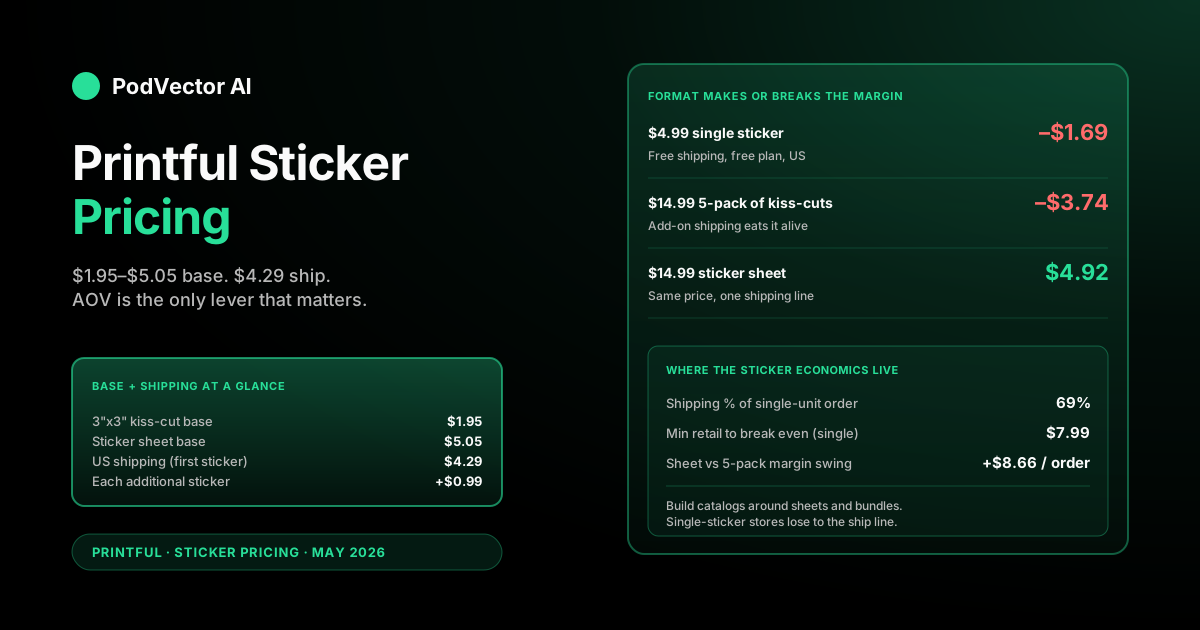
Quick Answer: Printful sticker prices run roughly $2.20–$5.05 base per unit, depending on type (kiss-cut, holographic, sheet) and size. US shipping is $4.29 for the first sticker after the February 2026 update, then $0.99 per additional unit on the same order.
The math doesn't work on single stickers. A $1.95 kiss-cut with $4.29 shipping costs $6.24 to fulfill — and most operators retail single stickers at $3–$5. The economics only land at 3+ stickers per order or via sticker packs and sheets.
The real lever isn't base price. It's average order value. Stickers are the highest-margin POD category per dollar of base cost when you can drive multi-unit cart sizes.
Sticker types Printful offers
Printful runs three core sticker formats. Each has a different base-price band and a different role in your catalog.
Kiss-cut stickers. Standard vinyl, cut down to the design with a backing sheet around the edge. The cheapest type. Sizes: 3"x3", 4"x4", 5.5"x5.5", 15"x3.75". The workhorse SKU.
Die-cut stickers. Cut precisely to the design outline with no backing border. Premium look, slightly higher base. Same standard sizes as kiss-cut.
Holographic stickers. Iridescent finish with the same die-cut shape options. Visually different enough to justify a higher retail price; base runs ~$1 over die-cut.
Custom sticker sheets. Multiple smaller designs printed on one larger sheet (5.83"x8.25"). Sold as a single SKU, fulfilled as one item. Excellent for niche shops, fandom merch, and gift packs.
Bumper stickers and transparent variants are listed in the catalog but priced similarly to kiss-cut at their respective sizes — they're not separate price tiers.
Base prices by size and type
Printful's catalog quotes "from $2.20" for stickers, but that's the smallest kiss-cut at the highest discount tier. Real list prices for new operators on the free plan look like this.
| Sticker type | Size | Free-plan base | Growth-plan base (typical) |
|---|---|---|---|
| Kiss-cut | 3"x3" | $1.95 | $1.59 |
| Kiss-cut | 4"x4" | $2.95 | $2.39 |
| Kiss-cut | 5.5"x5.5" | $3.95 | $3.19 |
| Kiss-cut | 15"x3.75" (bumper) | $4.95 | $3.99 |
| Die-cut | 3"x3" | $2.50 | $2.05 |
| Die-cut | 4"x4" | $3.50 | $2.85 |
| Die-cut | 5.5"x5.5" | $4.50 | $3.65 |
| Holographic | 3"x3" | $3.50 | $2.85 |
| Holographic | 4"x4" | $4.50 | $3.65 |
| Sticker sheet | 5.83"x8.25" | $5.05 | $4.05 |
Two patterns worth noting. First, the per-square-inch cost drops as you go up in size — a 5.5" kiss-cut at $3.95 is 13¢ per square inch, while a 3"x3" at $1.95 is 22¢ per square inch. Second, sticker sheets are the unit-economics winner: $5.05 base for a sheet that holds 4–8 small designs is materially cheaper than selling each design separately.
Growth discounts on stickers run consistently in the 18–22% range — a touch lower than the catalog's "up to 33%" ceiling. We unpack the wider discount math in our Printful t-shirt pricing breakdown where the same Growth mechanics show up on a different category.
Shipping is the single biggest line
This is where sticker pricing gets ugly. Shipping is not a small line on stickers — it's often the largest.
As of the February 2026 update, US sticker shipping is $4.29 for the first sticker in an order, plus $0.99 for each additional sticker on the same order. EU sticker shipping starts around $3.69 first / $0.79 additional; UK around $3.79 first / $0.85 additional; worldwide $5.99 first / $1.25 additional.
On a single 3"x3" kiss-cut at $1.95 base, US shipping is more than double the cost of the sticker itself. The shipping line is 69% of total fulfillment cost on that order.
This is the math that breaks unit economics on cheap retail sticker stores. Selling a $3.99 sticker with $0.99 shipping subsidized by the seller means $4.98 in customer revenue against $1.95 base + $4.29 shipping = $6.24 in fulfillment cost. That's a $1.26 loss per single-unit order before processing fees.
The fix is structural, not tactical. Either make single-sticker orders impossible (require 2–3 stickers minimum), price single stickers high enough to cover the shipping line ($7.99+ on a 3"x3"), or design the catalog around sheets and packs from day one.
How Growth membership changes sticker math
Growth's discount on stickers is modest in absolute dollars — typically $0.30–$0.90 per sticker — but the percentages stack up across volume.
The break-even is high. A store needs to save $24.99 a month in sticker discounts alone for Growth to pay for itself on stickers. At ~$0.50 average savings per sticker, that's 50+ stickers a month. Most sticker-only stores need 100+ fulfilled orders per month before Growth's sticker discount alone clears the membership fee.
The math changes if you sell stickers alongside apparel. Growth's 10–18% discount on tees adds dollars per order; pair that with the sticker discount and the membership clears its fee much earlier. The cleanest test is whether your total monthly Printful discount across all categories beats $24.99. We walk through that decision in our Printful t-shirt cost breakdown.
Stickers also do not benefit from Growth's shipping rates — there's no shipping discount under any subscription tier. The shipping line is the same whether you pay $0 or $24.99 a month.
Worked example: single sticker order
Walk through a 3"x3" kiss-cut sticker retailed at $4.99 with free shipping, on the free plan, US fulfillment.
| Line | Amount |
|---|---|
| Customer pays | $4.99 |
| Printful base | –$1.95 |
| Printful shipping (single US sticker) | –$4.29 |
| Stripe processing (2.9% + $0.30) | –$0.44 |
| Gross margin | –$1.69 |
Negative. The "$4.99 sticker" loses $1.69 per single-unit order. To break even on this SKU at $4.99 retail, the customer would need to buy three or more stickers per order — which is exactly what most successful sticker stores design for.
Re-run at $7.99 retail, free shipping:
| Line | Amount |
|---|---|
| Customer pays | $7.99 |
| Printful base | –$1.95 |
| Printful shipping | –$4.29 |
| Stripe processing | –$0.53 |
| Gross margin | $1.22 |
Positive — but it's a 15% gross margin on a sticker that retails at the high end of the category. Charge customer shipping ($0.99–$1.99 separately) and the margin lifts to a healthier range.
Worked example: 5-pack and sheet order
Now the same 3"x3" kiss-cut but sold as a 5-pack at $14.99 retail with free shipping, free plan, US fulfillment.
| Line | Amount |
|---|---|
| Customer pays | $14.99 |
| Printful base (5 × $1.95) | –$9.75 |
| Printful shipping ($4.29 + 4 × $0.99) | –$8.25 |
| Stripe processing (2.9% + $0.30) | –$0.73 |
| Gross margin | –$3.74 |
Also negative. Five-packs at low retail prices don't fix the problem — they compound the shipping line. The "five units × $0.99 add-on" is real money.
The fix is sticker sheets, not multi-unit kiss-cut orders. A sticker sheet ships as one item at $4.29 US, regardless of how many designs it contains. Same 5-design product as a sheet:
| Line | Amount |
|---|---|
| Customer pays | $14.99 |
| Printful base (sheet, free plan) | –$5.05 |
| Printful shipping (single sheet) | –$4.29 |
| Stripe processing | –$0.73 |
| Gross margin | $4.92 · 33% |
From –$3.74 to +$4.92 by switching the same retail price from a 5-pack to a sheet. Sticker sheets are the unit-economics workhorse on Printful — almost no other POD category swings margin this hard with a single product format change.
Why AOV is the only sticker lever that matters
The pattern across these examples: shipping is a fixed-ish line, so margin per order is mostly a function of how many sticker units (or how much sticker value) you can pack into a single shipment.
Three structural moves push AOV:
Sticker sheets as the default. Build the catalog around sheets, not individual stickers. Customers buy the value of a multi-design sheet; you ship one item. Margin per order is materially higher.
Bundle pricing tiers. Set 1-sticker, 3-sticker, and 6-sticker price tiers where the 3-pack and 6-pack are obviously the better deal. Even if you lose the 1-sticker buyer, the 3+ buyers are profitable. Many shops also set a free-shipping minimum at the 3-sticker mark.
Cross-category bundles. Add a sticker to a t-shirt order at fulfillment-discounted prices. The t-shirt absorbed the shipping cost; the sticker adds ~$1.95 base and ~$0.99 marginal shipping. A $2.94 cost on a $4.99 add-on retail is 41% margin. Stickers as bundle add-ons are the highest-margin sticker SKUs you can run.
Pricing strategy aside, brand perception matters too — and reputation drives whether customers trust your store enough to order multiple items. Our cross-cluster reads on Printful's company reputation and the 2025 honest review of Printful cover what your customers actually see when they research your supplier.
Hidden cost lines specific to stickers
A few cost lines hit stickers harder than apparel.
Reprints on small designs. Tiny illustration details print less reliably than bold solid-color designs. Stickers with fine line work see slightly higher reprint rates — Printful covers production-error reprints, but a 1–2% reshipment rate on returns and "I didn't like how it looks" issues is yours to absorb.
No-bleed design errors. Sticker designs that go past the cut line or lack a safe zone come back with white edges or trimmed elements. The reprint is free, but the back-and-forth costs days. Plan for QA on every new sticker SKU before listing.
Sample QA cost. Standard 20% off samples on free plan, 25% off on Growth. Eight new sticker SKUs at $2 base ÷ post-discount means roughly $13–$16 for a full sample run. Cheap relative to apparel sampling, but a real line.
International shipping surprises. Sticker shipping to non-US/EU regions can be 50–100% higher than the headline US rate. If your store sells globally, build region-specific shipping rules into your storefront rather than offering a single worldwide flat rate that bleeds money on the long-haul orders.
For the broader cost mechanics across all Printful products, see the rest of the Printful costs and charges hub and the broader Printful operator guide.
Tracking per-SKU margin on stickers
Stickers move enough volume that even a 50¢ per-unit drift adds up. A store doing 800 sticker units a month at –$0.50 margin per unit drift is –$400 a month silently leaving the P&L.
Catalog list prices don't tell you what's happening at the order line. The discount tier you're on, the actual size/region/quantity mix, and any sticker-as-bundle-add-on logic all collapse into a single landed cost per fulfilled SKU.
The clean structure is to land your Printful order data, your store revenue, and your ad spend in a single source of truth — your own data warehouse — and run a per-SKU margin query against current actuals. Whether that warehouse is Snowflake, Redshift, Databricks, or any equivalent, the value comes from joining the three datasets in one place.
That's the framing PodVector AI's AI employee Victor is built around. Connect your Printful account and Victor reads each order's actual line items — including which stickers shipped on their own versus as bundle add-ons — and answers questions like "which sticker SKUs dropped below margin floor this month?" or "what's my landed cost per sheet vs per kiss-cut?" — grounded in this month's data, not last quarter's screenshot. Victor answers the question and acts on those answers — with your approval (flagging when shipping creep eats too much of a category, drafting bundle-pricing experiments for review).
For the per-size pricing tables Printful publishes officially, see their custom stickers page. Print On Demand Business's 2026 sticker provider roundup is useful when you're benchmarking Printful against other sticker POD suppliers.
FAQs
How much does a Printful sticker cost?
Base prices run $1.95 (3"x3" kiss-cut, free plan) to $5.05 (sticker sheet, free plan), with Growth-plan prices 18–22% lower. The trap is forgetting shipping — US sticker shipping is $4.29 for the first sticker plus $0.99 per additional unit, so the landed cost per single-sticker order is often 2–3x the base price.
What's the cheapest Printful sticker?
The 3"x3" kiss-cut sticker at $1.95 base on the free plan (or about $1.59 on Growth). It's the workhorse sticker SKU but loses money at retail prices below ~$7 on single-unit orders due to the $4.29 shipping line.
Are sticker sheets cheaper than multi-sticker orders?
Yes, materially. A 5.83"x8.25" sticker sheet at $5.05 base ships as one item at $4.29 US. Selling five separate kiss-cuts as a 5-pack costs $9.75 base + $8.25 shipping. Sheets are roughly 50% cheaper to fulfill than equivalent multi-sticker orders at the same retail price.
Does the Growth plan save money on stickers?
Yes, but the absolute savings are small per unit ($0.30–$0.90). Growth pays for itself on stickers alone only at 50+ fulfilled sticker orders a month. If you sell stickers alongside apparel, Growth's 10–18% tee discount makes the membership easier to justify.
What's the right retail price for a Printful sticker?
For a 3"x3" sold as a single unit, $7.99–$9.99 with free shipping. For 3-packs and 5-packs, $14.99–$22.99. For sticker sheets, $9.99–$19.99 depending on design count. Below these floors and you lose money on the shipping line.
Do all Printful stickers ship from the same warehouse?
Printful routes sticker fulfillment to the regional facility closest to the customer (US, EU, Canada, Australia, or Mexico). This keeps shipping rates reasonable for most regions but does mean your turnaround time varies by destination — usually 2–5 business days production, plus carrier transit.
Are holographic stickers worth the upcharge?
Often yes from a margin standpoint, because retail prices for holographic stickers run 50–80% higher than standard kiss-cut equivalents while base cost is only ~$1 higher. Test on a small subset of your bestselling designs before committing.
Does Printful offer sticker bulk discounts?
Not at the order level — there's no per-order quantity discount on the base price. The discounts are tier-based (Growth membership) and packaging-based (sheets vs individual stickers). A high-volume sticker store benefits from Growth's per-unit discount stacking across the month, not from per-order tiers.
Stickers leak margin a quarter at a time. Catch them this month.
PodVector AI's AI employee Victor connects to your Printful account, reads every sticker order's actual line items, and tells you which sticker SKUs are running underwater after the shipping line and any add-on math. Ask "which sticker SKUs dropped below margin floor this month?" and get the answer from live data — not last quarter's spreadsheet.
Try Victor free