
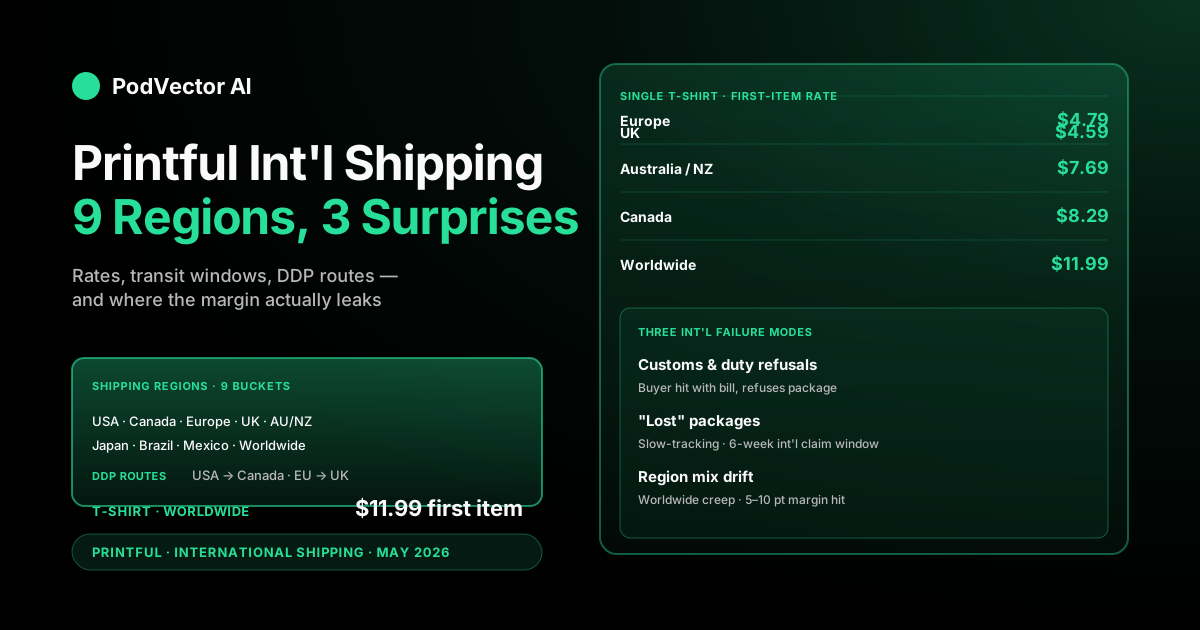
Quick Answer: Printful ships to roughly 180 countries, organized into 9 shipping regions. Standard international delivery runs 5–20 business days after fulfillment. Express is 1–3 days where available.
Costs are flat per product per region. A t-shirt runs around $4.59 to the UK, $4.75 to Japan, $7.69 to Australia/NZ, $8.29 to Canada, and $11.99 to a "Worldwide" destination. Add fulfillment time of 2–5 business days on top of every transit window.
Three things bite POD sellers on cross-border orders: customs and duties (the buyer pays, and sometimes refuses), region-mix drift that quietly erodes margin, and the long-tail refused-package cost that no rate card shows.
Printful's 9 international shipping regions
Printful doesn't price shipping country by country. It groups roughly 180 destinations into 9 regions, then sets one flat rate per product per region.
The regions you'll see at checkout:
- USA — domestic US
- Canada
- Europe — most EU member states
- UK — separated from Europe post-Brexit, with its own rate and DDP option
- Australia / New Zealand
- Japan
- Brazil
- Mexico
- Worldwide — the catch-all for everything not in the above eight, including most of Asia, Africa, the Middle East, and parts of Latin America
The Worldwide bucket is the one to watch. It's the most expensive region, the slowest, and the most exposed to customs friction. If your store accepts checkout from any country and you've never looked at your region mix, a meaningful slice of your orders is probably routing through Worldwide rates without you noticing.
The list of countries inside each region changes occasionally. Printful's official shipping page is the live source — check it once a quarter rather than memorizing it.
International delivery times by region
Total delivery time is fulfillment plus transit. Both legs change with destination, and the carrier transit numbers everyone quotes only cover the second half.
Standard transit windows after fulfillment (which itself runs 2–5 business days for most apparel):
- Canada: 5–10 business days standard, 3–5 business days DDP
- Europe (intra-EU): 3–7 business days
- UK: 4–8 business days standard, 3–7 business days DDP
- Australia / New Zealand: 7–14 business days
- Japan: 5–12 business days
- Brazil: 10–20 business days (customs is the long pole)
- Mexico: 5–12 business days
- Worldwide: 10–20 business days, longer for remote destinations
Express shipping is available to most regions and cuts the transit leg to 1–3 business days. It does not touch fulfillment, so the floor on any Printful order is still 3 business days door to door. For when the premium pays off, the Printful express shipping breakdown covers the math.
A practical example: a UK customer orders on Monday. Fulfillment runs 3 days (printed by Thursday). Standard transit takes 6 days (delivered the following Friday). Total: 9 business days, or about 13 calendar days. Switching to UK DDP shaves it to 6 business days total but adds a few dollars to the shipping cost.
Set your product page expectations against the upper end of each range. Customers forgive an arrival that beats the quote. They escalate when it slips by even a day.
What international shipping actually costs
Printful's international rates follow the same flat-per-product-per-region model as domestic. The first item in a shipping bucket carries the higher rate. Each additional item in the same bucket adds a smaller incremental charge.
Sample standard rates for a single t-shirt:
- UK: $4.59
- Europe: $4.79
- Japan: $4.75
- Australia / New Zealand: $7.69
- Canada: $8.29
- Worldwide: $11.99
Two things jump out. First, Europe and the UK are nearly as cheap as US domestic — Printful's Spain and Latvia facilities make these short hops. Second, Worldwide is roughly 2.5× the European rate for the exact same shirt. The destination, not the product, drives the cost spread.
The spread widens fast for heavier products. A hoodie that ships for $8.49 to the US can cost $25–$30 to a Worldwide destination. A backpack at $10.49 US can push past $35 internationally. The first-item charge is sticky; the per-additional-item add-on is more forgiving, which is why bundles ship better internationally than singles do.
One quiet cost pattern worth surfacing: multi-category carts split into separate shipping buckets, each with its own first-item charge. A customer who orders a t-shirt and a mug to Australia doesn't pay $7.69 + a small add-on. They pay two separate first-item rates, because t-shirts and mugs print at different facilities. The all-in international shipping bill on multi-product orders runs higher than the rate card alone suggests.
For the broader cost picture beyond shipping itself, the Printful Growth cost breakdown and the Growth plan cost breakdown walk through subscription tiers and how they interact with shipping economics.
Which facility ships your order — and why it matters
Printful runs production facilities in several countries, and the one that prints your order determines everything downstream — the carrier, the transit time, the customs path, and sometimes whether DDP is available at all.
The main facility footprint:
- USA: Charlotte (NC), Dallas (TX), Los Angeles (CA), and partner locations
- Canada: Toronto
- Europe: Riga (Latvia) and Barcelona (Spain)
- Mexico: Tijuana
- Partner facilities: Japan, Brazil, and Australia for select products
Printful's routing logic picks the geographically closest facility that prints the ordered product. A customer in Berlin who orders a standard t-shirt almost always gets it from Riga — short transit, intra-EU customs, no surprises. A customer in Sydney who orders the same shirt routes to the Australian partner facility when stock is available, or ships from the US if not.
The mismatch case is where international shipping gets expensive and slow: a product not stocked at the closest facility ships from the next-closest, sometimes thousands of miles farther. An "all-over-print" item rare at the EU facility can leave the US for a UK destination, doubling the transit time and falling into a different customs path. This is why your shipping cost on a single product can vary order to order even within the same region.
You don't get to pick the facility. You do get to see, on each Printful order detail, which facility printed it. Worth checking once a month to spot the products that consistently route the wrong way — they're candidates to drop or to add to a different catalog.
DDP, DDU, and the customs question
Delivered Duties Paid (DDP) means the seller — Printful, in this case — pre-pays import duties and taxes at the carrier handoff. The buyer pays nothing extra at delivery. Delivered Duties Unpaid (DDU), the default, means the buyer is on the hook for whatever the destination country's customs assesses.
Printful offers DDP on two routes:
- USA to Canada: 3–5 business days, duties pre-paid
- EU to UK: 3–7 business days, duties pre-paid
Every other international route is DDU. The buyer might owe nothing — under their country's de minimis threshold, the package clears without a fee. Or they might owe 10–25% of the order value in duty plus a customs broker fee. They don't know which until the package shows up with a bill.
The seller-side problem with DDU isn't the duty itself. It's the surprise. A buyer who paid $35 for a shirt and gets a $9 customs bill at the door often refuses the package or files a chargeback. You eat the shipping cost twice — once outbound, again on the return — plus the product cost if it's not resellable.
The cheapest preventive measure is a one-line notice on international product pages: "Additional duties and taxes may apply at delivery, depending on your country." It doesn't fix the duty. It pre-empts the surprise, which is what triggers the refusal.
For Canada and the UK specifically, DDP is almost always worth the small premium. Buyers in those markets are now sensitized to surprise duty bills — DDP listings convert better and refuse less.
VAT, IOSS, and the EU $150 threshold
The EU and UK both run a "collect VAT at checkout" regime for low-value imports. Get it right and your buyer pays a clean tax-included price. Get it wrong and they pay it twice — once to you, once to their customs office.
The EU version is called IOSS (Import One-Stop Shop). It applies to consignments under €150 (about $160). If you're registered for IOSS — or your selling platform handles it — VAT is collected at checkout, attached to the customs declaration, and the buyer receives the package with no surprise tax.
The UK version is similar: orders under £135 (about $170) require VAT collected at checkout, with the seller (or marketplace) responsible for remitting it.
What this means for a Printful seller:
- If you sell through Shopify, Etsy, or a similar platform, the platform usually handles IOSS and UK VAT registration on your behalf. Verify it in your tax settings — don't assume.
- If you sell direct via WooCommerce or a custom checkout, you're responsible. You can register for IOSS through an intermediary, or you can flag EU/UK orders as DDU and let the buyer handle it (which kills conversion).
- For orders over the threshold (€150 EU, £135 UK), VAT and duty are assessed at the border. There's no IOSS shortcut. The buyer pays at delivery or refuses.
The threshold is per-consignment, not per-line-item. A two-item order that totals €140 still falls under IOSS. A three-item order that totals €160 doesn't, even if each item is small.
Refused packages, lost orders, and international returns
Most international Printful orders arrive cleanly. The small percentage that don't fall into three buckets, each with its own economic shape.
Lost in transit. Tracking stops updating. The package never arrives. Printful's policy: file a lost-order claim after the international waiting window — typically 6 weeks past the expected delivery date. They reprint and reship at no cost.
What this means operationally: when a Sydney customer reports a missing order at day 21, you can't immediately reship. You acknowledge, set the 6-week expectation, and check back in. Most "lost" packages clear customs and arrive between weeks 3 and 6 — slow-tracking, not truly lost.
Damaged or wrong product. Photo evidence required, typically within 30 days of delivery. Printful reprints free of charge. The transit time on the reprint is the same as the original, which on a 15-day Worldwide route means a 30-day total resolution from the customer's first complaint.
Refused or undeliverable. The most expensive failure mode on international orders. The buyer rejects the package — usually because of a customs bill they didn't expect — or it's returned for a bad address. Printful does not automatically reship returned international packages. You decide: refund the customer (eating the outbound shipping and sometimes the return), or charge a reship.
Refused-package rates run higher on Worldwide and DDU routes than on DDP routes. Australia and Canada both have aggressive duty assessment on low-value imports. Brazil's customs process is unpredictable and can sit on a package for weeks before either delivering it or returning it.
The practical rule for international: if your refusal/return rate exceeds 5% in a region, your retail price for that region needs to absorb the cost or the channel loses money. Either reprice up, or stop shipping there.
For more on the printing-and-shipping handoff itself, see how Printful handles printing and shipping end to end.
Peak season for international orders
October through December stretches every assumption in this article. International orders feel it twice — once at fulfillment, once at the border.
Fulfillment stretches. Standard 2–5 days can become 7–10 days in mid-December. International orders, which already run longer end-to-end, slip past customer-set Christmas deadlines first.
Customs slows. Holiday import volume backs up customs offices in every major destination. A Brazil order that takes 14 days in October can take 25 in mid-December. Australia and Canada both publish peak-season delays each November.
Carrier capacity tightens globally. Even after the package leaves Printful's facility, regional carriers run at peak load. A Worldwide standard package that normally hits 14 days can stretch to 25 or beyond.
What to publish on your store: a holiday cutoff per region, not a single date. Typical anchors are December 5 for Worldwide and Australia, December 10 for Canada and Europe non-DDP, December 12 for UK DDP, December 15 for US domestic. After each region's cutoff, swap product page copy to "January delivery" for that region. The conversion hit on late-December international orders is smaller than the cost of every refunded "didn't arrive by Christmas" ticket.
Printful publishes its own peak-season fulfillment notices in the seller dashboard each October. Read them, then add a 3–5 day buffer for international transit on top of whatever Printful quotes.
The Printful global shipping guide has the broader cross-region picture if you're building a multi-region holiday calendar.
How international shipping eats POD margin
The shipping line on a POD P&L is the one that moves most often without anyone noticing. International orders accelerate every drift pattern.
Region mix shifts. Your store starts US-heavy. A viral post brings a wave of EU, UK, and Worldwide orders. The blended shipping cost per order moves up several dollars, your retail prices haven't changed, and your gross margin drops 5–10 points over a few weeks. Nothing in the dashboard flags it because the per-order metric still looks normal — the mix is what shifted.
Refusal-rate drift. A region that worked fine in spring starts refusing 8% of orders in late autumn as duty assessments tighten. You see the refund volume go up. You don't see, in the same view, that the rejection cost (outbound shipping + return + restocking) is the actual margin hit, not the refund itself.
DDP / DDU price changes. Printful re-prices international shipping when carrier contracts roll over. A 5–15% increase on UK DDP between quarterly newsletters is common. If you priced your store a year ago, your international shipping cost is almost certainly higher than your spreadsheet says it is.
Product mix drift inside international orders. Your international channel starts as 70% t-shirts. A new hoodie launch shifts it to 50/50. International hoodie shipping is 3× international t-shirt shipping. The blended international per-order cost just moved $4 without anyone updating the model.
Static spreadsheets don't catch any of these because the inputs change but nobody re-runs the math. The fix is the same as it is for any drifting line in a P&L: pull every itemized shipping line — region, product, DDP/DDU, refused-package costs — into the same place as your revenue and product cost, and watch per-region margin over time.
Operators who track it catch the drift in week one. Operators who don't see it in the quarterly P&L review, three months after the damage is done.
For the wider Printful operator picture beyond shipping, the Printful topic hub indexes every guide. The Printful shipping cluster hub indexes every shipping-specific breakdown.
FAQs
How long does Printful international shipping take?
Add 2–5 business days of fulfillment to the regional transit window. Standard transit runs 3–7 days within the EU, 4–8 days to the UK, 5–10 days to Canada, 7–14 days to Australia/NZ, and 10–20 days to Worldwide destinations. Total door-to-door is typically 2–4 weeks for cross-border orders.
How much does Printful charge for international shipping?
Flat per product per region. Typical single t-shirt rates: $4.59 UK, $4.75 Japan, $4.79 Europe, $7.69 Australia/NZ, $8.29 Canada, $11.99 Worldwide. Heavier products like hoodies cost 2–3× the t-shirt rate. Each additional item in the same shipping bucket adds a smaller incremental charge.
What countries does Printful ship to?
Around 180 countries, grouped into 9 shipping regions: USA, Canada, Europe, UK, Australia/New Zealand, Japan, Brazil, Mexico, and Worldwide. The Worldwide region is the catch-all for everything not in the named regions, including most of Asia, Africa, the Middle East, and parts of Latin America.
Does Printful pay customs and duties on international orders?
Only on the two DDP routes: USA-to-Canada and EU-to-UK. Every other international route is DDU, meaning the buyer is responsible for any import fees, VAT, or duties imposed at delivery. For low-value orders, duties are often waived under de minimis thresholds. For higher-value orders, buyers can be hit with a 10–25% duty bill — and refuse the package.
What is DDP shipping and is it worth it?
Delivered Duties Paid means Printful pre-pays import duties at the carrier handoff, so the buyer pays nothing extra at delivery. Printful offers DDP only on USA-to-Canada and EU-to-UK routes. For both, DDP is usually worth the small premium — buyers in Canada and the UK are sensitized to surprise duty bills, so DDP listings convert better and have fewer refused packages.
Does Printful handle EU VAT and IOSS?
If you sell through Shopify, Etsy, or a similar platform, the platform typically registers for IOSS on your behalf and collects EU VAT at checkout for orders under €150. Verify it in your store's tax settings. If you sell direct through WooCommerce or a custom checkout, you're responsible for IOSS registration through an intermediary. Orders over €150 are assessed at the border regardless.
What happens if an international Printful order gets refused at customs?
The buyer typically refuses when they receive an unexpected duty bill. Printful does not automatically reship returned international packages. You decide whether to refund the customer (eating the outbound shipping) or charge a reship. Refusal rates are highest on Worldwide and DDU routes — Brazil, Australia, and Canada being the sharpest examples.
How long do I have to file a lost-order claim for an international Printful order?
Printful's international lost-package waiting window is 6 weeks past the expected delivery date — twice the domestic window. Most "lost" international packages arrive between weeks 3 and 6, slow-tracking through customs rather than truly missing. File the claim after the window, and Printful reprints and reships at no cost.
Does Printful ship express internationally?
Yes, to most regions. Express transit is 1–3 business days but does not touch fulfillment time, so the floor on any Printful order is still 3 business days door to door. Express premiums on international routes can run $20–$40 per order. Worth it on time-critical orders, expensive as a default option.
Which Printful facility ships my international order?
Printful's routing logic picks the geographically closest facility that stocks the ordered product. EU customers usually get orders from Riga or Barcelona, Australian customers from the local partner facility when in stock, UK customers from Riga or Barcelona, and Worldwide customers from the US. You don't pick the facility, but you can see it on each order's detail page.
International shipping is the most volatile line in a POD P&L. Most sellers don't see it move.
The rate cards on Printful's website tell you what one order to one region costs. They don't tell you that 18% of your orders are now routing through Worldwide where margins are tight, or that Canada DDP just got 8% more expensive, or that your refused-package rate in Brazil has crept past 10%.
Victor connects to your Printful account, pulls every itemized shipping line — by region, by product, by DDP/DDU, by refusal status — into your live data warehouse, and answers questions like "how is international shipping eating my margin this week?" in plain English. No spreadsheet. No quarterly P&L surprise.
Try Victor free