
Quick Answer: Printful handles the full physical chain after a customer hits "buy" — printing, quality check, packing, label, and carrier hand-off. You never touch inventory, blanks, equipment, or shipping software.
Typical fulfillment is 2–5 business days, after which standard shipping adds 3–8 days in the US and 5–20 days internationally. Their published reshipment rate is 0.19% of orders.
"Handles" is not free. On a $24 retail t-shirt, you'll pay roughly $9–$13 for the blank + print and $4–$12 for shipping. The number that matters for a POD operator is gross margin after every line item Printful inserts between the order and the doorstep.
What "Printful handles printing and shipping" actually means
When sellers say Printful "handles printing and shipping," they're shorthand-ing a real fulfillment chain with several distinct steps. Knowing each step matters because each one has a cost, a failure mode, and a timeline you can quote to customers.
The chain runs from your store's order webhook to a package on someone's doorstep. Printful owns every step in the middle. You own the storefront, the design, the price, and the customer relationship.
Here is the actual handoff, in order:
- Order received. Your storefront pushes the order to Printful via a connected integration (Shopify, Etsy, WooCommerce, Squarespace, and others).
- Routed to a fulfillment center. Printful's system picks a facility based on destination and product availability.
- Blank pulled and printed. The chosen blank (t-shirt, hoodie, mug, poster, etc.) is pulled from inventory and printed using DTG, sublimation, embroidery, or DTF depending on product.
- Quality check and pack. The order is inspected, folded or wrapped, and packed with any pack-ins or branding inserts you've configured.
- Label generated. A shipping label is generated through Printful's negotiated carrier accounts.
- Handed to carrier. The package is handed off to USPS, UPS, FedEx, DHL, or a regional carrier depending on destination and service tier.
- Tracking sent back. Printful pushes the tracking number to your storefront, which fires the customer's shipment notification.
You see none of this. Your dashboard shows an order moving from "pending" to "fulfilled" with a tracking number attached. The middle steps are abstracted — which is the whole point of the model.
The printing side: where, how, and how long
Printful operates fulfillment centers across four continents. Public locations include facilities in the US (California, North Carolina, Texas), Canada (Ontario), Mexico (Tijuana), the UK, Latvia (Riga), Spain (Barcelona), Brazil, Japan, and Australia.
The routing logic is not random. When an order comes in, Printful's system checks destination, blank availability, and current production load. It then assigns the order to whichever facility can fulfill it fastest at the lowest internal cost.
For a US customer, this almost always means a US facility. For a European customer, it means Riga, Barcelona, or the UK. For Australia, it means the Australian facility when possible. Cross-region fulfillment happens but is rare for high-volume products.
The four print methods
"Printful handles printing" covers four distinct production methods, and the one used depends entirely on the product you sold.
Direct-to-garment (DTG) is the workhorse for t-shirts, sweatshirts, and hoodies. A specialized inkjet sprays water-based ink directly onto pretreated fabric. Print resolution is high, color range is wide, and the print is soft to the touch. Production is fast — typically inside an hour of pickup from queue.
Sublimation handles all-over print apparel, mugs, mousepads, and polyester goods. Dye is transferred from paper to material via heat press. The dye becomes part of the fabric or coating, which is why sublimation prints don't crack or peel like screen prints can.
Embroidery handles caps, beanies, and any apparel where stitched logos beat printed ones. A digitizer converts the design to stitch paths, then a multi-head machine produces the embroidered area. This method has the longest per-unit production time of the four.
Direct-to-film (DTF) is the newer option for products DTG can't handle — heavy fabrics, blends, or non-cotton blanks. The design is printed on film, coated with adhesive powder, and heat-pressed onto the garment.
Fulfillment time vs. shipping time
Operators consistently conflate these two numbers, and it bleeds into customer support tickets. They are separate.
Fulfillment time is the production window — from order received to label generated. Printful's stated range is 2–5 business days for most products. Embroidered items run on the higher end; standard DTG t-shirts often finish in 1–3 days.
Shipping time is the carrier transit window — from pickup to doorstep. That clock starts after the label is generated, not after the order is placed. A "5 business day" fulfillment plus a "5 business day" carrier transit means your customer waits two business weeks for their order.
Quote your customers a window, not a number. "Ships in 3–7 business days, then 3–8 business days transit" is honest. "Delivered in 5 days" is a refund waiting to happen.
The shipping side: regions, carriers, and transit times
Once a label is generated, Printful hands the package to a carrier. They've negotiated rates with USPS, UPS, FedEx, DHL Express, Royal Mail, and several regional carriers. You don't pick the carrier — Printful does, based on destination and the shipping service tier the order qualified for.
Shipping is priced by region, not by exact destination. A buyer in Vermont and a buyer in California both pay the "USA" rate even though the carrier travels very different distances.
Standard US shipping
For US destinations, Printful typically uses USPS Ground Advantage, UPS Ground, or FedEx Ground depending on package size and weight. Typical transit after pickup is 3–8 business days. Coast-to-coast moves run longer than within-region moves.
Standard rates for a single t-shirt to a US address sit around $4.69, with each additional t-shirt in the same order adding about $2.20. Mugs run higher per-unit because of weight; embroidered hats run lower per-unit because of size.
International shipping
Printful ships to over 190 countries. The destination determines which region's rate card applies. Typical regions: USA, Canada, Europe (EU + UK), EFTA, Australia/New Zealand, Japan, Brazil, and a catch-all "worldwide" bucket.
International transit after pickup is 5–20 business days. EU and UK routes typically arrive in 5–10 days. Worldwide routes — anything not in a named region — can stretch to 20.
A single t-shirt to Europe costs roughly $4.79. Canada is around $8.29. Australia or New Zealand is around $10.49. Worldwide is around $11.99 — half the retail price of a typical $24 t-shirt before any other costs.
What you don't get
A few capabilities are not part of "Printful handles shipping":
- No carrier choice at order time. If your customer wants UPS specifically, you can't promise it. Printful picks.
- No combined shipping across products from different facilities. If an order routes to two facilities, the customer gets two packages and two tracking numbers.
- No native cart-side rate calculation by default. You can install live rates as a Shopify or WooCommerce app, but flat rates are the default and what most stores ship with.
- No customs-cleared duty payment for most destinations. Printful covers DDP (delivered duty paid) for UK and Canadian orders. Most other destinations require the customer to pay any duties on import.
A single order, end to end
To make the chain concrete, here's a single t-shirt order through every step. Customer in Berlin, $24 retail price, design uploaded to Printful months ago.
Hour 0 — Order placed. Customer pays $24 plus $4.79 shipping on your Shopify store. The order webhook fires.
Hour 0 + 2 minutes — Order received by Printful. Printful's system picks the Riga facility because the destination is Berlin and Riga has the blank in stock. Order enters the production queue.
Day 1 — Production starts. A picker pulls a black large t-shirt blank. The DTG operator loads it onto the platen. The printer sprays ink. The garment moves to the heat tunnel to cure.
Day 1 + 3 hours — Quality check. A QC station inspects the print under bright light, checks placement, looks for blemishes. The t-shirt is folded and slid into a polybag.
Day 2 — Label generated. Printful's system selects a carrier (likely DHL or a regional partner for an EU intra-region shipment), generates the label, and updates your store's order status to fulfilled. Tracking number is attached.
Day 3 — Carrier pickup. The carrier scans the package onto a truck.
Days 4–8 — Transit. Package moves through the carrier network. Customer gets tracking updates from your store's shipment notification.
Day 9 — Delivered. Package on doorstep in Berlin.
Total customer wait: 9 days from click to doorstep. Total time you spent: zero, assuming the order went through without exceptions. Total cost to you: roughly $9 product, $4.79 shipping, plus payment processing fees on the $28.79 the customer paid.
What stays yours vs. what Printful owns
"Printful handles printing and shipping" can sound like Printful runs your business. It doesn't. The split is sharp and worth being clear about.
You own:
- The customer. Their email, their billing address, their order history. All of it lives in your store.
- The brand. Your logo, your pack-ins, your packing slip can all be custom (paid add-ons in some cases). The package shows up looking like it came from you.
- The product price. You set retail. Printful charges you a wholesale unit price and a shipping fee. Whatever's left is yours.
- Marketing, support, returns policy, and dispute resolution. If a customer complains, you respond. Printful supports you through their merchant dashboard, but the customer's relationship is with your brand.
Printful owns:
- The supply chain. Blanks, ink, equipment, fulfillment staff, facility leases, carrier accounts.
- Production quality. Their QC, their reshipment rate, their print consistency. Their published rate is 0.19%.
- Carrier selection. They pick which carrier and service tier each label uses.
- Shipping rates. You can mark up shipping at the store level, but the cost they bill you is fixed by region.
This split is what makes Printful a fulfillment partner rather than a marketplace. They print and ship under your brand. You build the audience and own the upside if you grow it.
The real cost of having Printful handle it
The thing every POD seller eventually models is gross margin per order. "Printful handles it" is convenient, but the convenience has a price you should see itemized before you scale.
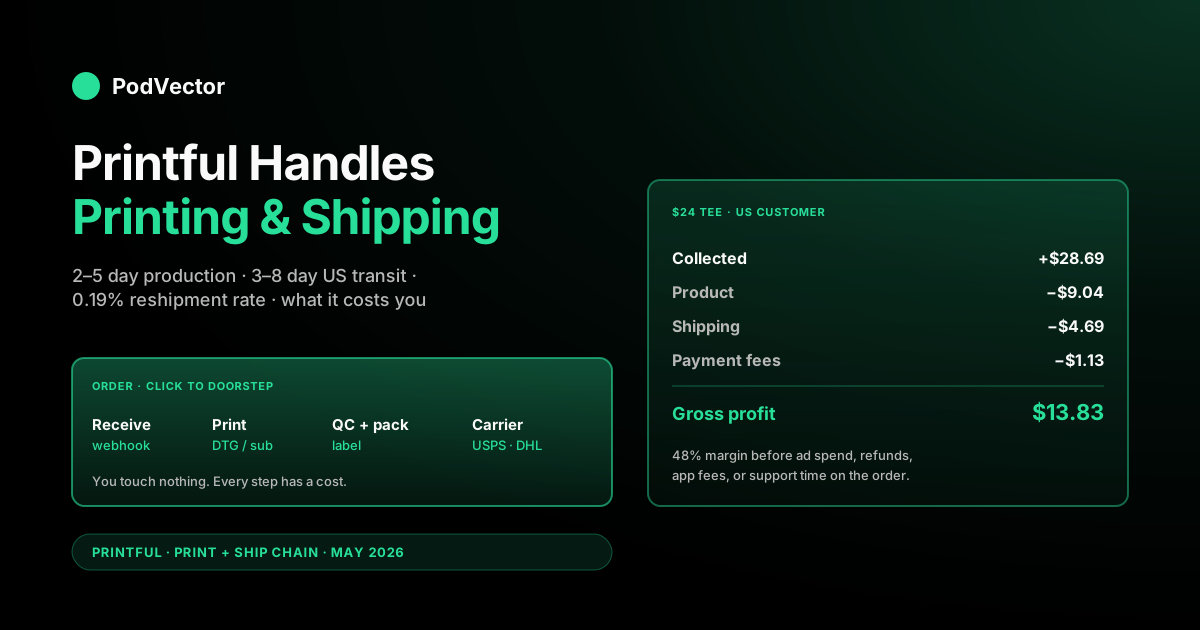
A representative $24 retail unisex t-shirt to a US customer:
- Retail price collected: $24.00 (product) + $4.69 (shipping charged to customer) = $28.69
- Printful product cost: ~$9.04 (varies by t-shirt model; basic blank is cheaper, premium higher)
- Printful shipping cost: $4.69 (you pay what you charged the customer if pass-through)
- Payment processing: ~$1.13 (2.9% + $0.30 on $28.69)
- Gross profit: ~$13.83
That's a 48% gross margin on a $24 t-shirt before any ad spend, app fees, refunds, or platform subscription costs. Realistic blended margin after acquisition cost is much lower — often 10–25% on a healthy POD brand.
Run the same math on a $24 retail t-shirt to a worldwide destination:
- Retail price collected: $24.00 + $11.99 = $35.99
- Printful product cost: ~$9.04
- Printful shipping cost: $11.99
- Payment processing: ~$1.34
- Gross profit: ~$13.62
Roughly the same gross profit in absolute terms, but a much worse percentage of revenue (38% vs 48%). That's because shipping ate the difference. If you're not passing shipping through to the customer — or if your store offers free shipping — that $11.99 comes straight out of margin.
This is the trap most POD operators don't see until they pull a full P&L. The product cost is easy to model. The shipping cost is the variable that mangles margin when you sell across regions.
For more detail on per-line cost breakdowns, see our full Printful shipping cost teardown and the USA t-shirt shipping cost breakdown.
Edge cases and hidden costs to plan for
Printful handles the happy path well. The exceptions are what catch operators off guard, especially during the first holiday season.
Holiday surcharges and capacity caps
From October through early January, fulfillment times extend. Standard 2–5 business day windows can stretch to 7–10. Carriers also impose peak surcharges on Printful, who in turn impose them on you (rates can rise temporarily).
Plan inventory and marketing accordingly. Pushing aggressive ad spend on a 2-day shipping promise in mid-December is how you generate refunds.
Reprints and reshipments
The 0.19% reshipment rate is real, but it applies to Printful's quality issues — print defects, blanks damaged in production, etc. Printful covers those at no charge to you.
Customer-caused issues — wrong address entered at checkout, "didn't fit," "wasn't what I expected" — are not covered. You absorb those at full cost.
Returns
Printful doesn't accept returns by default. Print-on-demand items are made-to-order and can't be resold. If you offer a returns policy, you're absorbing the return cost yourself and either restocking inventory you can't sell or destroying it.
Most POD operators offer reprints or refunds for quality issues only, not size or buyer's remorse.
Address validation failures
Bad addresses are common — typos, missing apartment numbers, P.O. boxes flagged by carriers. Printful holds the order and pings you through their dashboard. If you don't respond within the holding window, the order can be cancelled or returned.
Build a workflow for these. They're a small percentage of volume but a large percentage of support pain.
Region-specific quirks
Brazilian customs is famously slow and expensive. UK orders require VAT collection at checkout for items under £135 (Printful handles DDP, but the math on your end needs to be right). Some products are restricted from certain countries entirely.
For the regional rate tables and full transit windows, see our Printful shipping rates breakdown.
Is "Printful handles it" the right model for you
It depends entirely on what you're optimizing for.
Printful handles it well when: you're starting out, you don't want capex tied up in equipment or inventory, you're testing designs and need fast iteration, or your volume is low enough that bulk fulfillment economics don't pay off yet.
Printful handles it poorly when: you've grown past the volume where unit economics matter more than convenience, you've niched into a product they don't offer at a competitive rate, or your customer base is concentrated in regions where their shipping rates eat too much margin.
The middle ground — operators doing 1,000 to 10,000 units a month — is where the calculus gets interesting. Hybrid models (Printful for low-volume SKUs, in-house or alternate fulfillment for top sellers) become viable.
For comparisons against other rate cards, see our same-cluster posts on Printful shipping rates, USA t-shirt rates for 2025, and multi-shirt USA rates for 2025. The Printful shipping cluster covers transit times, regional differences, and rate strategy in depth, and the Printful topic hub indexes every Printful breakdown on the site.
For a third-party take on Printful's overall fit, Ecommerce-Platforms's overview covers comparison context with other POD platforms.
FAQs
Does Printful really handle everything from printing to shipping?
Yes — production, quality check, packing, label generation, and carrier hand-off. You handle the storefront, the customer, and any returns or refunds. Printful never interacts with your customer directly.
How long does Printful take to print and ship an order?
Fulfillment (production) is 2–5 business days. Shipping (carrier transit) is 3–8 business days for the US and 5–20 for international. Combined, plan for 5–13 days domestic and 7–25 international from order to doorstep.
What does Printful charge for printing and shipping combined?
On a typical $24 retail t-shirt to a US destination, Printful's product cost is around $9 and shipping around $4.69 — about $13.69 total before payment fees. International shipping can push that total above $20 depending on region.
Does Printful ship under my brand?
Yes. There is no Printful branding on the package. You can add custom packing slips, branded inserts, and (on paid plans) custom outer-pack branding so the unboxing reads as fully yours.
Can I choose the carrier Printful uses?
Not at the per-order level. Printful selects the carrier based on destination, package size, and the shipping service tier the customer paid for. Some service tiers map to specific carrier classes (e.g., DHL Express for expedited international), but you don't pick the carrier by name.
What happens if Printful prints my order wrong?
Printful covers reprints and reshipments for production defects — wrong size printed, misaligned design, damaged blank — at no charge to you. The published reshipment rate is 0.19%, so the practical incidence is low.
Does Printful handle returns?
Not by default. Print-on-demand items are made-to-order and can't be resold. If you offer customer returns for size or buyer's remorse, you absorb those costs yourself. Most POD stores limit returns to quality issues only.
Is Printful actually dropshipping?
Functionally yes — you don't hold inventory, and Printful ships directly to the customer under your brand. It's a specific form of dropshipping called print-on-demand: each item is manufactured per order rather than pulled from existing stock.
Can Printful handle high-volume stores?
Up to a point. They're built for indie creators and growing brands. Once you're consistently doing thousands of units a month of a single SKU, in-house or contract manufacturing typically beats Printful on unit economics — though you trade capex and ops complexity for that margin.
See exactly what Printful's handling is costing your margin
Printful is a great fulfillment partner — but every line item between the order and the doorstep is a number that belongs on your P&L. PodVector AI's Victor is an AI employee that connects to your store and Printful data and answers questions like "what's my real margin after shipping by region this month?" or "which SKUs lose money once Printful's fees are itemized?" — in plain English, against your live numbers.
No more pulling exports into spreadsheets. And get a real-time view of POD margin after every line item.
Try Victor free