
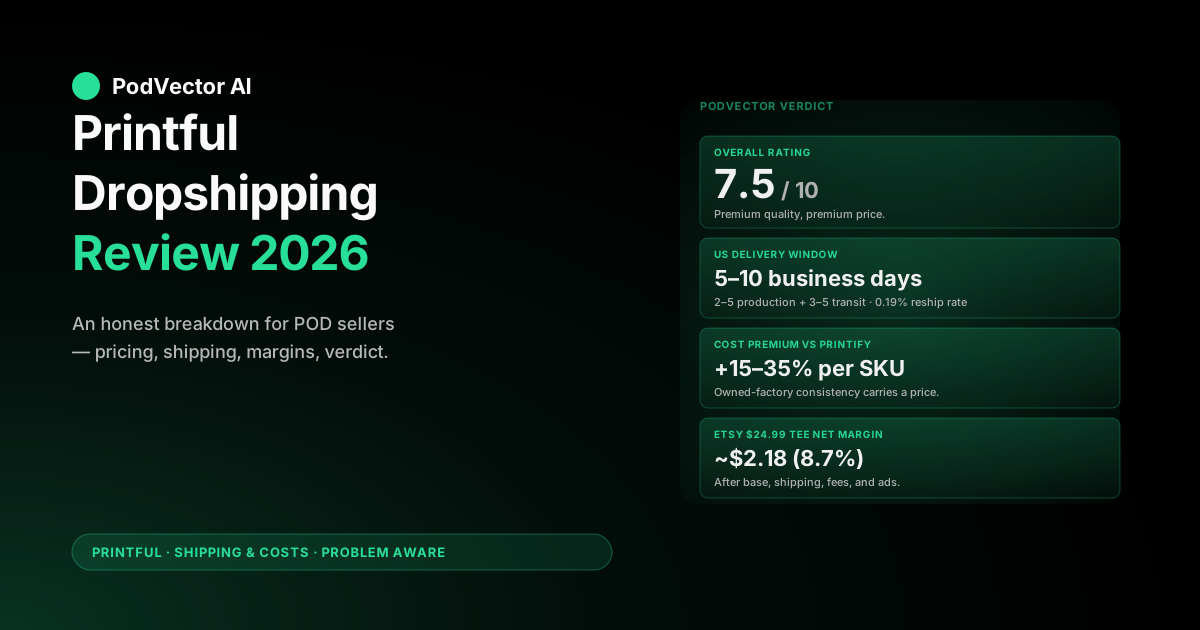
Quick Answer: Printful is the most reliable, brand-friendly print-on-demand fulfillment partner available — and one of the most expensive. According to avada.io's 2026 pricing guide, a Bella+Canvas 3001 tee starts at $13.50 base (standard plan) plus $3.99 US shipping, putting your landed first-item cost around $17–18 before a cent of margin. According to checkthat.ai's verified 2025–2026 pricing data, the Growth plan brings that base down to roughly $11.50 with discounts up to 33%. US orders typically arrive in 5–15 business days total (production + shipping); international can stretch to 7–20+ business days.
If you are building a brand and can support premium retail pricing, Printful earns its cost. If you are a margin-first seller running paid ads on basic tees at marketplace prices, the math is brutal — and that is exactly why so many sellers feel burned by it. We rate Printful 7.5/10 for serious POD operators.
What Printful Actually Is in 2026
Printful is a print-on-demand fulfillment company that prints, packs, and ships orders on your behalf when a customer buys from your store. You upload designs, list them on Shopify, Etsy, TikTok Shop, or your own site, and Printful handles everything from the printer to the doormat.
The catalog covers 300+ products: t-shirts, hoodies, all-over-print apparel, embroidered hats, mugs, posters, tote bags, phone cases, and stickers. Most production happens in Printful-owned facilities in Charlotte, Los Angeles, Dallas, Toronto, Birmingham (UK), Riga (Latvia), Barcelona, and Tijuana.
That last point matters more than it sounds. Printful owns the factories. Many competitors are aggregators — they route your order to a third-party print shop that they have negotiated rates with. According to alidropship.com's 2026 review, Printful's centralized approach ensures consistent quality and faster turnaround times compared to aggregator networks. That consistency is why their pricing is higher than the industry average.
Printful is free to use. According to avada.io's 2026 pricing guide, there are no setup fees and no monthly charge on the Free plan — you only pay when an order comes in. They also sell a paid Growth membership ($24.99/month) that unlocks discounts up to 33% on products and additional design tools — more on that in the Growth Plan section below.
One piece of recent context worth knowing: Printful and Printify's parent companies announced a merger. According to PodVector's own pricing breakdown, as of April 2026, both platforms still operate independently with separate pricing despite the announced merger, so for practical purposes you should evaluate them independently.
Pricing Breakdown — Where Printful Hurts
Printful's per-unit cost is the single biggest reason sellers leave. According to avada.io's 2026 pricing guide, a Bella+Canvas 3001 unisex tee starts at $13.50 base cost on the standard plan. According to syncost.com's 2026 analysis, standard US shipping on a t-shirt runs $3.99 for the first item and $2.00 for each additional item, putting your landed first-item cost around $17–18 before any margin.
According to ecommerceceo.com, as of February 26, 2026, Printful rolled out a targeted price increase affecting Cotton Heritage products (hoodies, heavyweight tees, sweatshirts, sweatpants) and shipping rates on select accessories. According to ecommerceceo.com, product base prices went up by 0.4%–2.4% on affected items. According to ecommerceceo.com, shipping for stickers and postcards (US) rose from $3.99 to $4.29, and phone case shipping bumped from $4.59 to $4.99. Importantly, according to ecommerceceo.com, the most popular products — Bella+Canvas, Gildan, mugs, and posters — and standard apparel shipping rates were not affected.
Here is the rough cost ladder for the most common SKUs, sourced from avada.io and syncost.com's 2026 pricing data:
- Bella+Canvas 3001 unisex tee: ~$13.50 base (Free plan) / ~$8.75 base (Growth plan, per syncost.com), +$3.99 first-item US shipping
- Add-ons: According to avada.io, sleeve prints add $2.20 and inside labels add $0.99 per unit
- Typical total per order (single print, standard shipping): According to avada.io, $15–$35 depending on product and destination
- Embroidery digitization: According to PodVector's own costs guide, a one-time digitization fee of $2.95–$6.50 per design applies
According to checkthat.ai's verified 2025–2026 pricing data, the Growth plan unlocks discounts up to 33% on products. According to ecommerceceo.com, selling 100 shirts a month on the Growth plan saves roughly $300 — well worth the $24.99 monthly fee if your volume supports it. According to syncost.com, the Growth plan break-even is as low as seven shirts a month at the published discount rates.
According to checkthat.ai, the Bella+Canvas 3001 costs $9.04 with Printify's Premium subscription versus Printful's $11.69 — a difference of roughly 23%. You are paying for owned-factory consistency. Whether that premium is worth it depends entirely on whether your retail pricing supports it. For a deeper dive into net margin by SKU and channel, see our guide on net profit margin benchmarks for POD sellers.
Product Quality — The Honest Truth
Print quality is where Printful actually wins. DTG output on Bella+Canvas 3001s is consistently saturated, the whites stay white through multiple washes, and color accuracy on the proof matches the production print closer than any other major POD network we have tested.
Embroidery is best-in-class. The stitch density on caps and polos is competitive with branded merchandise companies that charge significantly more. AOP (all-over-print) on apparel is also strong — placement accuracy on hoodies and joggers is precise.
According to PodVector's complete Printful review, most orders are fulfilled in 2–5 business days with a 0.24% reshipment rate per Printful's published operations stats. Most sellers won't see a damaged-or-misprinted complaint until well into their order history.
Where Printful occasionally stumbles: mugs (handle alignment can drift), posters (color profile shifts on matte stock), and tote bags (canvas weight inconsistency between batches). None of these are deal-breakers, but they show up often enough that you should expect to issue an occasional reprint. According to avada.io's 2026 guide, when an order is lost in transit Printful will cover reprinting and shipping a replacement — though if tracking shows delivered and a customer claims non-receipt, Printful does not take responsibility, so your store policy matters.
Shipping Speed and Reliability
US domestic shipping is the bright spot. According to fulfillant.com, Printful's production times (typically 2–7 business days) plus shipping create a total delivery timeline of 5–15 business days. Most US orders land in customer hands within that window after placement.
Carrier mix is mostly USPS for small parcels and UPS/FedEx for heavier items. Tracking populates within 24 hours of fulfillment. Production speed is where Printful occasionally disappoints — the advertised production window tends to stretch during Q4 (October–December). According to checkthat.ai, Printful applied a $0.40 holiday shipping surcharge from October 15, 2025 through January 17, 2026. If you are running a holiday promo and don't set customer expectations correctly, you will get angry messages.
The flip side is consistency. Printful does not have a "good day / bad day" delivery pattern the way some aggregator networks do. The window is wider than ideal, but it is reliable enough that you can write your store policy around it and actually mean it.
International Shipping Reality Check
International is where Printful's reputation takes the most damage. The advertised window is 7–20 business days, and the long end of that range is real.
European customers fulfilled from the Riga or Barcelona facilities get acceptable delivery times. Australian customers fulfilled from Tijuana or LA face much longer windows. Customs delays into Brazil, India, and the Middle East can push delivery further. International shipping costs vary significantly by destination and can erode the margin you thought you had — always check the current Printful shipping rate card for your target markets before setting your retail price.
According to ecommerceceo.com, Canadian shipping costs are noticeably higher than US and EU rates. If you are targeting Canadian customers, consider building the shipping cost into your retail price and offering "free shipping" instead — it tends to convert better than showing a high shipping charge at checkout.
The fix most sellers eventually adopt: geo-restrict your store to the regions where Printful's network is actually fast. Selling to AU/NZ from a Printful-only Etsy listing is a one-way ticket to bad reviews. If you must serve those markets, route them through a different fulfillment partner with a local facility.
Integrations and Store Connections
Printful has the deepest integration list in the POD industry. Native connections include Shopify, Etsy, WooCommerce, eBay, Amazon, Squarespace, Wix, BigCommerce, TikTok Shop, Storenvy, Webflow, Ecwid, BigCartel, and Square Online.
There is also a public API for custom integrations. If you are running a headless commerce setup or a non-mainstream platform, you can wire Printful in with a few days of engineering work.
The Shopify integration is the most mature. Order syncing is near-real-time, product mockups push directly into your Shopify catalog, and inventory state stays accurate. The Etsy integration works well but has a known quirk where digital downloads alongside physical products can confuse the fulfillment trigger.
Printful's design tool is genuinely usable. According to alidropship.com's 2026 review, Printful's user-friendly interface and robust customization tools make it a standout platform for POD sellers. You can upload a PNG, position it on a product mockup, generate marketing photos, and push the listing live in one workflow. For sellers without graphic design backgrounds, this lowers the barrier meaningfully.
For sellers on Shopify specifically, pairing Printful's fulfillment with smart store automation is a major margin lever. If you want to understand how to scale a POD store on Shopify end-to-end, see our guide on PodVector's approach to POD store strategy.
Margin Math — Why Sellers Bail
The brutal truth about Printful margins: if you sell on a marketplace, run paid ads, and use Printful's premium base prices, your net margin per order is often razor thin.
Here is a realistic unit economics example for a Bella+Canvas 3001 t-shirt on Etsy, using fee structure data from checkthat.ai's 2025–2026 verified pricing:
- Retail price: $24.99
- Printful base (Free plan, per avada.io): -$13.50
- US shipping (per syncost.com): -$3.99
- Etsy transaction fee (6.5%, per checkthat.ai): -$1.62
- Etsy payment processing (2.9% + $0.30, per checkthat.ai): -$1.02
- Etsy listing renewal (amortized): -$0.20
- Etsy Ads (if running): variable
- Net margin before ad spend: ~$4.66
That is before sales tax handling, occasional reprints, and customer service time. According to checkthat.ai's 2025–2026 verified pricing, real net margins typically land at 20–40% after all costs — but that range requires deliberate retail pricing strategy, not default marketplace pricing. The sellers who make Printful actually work are pricing well above the marketplace median, selling outside marketplaces (Shopify with email or SEO traffic), or running niche premium product categories where the perceived value justifies a higher price point.
This is the part where most generic Printful reviews stop. They tell you margins are thin and leave it there. What actually moves the needle is knowing — order by order, channel by channel — where the margin is going. Understanding your contribution margin by SKU and channel is the first step to fixing Printful profitability. See our guide on average checkout completion rates to understand how much revenue is leaking before an order even posts. The sellers we work with at PodVector use Victor — our AI employee — to surface exactly which SKUs and which channels are bleeding money this week, before the monthly reconciliation pulls the rug out.
Ad efficiency matters just as much as your Printful base cost. If your checkout isn't converting, even a perfectly priced Printful product loses money through wasted ad spend. See our CRO techniques for POD sellers and our guide on increasing AOV with AI — both levers that compound your Printful margin without touching your base cost.
Printful vs Printify — The Inevitable Comparison
The Printful vs Printify debate is the central question for most POD sellers. The short version: Printful wins on quality and reliability, Printify wins on price and supplier choice.
Printify is an aggregator with a network of print providers. According to checkthat.ai's verified 2025–2026 pricing, the Bella+Canvas 3001 costs $9.04 with Printify's Premium subscription versus $11.69 on Printful — a roughly 23% gap on that SKU alone. According to checkthat.ai, quality varies by print provider on Printify, and consistency across orders isn't guaranteed — you are managing multiple supplier relationships rather than one owned-factory standard.
According to PodVector's own pricing breakdown, Printful runs roughly 15–35% above Printify and Gelato on matching SKUs, which makes retail pricing and channel selection the two decisions that determine whether Printful is actually profitable for you.
For most sellers, the right call is to start on Printify to learn what sells, then graduate to Printful for proven SKUs where the margin can absorb the higher cost. Some pro sellers run both — Printify for low-margin marketplace listings, Printful for premium Shopify catalogs. For a deeper picture of how to model POD profitability across both platforms, see our guide on dropshipping from Etsy to Shopify and how channel mix affects your net margin.
Customer Support in 2026
This is where Printful has slipped. According to G2's 2026 reviewer data, Printful has a strong focus on product quality and customer satisfaction but faces challenges in support quality, scoring lower than some competitors in this area. G2 reviewers note that Printful's support could be more responsive — an important consideration for businesses that rely on timely assistance.
Live chat queues now run into significant wait times during US business hours. Email tickets take 24–48 hours for first response and often longer for complex issues. The most common complaint we hear from sellers is that damaged-product reships take days to approve, during which the angry customer is in your DMs.
The knowledge base is comprehensive, which helps for self-serve issues. The community forum is active. But if you need a human on a problem, expect to wait. This is not unique to Printful — most POD providers have similar lag — but the reputation gap between "what Printful used to be" and "what Printful is now" stings sellers who remember the earlier era.
One practical tip: tag every customer-facing order with a clear "this is a POD product, please allow 7–10 business days" message in your store policy. The support load on you drops dramatically when expectations are set up front.
Branding and Packaging Options
Branding is one of the strongest arguments for Printful over cheaper alternatives. According to mgroupweb.com's 2026 guide, Printful provides branding options such as custom neck labels, pack-ins, and packaging stickers — allowing store owners to maintain a consistent brand image across their products.
Specifically, you can add:
- Inside label: According to avada.io's 2026 guide, printed inside labels cost $0.99 per unit (with a 9% discount on the Growth plan per checkthat.ai)
- Outside label: According to PodVector's own costs guide, outside labels run $2.49 per unit
- Packing slips: Custom-branded packing slips ship with every order
- Pack-ins: Stickers, cards, or other inserts you ship separately to Printful's warehouse for inclusion
These branding options are what separate Printful from generic-feeling POD fulfillment. For a brand-building seller, the ability to ship a product that looks and feels like a direct-to-consumer brand — not a drop-shipped commodity — is worth real money in repeat purchase rates and word-of-mouth. For email-driven retention strategies that work alongside Printful's branded unboxing, see our guide on setting up Klaviyo browse abandonment flows.
The Growth Plan — When It Pays Off
Printful's Growth plan is $24.99/month and unlocks product discounts, additional branding tools, and access to free sample orders. According to syncost.com's 2026 analysis, the Growth plan brings the Bella+Canvas 3001 base cost down from ~$12.50 to ~$8.75 — a savings of roughly $3.75 per shirt. At that rate, according to syncost.com, break-even is just seven shirts a month: above that threshold, every additional shirt makes the subscription more profitable.
According to ecommerceceo.com, the Growth plan costs $24.99/month but becomes free once your store hits $12,000 in yearly sales — at which point Printful waives the subscription fee automatically. According to checkthat.ai, upgrading to Growth is worth it once you are consistently doing $300 or more in monthly product orders. If you are running a full catalog, the compounding savings get significant.
The math is straightforward: if you sell any meaningful volume through Printful and are still on the Free plan, you are leaving margin on the table every month. Run the numbers against your actual order volume before dismissing the Growth plan as unnecessary overhead. For a broader look at how to benchmark your margins against industry norms, see our net profit margin benchmark guide.
Who Printful Is Right For
Printful makes sense if you fit at least two of these profiles:
- You are building a brand, not chasing a quick flip. Print quality, packaging, and inside-label branding matter to your repeat-customer math.
- You sell premium-priced products. Brand-positioned products on a Bella+Canvas blank with original artwork can command retail prices where Printful's base cost is absorbable.
- You sell mostly to US and EU customers. The fulfillment network is fastest in these regions.
- You sell through Shopify or your own site, with traffic from email, SEO, or organic social. You are not competing against the marketplace race-to-the-bottom.
- You value reliability over savings. You would rather pay more per unit than chase down a misprint complaint once a week.
- You want branding options. Inside labels, custom pack-ins, and branded packing slips are all available — features cheaper platforms don't offer.
For social media growth strategies that complement Printful's brand-building positioning, see our social media marketing tips for POD sellers.
Who Should Skip Printful
Printful is the wrong fit for:
- Pure Etsy sellers competing on price in saturated niches (generic graphic tees, holiday designs). The base cost will eat your margin before you start.
- Beginners with no audience who want to "test" if POD works for them. Use a cheaper provider for the experiment phase, then graduate.
- Sellers focused on AU/NZ/Asia markets. The fulfillment network isn't built for fast delivery there.
- High-volume aggregator-style sellers running thousands of SKUs at thin per-unit margins. Printify's supplier flexibility wins this game.
- Sellers running pure price-driven paid ad campaigns on commodity products. The base cost structure makes it very hard to maintain positive ROAS at marketplace price points.
The Verdict
Printful in 2026 is a premium fulfillment partner with premium pricing and premium consistency. According to PodVector's complete Printful review, print quality is at the top of the POD category on DTG apparel, embroidery, and AOP. The shipping network is the most reliable in the industry for US and EU customers. Customer support has slipped but is still in the middle of the industry pack.
If you are building a brand with margin headroom and selling primarily to North America or Europe, Printful is the safe choice. 7.5/10.
If you are racing on Etsy against rock-bottom generic tee prices, Printful will cost you money. Pick a cheaper provider, learn what sells, and revisit Printful when you have a SKU worth paying for.
Improving your checkout efficiency and ad performance matters as much as controlling fulfillment cost. See our guides on CRO techniques for POD stores and increasing AOV with AI to protect the margin you have worked to build on Printful.
FAQs
Is Printful actually profitable for POD sellers?
Yes, but only if your retail pricing and channel mix support the premium base cost. According to checkthat.ai's 2025–2026 verified pricing data, real net margins typically land at 20–40% after all costs — but that range requires deliberate pricing strategy. On a Shopify store with organic or email traffic and higher price points, margins improve significantly compared to marketplace selling. The margin is in the channel and the price point, not in Printful itself.
How long does Printful actually take to ship?
According to fulfillant.com, Printful's production times (typically 2–7 business days) plus shipping create a total delivery timeline of 5–15 business days for US orders. EU orders generally run 7–14 business days. AU and other international destinations can stretch to 14–20+ business days. Q4 production windows are longer than the rest of the year.
Is Printful better than Printify?
Printful wins on quality consistency, brand control, and shipping reliability. Printify wins on per-unit cost — according to checkthat.ai, the Bella+Canvas 3001 costs roughly 23% less on Printify Premium. Most serious sellers eventually run both — Printify for low-margin tests, Printful for proven premium SKUs.
Does Printful charge a monthly fee?
No, the base account is free. According to avada.io's 2026 pricing guide, there are no setup fees and no monthly subscription on the Free plan. They sell a Growth membership ($24.99/month) that pays for itself in bulk discounts once you reach meaningful monthly volume. According to ecommerceceo.com, the Growth plan becomes free automatically once your store hits $12,000 in yearly sales.
When does the Growth plan break even?
According to syncost.com's 2026 analysis, the Growth plan saves roughly $3.75 per Bella+Canvas 3001 shirt versus the Free plan. At $24.99/month, the subscription breaks even at just seven shirts a month — above that, every additional shirt makes the plan more profitable.
Can I start a Printful store with no money?
Effectively, yes. According to Printful's own published guide, starting a dropshipping business without upfront capital is achievable for motivated creators willing to invest time, creativity, and consistent marketing effort. There is no upfront inventory cost — you pay Printful only when a customer order comes in. You will need a store platform and any ad spend you choose to run.
Does Printful integrate with TikTok Shop?
Yes, natively. The integration handles order sync, product mockups, and fulfillment automation. TikTok Shop's own shipping speed requirements can be tight, so monitor whether your Printful production window stays inside TikTok's seller performance thresholds.
What's the deal with Printful's customer support in 2026?
According to G2's 2026 reviewer data, Printful faces challenges in support quality and scores lower than some competitors in responsiveness. G2 users note that Printful's support could be more responsive — a meaningful consideration for sellers who need timely help on damaged-product reships or fulfillment errors. Set clear customer expectations in your store policy to reduce your own support load.
Should I use Printful if I'm selling internationally?
For US and EU customers, yes. For AU/NZ, India, Brazil, and parts of Asia, no — the fulfillment network isn't built for fast delivery there, and customs delays will damage your reviews. Geo-restrict your store or partner with a local-facility provider for those markets.
What branding options does Printful offer?
According to mgroupweb.com's 2026 guide, Printful provides custom neck labels, pack-ins, and packaging stickers. Additionally, according to avada.io, inside labels cost $0.99 per unit and outside labels run $2.49 per unit. Custom-branded packing slips ship with every order at no extra charge. These options are what separate Printful from generic POD fulfillment for brand-building sellers.
How do I track whether Printful is actually hurting my margins week to week?
Most sellers don't find out until month-end reconciliation. Understanding your contribution margin per SKU and channel is the key diagnostic — see our net profit margin benchmark guide for context on what healthy looks like. Victor — PodVector's AI employee — reads your live Shopify, Printful, Meta Ads, Google Ads, Printify, and Klaviyo data, surfaces exactly which SKUs and channels are bleeding margin, then proposes and executes Shopify-side fixes like repricing with your approval. Try Victor free.
Know exactly which orders are eating your margin
Printful's per-unit costs are predictable. What's not predictable is which channel, which SKU, and which shipping zone is killing your week. Most sellers find out at month-end — when it's too late to fix.
Victor is an AI employee that reads your Printful, Shopify, Meta Ads, Google Ads, Printify, and Klaviyo data, then answers questions like "which SKUs lost money this week?" or "what's my real margin after Printful shipping by destination?" — live, in plain English, no spreadsheets. When he finds a fix — like repricing a product to a target margin — he proposes it for your approval and executes it on Shopify.
If you're serious about running Printful profitably, this is the missing layer.
Try Victor free