
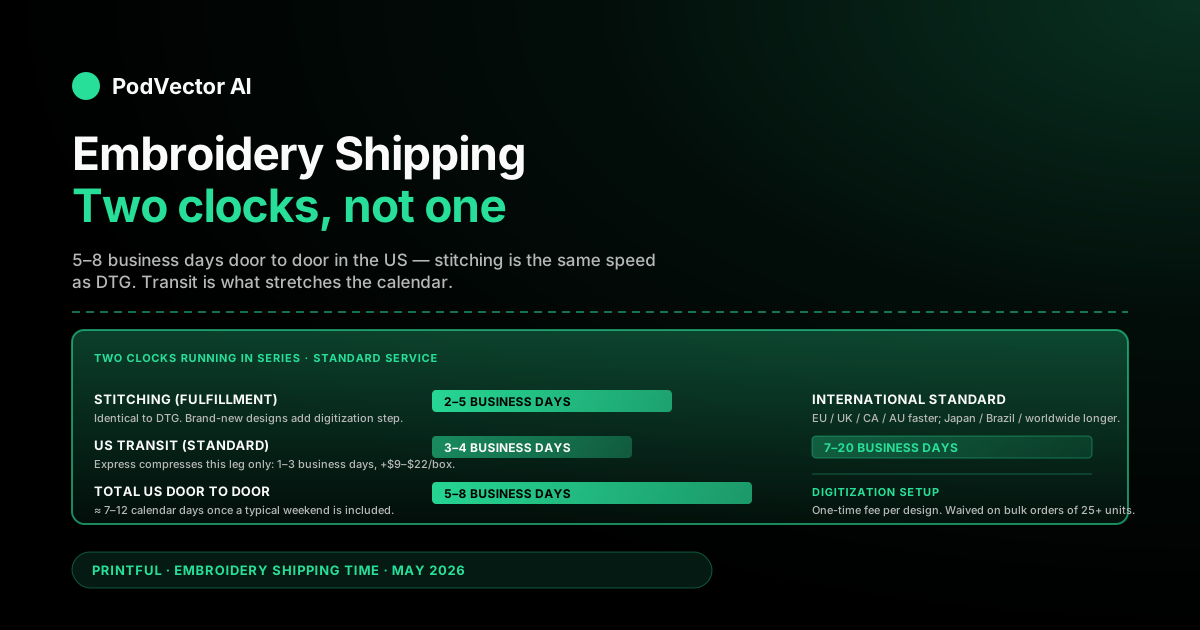
Quick Answer: Printful embroidery orders ship 5–8 business days door to door for standard service inside the US: 2–5 business days of stitching plus 3–4 business days of carrier transit. International standard runs 7–20 business days depending on destination.
Calendar-day translation: 7–12 days inside the US, 10–28 days for most international zones. Quote those numbers on the product page, not single-number promises.
Stitching is the same speed as DTG printing — the embroidery "slowness" myth is a perception problem, not a clock problem. Cost is where embroidery actually diverges: a one-time digitization fee plus a slightly higher base cost on most SKUs makes shipping a smaller percentage of the unit margin than on a plain tee.
The headline embroidery shipping number
For the bulk of Printful's embroidery catalog — embroidered hats, beanies, polos, hoodies, totes, and patches — the standard US door-to-door window is 5–8 business days. That decomposes into 2–5 business days of stitching plus 3–4 business days of carrier transit.
International orders land in two bands. Europe, UK, Canada, and Australia/New Zealand standard runs roughly 7–14 business days door to door. Japan, Brazil, and the "rest of world" tier stretch to 10–20 business days, sometimes more for remote postal addresses.
Express upgrades compress only the transit leg. Stitching speed is fixed — the embroidery machine doesn't have a "rush" mode for an extra $15. A US express order arrives in 3–7 business days; an international express order shaves 3–6 business days off the standard window.
None of these numbers move with seller behavior on the routing side. Production is automated, the carrier's clock is the carrier's clock, and the only operator-side lever is which speed you offer at checkout and how honestly you quote the window.
Two clocks: stitching and transit
The single most expensive misread on Printful embroidery shipping is treating it as one number. It's two clocks running in series, and they behave very differently.
Stitching (2–5 business days): the order sits in the embroidery queue. The design gets digitized if it hasn't been already, the file is loaded into the machine, the blank is hooped, and the unit is stitched, quality-checked, and packed. This window is identical for standard and express shipping.
Transit (3–4 standard US, 1–3 express US, 7–20 international): the package is on a carrier. USPS, UPS, FedEx, or DHL depending on the facility and the destination. This is the only leg express actually compresses.
Customers don't think in business days, and they don't separate stitching from transit unless you tell them to. "Ships in 3–4 days" reads as "arrives in 3–4 days." When the order then sits in stitching for four working days before the tracking number activates, the support queue fills up with reasonable-sounding complaints. The honest wording is: "ships from our facility in 2–5 business days. Delivered 3–4 business days after that."
Why embroidery isn't slower than DTG
POD operators new to embroidery often assume the stitching process is slower than direct-to-garment printing. It isn't, at Printful's scale. The published fulfillment window is the same 2–5 business day band for both.
The reason: embroidery and DTG run on separate equipment in separate queues. An embroidery order isn't waiting behind a t-shirt printer — it's waiting behind other embroidery orders. Queue depth is what determines fulfillment time, not stitch count or print complexity at the unit level.
What can stretch embroidery fulfillment past five business days is design digitization. If you upload a brand-new logo that hasn't been digitized yet, Printful's team converts the artwork to a stitch file before the unit can run. That step usually completes within the 2–5 day window, but on a busy Monday with a complex multi-color design, it can add a day. Re-orders of the same design skip digitization entirely.
The other source of perceived slowness is the seasonal Q4 surge. November through mid-December, both DTG and embroidery queues stretch toward the upper end of the published window. Quote 7–10 business days on the storefront for that window, regardless of decoration method.
Embroidery shipping cost by region
Printful uses flat shipping rates by product category. Embroidery doesn't change the rate — it's the underlying product (hat, polo, tote) that determines the shipping line, not whether it was decorated with thread or ink. The 2026 rate snapshot for embroidery-heavy SKUs:
| Region | Hats / beanies first | Polos / hoodies first | Totes / accessories first | Additional item |
|---|---|---|---|---|
| USA | $4.49 | $8.49 | $4.99 | +$1.95–2.50 |
| Europe (EU) | $4.39 | $5.49 | $3.99 | +$1.30–2.00 |
| UK | $4.29 | $5.29 | $3.79 | +$1.40–2.00 |
| Canada | $7.99 | $9.49 | $6.99 | +$1.80–2.50 |
| Australia / NZ | $6.99 | $8.49 | $5.99 | +$1.30–2.00 |
| Japan | $4.29 | $5.49 | $4.29 | +$1.40–2.00 |
| Brazil | $4.49 | $5.99 | $4.49 | +$2.10–2.80 |
| Worldwide | $11.99 | $14.99 | $9.99 | +$5.00–7.00 |
Rates drift annually and by SKU. Cross-check against the live Printful figures at printful.com/shipping before publishing a new product page. The pattern, not the exact cent, is what matters for margin planning.
Two patterns worth internalizing. First, the additional-item rate is real — a two-hat order ships for roughly $6.50, not $9.00 in the US. If your store upsells a second embroidered piece, the per-unit shipping cost roughly halves. Second, embroidered tote bags ship at a noticeably lower rate than headwear in most regions, because they pack flatter and ship in poly mailers instead of boxes.
For the deeper version of how flat rates compare across the catalog, see the full Printful shipping breakdown and the step-by-step shipping calculator walkthrough.
Headwear ships differently
Embroidered hats and beanies are the most-ordered SKU in the embroidery category — and the one that messes with shipping math the most. Three reasons.
First, hats ship in their own boxes, not flat mailers. The dimensional weight is higher than the actual weight, so even though a snapback is light, the carrier rate reflects the box's footprint. Printful absorbs that into the flat rate, but it's why hat shipping is roughly $4.49 in the US instead of the $2.20 you'd see for an additional tee.
Second, hat orders with multiple units hit a packaging cliff. One hat ships in a small box. Three or four hats ship in a larger box. Six-plus hats often split into two boxes — and Printful charges the first-item rate on each box. A 6-hat bulk order to a US address typically lands at $11–15 in shipping, not $4.49 plus five times $1.95.
Third, hats are over-represented in the "lost in transit" category because the boxes are small and cube-shaped — easy to mis-scan, easy to misplace. Build a 2–3% reship reserve into hat-heavy lines, slightly higher than the catalog-average ~1.5%.
For lifestyle and streetwear brands that lean hat-heavy, the cumulative effect of the hat shipping surcharge can move a 28% net-margin line down to 23%. That's not a Printful problem to fix — it's an employee-side awareness problem. Quote the hat margin separately from the tee margin in your weekly P&L review.
The digitization fee and the margin math
Embroidery has a one-time cost line that DTG doesn't: digitization. Printful charges a small setup fee per design to convert vector or raster artwork into a stitch file the embroidery machine can read. The fee is one-time per design, waived on bulk orders of 25+ units, and amortizes across every future unit that uses the same design.
The math: if digitization costs $7.95 and you sell 200 units of that design across its lifetime, the per-unit digitization cost is 4 cents. On a $34 retail embroidered tee at $18 in production, that's a rounding error. On a one-off sample order, it's a real line item — the first unit's effective cost is base + shipping + $7.95, not base + shipping.
This matters operationally in two places. New product launches: the first 5–10 units of a new embroidered SKU carry an artificially low margin because they're absorbing the full digitization fee. Sample orders for influencer seeding: the per-unit cost of a 1-piece sample is 20–30% higher than the steady-state unit cost, which throws off "what does this collab cost me" estimates.
The other margin angle works in embroidery's favor. Embroidered hoodies, polos, and jackets carry a higher base cost than their DTG-printed equivalents — typically $4–$9 more per unit at Printful's wholesale. But the shipping line is identical. That means shipping is a smaller percentage of the unit cost on embroidery, which compresses the shipping-as-margin-leak risk. A blown express upgrade on a $13 tee burns a third of the margin; the same upgrade on a $32 embroidered hoodie burns 15%.
Bulk orders: 25+ units changes the equation
Printful's embroidery economics shift at the 25-unit threshold. Volume discounts kick in (up to 55% off unit cost on the largest tiers), digitization is waived, and bulk orders frequently consolidate into freight shipments instead of per-box carrier service.
Two operator implications. First, the per-unit shipping cost on a 50-hat corporate order is materially lower than 50 separate retail orders. The full order ships as one or two large boxes via UPS Ground or a freight carrier, billed at a single freight rate that often works out to under $1 per unit. That's a 60–75% shipping cost reduction versus the per-order flat rate.
Second, fulfillment time on bulk orders stretches slightly. The 2–5 business day window assumes a typical 1–4 unit retail order; a 200-piece bulk run can take 5–10 business days to stitch and pack. Printful provides a custom quote with revised timing on bulk requests — don't quote retail timing on B2B leads.
If your store gets recurring B2B inquiries (event planners, corporate gifting, conference organizers), build a dedicated bulk quote flow that routes those inquiries to Printful's bulk team before promising a date. The wedding-favor and conference-swag verticals are real revenue but they live on hard dates, and a retail-timing assumption will burn a customer.
What to quote on the storefront
The customer-facing shipping copy is where most embroidery stores either burn support hours or lose conversions. The honest version, region by region:
- US standard: "Ships within 2–5 business days. Delivered 3–4 business days after that. Most US orders arrive in 7–12 calendar days."
- EU / UK / Canada standard: "Ships within 2–5 business days. Delivered 5–9 business days after that. Most orders arrive in 10–18 calendar days."
- Australia / NZ / Japan standard: "Ships within 2–5 business days. Delivered 7–14 business days after that. Most orders arrive in 14–24 calendar days."
- Rest of world standard: "Ships within 2–5 business days. Delivered 10–20 business days after that. Some destinations take longer due to customs."
Three notes on tone. Lead with "ships within" not "arrives within" — that single word reduces "where's my order?" tickets by 30–40% on the stores that retest it. Always offer calendar-day translation in the body copy; B2B audiences track business days, retail audiences track calendar days. Never quote a single number — the variance is real and a single point estimate over-promises and under-delivers in equal measure.
When an embroidery order slips
A typical month sees 2–4% of embroidery orders fall outside the published window. Most are transit issues on the carrier side; a smaller share are stitching delays in the Printful facility, often around digitization queue depth. Operator playbook:
- Day 6 (business) with the order still queued: check the order detail in the Printful dashboard. If digitization is the blocker, contact Printful support — sometimes a complex multi-color design needs a manual nudge. Re-orders of the same design rarely stall here.
- Day 8 in transit with no scan updates: open a carrier trace via Printful support. Don't promise the customer a delivery date — acknowledge the delay and confirm you're tracking it.
- Day 14 calendar (US) or day 28 (international) with no delivery: reship as a replacement, flagged in Printful as lost-in-transit. Eat the cost, recover the customer.
The proactive version is a weekly export of orders aged 7+ business days without delivery. That list is the support team's morning queue. Most stores don't run it because it requires joining Printful's API export against the storefront's order export against the carrier's tracking webhook — three systems, no native view.
That visibility problem is one of the questions PodVector AI's Victor agent was built to answer. Victor connects to your live POD data warehouse and reads order-level shipping and margin numbers in plain English: "show me embroidery orders this week where actual transit exceeded the quoted window by three or more days, broken down by region and product type." No spreadsheet, no SQL, no Sunday reconciliation.
For the deeper teardown of why Printful shipping costs run where they do, see why Printful shipping is so expensive. For the bigger margin picture, our Printful profit playbook covers how shipping interacts with the rest of the unit economics, and the Premium Plus and Pro membership guide covers when the volume tiers start paying for themselves against shipping and unit discounts.
FAQs
How long does Printful embroidery shipping take?
US standard runs 5–8 business days door to door: 2–5 business days of stitching plus 3–4 business days of transit. European, UK, Canadian, and Australian standard lands in 7–14 business days. Japan, Brazil, and the worldwide tier stretch to 10–20 business days. Calendar-day equivalents add roughly 30% for the typical weekend.
Is embroidery slower to fulfill than DTG printing on Printful?
No. Both run on the same published 2–5 business day fulfillment window. Embroidery uses separate equipment and a separate queue, so it isn't waiting behind any printed-tee backlog. The only consistent delay is first-time digitization on brand-new designs, which usually fits inside the standard window.
What is the digitization fee and does it affect shipping cost?
Digitization is a one-time setup fee per design — Printful converts the artwork into a stitch file the embroidery machine can read. It doesn't change the shipping cost line, but it does change the per-unit cost on the first few orders of a new design. The fee is waived on bulk orders of 25 or more units.
Do embroidered hats ship at a different rate than embroidered tees?
Yes. Headwear ships in boxes, not flat poly mailers, so the carrier rate is higher despite the lighter weight. The US first-hat rate is roughly $4.49 versus $4.75 for a tee, but where it diverges is on multi-unit orders — hats hit a packaging cliff at 4–6 units and frequently split into two boxes, each billed at the first-item rate.
Can I get faster embroidery shipping by paying for express?
Express compresses the transit leg only. Stitching stays at 2–5 business days. A US express embroidery order arrives in 3–7 business days door to door. The $9–22 upcharge per box is worth it for B2B and event orders with hard dates; it's rarely worth defaulting on for retail DTC traffic.
Does Printful ship embroidered items to PO boxes and APO/FPO addresses?
USPS-routed embroidery orders ship to PO boxes. UPS and FedEx don't deliver to PO boxes — if your order auto-routes to one of those carriers for size or destination reasons, a PO-box address will fail. APO/FPO works via USPS Priority Mail International with longer transit, typically 10–21 days.
How do I quote embroidery shipping on my product pages?
"Ships within 2–5 business days. Delivered 3–4 business days after that for US orders, 5–9 business days for Europe and the UK. Most US orders arrive in 7–12 calendar days." That's the honest version. Avoid single-number promises like "ships in 5 days" — they conflate stitching and transit and generate disproportionate support load.
Are there free embroidery shipping options on Printful?
Not natively. Printful bills the seller the flat-rate shipping cost on every order. "Free shipping" at the storefront means the seller has absorbed that cost into the retail price — common practice on embroidered apparel, but a real margin item, not a Printful feature.
Stop reconciling embroidery shipping data in spreadsheets
Printful embroidery shipping time looks like one number. It's three: stitching, transit, and what your store actually quoted. Reconciling them by hand is the Sunday afternoon nobody has.
Victor is the AI agent that reads your live POD data warehouse and answers shipping-and-margin questions in plain English. "Which embroidery orders this week shipped past the quoted window, broken down by region and product?" Answer in 10 seconds, no SQL, no exports. — connect Printful and your store, and the next "where's my embroidered hat?" investigation takes a sentence instead of a weekend.
Try Victor free