
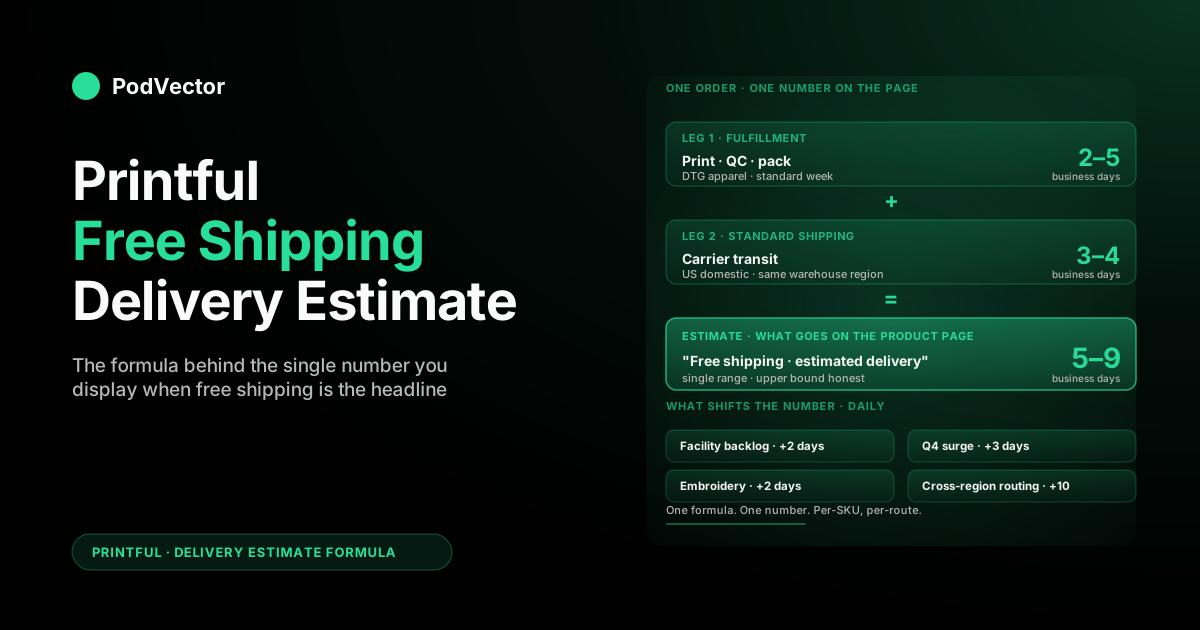
Quick Answer: The Printful free shipping delivery time estimate is one number — a single business-day range you display per product. It is the sum of two parts: 2–5 business days fulfillment plus the standard shipping leg for the customer's route (3–4 days US domestic, 5–20 international).
For a US-domestic apparel order with free shipping, the realistic estimate to put on a product page is 5–9 business days. International ranges hit 7–25. Free shipping means the standard tier — Printful does not run a faster "free" lane.
This guide breaks down the formula Printful uses, how to compute the estimate for one order, and how to display it cleanly without spooking the customer or eating chargebacks.
The formula behind the estimate
Printful's estimated delivery time is a sum, not a guess. The platform publishes the formula directly: estimated fulfillment time + estimated shipping time = estimated delivery time.
When you offer free shipping, you are not changing the formula. You are pinning the shipping leg to the standard tier, because that is the cheapest fulfillment option Printful sells you and the one you are absorbing into product price.
The customer never sees "free shipping = standard." They see one number: a delivery range. Your job is to make that number accurate enough that nobody opens a "where is my order" ticket on day six.
For the storefront tables and copy templates, see Printful free shipping delivery time estimates: full breakdown. This article focuses on the math behind a single estimate.
Fulfillment leg: where the 2–5 days comes from
Fulfillment is the time between order receipt and "shipped" status. Printful runs printing, quality check, and packing in this window. The published range is 2–5 business days across all standard apparel and accessories.
Non-apparel runs longer in practice. Sublimation products, embroidered items, and items routed through a partner facility add 1–3 business days. For an embroidered cap or a sublimated all-over hoodie, plan on 3–7 business days fulfillment, not 2–5.
The number is a 95th-percentile estimate — most orders finish in 2–3 days during normal weeks. Q4 stretches it. Mid-November through late December routinely runs 5–7 days even for plain apparel, and the published "2–5" does not adjust seasonally.
For embroidered items specifically, see the timing notes in our Printful embroidery review — the fulfillment leg is materially different from DTG.
Shipping leg: standard tier per route
The shipping leg is the carrier transit time after Printful hands the package off. Standard is the only tier consistent with free shipping economics — express adds $5–$15 per order that you would have to eat.
The published standard ranges:
- US domestic: 3–4 business days post-fulfillment
- EU within-region: 3–5 business days
- UK within-region: 3–5 business days
- Canada within-region: 3–7 business days
- International cross-region: 5–20 business days
The cross-region range is the trap. A US-fulfilled order shipped standard to Germany routinely takes 14–18 business days door-to-door because customs adds 3–10 days that Printful does not break out separately.
Printful auto-routes to the fulfillment center closest to the destination when stock allows. A German customer ordering an apparel item gets routed to the Latvia or Spain facility, not the US — which collapses the cross-region penalty.
Computing the estimate for one order
Take a single order: US customer in Austin, one DTG t-shirt, free shipping.
Fulfillment leg: 2–5 business days (apparel, standard).
Shipping leg: 3–4 business days (US domestic standard).
Total estimate: 5–9 business days.
You display that range on the product page. The customer sees a single delivery window. Internally you know the lower bound is best-case fulfillment + best-case carrier, and the upper bound is the realistic worst case for a non-peak week.
For a UK customer ordering the same shirt, the math shifts based on routing. If Printful routes from the Latvia facility, fulfillment + shipping totals 5–10 days. If they route from a US warehouse because of stock, you are looking at 12–22 days plus customs friction.
You cannot know which routing Printful will use until the order is placed. The safe storefront estimate is the conservative upper bound for the customer's region, not the routing-dependent lower bound.
What shifts the estimate on a given day
The published 2–5 and 3–4 are averages. Real-world variance comes from four inputs that change daily:
- Facility backlog — if a fulfillment center is over capacity, the 2–5 day range can stretch to 4–7 day for a week. Printful does not publish per-facility queue depth, so you do not get a heads-up.
- Product type — embroidery, sublimation, and partner-fulfilled items run slower than DTG apparel. A mug from the Latvia facility moves on a different queue than a t-shirt from the same building.
- Carrier disruption — weather, holidays, or carrier strikes (UPS, USPS, Royal Mail) add 1–5 days at random. The estimate does not adjust in real time.
- Stock substitution — if the closest facility is out of the requested SKU, Printful routes from the next-nearest facility, which can add 5–10 days to the shipping leg.
None of these are visible to the customer at checkout. They see the estimate you displayed when they added the item to cart, and they hold you to it.
Displaying the estimate on your storefront
The estimate you put on the product page is a promise. The number it contains has three jobs: set expectations, suppress "where is my order" tickets, and avoid killing conversion.
The safe display is a business-day range with a "ships from" line beneath. Example: "Free shipping. Estimated delivery 5–9 business days. Ships from Charlotte, NC."
If you sell internationally, conditional rendering by IP-detected region beats a single global estimate. A UK visitor seeing "5–9 business days" who actually waits 18 is a refund request. A UK visitor seeing "7–14 business days" who gets it in 10 is a positive review.
Do not bury the estimate at checkout. The decision to buy happens on the product page — by the time a customer reaches checkout, they have already mentally committed to a delivery window. A 14-day surprise at checkout is a cart abandonment, not a sale.
Margin impact of the estimate you choose
The estimate is not just a UX choice — it has a margin tail. Three line items move with how aggressive or conservative you set the displayed range.
Tight estimate ("5–7 days") drives conversion up by 2–4% on apparel listings because the perceived shipping speed matches Amazon-grade expectations. It also drives "where is my order" support volume up by 3–5x on orders that hit day 8 — and each ticket costs you 5–15 minutes of operator time plus the occasional refund.
Conservative estimate ("7–14 days") suppresses tickets to near zero. Conversion drops 1–3% on impulse buys, but average order value rises slightly because the customers who do buy are pre-screened for patience.
The right setting depends on your margin per unit. If you are running a $4 contribution margin on a $24 tee, one refund swallows six orders of profit. Conservative wins on thin-margin SKUs. Tight wins on premium SKUs where the refund rate stays low and the conversion lift compounds.
For the underlying cost math, see Printful mug cost: full breakdown and Printful phone case base cost: full breakdown — the per-SKU contribution number is what tells you which estimate style your catalog supports.
Tracking the actual estimate vs. delivery
The estimate you display is a hypothesis. The data that proves or breaks it is the gap between order date and delivered status across your real shipments.
Printful exposes shipping events through the order webhook: package shipped, in transit, delivered. The dataset you actually want is order_id, fulfilled_at, delivered_at, route, product_type, and the displayed estimate at purchase time. With those six fields you can compute realized delivery time per route and per SKU.
Most sellers do not track this. They display a static "5–9 business days" because the Printful help center said 2–5 + 3–4. When the actual median for their store is 8 business days, they keep promising 5 and absorbing tickets.
The fix is to log the displayed estimate at purchase time and compare it monthly to realized delivery dates. If the median realized delivery for US domestic is 7.5 days and your displayed estimate is 5–9, the estimate is honest. If you display 3–5 and realized is 7.5, you are buying refund requests.
For broader context on the no-upfront-cost economics that lets you absorb shipping into price in the first place, see Printful no-upfront-cost print on demand: full breakdown. The cluster hub at Printful costs and charges covers the rest of the cost lines.
Printify users running a similar free-shipping playbook will find a direct timing comparison in which is better, Printify or Printful. The full Printful topic hub indexes the rest of the platform deep-dives.
For the canonical timing tables published by Printful itself, see the Printful shipping page.
FAQs
Does Printful offer free shipping?
No. Printful does not run a free-shipping lane. You absorb the standard shipping rate into product price and present a $0 shipping line at checkout. The delivery time defaults to the standard tier.
How does Printful calculate the estimated delivery time?
The formula is estimated fulfillment time (2–5 business days for most apparel) plus estimated shipping time for the customer's route. The platform sums the two ranges and surfaces a single delivery window.
Why does my free shipping estimate vary by customer location?
Because the shipping leg changes by route. US domestic standard is 3–4 business days; EU within-region is 3–5; international cross-region is 5–20. Printful auto-routes to the closest fulfillment center when stock allows, which collapses cross-region delays for international customers.
Should I display a single estimate or a range?
A range. "5–9 business days" is more accurate than "7 business days" because fulfillment variance is real. A single number triggers tickets the moment the order ships on day 6.
Does the estimate include weekends?
No. All Printful estimates are in business days. A 5–9 business day estimate placed Monday delivers between the following Monday and Friday of the next-following week.
What's the typical Q4 slippage?
Mid-November through late December stretches the fulfillment leg from 2–5 to 4–7 business days. Carrier delays add 1–3 more. A 5–9 day non-peak estimate runs 8–14 in mid-December.
How do I track whether my displayed estimate is accurate?
Log the displayed estimate at purchase time, then compare to realized delivery dates from the Printful order webhook. Compute realized delivery per route and per product type monthly. If the median realized delivery exceeds your upper bound, the displayed estimate is too tight.
Does express shipping ever make sense alongside free standard?
Yes, as an optional checkout upgrade. Surface express as a paid line item at checkout while keeping free standard as the default. Customers who need faster delivery self-select and pay for it.
Stop guessing whether your displayed estimate is honest
Most POD sellers display a generic "5–9 business days" because the Printful docs say 2–5 + 3–4. Realized delivery on your store is a different number — and you do not know it.
Victor is an AI business operator for your POD store. He reads your live Shopify and Printful data, computes realized delivery time per route and per SKU, flags where your displayed estimate is buying refund requests, and proposes the exact range to display per product page. Once you approve, he can update Shopify metadata directly.
It is the three legs together — a POD playbook baked into the agent, a live connection to your store data, and the ability to act on it — that turns a generic "2–5 + 3–4" promise into a per-SKU estimate your customers actually hit.
Try Victor free