
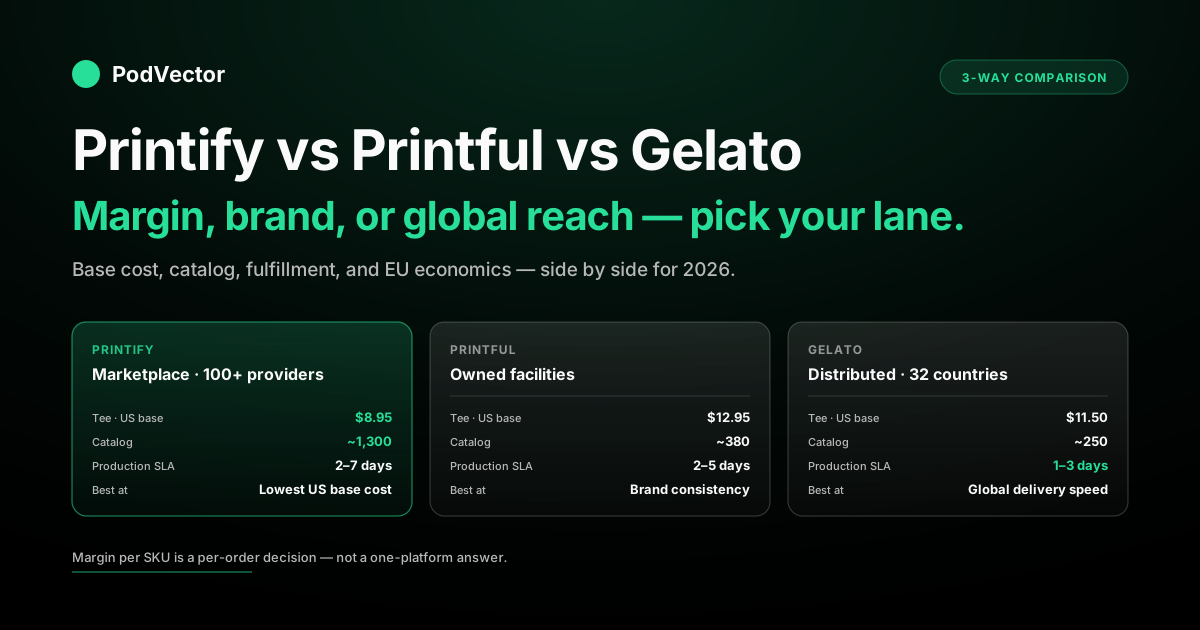
Quick Answer: Printify wins on US base cost and catalog breadth. Printful wins on brand consistency and owned-facility quality. Gelato wins on global delivery speed, EU/UK economics, and customs avoidance.
Pick Printify if your buyers are mostly US and you compete on margin. Pick Printful if brand consistency and unboxing matter. Pick Gelato if your buyers sit outside the US — particularly EU, UK, AU, JP, BR, or LATAM — where local production reshapes the landed-cost math.
Most established POD operators in 2026 don't pick one. They route SKUs to whichever supplier prices, prints, and ships them best for that order. The breakdown below covers each axis with current 2026 pricing, the EU VAT angle most US-focused guides skip, and the comparison none of the three publish: what changes when you actually look at margin per SKU.
The 3-way decision in 60 seconds
Three platforms, three architectural bets. Printify is a marketplace stitching 100+ third-party print providers into one dashboard. Printful runs its own production facilities in the US, EU, Mexico, Canada, Japan, and Australia. Gelato is a curated network of 140+ partner facilities across 32 countries with automatic local-production routing.
That single architectural choice ripples into every other axis — base cost, quality variance, shipping speed, catalog breadth, branding control, and risk profile. There isn't a "best" supplier in the abstract. There's a best supplier for your buyer geography, your product mix, and your margin tolerance.
The rest of this comparison unpacks each axis with 2026 numbers and the trade-offs the three suppliers' marketing pages don't volunteer.
Side-by-side snapshot table
Each row is unpacked in the sections below. This is the at-a-glance version.
| Axis | Printify | Printful | Gelato |
|---|---|---|---|
| Model | Marketplace of 100+ providers | Vertically integrated, owned facilities | Distributed network, 140+ partners in 32 countries |
| Bella+Canvas 3001 tee, US base | $8.95 (Premium) / $10.95 (Free) | $12.95 | $11.50 |
| Subscription | Premium $39/mo (or $299/yr ≈ $24.92/mo), up to 20% off | Growth $24.99/mo, up to 33% off | Gelato+ ~$24/mo ($19.99/mo billed yearly), ~10% off; Gold tier ~$99/mo, ~20% off |
| Catalog size | ~1,300 products | ~380 products | ~250 products |
| Production SLA | 2–7 business days (varies by provider) | 2–5 business days | 1–3 business days |
| Local production coverage | US, EU, UK, AU, CN (varies by provider) | US, EU, MX, CA, JP, AU | 32 countries; ~90% of orders produced locally |
| Defect rate | 1–6% (varies by provider tier) | 1–2% (consistent) | 1–3% (consistent) |
| Best at | Lowest US base cost, widest catalog | Brand consistency, US/EU apparel | Fastest global delivery, EU/AU/LATAM coverage |
| Weakest at | Quality variance across providers | Base cost on commodity SKUs | Catalog breadth, US base cost |
Three business models, three trade-offs
The architectural difference is the most useful lens for picking between these three. Pricing, quality, and shipping all flow from it.
Printify owns nothing. It's an order-routing layer that sits on top of 100+ third-party print providers. When you list a Bella+Canvas 3001 tee, you're choosing which provider fulfills it — Monster Digital, SwiftPOD, Sensaria, MyLocker, and dozens more, each with their own pricing, quality, and fulfillment record.
That marketplace structure pushes base costs down because providers compete inside the catalog. It also pushes quality variance up, because you're aggregating the output of dozens of different facilities. Both effects are real.
Printful owns everything. Same machines, same staff, same QC checks across every facility. The result is the lowest variance of the three — the order you place today and the order you place in six months come out the same.
The trade-off is structural cost. Owned facilities mean rent, capex, and staffing on Printful's books. That overhead is priced into every base cost.
Gelato is the in-between model. Gelato doesn't own production but the partner network is curated, contractual, and tightly managed. The routing happens automatically — your order goes to whichever Gelato partner is closest to the buyer.
The result is shipping speed Printful and Printify can't easily match outside their two or three primary geographies. Gelato is what happens when you optimize for "where the buyer is" instead of "where the cheapest printer is." Producing close to the buyer also cuts shipping distance and packaging waste, which is why Gelato leans on sustainability as part of its pitch — a real tiebreaker for some EU brands, though not a reason to override the cost-and-quality math.
Pricing — where Printify usually wins, and where it doesn't
Pricing is where most comparison guides over-rotate on the sticker number. Base cost matters, but the subscription tier and destination country move the all-in landed cost more than base price suggests.
Concrete example, Bella+Canvas 3001 unisex tee, single-color front print, US fulfillment:
- Printify Free: $10.95 base + ~$4.50 shipping = $15.45 landed
- Printify Premium ($39/mo, or $299/yr): $8.95 base + $4.50 shipping = $13.45 landed
- Printful Free: $12.95 base + ~$5.50 shipping = $18.45 landed
- Printful Growth ($24.99/mo): $11.32 base + $5.50 shipping = $16.82 landed
- Gelato Free: $11.50 base + ~$4.95 shipping = $16.45 landed
- Gelato+ Gold ($99/mo): $9.20 base + $4.95 shipping = $14.15 landed
On US tees, Printify Premium beats Printful Growth by $3.37 per unit and Gelato+ Gold by $0.70. At 1,000 units a month, that gap is $3,370 between Printify and Printful — pure margin.
The picture flips on EU shipments. A US-printed Printful or Printify order shipping to Germany takes 7–12 business days plus international shipping cost. The same order printed in Gelato's German partner facility ships in 3–5 days at domestic shipping rates. Once landed cost and refund risk are factored in, Gelato beats both on most EU orders.
Subscription math also shifted in 2026. Printify raised Premium to $39/month — the priciest monthly tier of the three — though the $299/year annual plan brings the effective cost back to ~$24.92/month. On the monthly plan, Premium's ~$2/unit base discount now pays back at ~20 units; on the annual plan, ~12. Printful Growth ($24.99/mo) pays back at ~10–15 orders. Gelato+ at ~$24/month pays back at ~15–20 orders; the higher Gold tier (~$99/mo) needs ~50 orders to justify, which is why most Gelato sellers stay on Gelato+ until they cross that threshold.
The practical takeaway from the 2026 price moves: Printify still wins on raw US base cost, but its subscription is no longer the cheap one. If you're under ~20 orders/month, the annual Premium plan — not monthly — is what keeps Printify's margin edge intact.
For the deeper Printify-vs-Printful pricing breakdown without Gelato in the mix, see Printify vs Printful comparison 2025.
Quality and consistency — Printify's biggest "but"
Quality across the three platforms isn't a simple ranking. It's a variance question, and Printify is on the wrong side of it.
Printful's defect rate hovers around 1–2% in seller surveys, with low variance because every Printful facility runs the same equipment and QC. Gelato's defect rates run 1–3% with similar consistency, because the partner network is curated and tightly managed.
Printify's defect rate ranges from 1% on top-tier providers (Monster Digital, SwiftPOD, Sensaria) up to 6% on lower-tier ones. Mid-tier providers run 3–4%. The marketplace average is dragged up by the long tail.
The practical implication: on Printful and Gelato, quality is the platform's job. On Printify, quality is your provider-selection discipline. Sellers who treat Printify like a single supplier and don't actively manage their provider list end up with the highest defect rates of the three.
Top-tier Printify providers match Printful and Gelato on absolute quality. The sellers running disciplined provider selection on Printify get the best of both worlds — Printify's prices with Printful-tier quality. The sellers who don't, get the worst.
Shipping speed and global reach
Shipping is Gelato's signature axis and the strongest argument for using it on global stores.
Printify production runs 2–7 business days depending on the provider. Some ship in 48 hours; others queue for a week. Geography depends on which provider you picked — most US providers ship US, some have EU partners, fewer have UK or AU coverage. Total delivery: 4–10 days domestic, 10–18 international.
Printful produces in 2–5 business days, then ships from the facility closest to the buyer — US, Mexico, Canada, EU, Japan, or Australia. Domestic delivery in any of those geographies: 3–7 days total. Outside those, expect 8–14 days international.
Gelato produces in 1–3 business days and ships from one of 140+ partner facilities in 32 countries. About 90% of orders are produced and shipped from inside the buyer's country. Total delivery in supported countries is typically 3–5 days. The cross-border premium that hits Printful and Printify on non-domestic orders mostly disappears.
For US-only stores, all three deliver fast enough. For EU, UK, AU, JP, BR, or LATAM stores, Gelato's local-production model is structurally faster — and the gap is wide enough to show up in conversion rate, refund rate, and review score.
Product catalog
Catalog breadth diverges sharply.
Printify's ~1,300 products include every major garment, accessory, drinkware, and home-goods category, often with three to ten provider variants per SKU. If a trending TikTok product exists in POD, Printify carries it.
Printful's ~380 products are tighter — Bella+Canvas, Gildan, Stanley/Stella, AS Colour for apparel; HUF and Champion for licensed pieces; and a curated set of accessories, mugs, and posters. The catalog feels designed rather than aggregated.
Gelato's ~250 products lean heavily into wall art, posters, photo books, and mugs — categories where local fulfillment delivers the biggest shipping advantage. Apparel exists but is narrower than Printful's lineup.
For wall art, posters, and photo products, Gelato's catalog is competitive with Printful and beats Printify on quality consistency. For trend-driven apparel, Printify wins on options. For curated brand-driven apparel, Printful wins on quality and consistency.
Branding and customization
Custom packing slips, inserts, neck labels, and on-package branding separate POD platforms from "white-label-only" suppliers.
Printify branding depends on the provider. Some providers support custom packing slips and inside-collar labels (Monster Digital, SwiftPOD, MyLocker on premium tiers). Many don't. The branding option exists but is provider-by-provider rather than platform-wide.
Printful offers the deepest branding stack: custom packing slips with your logo (free on all plans), branded inserts (paid add-on), inside-collar labels on apparel ($2.49–$2.99/unit), and tear-away labels. Branding is consistent because Printful's facilities print and apply it directly.
Gelato supports custom packing slips on all plans, inserts on Gelato+ Gold, and inside-collar labels on a subset of apparel SKUs. Branding is more limited than Printful's but more consistent than Printify's because the partner network is curated.
For brand-driven sellers who care about unboxing, Printful is still the strongest. For Etsy or TikTok-Shop sellers where unboxing matters less than landed price, Printify or Gelato suffice.
Integrations and ease of use
All three integrate with the major storefronts. The depth varies.
Printify integrates with Shopify, Etsy, eBay, Walmart, Wix, Squarespace, BigCommerce, WooCommerce, PrestaShop, and TikTok Shop. The integrations are functionally complete — order sync, product sync, mockup generation — and slightly thinner than Printful's on tax/shipping overrides.
Printful integrates natively with Shopify, Etsy, eBay, Amazon, TikTok Shop, WooCommerce, Squarespace, Wix, and BigCommerce — plus Webflow, Storenvy, and Big Cartel. The integrations are deep: order sync, product sync, in-channel mockup generation, and tax/shipping override at the channel level. For more, see the complete Printful integrations guide.
Gelato integrates with Shopify, Etsy, WooCommerce, Wix, Squarespace, BigCommerce, and TikTok Shop. The native integration count is smaller, and a few channels (Walmart, eBay) require Gelato's API or a third-party connector. For most Shopify and Etsy stores, the gap doesn't matter.
For ease of use, Printful's UI is the most polished — onboarding flow, mockup generator, and dashboard are all production-grade. Printify's UI is functional but feels more utilitarian, especially for first-time POD sellers picking providers. Gelato's UI is the cleanest of the three for design-driven products like wall art and posters but has fewer apparel-mockup options.
EU VAT, customs, and the international wrinkle
This is where the choice gets genuinely different — and where most US-centric comparison guides skip past the most important variable for non-US sellers.
When a US-printed Printify or Printful order ships to Germany, three things happen. The order crosses a customs border. EU VAT is calculated and either prepaid (under IOSS for orders ≤ €150) or charged on delivery. Cross-border shipping cost is added on top.
The buyer's experience: longer delivery, occasional customs delays, and sometimes a surprise VAT charge at the door if you didn't enroll in IOSS. The seller's economics: $4–8 in international shipping, 5–10 extra days of fulfillment risk, and a higher refund rate.
This gets worse on July 1, 2026. The EU is removing the customs duty exemption for low-value consignments (the old €150 relief) and phasing in a flat handling/duty charge — reported around €3 per low-value parcel — on goods imported from outside the bloc. For US-printed Printify and Printful orders crossing into the EU, that's a new per-parcel cost and another reason a package can stall at the border. Anything produced inside the EU never crosses that border, so the change doesn't touch it.
Gelato's local-production model sidesteps almost all of it. A German-bound order is printed in Gelato's German partner facility, shipped domestically, and delivered in 3–5 days at domestic shipping rates. No customs border crossed. VAT handled inside the EU. No surprise fees at the door.
For sellers with significant EU, UK, AU, JP, or BR traffic, this isn't a marginal advantage. It's a structural difference in unit economics that can swing margin per order by $3–6 once shipping cost, refund rate, and chargeback exposure are netted out.
If your top three buyer countries are all US, Printify Premium usually wins on margin. If even one of your top three is non-US, run the numbers — Gelato often wins once cross-border math is factored in.
The Printful + Printify merger and what it changes
In late 2024, Printful and Printify announced plans to merge as equal partners under a single parent company. As of mid-2026, both platforms continue operating independently — separate accounts, separate dashboards, separate pricing, separate catalogs.
The merger doesn't shift today's three-way trade-off. Printify still wins on US base cost, Printful still wins on consistency, Gelato still wins on global shipping speed.
What it does shift is the supplier-diversification calculus. If Printful and Printify eventually consolidate operations, sellers who run on both today are concentrating risk on one parent company. The case for piloting Gelato (or a smaller third supplier) as a non-merged hedge gets stronger every quarter.
Gelato is independent, well-capitalized, and explicitly positioned as the alternative for sellers wary of the Printful/Printify consolidation. Several POD operators are running production splits of 60% Printful or Printify, 40% Gelato in 2026 specifically to avoid single-parent-company exposure.
Running two or three suppliers at once
The strongest POD operators in 2026 don't run on one supplier. They route SKUs to whichever supplier prices, prints, and ships them best for that order.
A common pattern: Printify Premium for US apparel where margin is decisive; Printful for brand-driven SKUs where consistency drives reorders; Gelato for EU wall art and posters where local production turns 12-day delivery windows into 4-day windows.
The cost of running multiple POD apps in Shopify is small — they don't conflict. The work is per-supplier mockup generation and per-supplier sample ordering. The margin upside is real because the optimal supplier varies by garment, region, and season.
For the broader supplier landscape including Gooten, CustomCat, SPOD, and Apliiq, see Printful alternatives: the complete comparison. For the head-to-head Printful vs Printify analysis without Gelato in the mix, see Printful vs Printify: which is best for POD sellers.
The comparison most POD sellers actually need
Every comparison guide, including this one, treats the choice as platform-level. That framing produces a platform-level answer: Printify for margin, Printful for brand, Gelato for global.
The actual question every POD seller has to answer is per-SKU. On your Bella+Canvas 3001 in heather grey, shipping to your top region, with your ad-blended customer acquisition cost, which supplier produces a higher contribution dollar per order?
The answer flips by garment, region, volume, and season. None of the public comparison articles fill that gap. They quote averages — a $4 base-cost difference, a 99% accuracy claim, a 1–3 day fulfillment SLA — and stop there. Your unit P&L runs on specifics, not averages.
Closing that gap takes three pieces working together. Every order's supplier-charged cost has to flow into a single source of truth alongside revenue, ad spend, refunds, and processor fees. The math has to run per-SKU and per-supplier so a tee that's profitable on Printify and a poster that's profitable on Gelato both show up clearly. The answer has to surface fast enough to act on — switching a single SKU's supplier is high-leverage if the data is fresh, useless if it's a quarter old.
This is what PodVector AI built Victor to run. Victor is an AI employee for POD stores — he manages your Meta and Google ads, your Shopify catalog, and your Printify/Printful fulfillment, asking for approval before each material move.
Because every order's true supplier cost flows into one live data layer alongside revenue, ad spend, and refunds, Victor doesn't just flag that a tee is cheaper on Printify and a poster cheaper on Gelato — he re-routes that SKU to the better supplier and updates the listing once you sign off. The right supplier isn't always Printify or always Printful. It's per-SKU, and a seller without per-SKU supplier data is guessing on the most expensive lever in the business.
For the underlying profitability picture, see is Printify profitable and how to make money with Printful. For the broader POD profit-tracking picture, the complete profit-tracking guide for Shopify POD covers the full unit-economics stack.
FAQs
What's the cleanest one-line summary of Printify vs Printful vs Gelato?
Printify is a marketplace with the lowest US base cost and quality that depends on which provider you pick. Printful is owned facilities with consistent quality at higher base cost. Gelato is a distributed local-production network with the fastest global delivery and the best EU economics.
Which is cheapest?
For US orders, Printify Premium beats both Printful and Gelato on most apparel SKUs by $1–4 per unit. For EU orders once landing cost is included, Gelato is often the cheapest because local production avoids international shipping and customs delays.
Which has the fastest shipping?
Gelato. Production in 1–3 business days plus local-network delivery puts ~90% of orders in the buyer's hands within 3–5 days globally. Printful is fast inside the US, EU, MX, JP, and AU. Printify speed depends on provider and route — fast on top-tier US providers, variable elsewhere.
Which has the most consistent print quality?
Printful and Gelato both run 1–3% defect rates with low variance. Printify's top-tier providers match that, but Printify's average is dragged up by mid- and lower-tier providers in the marketplace. On Printify, quality is your provider-selection discipline.
Which has the widest catalog?
Printify, by a wide margin — ~1,300 products versus ~380 for Printful and ~250 for Gelato. If a trending POD product exists, Printify almost certainly carries it.
Which is best for international Etsy sellers?
Gelato, in most cases. Local production in 32 countries means EU, UK, AU, and JP buyers get domestic-style shipping and avoid customs delays — which directly improves Etsy review scores and on-time delivery metrics. For US-only Etsy sellers, Printify Premium often wins on margin instead.
Which is best for Shopify sellers running paid ads?
Printify Premium typically wins on US paid search where margin is decisive. Printful tends to win on US paid social thanks to lower defect and reprint rates. Gelato wins on EU paid social where shipping speed compounds with conversion rate and review score.
Which is best for wall art, posters, or photo books?
Gelato. The platform was built around print-and-ship-locally for high-shipping-cost products like wall art, framed posters, and photo books. Printful and Printify also offer these categories but ship from fewer locations and miss Gelato's local-production economics.
How does EU VAT affect the choice?
For EU-bound orders, Gelato's local-production model handles VAT inside the EU and avoids customs entirely. Printify and Printful US-printed orders cross a customs border, require IOSS enrollment for orders ≤ €150, and add 5–10 days of fulfillment risk. The economic gap is $3–6 per EU order once cross-border costs are netted out — and it widens from July 1, 2026, when the EU drops the €150 duty exemption and adds a flat (~€3) charge per low-value import from outside the bloc.
Can I run all three suppliers in the same Shopify store?
Yes. Printify, Printful, and Gelato all install as separate Shopify apps and don't conflict. Most established POD sellers in 2026 run two or three suppliers and route per SKU based on margin and geography. The added work is per-supplier mockup generation and per-supplier sample ordering.
Does the 2024 Printful + Printify merger change which one I should pick?
Not for today's order economics. Both platforms continue operating separately as of 2026. The merger does increase the case for piloting Gelato as a non-merged third supplier — supplier diversification matters more when two of your three options share a parent company.
Which one has the best customer support?
Printful's support is the most responsive and most consistent — 24/7 live chat, fast email turnaround, and named account managers above $50K monthly volume. Gelato's support is high-quality but office-hours focused. Printify's support routes through both Printify and the underlying provider, which can extend resolution times on production issues.
Stop comparing platforms. Let Victor run the ops.
Printify might win your US tees. Printful might win your branded hoodies. Gelato might win your EU posters. Spreadsheet comparisons go stale within weeks.
Victor is an AI employee for POD stores: he runs your Meta and Google ads, your Shopify catalog, and your Printify/Printful fulfillment — with your approval on every material move. He reads every order's true supplier cost in one live data layer, then re-routes SKUs and updates listings to the supplier that actually wins each one. POD-native unit economics, no spreadsheets.
Try Victor freeFor more angles on the same axes, the 2026 3-way guide from Print on Demand Business covers similar ground with EU-VAT specifics. For the head-to-head without Gelato, see Printful vs Printify: which is best for POD sellers and Printful vs Printify vs Gelato: which is best for POD sellers (the inverse-keyword sibling). For the broader supplier landscape, the Printful alternatives guide covers Gooten, CustomCat, SPOD, and Apliiq. The full Printful comparison cluster lives at the Printful comparison hub; the broader Printful topic at the Printful topic hub.