
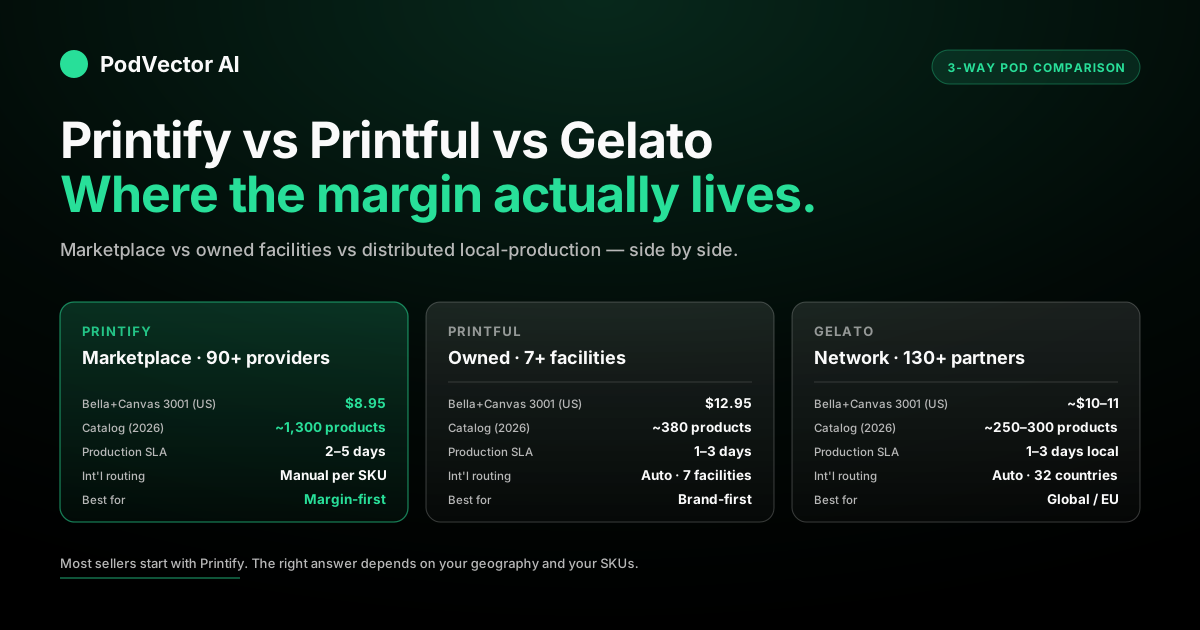
Quick Answer: Printify is best for US-heavy stores that want the lowest base costs and the widest catalog. Printful is best for brand-first stores that need consistent quality and packaging on every order. Gelato is best when 20%+ of your orders ship internationally — its 140+ local print partners cut shipping cost, delivery time, and customs risk.
One 2026 update changes the calculus: Printify and Printful announced a merger in November 2024 and still operate as separate platforms, but Printful has cut base prices since — the old $5–6 tee-price gap is now $2–3.
Below is the full comparison — pricing, catalog, quality, fulfillment, integrations, branding — plus the per-SKU margin question no platform-level chart can answer for you.
TL;DR: 30-second verdict
Pick Printify if base cost is the dominant lever, your catalog needs to span 30+ product types, and you're shipping mostly to the US.
Pick Printful if your brand depends on consistent quality, your customers expect Printful-grade packaging, and you can absorb a higher base cost.
Pick Gelato if a meaningful share of your orders ship outside the US — especially to the EU, UK, or Australia — and your top sellers are wall art, posters, or apparel where local production cuts shipping by 40%+.
Most serious sellers end up running two of the three in parallel. The question isn't which one is "best" in the abstract — it's which combination unlocks the most profit on your catalog.
One caveat before the details: Printify and Printful are now one company on paper. They announced a merger in November 2024 and still run as separate platforms, but pricing on both has shifted since — details in the merger section below.
Side-by-side snapshot table
The 30-second version. Each axis is unpacked below.
| Axis | Printify | Printful | Gelato |
|---|---|---|---|
| Production model | Marketplace (~90 providers) | Owned + partner facilities | Distributed network (140+ partners, 32 countries) |
| Bella+Canvas 3001 tee, US base | ~$9.50 (budget provider) / ~$7.60 (Premium) | ~$11.50 (no sub, post-merger cuts) | ~$10–11 (region-dependent) |
| Subscription | Premium $39/mo or $299/yr (up Feb 2026), up to 20% off | Growth $24.99/mo, free over $12K/yr revenue | Gelato+ $29.99/mo ($19.99 annual); Gold $119/mo |
| Catalog (2026) | ~1,300 products | ~400 products | ~250–300 products, deep wall art |
| Median production time | 2–5 business days | 1–3 business days | 1–3 business days locally |
| International routing | Manual — list per provider | Auto across owned + partner facilities | Auto across 140+ partners; ~90% produced locally |
| Quality consistency | Variable (provider-dependent) | High and uniform | Medium-high (auto-vetted) |
| Branding inserts | Provider-specific, partial | Native across all orders | Partial — packing slips wide |
| Best for | US-heavy, broad catalog, margin-first | Brand-first, paid-social, consistent UX | Global/EU stores, wall art, faster int'l |
Three different production models
Almost every "Printify vs Printful vs Gelato" comparison glosses over the single fact that explains the rest: these three companies don't run the same kind of business.
Printify is a marketplace
When a customer orders through Printify, the order routes to whichever third-party provider you picked when you listed the product. SwiftPOD, Monster Digital, Drive Fulfillment, Dimona, and roughly 90 others compete inside the catalog on base price, location, and product range.
The good news: providers compete, so base costs stay low and the catalog is enormous. The bad news: Printify doesn't run the print shop. Quality control is whatever each provider chooses to enforce. Two SKUs from two providers can ship in the same order and feel like they came from two different companies — because they did.
Printful runs its own facilities
Printful operates owned print and embroidery centers in the US, Mexico, and Europe (Riga and Barcelona), plus vetted partner facilities in markets like Japan, Australia, Canada, and Brazil. Nearly every order touches a facility running Printful's quality spec, with a reshipment rate under 0.25%.
One quality standard, applied uniformly. Branding inserts work the same way on every order. Customer support owns the entire chain. The trade-off is straightforward — fewer products, higher base cost.
Gelato runs a distributed local-production network
Gelato's model is the third option: 140+ partner facilities in 32 countries, but with automatic routing. When a UK customer orders, Gelato sends the job to a UK printer. When an Australian customer orders the same SKU, the order routes to an Australian facility automatically.
The seller doesn't pick a provider per listing — Gelato matches each order to the nearest qualified facility on the fly. International shipping shrinks dramatically because most orders never cross a border.
Each model is the right answer to a different question. Marketplaces maximize catalog and base-cost flexibility. Owned facilities maximize consistency. Distributed networks minimize international shipping and customs friction.
The Printify–Printful merger: what it changes
In November 2024, Printify and Printful announced they were merging. As of mid-2026 they still operate as separate platforms — separate accounts, separate catalogs, separate apps — so this comparison remains a real three-way choice.
But the merger has already moved prices. Printful cut base costs across much of its catalog, shrinking the classic Printify-vs-Printful tee gap from $5–6 per unit to roughly $2–3. Printify, meanwhile, raised its Premium subscription in February 2026.
Two practical takeaways. First, if you dismissed Printful years ago on price, re-run the math — the gap that justified that call has narrowed. Second, Gelato is now the only major independent platform of the three, which matters if you want supplier leverage or a hedge against post-merger consolidation.
Nobody outside the company knows whether the two platforms eventually combine into one. Until they do, treat them as separate suppliers with increasingly similar pricing — and judge each on today's numbers, not 2024's.
Pricing and subscription breakdown
Pricing is what most comparisons get wrong by reading too much into it. We'll cover it carefully here, then explain why base cost is rarely what determines per-SKU profit.
Base costs, head-to-head
On the benchmark Bella+Canvas 3001 tee shipping inside the US, after Printful's post-merger price cuts:
- Printify, budget provider: ~$9.50
- Printify Premium (up to 20% off): ~$7.60
- Printful (no subscription): ~$11.50
- Printful Growth: ~$10.50
- Gelato Free: ~$10–11 (US region)
- Gelato+ / Gold: ~$8.50–9.50 (US region, top-tier discount)
Printify Premium still wins most US apparel SKUs, with Gelato's top tier close behind — but the old $5–6 Printful gap is now $2–3. For the line-by-line math, see our POD t-shirt base cost breakdown across Printful and Printify, the Printful tee base price breakdown, and the Printful Bella+Canvas 3001 cost breakdown.
Subscription math
The three paid plans no longer cost the same, so the break-even math changed in 2026.
- Printify Premium now runs $39/mo month-to-month or $299/yr (~$25/mo) after the February 2026 increase. At 20% off a ~$9.50 tee, monthly billing breaks even around 20 tee-equivalents per month; annual billing around 13.
- Printful Growth is $24.99/mo — and free once your store clears $12K in sales over 12 months, which makes it a default "yes" for established stores.
- Gelato+ is $29.99/mo (or $19.99/mo billed annually); Gold at $119/mo only makes sense at serious monthly volume.
Below those volumes, every paid plan costs more than it saves. Above those volumes, the discount compounds — and the paid tier becomes a no-brainer.
The all-in cost most comparisons skip
Sticker price is one line in your unit P&L. The full picture includes shipping (paid by you or amortized into AOV), platform fees, refund allowance for defects, and ad spend amortized across each order.
A $2 base-cost win disappears fast if the provider's defect rate is 3 points higher, or if shipping to your top customer region costs $3 more. Gelato's distributed network often wins the all-in math even when it loses on base price — because per-region shipping savings stack up across thousands of orders.
For the deep cost-side analysis across all three platforms, the full Printful vs Printify vs Gelato cost comparison walks through the math by category.
Product catalog
This is where Printify's marketplace model shows its biggest advantage.
Printify's catalog clears 1,300 products in 2026 — apparel, accessories, drinkware, home decor, wall art, phone cases, jewelry, pet supplies, the long tail. If you can imagine a print-on-demand product, a Printify provider almost certainly carries it.
Printful sits at roughly 400 products. The trade-off is that every Printful product was qualified by Printful, sourced through Printful-vetted suppliers, and printed in Printful-run facilities. Smaller list, deeper consistency.
Gelato's catalog hovers around 250–300 products, with a clear emphasis on wall art, posters, photo books, calendars, and apparel basics. For sellers building catalogs around art and stationery, Gelato's depth on those specific categories is hard to beat.
For sellers running multi-category stores or A/B-testing new product types weekly, Printify's catalog breadth is a structural advantage. For sellers running a tight branded apparel line, Printful's narrower catalog is enough — and the consistency premium pays for itself.
Print quality and consistency
Quality on any single product is roughly comparable across all three at the high end. The real difference is variance.
Printful's variance is the lowest because every order ships from a Printful facility. The print, the garment, the packaging — all consistent. A repeat customer's second order looks and feels exactly like their first.
Printify's variance is the highest because the marketplace lets sellers pick from many providers per SKU. A skilled Printify seller curates which provider runs which SKU and locks in the consistency they want. A casual Printify seller gets the catalog default and ends up shipping inconsistent product to the same buyer.
Gelato sits in the middle. The partner network is auto-vetted by Gelato, so quality floors are higher than a wide-open marketplace, but a UK-printed order and an Australian-printed order can have small detectable differences in print depth, garment color, or finishing.
The honest read: if your brand premium depends on perfect repeatability, Printful is the safest pick. If you can absorb some variance for catalog breadth and lower base cost, Printify works. If your customers are geographically spread and shipping speed matters more than print uniformity, Gelato is the right trade-off.
Shipping speed and fulfillment
This is the axis Gelato was built to win.
Production time
All three quote 1–5 business days for production before the order ships:
- Printful: 1–3 business days, consistent across owned facilities
- Printify: 2–5 business days, varies meaningfully by provider
- Gelato: 1–3 business days locally, longer if a regional facility is queued
International shipping
This is where Gelato pulls ahead and the gap is large.
Printify orders ship from wherever the provider lives. A US Printify provider shipping to an Australian customer looks like every other international package — slow, expensive, customs risk. Sellers who care about international delivery have to manually list duplicate SKUs through multiple regional Printify providers, which is fragile and high-maintenance.
Printful auto-routes across its owned facilities. A UK customer ordering a Printful product gets routed to Riga or Barcelona, not the US. The system works, but the catalog of products available in the EU is narrower than what's available in the US.
Gelato's entire architecture exists to solve this problem. The seller lists one SKU; Gelato matches each order to the closest qualified printer. UK customers get UK production. Australian customers get Australian production. Gelato reports that ~90% of orders are produced locally and ~90% deliver within 5 days — because most orders never cross a border.
For US-only stores, this advantage is invisible. For any store with even 20% international order share, Gelato's routing saves real money and real days.
Customs, VAT, and the 2026 EU duty changes
Cross-border orders don't just cost shipping — they can trigger import duties, VAT collection at the border, and customs delays your customer blames you for.
This got more expensive in 2026. On July 1, 2026, the EU removed its €150 duty-free threshold for imported parcels, replacing it with a flat duty on low-value imports. Every US-printed order entering the EU now carries an extra cost that locally produced orders skip entirely.
That shifts the math further toward local production. A Gelato order printed inside the EU — or a Printful order routed to Riga or Barcelona — never touches import duty. A Printify order from a US provider to a German customer now always does.
Integrations and storefronts
All three integrate with the major storefronts. The differences are in depth, not breadth.
- Shopify: Native apps for all three. Printful and Printify offer the deepest Shopify integration — automatic order sync, two-way inventory updates, product import. Gelato's Shopify app is solid but slightly thinner on bulk operations.
- Etsy: All three integrate. Printify is the dominant choice on Etsy by user count — partly because Etsy sellers gravitate to its catalog breadth and pricing flexibility.
- WooCommerce, Wix, Squarespace, BigCommerce: All three support these. Configuration depth varies by platform.
- Amazon, eBay, TikTok Shop: Printful has the broadest marketplace integration set; Printify is catching up; Gelato is more focused on direct-to-consumer storefronts.
- API access: All three publish public APIs. Printful's API is the most mature (and free to use — see the Printful API pricing breakdown); Printify's API has expanded fast since 2024; Gelato's API is well-documented and improving.
- Design and mockup tools: All three ship free built-in design tools. Printify and Printful both added AI image generation and expanded mockup libraries; Gelato's editor is strongest for wall art and photo products.
For most sellers, integration depth is not a deciding factor — all three connect to the major storefronts. The decision should ride on production model fit, not on whether the Shopify app exists.
Branding and customer experience
This is where Printful's owned-facility model translates into a real competitive moat.
Printful supports custom packing slips, branded labels, neck label printing, packaging inserts, and pack-in marketing collateral natively across every order. Because Printful runs the facility, branding is one centralized configuration that flows through every order automatically.
Printify's branding support is provider-specific. Some Printify providers support custom packing slips and inserts; many do not. Sellers running Printify with branding ambitions have to filter providers by which branding features each one supports — and they often end up locked into one or two providers as a result.
Gelato supports packing slips and limited inserts across most of its partner network, but the depth varies by region. UK and EU partners tend to have richer branding support than smaller regional facilities.
For sellers building a branded apparel business where the unboxing matters, Printful is the strongest choice. For sellers competing on price or selling through marketplaces where branding is less visible to the buyer, the trade-off is acceptable.
Decision matrix: pick X if Y
The clean framing for the decision:
Pick Printify if
- Base cost is your dominant lever and you're optimizing margin per SKU
- Your catalog spans more than 20 product types or you A/B-test new products often
- You're selling on Etsy, where Printify's catalog and pricing are dominant
- Most of your customers are in the US and international shipping is a small share of orders
- You're willing to invest the time to curate which providers handle which SKUs
Pick Printful if
- Your brand depends on perfect repeatability across orders
- You run paid social where unboxing and customer experience drive repeat rate
- You need branding inserts and packaging customization on every order, not most orders
- You can absorb a higher base cost in exchange for fewer customer-experience surprises
- Your catalog is narrower (10–30 SKUs) and brand consistency matters more than catalog breadth
Pick Gelato if
- A meaningful share of your orders (20%+) ship outside the US
- Your top categories are wall art, posters, photo books, or printed paper goods
- You sell in the EU, UK, or APAC regions where local production matters
- You want a single SKU that auto-routes globally instead of duplicating listings per region
- Customs friction has burned past international orders
Pick a combination if
- You're at scale (~$10K+/mo revenue) and willing to manage multiple suppliers
- Your catalog is wide enough that no single provider's catalog covers everything
- You have geographic concentration in two regions (e.g., US + EU) and want best-in-class for each
The most common combo at scale: Printify for catalog breadth on US orders, Gelato for international fulfillment, and occasionally Printful for the small core of brand-critical SKUs. For a focused two-way Printful vs Printify comparison, see our 2025 Printful vs Printify review and the aggregated Printful vs Printify reviews. The full hub of Printful comparison articles covers more head-to-head matchups, and the Printful topic hub indexes every Printful-related guide on this site.
The per-store profitability question
Here's the hard truth every platform comparison runs into: the right answer depends on your catalog, your buyer geography, and your ad mix. A one-size benchmark can't replace your numbers.
The questions that actually drive the supplier decision look like this:
- "For my top 10 SKUs by revenue, what would the same product cost — base + shipping + refund reserve — on each of the three suppliers?"
- "What's my actual international order share by country, and what would Gelato save me on those orders specifically?"
- "Which of my Printify providers has the highest defect rate per 1,000 orders, and what would switching that one SKU to Printful do to repeat-purchase rate?"
- "If I moved my top 5 wall-art SKUs from Printify to Gelato, what's the net margin change after factoring in shipping savings?"
None of these are answerable from a generic comparison chart. They require your Shopify orders, your Printify cost data, your ad spend by SKU, and your shipping breakdown by country — joined and queried.
This is the gap PodVector AI was built for. Victor connects to your Shopify, your Printify/Printful supplier accounts, and your Meta/Google ad accounts, runs the cost-vs-revenue math by SKU automatically, and proposes specific actions: "Move Printify SKU X to Printful — projected $1,840/mo margin gain across last 90 days of order history." On approval, Victor executes the relevant Shopify changes — price updates, collection re-organization, and discount creation — through the action ledger so every change is auditable.
Most POD sellers comparing these three suppliers don't need another opinion piece. They need their own data, joined and analyzed. Try Victor free and ask "which supplier is most profitable for my top SKUs?" — and get an answer grounded in your actual orders.
FAQs
Is Printify cheaper than Printful and Gelato?
For most US-shipping apparel SKUs, yes — Printify Premium typically wins on base cost by $1–3 per unit, though Printful's post-merger price cuts narrowed the gap. Cheapest base cost rarely equals highest profit, because shipping and defect rates vary by provider. Run the math on your specific top SKUs before assuming Printify is the right pick.
Are Printify and Printful the same company now?
They announced a merger in November 2024, but as of mid-2026 they still operate as separate platforms with separate accounts, catalogs, and pricing. The visible effect so far is pricing: Printful cut base costs, and Printify raised its Premium subscription in February 2026. Compare them as separate suppliers using current numbers.
Which is better for international shipping — Printful or Gelato?
Gelato by a clear margin. Gelato's 140+ partner facilities across 32 countries auto-route each order to the nearest qualified printer — ~90% of orders are produced locally. Printful auto-routes across its owned and partner facilities, which works for major markets but doesn't match Gelato's coverage in smaller regions.
Can I use Printify, Printful, and Gelato together?
Yes — and many sellers at scale do. The standard pattern is Printify for catalog breadth on US orders, Gelato for international fulfillment, and Printful for brand-critical SKUs where consistency matters most. The cost is operational complexity: more accounts, more reconciliation, more provider variance to track.
Which is best for Etsy?
Printify dominates Etsy by user count, partly because Etsy sellers value catalog breadth and pricing flexibility above brand uniformity. Printful and Gelato both work on Etsy too, but Printify's catalog and provider-pricing competition fit the Etsy seller profile most naturally.
Which is best for Shopify?
All three integrate natively with Shopify. The decision rides on the production model that fits your business, not on the Shopify app. Printful's Shopify integration is the most mature; Printify's has expanded fast; Gelato's is solid for direct-to-consumer fulfillment.
Does Gelato work for the US market or only EU?
Gelato has US production partners and works fine for US-only stores. The advantage of Gelato collapses to "another reasonable POD option" if your customers are 100% US — the value comes from international routing. If your store is US-only, Printify or Printful are usually better fits than Gelato.
What about quality differences across the three?
On any single product, quality is roughly comparable at the high end. The difference is variance. Printful is the most consistent because every order ships from owned facilities. Gelato is auto-vetted but partner-dependent. Printify is the most variable because providers compete inside the catalog without a uniform quality floor — skilled curation by the seller is required to lock in consistent product.
How do I know which supplier is most profitable for my catalog?
The honest answer: by joining your actual order data with each supplier's cost structure, then running the math by SKU. A platform comparison can't tell you whether Printify or Printful wins on your specific catalog — only your numbers can. Victor at PodVector AI connects your Shopify, Printify, and Printful accounts, runs that math for you, and then proposes concrete actions — executing the Shopify changes once you approve them.
Let Victor run the supplier math — then act on it
Picking between Printify, Printful, and Gelato is a judgment call. Picking the most profitable supplier for your specific catalog is a math problem — and then an execution problem.
Victor connects to your Shopify, your Printify/Printful accounts, and your Meta/Google ad accounts, runs the margin math per SKU on your real order history, and proposes specific moves. When you approve, he executes them on Shopify — price updates, discount creation, collection moves — all tracked in an audit ledger.
— connect your store and ask "which POD supplier is most profitable for my top SKUs?"
Try Victor freeExternal reference: printondemandbusiness.com's 3-way comparison (2026) for an additional neutral take.