
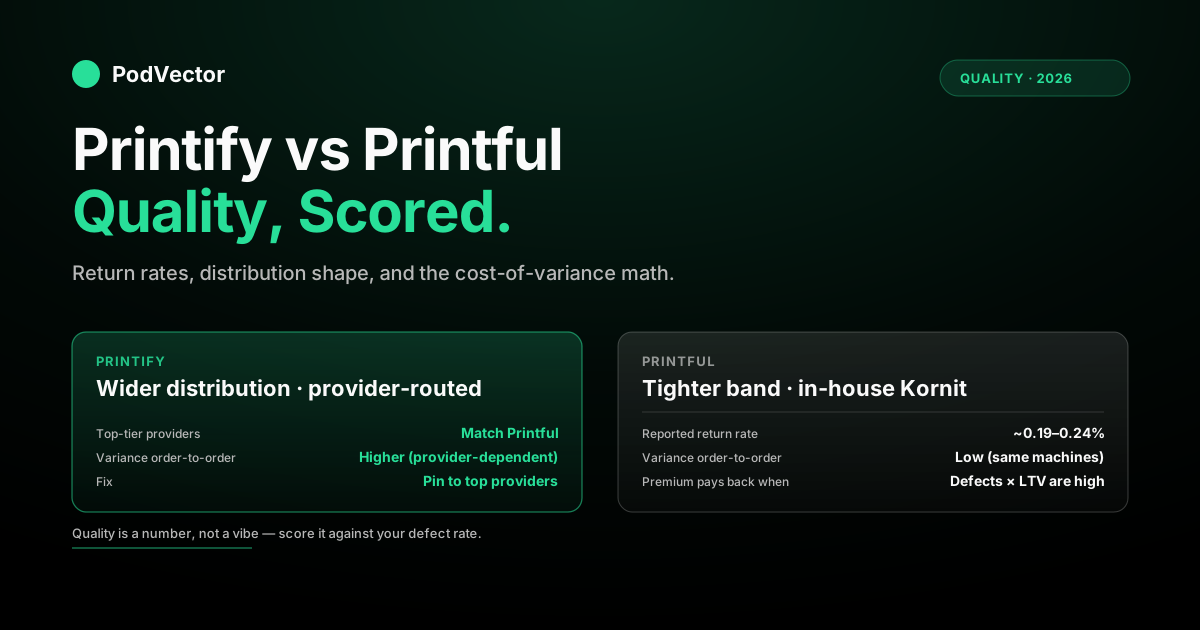
Quick Answer: Printful is more consistent — its in-house facilities report a return rate of roughly 0.19–0.24% on quality issues, and most customer reviews describe a tight quality band. Printify's quality is provider-dependent, ranging from "matches Printful" with top-tier providers (Monster Digital, SwiftPOD, Dimona Tee) to noticeably worse with lower-rated providers.
The honest answer is per-SKU. On average, Printful's quality is higher, but the gap has narrowed in 2026 and Printify's best providers hit the same ceiling. Whether Printful's quality premium is worth the $4-per-tee base-cost difference depends on your defect rate, replacement cost, and how brand-sensitive your customers are.
Below: the headline numbers, what the data actually says, the cost-of-variance math nobody publishes, and the sample-testing protocol that turns the question into a number for your store.
The headline numbers
Most "Printify vs Printful quality" posts dance around hard numbers. Here are the ones that matter.
| Quality metric | Printful | Printify |
|---|---|---|
| Reported return rate (quality issues) | ~0.19–0.24% of orders | Not officially published; community reports vary by provider |
| Production model | In-house, owned facilities | Marketplace of 80+ third-party providers |
| Print equipment standard | Kornit Atlas / Avalanche across regions | Provider-dependent (varies) |
| Quality variance across orders | Tight — same machines, same staff | Wide — different providers, different presses |
| Sample order discount | 20% off, up to 3 products/month (account perk) | Standard pricing |
| Top-tier ceiling | High and predictable | Matches Printful with top providers; lower with weaker ones |
| Reprint/refund policy | Centralized — Printful eats the cost | Provider-routed — varies, occasional friction |
Two takeaways. Printful's average quality is higher and tighter. Printify's peak quality matches Printful, but the average drags lower because of provider variance.
The interesting question isn't "which is higher quality" — that's settled, on average. It's "is the difference worth the price gap, given your margin and customer mix?"
One thing that hasn't changed the answer: the two companies merged on November 5, 2024, but as of mid-2026 they still run as separate platforms with separate production networks. Printful's in-house facilities and Printify's third-party marketplace operate exactly as before, so the quality distinction below is fully intact — don't assume the merger has homogenized output yet.
Print quality: what's actually different
Both platforms primarily use direct-to-garment (DTG) printing on apparel. DTG sprays water-based ink directly onto the fabric, which gets absorbed and cured.
Printful runs Kornit Atlas and Avalanche printers across its facilities. Same model, same calibration, same color profiles. A red ink on a navy tee out of the Charlotte facility looks the same as a red ink on a navy tee out of the Latvia facility. Predictable.
Printify routes orders to whichever provider is the chosen supplier for that product. Top-tier providers (Monster Digital, SwiftPOD, Dimona Tee) run the same Kornit-class equipment Printful uses. Mid-tier providers run older Brother or Epson DTG presses. Lower-tier providers may use entry-level DTG with less calibrated color management.
The visible difference on a finished tee usually shows up in three places.
Color saturation. A Kornit Atlas can lay down dense, rich colors that pop on dark garments. An entry-level DTG can wash colors out by 5–15%, especially on heathered or dark fabrics.
Fine-line crispness. Thin lines, small text, and detailed gradients reveal printer resolution differences. Printful and top Printify providers handle 12pt text cleanly. Lower-tier providers can soften letters or lose fine detail.
White underbase coverage. Dark garments need a white underbase printed first so colors don't sink in. The underbase has to be calibrated tightly — too thin and colors look muddy, too thick and the print feels stiff. This is the dimension where Printful's standardized process wins most.
For a wider view of the platforms beyond just print quality, our full Printify vs Printful breakdown covers pricing, catalog, and integrations side by side.
Blank quality: same wholesalers, different selection
Here's a fact most quality reviews miss. Printful and Printify often source the exact same blanks from the same wholesalers.
A Bella+Canvas 3001 unisex tee is a Bella+Canvas 3001 unisex tee — whether it goes through Printful or a Printify provider. The garment quality, fit, weight, and finish come from the manufacturer, not the printer.
Where the platforms differ is in which blanks they make available.
Printful curates a tighter blank catalog. Around 340 products in 2026, focused on premium and proven SKUs — Bella+Canvas, Gildan Softstyle, Stanley & Stella, Champion, Independent Trading.
Printify offers a deeper blank catalog. Over 900 products, including the same premium blanks plus a much wider selection of lower-cost options (Gildan basic tees, generic phone cases, lower-GSM hoodies).
The practical implication: if you're using the same Bella+Canvas 3001 on both platforms, the blank itself is identical. If you're comparing a $8.95 Printify Gildan 5000 against a $12.95 Printful Bella+Canvas 3001, you're comparing different garments, not different platforms.
Always match blanks SKU-for-SKU when you compare quality. Otherwise you're measuring blank choice, not platform.
Why Printify quality has a wider distribution
Printful runs one quality distribution. Printify runs many — one per provider, sometimes per location.
This is the structural reason Printful gets called "more consistent" while Printify gets called "hit or miss." Both descriptions are accurate; they describe different shapes of the same quality curve.
Printful's curve is narrow. Most orders cluster around a single mean, with a small left tail of misprints and a small right tail of orders that came out unusually well. The tail probability is low — that's the 0.19–0.24% return rate.
Printify's curve is wider. The mean depends on which provider routed your order. Top-tier providers have a narrow distribution that overlaps with Printful's. Lower-tier providers have a curve shifted lower and wider — same mean print quality on average, but more variance order-to-order.
If you pin every product to a specific top-tier provider in Printify's settings, you can flatten most of the variance. The default behavior — letting Printify route to the best-available provider in the customer's region — is what introduces the variance most "Printify quality is inconsistent" reviews complain about.
The fix is real: pick a primary provider per product, treat backup providers as fallbacks, and re-test quality every 6 months. Most sellers don't do this, which is why the "inconsistent" reputation persists.
Printify makes this easier than it used to. Each provider now carries a Print Provider Performance Score — an aggregate of on-time production, reprint rate, and order accuracy — visible before you pin a supplier. Use it as a first filter, but treat it as a starting point, not the verdict: the score is platform-wide, not specific to your blank and design, which is why a real sample order still beats any number Printify shows you.
Embroidery and specialty prints
Embroidery is where Printful's vertical integration shows up clearly. Printful runs in-house embroidery on industrial Tajima machines, with a calibrated stitch density and thread library that produces tight, dense logos.
Printify offers embroidery through specific providers, and quality varies meaningfully. Top providers (MyLocker, Drive Fulfillment) produce embroidery quality competitive with Printful. Lower-tier providers occasionally show looser stitches, color drift, or registration issues on small logos.
For all-over print (AOP), the situation flips. Printful only offers AOP on a limited subset of products. Printify supports AOP across dozens of products through specialized providers, and the quality on top AOP providers (Subliminator, MWW On Demand) is excellent.
UV print is another dimension worth checking before you commit a hard-goods line. Printful runs standardized UV gear (Mimaki and Inkcups Helix) across its hard-goods catalog, so a UV-printed tumbler or phone case comes out the same order to order. Printify routes UV products to whichever provider stocks them, so calibration and durability vary by supplier — sample before you scale a UV hero product.
Sublimation, UV print, and embroidery patches mostly favor Printful for consistency and Printify for selection. If your hero product is an embroidered hat, Printful's standardized output is a safer default. If it's an AOP swimsuit, Printify is the only option that ships at scale.
Packaging, labels, and unboxing
Packaging quality is the part of "POD quality" that the customer sees first — before they even unfold the garment.
Printful wins on this dimension by a clear margin. Custom packing slips with your logo, branded tear-out neck labels (DTG-printed and embroidered options), pack-in stickers, premium polybag inserts. The package looks like it came from your brand, not a fulfillment center.
Printify's packaging is provider-dependent. Some providers offer branded inserts, some don't. Custom neck labels are inconsistent across providers — what works on a Monster Digital tee might not work on a SwiftPOD tee.
If you're running a direct-to-consumer brand where unboxing matters, Printful's packaging consistency alone can justify the higher base cost. If your customer judges quality by the product itself and ignores the bag, the gap doesn't move your refund rate.
The deeper question — whether Printful's premium membership is worth the cost — is where the quality conversation runs into the pricing conversation. Our Printful Premium membership benefits breakdown and Printful Premium worth-it analysis work through whether the unlock pays back at your volume.
The cost of quality variance — the math
This is the section nobody else publishes, and it's the one that should drive your decision.
Quality differences only matter as money. A higher defect rate costs you in replacement orders, refunded shipping, processing fees, ad spend that didn't convert, and the customer-acquisition cost of every angry reorder you have to win back.
Here's the simple model. For a $25 tee with a $10 base cost and $7 fulfillment shipping:
- Defect rate × replacement cost = quality variance cost per order
- Replacement cost ≈ $10 base + $7 shipping + $1.50 processing fee + $2 ad spend already attributed = ~$20.50 per replacement
If Printful's defect rate is 0.20% and Printify's effective defect rate (averaged across providers, assuming you don't pin to top-tier) is 1.0%, the difference is 0.80 percentage points. On 1,000 orders that's 8 extra defects, costing 8 × $20.50 = $164 of quality variance per 1,000 orders.
Printify's base-cost savings on the same 1,000 orders are roughly $4 × 1,000 = $4,000 at the Bella+Canvas 3001 list-price gap.
$4,000 minus $164 leaves $3,836 of net advantage to Printify even at a five-times-higher defect rate. The margin math doesn't favor Printful unless your defect rate gap is much wider, your replacement cost is much higher (premium niches with custom packaging), or your customer LTV is materially affected by every defect.
That's the math. The quality story isn't binary; it's a number that has to clear a bar.
If you're optimizing the cost side of this equation, the same logic shows up in our Printify vs Printful vs Gelato breakdown and the deeper 3-way comparison with full pricing.
When Printify's quality is good enough
Printify's quality is good enough when:
- You pin every hero product to a top-tier provider (Monster Digital, SwiftPOD, Dimona Tee, MyLocker)
- Your customer judges quality by the garment itself, not the packaging
- Your defect rate is below 1.5% in production data — well within margin tolerance
- Your niche is price-sensitive and a $4 lower base cost meaningfully expands your ad-buying ceiling
- You're testing 20+ SKUs and need depth Printful can't match
- You sell globally and want orders routed to a regional provider, not cross-shipped from one country
Most price-led POD operations fit this profile. The "Printify is lower quality" reputation is largely the result of sellers not pinning providers, then complaining about the variance the routing introduces. Pin your providers and most of the gap closes.
When Printful's quality premium pays for itself
Printful's quality premium pays for itself when:
- Your unboxing is part of the product — gift items, premium niches, repeat customers, subscription boxes
- Your defect rate on Printify is genuinely high (over 2%) and ad efficiency is suffering from refund-driven attribution noise
- Your customer LTV is high enough that one bad print costs you a $200+ future revenue stream
- You can't tolerate the operational overhead of testing providers, pinning suppliers, and re-testing every 6 months
- Your catalog is narrow (5–15 hero SKUs) — you can absorb the higher base cost on a focused list
- You're selling embroidered logos at scale and want one source of consistent stitch density
The takeaway isn't that Printful is "better" or "worse" than Printify on quality. The takeaway is that Printful's premium is a paid insurance policy on consistency. Whether that policy pays out depends on what variance would actually cost you.
The 3-step sample testing protocol
Stop arguing about quality from blog posts. Run this protocol once and the answer becomes a number, not an opinion.
Step 1: Order matched samples from both platforms.
Same blank (e.g. Bella+Canvas 3001 in heather grey, size M). Same design — pick something with thin lines, gradients, and dense color. Order 3 from Printful and 3 from each Printify provider you'd realistically use. Use Printful's 20% sample discount.
Cost: roughly $50–$80 for a thorough test. Less than one ad-spend test for most stores.
Step 2: Score each sample on five dimensions.
Use a 1–5 scale per dimension and write the scores down before you compare side-by-side.
- Color saturation and accuracy vs. your design file
- Fine-line and small-text crispness
- White underbase quality (if printing on dark)
- Hand feel — does the print feel stiff, soft, or natural?
- Wash test (after 3 wash cycles): fade, cracking, peeling
Total each platform out of 25. The wash test is the one most sellers skip, and it's the dimension your customer feels most by week three.
Step 3: Tie the score to a real margin number.
Multiply the difference in expected defect rate by the replacement cost from your business. If Printful scores 4 points higher and that translates to a 0.8 percentage-point lower defect rate, multiply by your replacement cost and per-order revenue to get the dollar swing.
Now you have a number. Compare it to the base-cost difference per order. If the quality dollar swing exceeds the base-cost gap, Printful wins on your store. If not, Printify wins.
The per-SKU truth most quality posts skip
Every "Printify vs Printful quality" comparison ends with a verdict like "Printful is more consistent, but it's pricier." That's the right starting point. It's also where most analyses stop.
Here's what plays out once you're shipping volume.
Front-print tees: Printify usually wins on margin if you pin to a top-tier provider. The quality gap on a single front-print Bella+Canvas 3001 is small enough that the $4 base-cost difference dominates.
Heavy hoodies and zip-ups: Printful often wins. Printful's premium hoodie blanks and standardized print process produce a more consistent feel, and the customer's quality perception on heavier garments is more sensitive to print-hand and underbase weight.
Embroidered hats and jackets: Printful usually wins. The standardized stitch density on Printful's in-house Tajima machines holds up across orders better than Printify's provider-routed embroidery.
All-over-print products: Printify wins by default. Printful's AOP catalog is too narrow; Printify has more SKUs and the top AOP providers produce excellent quality.
Mug, ceramic, and home goods: Mixed. Provider quality varies more on these categories. Some Printify providers exceed Printful, some fall short. You have to test.
This is the answer most comparison guides won't give, because they don't have your real margin data. The truthful version is: some of your products will be more profitable on Printify with acceptable quality, some on Printful with premium quality, and the only way to know is to look at the numbers per-SKU.
That's a hard problem to solve manually. You'd need base costs, real fulfillment shipping, defect rate by supplier, replacement cost, ad spend, and refund-attribution drag, refreshed as supplier prices and provider routing change.
This is exactly the gap Victor closes for PodVector AI users. Victor is an AI employee connected to your store, ad accounts, and POD suppliers through a unified data warehouse.
You can ask "which supplier had the lowest defect rate on my hoodies in the last 60 days?" or "which platform's tees have a better effective margin after refunds?" in plain English. The answer comes back with real margins, not list prices.
Victor answers the question. Tomorrow's roadmap is acting on it — flagging SKUs that should switch suppliers, simulating the margin lift before you swap, and routing future production to whichever supplier the data favors.
Verdict: which to pick in 2026
If quality is your top priority and you're willing to pay for consistency: Printful. The in-house production model, standardized equipment, and centralized quality control deliver a tighter quality band than Printify's marketplace can match on average.
If margin is your top priority and you're willing to pin providers and run the sample protocol: Printify. The base-cost savings dominate the quality cost of variance for most product categories, and Printify's top-tier providers match Printful's quality ceiling.
If you're running a real store with mixed products: both, mixed by SKU. Printify for margin-led, price-sensitive products. Printful for premium-led, brand-sensitive products. Use per-SKU profit data to decide which goes where.
For a complementary view starting from the Printful side, see our Printful vs Printify breakdown. For the broader Printful category, the Printful comparison hub covers every alternative, and the Printful topic hub is the entry point for everything Printful.
For an outside perspective with a different angle, Merch Titans ran a 3,200-word breakdown of the same matchup with their own quality observations.
FAQs
Is Printful better quality than Printify?
On average, yes. Printful's in-house production produces a tighter quality distribution and a lower published return rate (0.19–0.24%). Printify's quality varies by provider — top-tier providers (Monster Digital, SwiftPOD, Dimona Tee) match Printful, while lower-tier providers fall below. If consistency matters most, Printful wins. If you're willing to pin your products to top providers, Printify can match the same ceiling.
Why is Printify quality inconsistent?
Printify uses a marketplace of 80+ third-party providers running different print equipment, color profiles, and quality standards. By default, Printify routes orders to the best-available provider in the customer's region — which can mean a different supplier ships order #1 versus order #2 of the same product. Pinning each product to a specific top-tier provider eliminates most of the variance.
What is Printful's return rate vs Printify's?
Printful publishes a return rate of approximately 0.19–0.24% for quality-related issues. Printify hasn't officially published an equivalent figure, and community-reported rates vary widely by provider. Top-tier Printify providers report rates competitive with Printful; lower-tier providers can run 2–4 times higher.
Does Printify use the same blanks as Printful?
Often yes. Both platforms source from the same major wholesalers (Bella+Canvas, Gildan, Stanley & Stella, Champion). A Bella+Canvas 3001 tee is the same garment regardless of platform — the difference shows up in the print, packaging, and quality control, not the blank itself. Always match blanks SKU-for-SKU when comparing.
Which platform has better embroidery quality?
Printful, on average. Their in-house industrial Tajima embroidery machines produce a tight, consistent stitch across all orders. Printify's embroidery quality is provider-dependent — top providers (MyLocker, Drive Fulfillment) match Printful, while lower-tier embroidery can show stitch variance, registration drift, or color issues on small logos.
Is Printful's quality worth the higher price?
Depends on your defect rate, replacement cost, and customer LTV. Run the math: defect rate × replacement cost × order volume gives you the dollar swing of higher quality, then compare to the base-cost savings of going with Printify.
For most front-print tee operations, Printify wins the math even at a five-times-higher defect rate. For premium hoodies, embroidered hats, or branded unboxing experiences, Printful's premium can pay for itself.
Can I improve Printify quality without switching to Printful?
Yes — three things. First, pin every hero product to a specific top-tier provider (Monster Digital, SwiftPOD, Dimona Tee, MyLocker). Second, order samples from each provider every 6 months to catch quality drift.
Third, set up a refund-rate alert per provider so you spot a degrading supplier before customer complaints pile up. Most "inconsistent Printify" stories come from sellers skipping these steps.
How do I know which platform is more profitable for my products?
Look at real per-SKU margins, not list prices. Pull base cost, real fulfillment shipping, ad spend, defect-driven replacements, and refunds per SKU per supplier.
PodVector AI's Victor agent does this automatically by reading your live store, ad, and supplier data and answering plain-English questions like "which supplier had the lowest effective margin after refunds for my best-selling tees in the last 60 days?"
Stop guessing on POD quality. Ask Victor.
Printify's quality is a number you can measure. Printful's premium is a number you can compare it to. Both numbers depend on your real defect rate, replacement cost, ad spend, and refunds — not on a blog post's averages.
Victor connects to your store, ad accounts, and POD suppliers, builds a unified data warehouse, and lets you ask the question in plain English: which supplier is most profitable on my Bella+Canvas tees after refunds in the last 60 days?
Try Victor free