
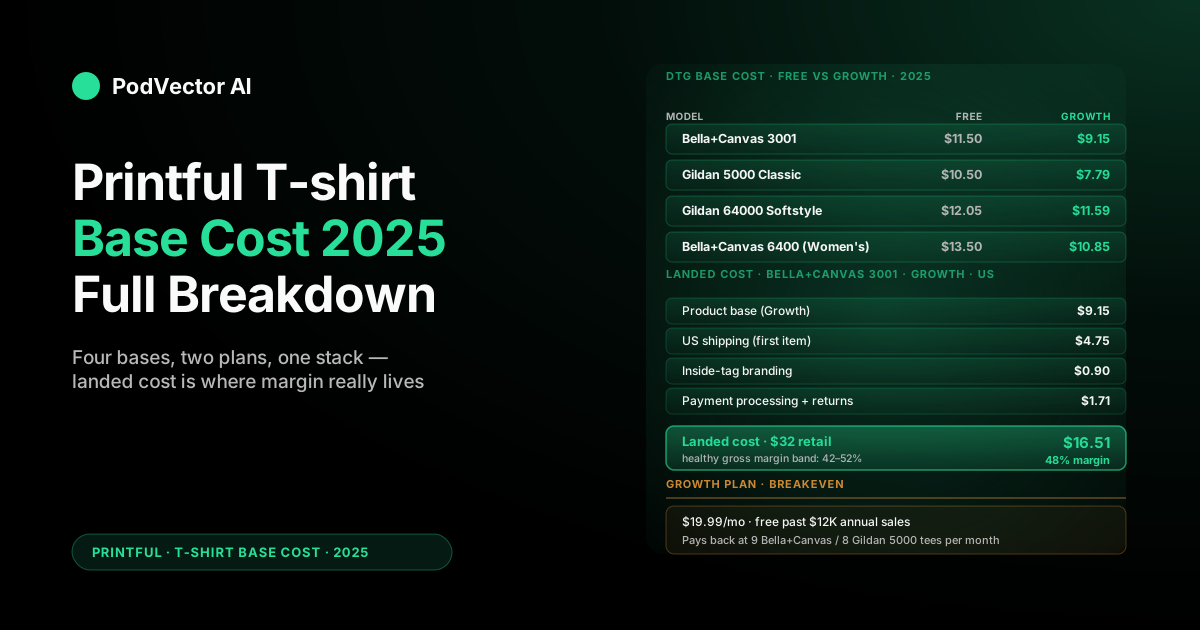
Quick Answer: Printful's most-used t-shirt bases in 2025 are Bella+Canvas 3001 at $11.50 (Free) / $9.15 (Growth), Gildan 5000 at $10.50 / $7.79, and Gildan 64000 at $12.05 / $11.59. The Growth plan is now $19.99/month and free past $12K in annual sales.
Base cost is one line. The number that decides whether a SKU actually makes money is landed cost — base plus DTG print area, shipping, payment processing, returns, and any branding adders.
This guide breaks every line of the t-shirt cost stack, runs landed-cost math on the three most common bases, and shows the per-SKU view that tells you which tees are real margin and which are noise.
What changed in Printful's 2025 t-shirt pricing
Two structural changes hit POD t-shirt margins in 2025, and you need to price both into your store.
The Growth plan got cheaper. Printful dropped the Growth plan from $24.99/month to $19.99/month and pushed DTG-product discounts up to roughly 20% off the Free-plan base. The threshold to get Growth free didn't change — you still get it complimentary after hitting $12,000 in annual sales.
DTG base prices dropped on most apparel. The biggest drop was on Bella+Canvas 3001 (down from $13.50 to $11.50 on Free; $9.15 on Growth). Gildan 5000 fell to $10.50 / $7.79. The catch: shipping rates went up in the February price update, so the headline base savings don't all carry through to landed cost.
For a working POD operator selling 200+ tees a month, the 2025 changes are a net win — but only if your retail prices and ad CPMs already cleared the old margin bar. The new math gets covered in the Growth plan section below.
Base cost by t-shirt model (Free vs Growth)
These are the May 2025 DTG base costs for the four bestselling Printful t-shirt models, US fulfillment, one print area included. Cross-reference against the live Printful catalog before locking your retail prices — the rate sheet ticks every quarter or two.
| T-shirt model | Free plan base | Growth plan base | Growth savings |
|---|---|---|---|
| Bella+Canvas 3001 (Unisex Staple) | $11.50 | $9.15 | $2.35 (20%) |
| Gildan 5000 (Classic Tee) | $10.50 | $7.79 | $2.71 (26%) |
| Gildan 64000 (Softstyle) | $12.05 | $11.59 | $0.46 (4%) |
| Bella+Canvas 3001 (Women's Relaxed Jersey 6400) | $13.50 | $10.85 | $2.65 (20%) |
Two things to notice in that table.
The Growth discount isn't uniform. Bella+Canvas and the Gildan 5000 get the full 20–26% drop. The Gildan 64000 (Softstyle) only gets a token 4% — Printful keeps margin on that one because it's their volume seller for "soft hand feel" buyers.
The Bella+Canvas 3001 is still the default. Lower base than Gildan 64000, comparable feel, broader size run, and the highest-volume base on Printful by a wide margin. Most POD stores running on Printful end up here unless they have a specific reason to switch.
Print area pricing — front, back, sleeve
The base price covers one print area. Every additional print area is a line item, and on bestselling tees those adders are where new sellers miss margin.
| Print area | Free plan adder | Growth plan adder |
|---|---|---|
| Front (included) | $0.00 | $0.00 |
| Back print | +$5.95 | +$4.75 |
| Left sleeve | +$2.49 | +$1.99 |
| Right sleeve | +$2.49 | +$1.99 |
| Inside-neck label print | +$2.49 | +$1.99 |
A "front + back" tee — common for sports merch, niche slogan designs, and band tees — is structurally a different SKU from a single-front tee. On Bella+Canvas 3001 Growth, base $9.15 + back print $4.75 = $13.90 before any other line. That's the number you anchor retail on, not $9.15.
Sleeve prints are the most-undervalued upcharge. Adding a left-sleeve print on a tee that's already getting a front print costs you $1.99 on Growth and lets you list the same design as a "premium" SKU at $5–$8 higher retail. The ROI on the upcharge is usually 3–4×.
Growth plan math: when it pays back
The Growth plan is $19.99/month, or $239.88/year, and it's free past $12K in annual sales. The question every operator runs eventually: at what monthly volume does the $19.99 pay back?
The breakeven on a Bella+Canvas 3001 is straightforward. Growth saves $2.35 per tee versus the Free plan. To clear the $19.99 monthly cost you need 9 tees per month. Anything past 9 tees and you're saving money.
On Gildan 5000 the breakeven is even lower — $2.71 savings per tee means 8 tees per month covers the plan cost. On Gildan 64000 Softstyle, the breakeven jumps to 44 tees per month because the discount is only $0.46.
The practical answer for most POD stores: if you're selling Bella+Canvas or Gildan 5000 in any meaningful volume, Growth pays back almost immediately. The plan is structured to lock you in once you're moving units — by the time you cross $12K annual sales the plan is free anyway.
The shipping line that turns into your real cost
Base cost without shipping is a fantasy number. The shipping line is where the t-shirt cost stack actually lives or dies.
US shipping on a t-shirt in 2026 is $4.75 first item / +$2.20 each additional on Printful, post the February 2026 rate update. International rates run 1.3–2.5× the US base depending on region.
For the full per-region rate sheet, multi-item math, and the February pricing change context, walk through the Printful shipping costs breakdown. The short version: a 1-tee US order ships for $4.75, a 4-tee order ships for $11.35 (cheaper per unit), and a single tee shipped to Australia ships for $7–$9 depending on weight tier.
Two related deep-dives if you're auditing landed cost: how Printful's shipping fees stack against retail margins, and Printful's shipping price tiers across product categories.
The full t-shirt cost stack, line by line
The number that decides whether a SKU makes money isn't the base cost — it's landed cost per unit, which includes every fee that touches the order.
Here's the full stack on a single-front Bella+Canvas 3001 tee, US Shopify store, Growth plan, $32 retail:
- Product base (Growth): $9.15
- US shipping (first item): $4.75
- Inside-tag branding: $0.90
- Shopify payment processing (2.9% + $0.30): $1.23
- Return reserve (1.5% of retail): $0.48
- Landed cost total: $16.51
- Gross margin: $15.49 (48%)
The same tee on the Free plan: product base jumps to $11.50, landed cost climbs to $18.86, gross margin drops to $13.14 (41%). That seven-point margin difference is what the Growth plan buys you on a Bella+Canvas SKU.
Three lines on that stack are where most operators underestimate cost.
Inside-tag branding ($0.90). Custom neck label printing reads as a "nice to have" until you realize most US POD stores include it as a default. Skipping it makes the tee feel like a generic Bella+Canvas with a graphic, not a brand. Most stores add it and absorb the $0.90.
Payment processing. Shopify Payments runs 2.9% + $0.30 on online orders. On a $32 tee that's $1.23 — a real line, not rounding. PayPal and Stripe are similar; some marketplaces (Etsy, Amazon) run higher.
Return reserve. Print-on-demand has near-zero return rates because items are made-to-order, but you'll still see ~1.5% returns on sizing issues, print quality complaints, or shipping damage. Reserving 1.5% of retail per order keeps you whole on the small percentage that come back.
Three landed-cost examples
Three real SKU + region combinations to anchor what landed cost looks like in practice. All Growth plan, all DTG single-front print.
Example 1: Bella+Canvas 3001, US, $32 retail
- Product base: $9.15
- US shipping: $4.75
- Inside-tag branding: $0.90
- Payment processing: $1.23
- Return reserve: $0.48
- Landed cost: $16.51 → Gross margin: 48%
Example 2: Gildan 5000, US, $26 retail (budget tier)
- Product base: $7.79
- US shipping: $4.75
- No inside-tag branding (budget SKU)
- Payment processing: $1.05
- Return reserve: $0.39
- Landed cost: $13.98 → Gross margin: 46%
Example 3: Bella+Canvas 3001 front + back, EU, $38 retail
- Product base: $9.15
- Back print adder: $4.75
- EU shipping (first item): $6.69
- Inside-tag branding: $0.90
- Payment processing (2.9% + $0.30): $1.40
- Return reserve: $0.57
- Landed cost: $23.46 → Gross margin: 38%
Example 3 is the classic margin trap. Front+back is a premium SKU, EU shipping is double US, and the operator stops at "I added $6 for the back print" without re-running the full stack. The 38% gross margin is workable but it's a real step down from US economics.
The print quality on these bases matters as much as the cost — if a SKU drops to 38% gross margin, customer satisfaction has to carry the rest. The Printful print quality review and overall Printful quality breakdown cover what to expect across DTG print runs.
Margin targets — what's actually healthy in 2025
Healthy gross margin on a Printful tee in 2025 is 42–52%. Below 38% and you're not running a real business once you layer in ad spend and operating cost. Above 55% and you're either pricing premium niches (band merch, fitness niche, character licensing) or your ad spend is so low you don't actually have a growth engine.
The math underneath: a typical POD store spends 25–35% of revenue on paid acquisition. At 48% gross margin, after 30% on ads, you're at an 18% contribution margin before operating cost. That's the band where a $50K/month POD store starts being able to pay an owner.
Operators who underprice tees usually have one of two problems. Either they anchored on $9.15 base instead of $16.51 landed, or they copied a competitor's retail price without knowing the competitor's plan tier and shipping setup.
How to set your retail price floor
The simplest pricing formula that holds up across most POD t-shirt SKUs:
Retail floor = Landed cost / (1 - target gross margin %)
Worked example: Bella+Canvas 3001 Growth, US, landed cost $16.51, 48% target margin.
$16.51 / (1 - 0.48) = $16.51 / 0.52 = $31.75
Round up to $32 retail and you've got a tee that hits margin target across the Free-plan version too (where landed cost is ~$18.86, giving 41% gross margin — still survivable while you scale to Growth).
For front+back tees and premium niches, run the same formula on the higher landed cost. The retail floor on Example 3 above: $23.46 / 0.52 = $45.12 retail floor. If you can't price a front+back EU tee at $45+, skip the SKU.
Tracking base cost change per SKU
Printful changes base costs and shipping rates every 2–3 quarters. The 2025 DTG drop is one example; the February 2026 shipping increase is another. If you don't catch the change inside a week, you're either undercharging on a SKU that's now more expensive or eating margin you could have passed through.
The lazy answer is to check Printful's catalog manually once a quarter. The problem is that one new base cost on Bella+Canvas affects 12 of your color/size SKUs, and the change date doesn't line up with your quarterly review.
The structural answer is to track Printful base cost as a time-series feed per SKU, with retail price as the second series and gross margin as a derived field. The moment any SKU's gross margin drops below your floor (say 42%), it surfaces in your alerts and you decide: raise retail, drop the SKU, or run a one-time clearance.
This is the kind of work where an AI agent on top of a live data warehouse earns its keep. Victor — PodVector AI's AI employee for POD stores — ingests Printful order webhooks, attaches itemized cost lines per SKU, and proposes specific actions on margin drift: "Bella+Canvas 3001 front+back EU dropped to 36% gross margin after the February shipping change — propose raising retail from $42 to $45 to restore the 42% floor." On approval, the price change executes on Shopify directly with a full audit trail.
The difference between Victor and a static dashboard is that Victor knows your margin floor, watches every line, and proposes the action — you don't have to remember to run a quarterly review or stare at a chart.
FAQs
What is the cheapest Printful t-shirt base in 2025?
Gildan 5000 on the Growth plan at $7.79 base. It's the budget POD workhorse — lower thread count and slightly boxier fit than Bella+Canvas, but the lowest DTG-eligible cost on the catalog and a healthy 45–48% gross margin at $24–$26 retail.
How much does a front+back print add to the base cost?
Adding a back print adds $4.75 on the Growth plan and $5.95 on the Free plan. That makes a front+back Bella+Canvas 3001 cost $13.90 base on Growth before shipping, branding, or processing — a different SKU economically from a single-front tee, and it needs to be priced as such.
Is the Printful Growth plan worth it for t-shirt sellers?
For most t-shirt sellers, yes — the breakeven is 8–9 tees per month on Bella+Canvas or Gildan 5000. The plan is also free once you hit $12K in annual sales, so the only operators paying the $19.99 long-term are stores doing under $1K/month, where the plan still pays back at 9+ tees.
What's the real landed cost of a Bella+Canvas 3001 tee on Printful?
Roughly $16.51 on the Growth plan in the US, including base ($9.15), first-item shipping ($4.75), inside-tag branding ($0.90), Shopify payment processing ($1.23 on $32 retail), and 1.5% return reserve ($0.48). On the Free plan the same tee lands at ~$18.86.
Did Printful raise or drop t-shirt prices in 2025?
Both — DTG base prices dropped on most apparel (Bella+Canvas 3001 fell from $13.50 to $11.50 on Free), but shipping rates went up in the February 2026 update. Net effect on a typical US-shipped tee: ~$1–$2 saved per unit, less if you ship a lot of multi-item or international orders.
How does Printful t-shirt pricing compare to Printify?
Printify's base costs are 10–25% lower on the same Bella+Canvas / Gildan models, but quality control is split across multiple print providers and you'll see more variance run-to-run. Printful runs centralized fulfillment, so base cost is higher but quality consistency is tighter. Most operators picking between them weight on print quality and reliability, not base cost alone — the official Printful pricing page and a Printify catalog comparison side by side is the right starting point.
Where can I see Printful's official 2025 pricing changes?
Printful publishes a pricing update changelog on its blog, but a cleaner third-party summary lives at SourceLow's Printful 2025 pricing changes guide. Cross-reference against the live Printful catalog before locking retail.
Related reading
For the full Printful cost picture, walk through the Costs & Charges cluster on Printful — shipping rate breakdowns, hidden-fee audits, and the cost-tracking patterns POD operators use to keep margin honest. The Printful topic hub covers reviews, integrations, and product catalog deep-dives for sellers running on the platform.
Stop guessing on Printful margin
Base cost is one line. Real margin lives in the stack — shipping, processing, returns, plan tier, and the pricing change you missed last quarter.
Victor watches every Printful line per SKU in your store, surfaces margin drift the moment it happens, and proposes the specific retail price changes or discount campaigns to restore your floor. On your approval, the actions execute on Shopify directly.
Try Victor free