
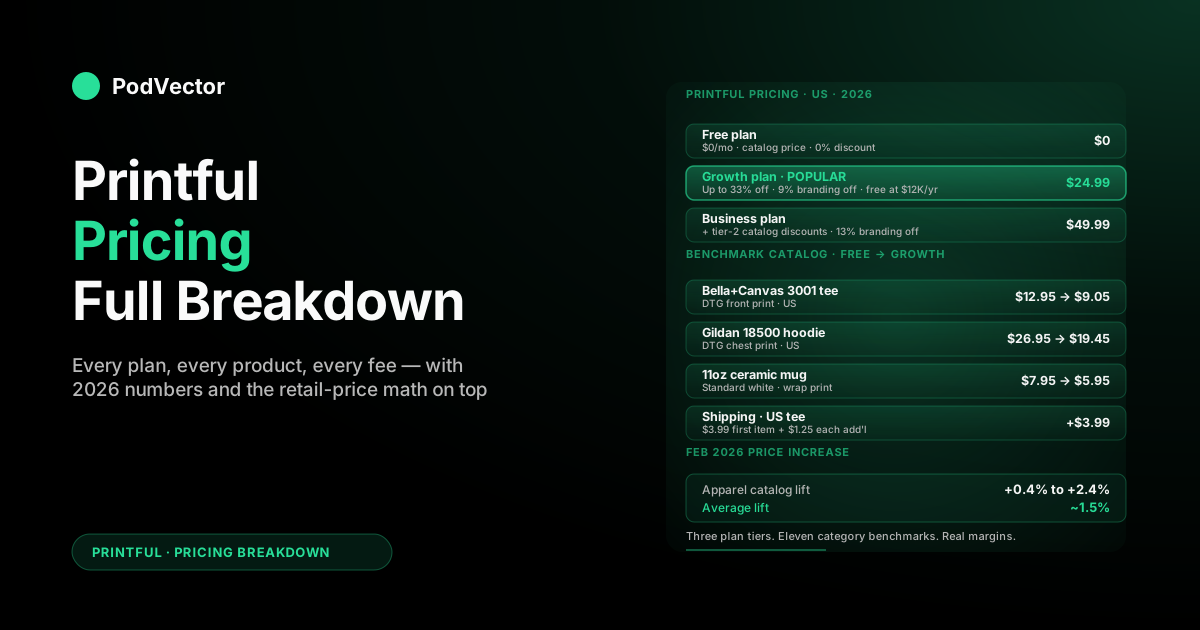
Quick Answer: Printful pricing in 2026 has three plan tiers — Free ($0), Growth ($24.99/mo), and Business ($49.99/mo) — plus a per-order pricing stack of product base cost, optional print/embroidery add-ons, branding charges, and shipping. A Bella+Canvas 3001 tee runs $12.95 on Free and ~$9.05 on Growth; a unisex hoodie runs $26.95 on Free and ~$19.45 on Growth. Shipping is zone-flat: US tee $3.99, hoodie $5.49, mug $4.99.
Printful applied a 0.4–2.4% across-the-board price increase in February 2026 on apparel categories. That's small per-unit but compounds at volume — a store doing 300 tees/mo at the average 1.5% lift quietly absorbs ~$58/mo unless retail prices move with it.
The pricing decision that actually matters isn't which plan to pick. It's setting your retail price high enough that Printful's stack plus your ad CAC and marketplace fees still leaves a margin. This guide walks every Printful price line with 2026 numbers, then shows the retail math.
Printful plan pricing: Free, Growth, Business
Printful's account-level pricing has three tiers as of 2026. Every plan gives you full catalog access, unlimited storefront integrations, and the same fulfillment SLA. What changes between tiers is how much you pay per unit and how big a branding discount you get.
| Plan | Monthly cost | Product discount | Branding discount | Free for stores making |
|---|---|---|---|---|
| Free | $0 | None — full catalog price | None | Always free |
| Growth | $24.99 ($239.88/yr) | Up to 33% off (avg ~22%) | 9% off branding fees | $12K+ annual store revenue |
| Business | $49.99 | Up to 33% + tier-2 catalog deals | 13% off branding fees | $60K+ annual store revenue |
The Growth plan is the one most POD sellers should care about. The $24.99/month sounds optional until you do the math: at the typical 22% product discount, a single Bella+Canvas tee saves you ~$2.85. So thirteen tees a month covers the subscription.
If you're doing fewer than 12 orders/month, Free is the right call — you'll pay the headline catalog price, but you won't burn $25/mo for discounts you can't recover. Once order volume turns predictable, Growth is the default. Business kicks in around 600+ orders/month, where the tier-2 catalog discounts on specific SKUs start mattering more than the Growth-vs-Business spread.
One nuance most articles miss: the "free for stores making $X" clause is a credit, not a waiver. You still get charged $24.99 monthly; Printful reimburses the charge once your store crosses the revenue threshold for that month. Cash flow matters for new sellers — budget for the up-front charge even if you'll get it back.
Product base pricing by category (2026)
Base product cost is the largest line in Printful's per-order pricing stack. Below are current 2026 prices on Printful's US fulfillment network, in USD, on the Free plan. Growth-plan prices are roughly 22% lower on average — sometimes 18%, sometimes 30%, depending on the SKU.
| Category | Benchmark SKU | Free plan | Growth plan |
|---|---|---|---|
| Unisex tee | Bella+Canvas 3001 | $12.95 | ~$9.05 |
| Heavyweight tee | Gildan 5000 | $11.50 | ~$8.05 |
| Long-sleeve tee | Bella+Canvas 3501 | $18.25 | ~$12.75 |
| Unisex hoodie | Gildan 18500 | $26.95 | ~$19.45 |
| Pullover sweatshirt | Gildan 18000 | $23.50 | ~$16.95 |
| Embroidered hat | Yupoong 6606 dad hat | $15.95 | ~$11.45 |
| Ceramic mug (11oz) | Standard white mug | $7.95 | ~$5.95 |
| Tote bag | BAGedge BE008 | $13.50 | ~$9.75 |
| Phone case (iPhone) | Tough Case | $16.95 | ~$12.45 |
| Poster (18×24) | Matte premium poster | $11.95 | ~$8.45 |
| Sticker (3×3) | Die-cut vinyl | $3.50 | ~$2.55 |
Two things worth flagging in this table. First, the dollar gap between Free and Growth on a single hoodie ($26.95 vs ~$19.45) is $7.50 — meaning four hoodies on Growth covers the subscription entirely. Hoodie-heavy stores hit Growth break-even faster than tee-heavy stores.
Second, the per-unit price varies by fulfillment region. EU prices run roughly 5–18% higher than the US table above on most apparel SKUs, and AUS prices run 8–22% higher. If you sell globally with regional routing on, your average per-unit cost will be higher than the US numbers suggest.
For the parallel breakdown of every cost line — not just price — see the Printful costs & charges hub, which walks the full six-line cost stack including reserve costs like refunds and FX.
Print method pricing: DTG, embroidery, AOP, DTF
Printful prices the same garment differently depending on which print method you choose. DTG (direct-to-garment) is the default on most apparel — that's the price you see in the catalog. The other three methods carry surcharges.
| Print method | What it is | Pricing approach |
|---|---|---|
| DTG | Ink sprayed directly onto fabric — default for tees and hoodies | Included in catalog base price |
| Embroidery | Thread stitched onto the garment — used on hats and accent placements | Standard +$2.49/placement; unlimited-color +$3.50/placement |
| AOP | All-over print — pattern covers the entire garment | Higher base price entirely; AOP tee runs $19–28 vs $11–13 for DTG |
| DTF | Direct-to-film transfer — used for synthetic fabrics and brighter colors on dark garments | Comparable to DTG on most SKUs, occasional +$0.50–$1.50 premium |
Embroidery is the line most new sellers miss. A $15.95 dad hat with an embroidered front logo is $15.95 + $2.49 = $18.44 — not $15.95. If you forget the embroidery fee in your retail-price math, you've quietly clipped $2.49 off your margin on every hat order.
The other gotcha: embroidery digitization. The first time you upload an embroidery design, Printful charges a one-time digitization fee of $3.50 to convert it into a stitch file. That's a setup fee, not a per-unit fee, but if you launch ten new embroidery designs in a month it's $35 of overhead nobody warned you about.
Extra print area pricing
The catalog price covers one print area — typically the front of a tee or the chest of a hoodie. Every additional print area is a surcharge.
| Print area | Free plan price | Growth plan price |
|---|---|---|
| Back print | +$5.95 | ~+$4.65 |
| Left sleeve | +$2.49 | ~+$1.95 |
| Right sleeve | +$2.49 | ~+$1.95 |
| Inside neck label print | +$2.49 | ~+$1.95 |
| Outside neck label print | +$2.49 | ~+$1.95 |
A "front + back + sleeve" design on a Bella+Canvas 3001 isn't a $12.95 tee. On the Free plan it's $12.95 + $5.95 (back) + $2.49 (sleeve) = $21.39 before shipping. That's the math that surprises sellers who priced their multi-area designs at the same retail as their single-area designs.
The decision rule: only add print areas where the design actually requires it. A back-print logo "for branding" that customers don't see at first impression is rarely worth $5.95 of margin per unit. A front-and-back narrative design that genuinely sells the product is worth it — but price for it.
Branding pricing: labels, pack-ins, packaging
Branding fees sit between product pricing and shipping pricing in the order — they're per-unit fees you opt into for white-label or store-branded fulfillment.
| Branding option | What it does | Pricing |
|---|---|---|
| Inside neck label print | Replaces the Bella+Canvas / Gildan tag with your brand | $2.49/unit (Free), ~$2.27 (Growth) |
| Outside neck label print | Adds an outside brand tag | $2.49/unit (Free), ~$2.27 (Growth) |
| Custom pack-ins | Printful inserts your branded card/sticker into the order | $0.45–$1.95/unit depending on item |
| Branded inserts (Printful-supplied) | Pre-designed Printful inserts with your logo | $0.50/unit |
| Premium packaging | Branded mailer or kraft box instead of poly bag | +$1.95/order (not per-unit) |
| Custom packing slip | Logo + custom message on the slip | Free on Growth and above |
Branding adds up faster than people think. A "fully branded" tee — inside label print, branded insert, premium mailer — costs $2.49 + $0.50 + $1.95 = $4.94 on top of the $12.95 catalog price. The same tee from Free-plan-no-branding lands at $12.95. That's a 38% production-cost difference for the branding alone, before printing.
Whether it's worth it depends on your retail price point. At a $19.99 retail tee on Etsy, full branding is impossible — the margin doesn't exist. At a $34.99+ retail tee on your own Shopify storefront with repeat-customer LTV, full branding is usually the right call because perceived quality drives reorders.
Printful shipping pricing
Printful's shipping pricing is zone-based and product-category-based. There's a flat first-item rate per category, plus a smaller additional-item rate for items in the same category in the same order.
| Product | US first item | US each additional | EU first item | Worldwide first item |
|---|---|---|---|---|
| T-shirt / tank | $3.99 | $1.25 | €4.69 | $7.99–$14.99 |
| Sweatshirt / hoodie | $5.49 | $1.75 | €5.99 | $9.99–$18.99 |
| Ceramic mug (11oz) | $4.99 | $2.99 | €4.99 | $8.99–$16.99 |
| Hat | $3.99 | $1.50 | €4.69 | $8.99–$14.99 |
| Poster (18×24) | $5.99 | $2.50 | €7.99 | $11.99–$22.99 |
| Sticker | $3.99 | $0.50 | €2.99 | $5.99–$9.99 |
The shipping pricing has two structural implications most sellers don't optimize for. First, the additional-item rate is much lower than the first-item rate — a 2-tee order ships for $3.99 + $1.25 = $5.24, not $7.98. That's a strong argument for bundling: if you can get customers to buy two items, your shipping margin improves on the second one.
Second, international shipping pricing is where margin goes to die on cheap products. A $19.99 tee shipping to Australia at $14.99 means $34.98 landed cost to the customer — usually pushing them back to "I'll order from a local supplier." Either price up internationally or restrict shipping regions to where the math works.
For the Etsy-specific shipping interaction (since Etsy's free-shipping listing boost depends on offering shipping at certain price points), see Printful Etsy integration cost breakdown and Printful Etsy integration fees.
Sample order pricing
Sample orders are how POD sellers actually validate product quality before listing. Printful prices them differently depending on plan.
- Free plan: 20% discount on samples, capped at one sample order per quarter
- Growth plan: 25% sample discount, plus the regular Growth product discount stacks (so total can hit ~40% off)
- Business plan: Same 25% sample discount as Growth, with deeper product discounts compounding
A Free-plan seller wanting samples of five new designs across two product types is going to spend ~$80–120 on samples before listing. A Growth-plan seller doing the same testing spends ~$55–80. Sample budgeting is a real line item in the first 90 days and rarely gets quoted in headline "Printful is free to start" framing.
The February 2026 price increase
Printful raised catalog prices 0.4–2.4% across most apparel categories in February 2026, with a smaller shipping-rate adjustment on accessories. The average lift across the apparel catalog was ~1.5%.
The increase is small per-unit — a $12.95 tee went to roughly $13.10–$13.25 depending on the specific SKU — but the cumulative impact at volume is real. A store doing 300 tees per month absorbs ~$58/mo if it doesn't raise retail prices in response.
Two things changed structurally that POD sellers should know:
- Embroidery digitization stayed flat — $3.50 per design, unchanged. So embroidery-heavy stores were less affected than DTG-heavy stores.
- Bella+Canvas tees took the high end — most B+C SKUs moved up 1.8–2.4%, while Gildan SKUs moved up 0.4–1.1%. If you're price-sensitive on apparel, Gildan got relatively cheaper vs B+C in this cycle.
Printful typically does one cost cycle per year, in February or March, tracking input costs (fabric, ink, labor at the fulfillment centers). The right operating posture is to expect a 1–3% cost lift annually and review retail prices in Q1 each year accordingly.
How to set your retail price on top
Printful's pricing is one half of the equation. The other half is what you charge customers — and that's where most stores leave money on the table by either underpricing (and netting zero after fees) or overpricing (and getting no conversions).
The simplest retail-pricing formula that works in POD:
Retail price = (Printful cost + shipping) × 2.5–3.0
For a Bella+Canvas 3001 tee on Free plan with US shipping included: ($12.95 + $3.99) × 2.5 = $42.35. Round to $39.99 or $42.99 for psychology. That's the floor for sustainable margin once Etsy fees + ad CAC + refund reserve get subtracted.
The multiplier varies by channel:
- Etsy: 3.0× because Etsy takes ~8% + transaction fees + listing fees + offsite-ads cut on top
- Your own Shopify storefront: 2.5× works because no marketplace take, but you're paying Meta/Google CAC instead
- Amazon Merch on Demand: different model entirely (Amazon prints; you don't pay Printful) — outside this guide's scope
If you're on Growth, the math shifts in your favor: ($9.05 + $3.99) × 2.5 = $32.60. You can price more aggressively at $29.99 and still hit margin, which matters for conversion at sub-$30 price points where Etsy traffic clusters.
For the deeper margin treatment that walks the same math but with Printful-specific fees and absorbed costs, see what you need to know about Printful profit margin and Printful profit margins in print on demand.
Margin scenarios: what each price actually nets you
Three realistic POD scenarios with full Printful pricing and end-channel fees applied. Numbers are 2026, US fulfillment.
Scenario A — $19.99 Etsy tee, Free plan
| Retail price | $19.99 |
| Printful base (B+C 3001, Free) | −$12.95 |
| Shipping | −$3.99 |
| Etsy transaction + listing fee (~8.5%) | −$1.70 |
| Refund reserve (5%) | −$1.00 |
| Payment processor (~3% + $0.30) | −$0.90 |
| Net per unit | −$0.55 |
Loss per unit. The $19.99 Etsy tee on Free plan is a structural money-loser before you've spent a dollar on ads or considered Etsy Offsite Ads (another 15%). Don't list at this price point on Free.
Scenario B — $29.99 Etsy tee, Growth plan
| Retail price | $29.99 |
| Printful base (B+C 3001, Growth) | −$9.05 |
| Shipping | −$3.99 |
| Etsy fees (~8.5%) | −$2.55 |
| Refund reserve (5%) | −$1.50 |
| Payment processor | −$1.20 |
| Net per unit | $11.70 |
$11.70 of gross margin per tee. After amortizing the $24.99 Growth subscription across ~13+ orders/mo, real net is closer to $10/unit. That's a healthy POD margin if you can hit volume.
Scenario C — $39.99 Shopify hoodie, Growth plan
| Retail price | $39.99 |
| Printful base (Gildan 18500, Growth) | −$19.45 |
| Shipping | −$5.49 |
| Shopify + processor (~3.5%) | −$1.40 |
| Refund reserve (5%) | −$2.00 |
| Meta CAC (assumed $6) | −$6.00 |
| Net per unit | $5.65 |
Tight. $5.65 net on a $39.99 hoodie with ads — that's 14% net margin. Workable, but it depends entirely on Meta CAC staying at $6. If CAC drifts to $9, the hoodie is breakeven; at $12, you're losing money on every conversion.
The lesson across all three: Printful pricing alone doesn't tell you whether a SKU is profitable. The retail price, channel fees, and CAC line all have to be modeled together. For the cross-supplier "every POD cost line including the absorbed ones" view, see Printful features and pricing full breakdown.
How to lower your Printful pricing
Five operating moves that actually reduce what you pay Printful, in rough order of effort vs payoff:
- Move from Free to Growth once you hit 12+ orders/month. Easiest 22% discount in POD.
- Swap Bella+Canvas for Gildan on basics. Gildan 5000 is $11.50 vs B+C 3001 at $12.95 — same DTG print quality, mild fabric difference. Customers rarely notice on listing photos.
- Drop single-color back prints. A $5.95 back-print fee for a small back-of-neck logo is rarely the conversion driver. Front-only saves the line.
- Bundle to use the additional-item shipping rate. 2-tee orders ship at $5.24 total instead of $7.98 separately. Free shipping over $X often pays for itself this way.
- Re-stage your product mix toward higher-margin SKUs. Mugs and stickers have lower absolute margin but higher percentage margin. Hoodies have higher absolute margin per unit. Tees are typically the middle. Optimize toward the customer cohort that actually converts.
Tracking Printful pricing changes when you scale
Printful's catalog has ~490 products. When pricing shifts (annual February cycle, occasional mid-year SKU adjustments), individual SKU-level price changes don't trigger an email. The store owner finds out either by reading a Printful blog post or — more commonly — by noticing margin compression a quarter later.
Two ways to monitor this at scale once you've got more than ~30 active SKUs:
Manual: Once per month, export your Shopify product list and Printful cost-per-SKU. Compare to last month's snapshot. Flag any SKU where the Printful side moved >2%. This takes ~30 minutes if you're disciplined; most sellers do it for one month, then stop.
Automated: Pipe Printful's per-order cost lines into your data layer alongside your Shopify retail prices and channel fees. Set an alert on margin drift >3% at the SKU level. The infrastructure is the same whether you build it yourself in BigQuery or Snowflake, or you let an agent run it.
PodVector AI's Victor is the employee capability of the second option — purpose-built for POD. Victor pulls itemized Printful costs (per-SKU base, add-ons, shipping) against Shopify revenue via webhooks, and surfaces which SKUs dropped below margin after the last Printful price cycle. When margin drift is found, Victor proposes a specific Shopify price change and executes it on your approval, with an audit trail of what changed and why. The combo — POD playbook in the agent, live data from your store, and the ability to act on it — is what separates this from a generic analytics dashboard or a generic AI chatbot. If you've ever wondered "is my margin actually still healthy on the tees I launched in January?" without sinking three hours into spreadsheets, that's the gap Victor closes.
FAQs
Is Printful actually free to start?
Yes — no signup fee, no monthly minimum on the Free plan, no charge until a customer orders. The "free to start" framing is accurate. What it doesn't tell you is that the per-order Printful pricing is higher on Free than on Growth, so "free to start" and "cheapest to operate" are different questions with different answers.
How much does Printful cost per month for a real POD store?
For a store doing 30 orders/month, real monthly Printful cost runs roughly $400–$700 — that's product cost + shipping + branding + the $24.99 Growth subscription if you've moved up. The headline plan price ($0 or $24.99) is a small line in the total monthly Printful spend; per-order costs dominate.
When does it make sense to switch from Free to Growth?
~12 orders per month is the simple threshold. At 12 tees/mo the 22% Growth discount saves ~$34, which more than covers the $24.99 subscription. For hoodie-heavy stores, the threshold is lower — 4 hoodies/mo covers it on the hoodie discount alone.
Does Printful pricing include shipping?
No. Catalog prices are product-only. Shipping is a separate per-order line, zone-based and product-category-based. Quoted in our table above — US tee $3.99 first item, $1.25 each additional, etc.
How does Printful pricing compare to Printify?
Printful runs roughly 15–35% above Printify on matching SKUs. Printful trades higher per-unit cost for tighter fulfillment SLA, more consistent print quality at scale, and fully-owned print facilities. Printify trades lower per-unit cost for a network of third-party Print Providers with quality variance. For the side-by-side breakdown, see the full Printful hub and the Printful costs & charges cluster.
What's the cheapest Printful product?
Stickers at $3.50 (Free plan, 3×3 die-cut) and standard ceramic mugs at $7.95 are the lowest-base-cost SKUs in the catalog. Margin percentage on these is high; margin dollars per unit are low. They work best as add-ons or cart-builders in a bundle strategy, not as primary SKUs.
Is the Printful pricing calculator accurate?
For the line items it includes (product, shipping, plan), yes. What it doesn't include is your channel fees (Etsy take-rate, Shopify processor cut), your refund reserve, or your ad CAC. The Printful calculator answers "what does Printful charge me?" — not "what's my net margin?" The retail-pricing formula and margin scenarios above cover the gap.
Did Printful raise prices in 2026?
Yes — 0.4–2.4% across most apparel categories in February 2026, with the average lift around 1.5%. The cycle is typically annual. Q1 each year is when retail prices should be reviewed.
Can I negotiate Printful pricing?
Below the Business plan, no — pricing is published and uniform. At Business plan volume (typically 600+ orders/month) and especially with Enterprise inquiries, tier-2 catalog discounts on specific SKUs are negotiable. The leverage point is annual order volume, not order size.
Know your real margin per SKU, not your guessed margin
Printful pricing is one of four moving pieces in your POD margin — and the only one you'll actually find on a single page. Channel fees, refund rate, and ad CAC are the other three, and they shift every week.
Victor is PodVector AI's agent for POD operators. He pulls itemized Printful costs against Shopify revenue and Meta/Google ad spend in your live data warehouse, identifies SKUs that dropped below margin after the last Printful price cycle, and proposes specific Shopify price changes you can approve and execute in one click. Built specifically for POD — Printful and Printify cost models are baked into the agent.
For the canonical reference on Printful's plan pricing direct from the source, see Printful's official pricing page.
Try Victor free