
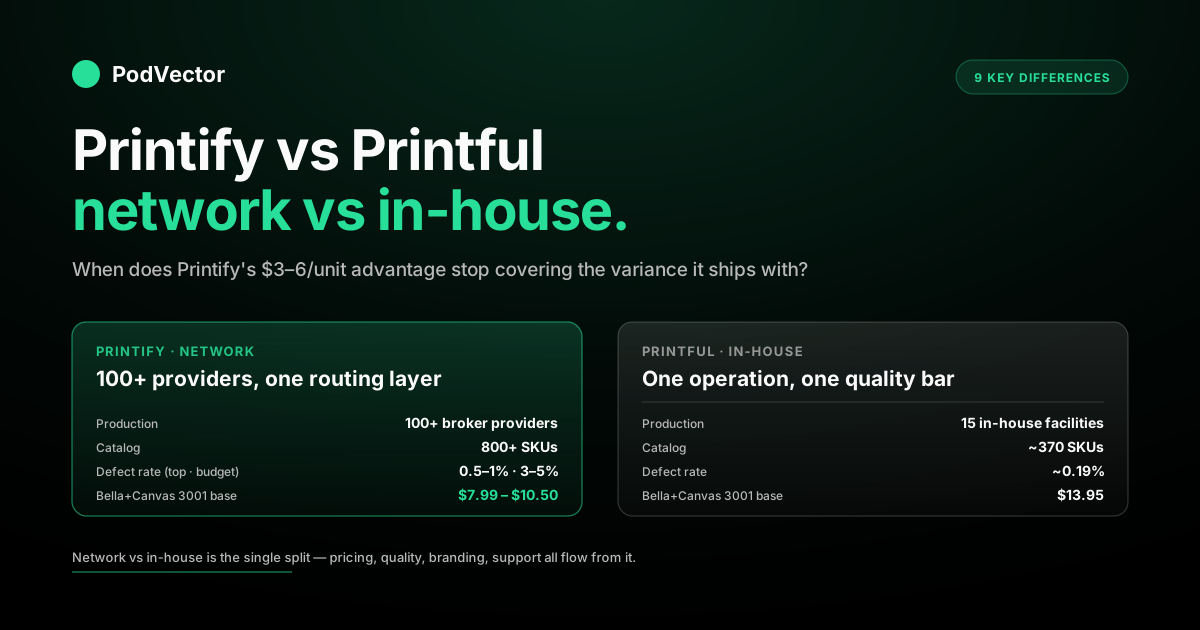
Quick Answer: Most POD sellers start on Printify because it's cheaper and has more products. The decision to move to Printful comes down to one question — does the variance in a 100-provider network cost you more than the $3–6/unit you save?
The structural difference: Printify is a broker network of 100+ independent print providers; Printful is an in-house printer with 15 facilities. Everything else — pricing, quality, branding, support — flows from that single architectural split.
Below: nine differences that determine when Printify wins and when Printful pulls ahead, plus the per-SKU framework reviews skip.
Why most POD sellers start with Printify
Searching "Printify vs Printful differences" usually means one thing — you're already on Printify, or leaning that way, and trying to figure out what you'd actually gain by moving to Printful.
The reasons sellers default to Printify are simple. It's cheaper across nearly every SKU. It carries roughly twice the catalog. It lets you compare providers and pin the one with the best margin on each product. For a first-year POD shop testing 40 designs to find 2 winners, that flexibility matters more than anything Printful offers.
The reasons sellers eventually look at Printful are also simple — but they only show up after volume. Defect rates that were a rounding error at 50 orders/month become refund storms at 500. A provider you trusted slips its Performance Score and you find out from a one-star review. Branded packaging is consistent on facility 1 and missing entirely on facility 2.
The nine differences below are where those tensions surface. Each one tells you whether Printful's premium would pay back for your shop, or whether the Printify savings still wins.
All 9 differences at a glance
The headline numbers before the deep dive:
| Difference | Printify | Printful |
|---|---|---|
| Production model | Network, 100+ providers | In-house, 15 facilities |
| Base cost (Bella+Canvas 3001 tee) | $7.99–$10.50 | $13.95 |
| Catalog size | 1,300+ SKUs | ~500 SKUs |
| Reshipment / defect rate | 0.5–5% (provider-dependent) | ~0.19% |
| Plan discount | Premium: up to 20% | Growth: up to ~30% |
| Branding execution | Varies by provider | Uniform across facilities |
| Production time | 2–10 business days | 2–5 business days |
| Support resolution | 5–10 days (via provider) | 3–6 days (platform-direct) |
| Mockup tool | Standard preview generator | Advanced AI mockup + lifestyle imagery |
1. Production model — broker network vs in-house
This is the difference everything else flows from. Printify doesn't own a single printer. It sits between you and 100+ independent print providers — Monster Digital, SwiftPOD, Dimona Tee, Print Geek, T-Shirt and Sons, dozens more.
Each provider runs its own machines, ink, staffing, quality bar, and packaging stack. Printify is a routing layer that publishes a unified catalog and forwards your orders to the provider you picked at the SKU level.
Printful is the opposite architecture. It owns 15 fulfillment facilities globally and prints every order in-house. Same machinery, same inks, same trained staff, same QA, same packaging stack across all 15 sites. The platform is the printer.
The Printify model wins on flexibility. You can shop a Bella+Canvas 3001 across 6+ providers, sort by base cost, and pin the cheapest. You can re-pin to a different provider in two clicks if your current one slips. You can A/B-test the same design across two providers to see which ships fewer defects.
The Printful model wins on predictability. You don't choose a provider — there's one — and that one provider has the same defect rate, the same fabric weight, the same packaging across every order you've ever placed. Predictability is the product.
2. Pricing and base costs
Printify is cheaper. Across the bestselling apparel SKUs the gap runs $3.45–$5.96 per unit, and it widens on hoodies and posters.
Concrete numbers on a Bella+Canvas 3001 tee (the POD bellwether SKU). Printify top-tier providers price it at $10.50; Printify budget providers at $7.99. Printful prices the same blank at $13.95. That's $3.45 saved on a top-tier provider, $5.96 on a budget provider — before any plan discount.
Plan tiers shift the math but don't close the gap. Printify Premium gives up to 20% off product cost. Printful overhauled its membership tiers — Growth ($24.99/month, free once you clear $12K in annual sales) now scales the product discount with your sales volume up to roughly 30%, rather than the flat single-digit cut it offered in prior years. Even at the top discount tier, Printful's blank typically lands above the Printify base on apparel.
The full Printful plan-tier math is in the Printful Growth membership price breakdown, and the per-feature value analysis is in the Printful Growth benefits breakdown.
Where Printful catches up is in branded packaging cost. Printful's branded labels and inserts are included in the Growth/Business plan; Printify charges per-provider for branded packaging where it's offered, and many providers don't offer it at all. If branded inserts are a hard requirement, Printful's $13.95 tee may be cheaper than a Printify $9 tee + provider-specific branding upcharge + dual-source defect insurance.
3. Product catalog size
Printify carries 1,300+ SKUs — more than twice Printful's ~500. The gap has widened as Printify's provider network keeps adding catalog, and it's biggest where it matters least for most shops, but where it matters at all, it matters a lot. For perspective, Printify lists roughly 150 men's tee options to Printful's ~45, and dozens of mug variants to Printful's handful.
The overlap is real. Both cover the bestselling 50 SKUs that drive most POD volume — Bella+Canvas tees, Gildan basics, Champion hoodies, AS Colour staples, ceramic mugs, posters, canvas wall art, tote bags, phone cases. If you sell from that 50-SKU shortlist, both platforms have you.
The non-overlap is where Printify pulls ahead. All-over-print apparel runs deeper on Printify (joggers, swim trunks, AOP hoodies). Pet products are broader on Printify (pet beds, pet bandanas, custom pet portraits). Home goods runs deeper (custom shower curtains, tapestries, blanket variants). Niche drinkware (stainless tumblers, color-changing mugs, frosted shot glasses) is a Printify advantage. Printful's tighter catalog is curated; Printify's wider catalog is additive — it inherits whatever every provider carries.
If your niche is core apparel, the catalog gap doesn't matter. If your niche is long-tail or AOP-heavy, the catalog gap is the deciding factor before any other consideration.
4. Print quality consistency
Both platforms can deliver excellent prints. The difference is variance.
Printful's published reshipment rate is ~0.19% — roughly 1 defect per 525 orders. Same machines, same inks, same QA across 15 facilities means the bell curve is tight.
Printify's variance is wider because the provider pool is wider. Top-tier providers (Monster Digital, SwiftPOD, Print Geek) cluster around 0.5–1% reshipment rates — within striking distance of Printful. Mid-tier providers run 1–3%. Budget providers can hit 3–5% defect rates on bad weeks, especially during seasonal volume spikes.
The catch is that Printify's Performance Score (the platform's public 1–10 provider grade) is computed monthly and moves. A provider you trusted in Q1 can slip in Q3 when a new operator joins the print floor or QA processes change. Printful's quality bar drifts less because the operating model drifts less.
The practical workaround on Printify is to pin flagship SKUs to top-tier providers, watch the Performance Score every two weeks, and re-pin proactively. That works — it just requires monitoring Printful sellers don't need to do.
5. Branding and packaging
Printful executes branded packaging uniformly. Inside-collar labels, packing slips with your logo, branded polybags, and pack-in inserts ship the same way from every Printful facility. Order one from California; order the same SKU from Latvia three weeks later; the unboxing experience is identical.
Printify's branding is per-provider, and the consistency varies. Some providers (Monster Digital, SwiftPOD) offer custom neck labels and branded packing slips. Others offer none. Brand inserts (the small printed card most DTC POD shops include) are inconsistent — available on some providers, unavailable on others, and the print quality of the insert itself varies.
This is where the broker-vs-in-house gap shows up hardest for brand-led shops. A Printful-driven Shopify brand can promise "same unboxing every time" with zero ops overhead. A Printify-driven brand has to either commit to one provider (and lose the cost flexibility that put them on Printify in the first place) or accept variance in the unboxing.
6. Integrations and platform support
Both cover the integrations that move most POD volume — Shopify, Etsy, WooCommerce, Amazon, eBay, TikTok Shop, Wix natively.
Where Printful pulls slightly ahead is native integration breadth — roughly 21 first-party connectors to Printify's ~11. Squarespace, BigCommerce, Storenvy, Wish, Webflow, and Walmart Marketplace all have first-party Printful connectors; Walmart in particular is a Printful-only channel right now, which matters if you're chasing that marketplace's traffic. Printify covers the major platforms and uses Zapier or its API for the rest.
Where Printify pulls ahead is the Etsy relationship. Printify holds the official Etsy partnership badge inside Etsy seller-tools and tends to ship Etsy-specific features (auto-syncing Etsy listing variants, Etsy ad budget surfacing) ahead of Printful. Functionally both connectors handle order flow the same way — but Printify reads as the Etsy-preferred partner.
For shops that run on Shopify, the integration gap is essentially zero. For shops that need Squarespace or BigCommerce, Printful is the cleaner pick. For Etsy-first shops, Printify has the slight edge on platform alignment.
For a deeper comparison of features and pricing, the Printful vs Printify features & pricing comparison walks the integration coverage axis-by-axis.
7. Production and shipping speed
Printful's median production time is 2–5 business days. Tight bell curve, low variance, predictable across all 15 facilities.
Printify's production time is the same network-variance story. Top-tier providers ship in 2–4 business days. Mid-tier in 4–6. Budget providers can hit 5–10 days, sometimes longer during seasonal spikes.
Shipping speed itself (carrier transit after the order ships) is comparable — both platforms route through USPS, UPS, DHL, and regional carriers with similar transit windows. The production-time gap is where the real difference sits domestically. Internationally, Printful's in-house network tends to win on shipping cost: because every order prints in one of its own facilities, rates are flatter and often noticeably cheaper than routing a Printify order through a US provider to an overseas buyer. If a chunk of your orders ship outside the US, factor Printful's lower international shipping into the per-unit math — it can erase part of Printify's base-cost advantage.
For shops promising "ships within 3 days" on Shopify product pages, Printful's predictability is the safer fulfillment promise. For shops willing to either pin Printify orders to top-tier providers or set "ships within 7 days" expectations, Printify works fine — and the cost savings often justify the longer fulfillment window.
8. Customer support flow
Printful runs 24/7 live chat with platform-direct support. A defect claim opens with the Printful support team, escalates internally to the facility that produced the order, and resolves typically in 3–6 days with replacement shipped or refund issued.
Printify support is more layered. The Printify support team is the front door, but for a defect or production issue, they often route the claim to the print provider that produced the order. Each provider has its own claims-handling SLA. Resolution typically runs 5–10 days, and the quality of the back-and-forth varies — some providers (top-tier) respond fast and pleasantly; others (budget) drag.
For shops with low order volume, the support delta is mostly invisible — you rarely file claims. For shops above 500 orders/month, the support delta compounds. A 5-day vs 9-day claim resolution on 15 defects/month is 60 customer-facing days of "where is my replacement" friction.
9. Design and mockup tools
Printful's mockup generator is the more advanced of the two. Lifestyle imagery (models wearing the tee, mug on a desk, poster on a wall) is rendered from a curated photo library. The AI-assisted mockup tool generates listing-ready imagery from a design upload. Background removal, color recoloring, and design alignment helpers are built in.
Printify's mockup generator is functional but flatter. Most mockups are flat-lay product photos (tee on white, mug on white) with the design overlaid. Lifestyle imagery is limited and tends to feel templated. The Smart Image Tool gives lifestyle output but the gap to Printful's library is real.
For a shop that lists 5 SKUs and shoots its own product photography, the mockup gap doesn't matter. For a shop that launches 30 designs a month and relies on platform-generated imagery for the Etsy or Shopify listing — Printful's mockup tooling saves real time and renders higher-converting imagery.
When to stay Printify, when to move to Printful
The differences above are the facts. The decision is a function of your specific shop's profile.
Stay on Printify if
You're under $5k/month and still validating designs. Cost flexibility matters more than consistency at this stage; you're not running enough volume for variance to hurt.
You're margin-sensitive and the $3–6/unit gap is the line between profitable and break-even. The math justifies the operational overhead.
Your niche is long-tail or AOP-heavy. Printful doesn't carry the SKUs you need.
You sell on Etsy and benefit from Printify's platform alignment.
Move to Printful if
You're brand-led DTC where unboxing consistency drives repeat purchase. Printify's per-provider branding variance erodes the brand promise.
You're paid-ad-driven where defect-rate variance hurts ROAS through refunds, replacements, and bad reviews. The $3–6/unit Printify savings rarely fund your ad budget if defect rate climbs to 2–3%.
You need integrations Printify doesn't offer natively (Squarespace, BigCommerce, Webflow).
Your support team is one person and can't absorb 5–10 day Printify claim resolutions at scale.
Run both if
You're above $10k/month and your SKU mix splits cleanly between flagship products (5–15% of SKUs driving 60–80% of revenue) and long-tail products. Flagships go on Printful for consistency; long-tail goes on Printify for cost. The dual-dashboard reconciliation is real overhead — at scale it's worth the per-SKU optimization unlock.
For a wider pros-and-cons walkthrough, the Printful vs Printify pros and cons comparison lays out the trade-offs side by side. The Printful vs Printify pricing review goes deeper on the cost math. Browse the Printful comparison hub for every Printful-vs-X review and the Printful topic hub for everything Printful.
The per-SKU answer averages can't give you
Every framework above gives a category-level answer. Stay Printify under $5k; move to Printful for brand-led DTC; run both above $10k. Those are useful starting points — and they're not enough.
Your P&L doesn't run on category averages. It runs on per-SKU contribution dollars. On your top-selling tee, in your chosen blank and color, shipped from your chosen provider to your top buyer states — what's the real margin after fees, refunds, and the actual reprint rate from your last 90 days?
Which 10 SKUs would clear $3+ more per order if you switched suppliers? Which Printify provider's Performance Score has slipped enough this quarter to move flagship listings off it? Which Printful SKU is so margin-thin that moving it to Printify would pay back even after the defect-rate penalty?
None of the public Printify vs Printful difference guides answer these. They quote averages — $4 saved per shirt, 0.19% defect rate, 0.5–5% Printify defect range — and stop there. Margin runs on the specific SKU + provider + buyer-state + ad-channel combination that produced the order.
Closing this gap takes three pieces working together. Every order's supplier-charged cost, refund event, and reshipment has to land in one source of truth alongside ad cost (Meta, Google), processor fees, and customer LTV. The math has to run per-SKU and per-provider so a tee profitable on Monster Digital and a hoodie profitable on Printful both surface clearly. The data has to refresh fast enough to act on — switching a provider 90 days late is too slow when review velocity drives marketplace ranking.
This is the work PodVector AI built Victor to do. Victor is an AI employee for your POD shop, not a dashboard you log into — it connects your Shopify, Printful, Printify, Meta, and Google data, watches per-SKU and per-provider margin as orders land, and flags the moves: which SKU would clear more if you switched from Printful to Printify, which Printify provider's defect rate has crept up this quarter, which flagship listing should move off a slipping provider now. You can also just ask it — "what's my real defect rate per Printify provider this quarter?" — and it works the answer out of your live data and tells you what to do about it.
FAQs
What is the main difference between Printify and Printful?
Printify is a broker network of 100+ independent print providers; Printful is an in-house printer with 15 facilities. Every downstream difference — pricing, quality, catalog, branding, support — flows from that single architectural split.
Is Printify or Printful cheaper?
Printify is cheaper across nearly every SKU. On a Bella+Canvas 3001 tee, Printify top-tier providers price at $10.50 and budget providers at $7.99 vs Printful at $13.95 — a $3.45–$5.96/unit gap before plan discounts. The gap widens on hoodies and posters.
Does Printify or Printful have better print quality?
Printful has narrower variance. Published reshipment rate is ~0.19% vs Printify's 0.5–1% on top-tier providers and 3–5% on budget providers. Printify can match Printful with a top-tier provider on a good day; Printful's consistency across days is the actual edge.
Does Printify or Printful have more products?
Printify — 1,300+ SKUs vs Printful's ~500. The gap is biggest in all-over-print apparel, home goods, pet products, and niche drinkware. Both cover the bestselling 50 SKUs that drive most POD volume.
Which is better for Etsy sellers, Printify or Printful?
Printify holds the official Etsy partnership badge and tends to ship Etsy-specific features first. Both connectors handle order flow comparably. For Etsy-first shops, Printify has a slight platform-alignment edge; for cross-channel shops, the difference is small.
Which has better branding options?
Printful — by a clear margin. Inside-collar labels, branded packing slips, polybags, and inserts ship the same way from all 15 facilities. Printify's branding depends on which provider produces the order, and consistency varies.
Which is faster, Printify or Printful?
Printful's production is 2–5 business days, consistent across facilities. Printify ranges from 2–4 (top-tier providers) to 5–10 (budget providers). Carrier transit after the order ships is comparable on both.
Can I use Printify and Printful together?
Yes — most established shops above $10k/month do. Flagship SKUs go on Printful for consistency; long-tail or margin-sensitive SKUs go on Printify (pinned to top-tier providers). The hybrid splits the trade-off but adds reconciliation overhead across two dashboards.
Which has better customer support?
Printful — 24/7 live chat, platform-direct, claims resolve in 3–6 days. Printify routes through the print provider that produced the order, claims resolve in 5–10 days, and quality varies by provider.
Where can I find more on the Printify vs Printful comparison?
Axis-by-axis deep dives are at Printful vs Printify features & pricing, the Printful vs Printify pricing review, and Printful vs Printify pros and cons. The Printful comparison hub indexes every Printful-vs-X review.
The differences tell you which platform fits the average shop. Your shop isn't average.
Public guides quote averages — $4 saved per shirt, 0.19% defect rate, 2–5 day production. Your P&L runs on the specific SKU + provider + buyer-state + ad-channel that produced the order. Spreadsheets go stale by the next supplier-cost change. Victor is an AI employee that connects every Shopify, Printful, and Printify charge, watches per-SKU margin as orders land, and tells you which provider to move each listing to — ask "which provider had the best margin on my top 10 SKUs this quarter?" and act on the answer. POD-native, no spreadsheets.
Try Victor freeFor an outside view, Shopify's Printful vs. Printify comparison walks the same axes from the Shopify-merchant angle. To go broader on Printful operations, see the Printful topic hub.