
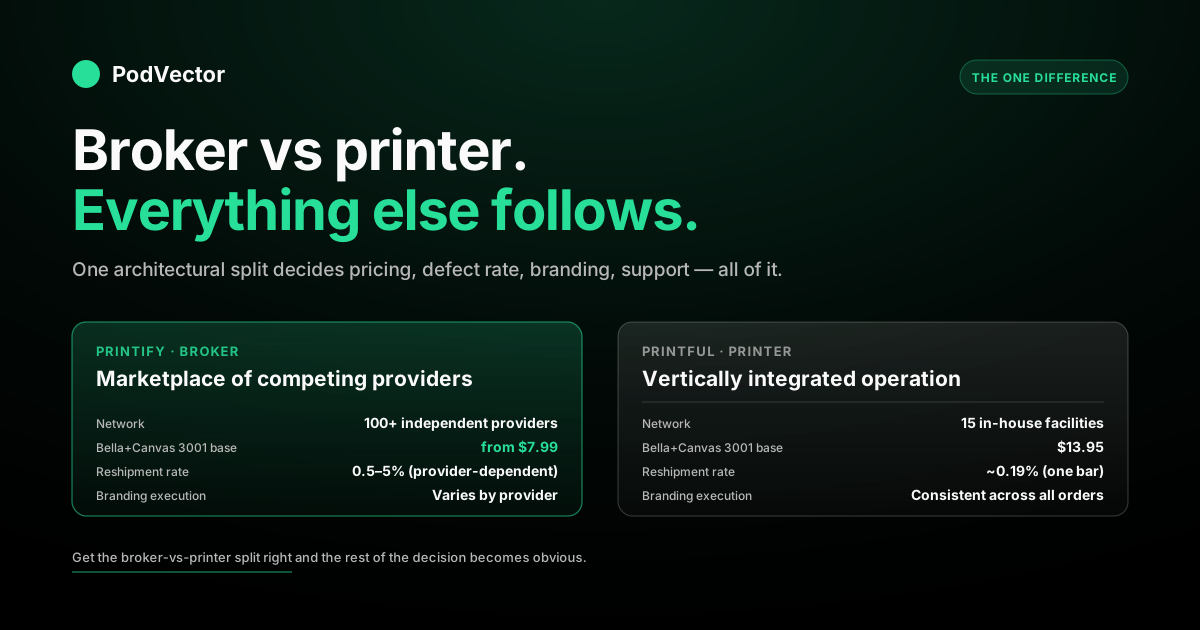
Quick Answer: The real difference between Printify and Printful is structural, not feature-list. Printify is a broker — a marketplace of 100+ independent print providers competing on price and lead time. Printful is a vertically integrated printer — 15 in-house facilities running one quality bar.
Every other comparison point — base cost, defect rate, branding, support, integrations — is a downstream consequence of that single architectural split. Get the split right and the rest of the decision becomes obvious.
Below: how the broker-vs-printer split cascades, when each model wins for a POD shop, and the per-SKU framework that beats "pick one and stick with it."
The one difference that matters
Most "Printify vs Printful" comparisons list ten or fifteen feature differences and call it analysis. That's misleading. The features aren't independent — they're symptoms of one underlying choice.
Printify is a broker. It owns no presses, no facilities, no garments. It runs a marketplace where ~100 print providers compete to fulfill your orders, and Printify routes each order based on price, location, and the provider's published lead time.
Printful is a printer. It owns and operates 15 fulfillment facilities across the US, EU, UK, Australia, Japan, Canada, Mexico, and Brazil. Every order goes through one operation with one quality standard.
That's it. That's the entire difference. Everything reviewers list — cheaper base prices, larger catalog, variable defect rates, packaging inconsistency, support routing — derives from broker-vs-printer.
How it cascades into everything else
The cascade is mechanical. Once you know which model you're using, the downstream traits follow without any further data.
Broker model means competitive base prices. Providers compete for your order, and the cheapest usually wins the routing. That edge used to be decisive — a $5-6/unit gap on a Bella+Canvas 3001 before the November 2024 merger. Printful's post-merger price cuts have narrowed it: today both land around $11-12 base on that SKU, and the broker's remaining advantage is provider-level — you can still find a Printify provider undercutting Printful by $2-3 on specific SKUs, but the flat $6 gap is gone.
Broker model means wider catalog. Each provider brings its own SKUs. Aggregate them and you get 1,300+ products across 140+ facilities vs Printful's ~450. If you sell niche items — all-over print joggers, ceramic ornaments, embroidered patches — the broker model has them.
Broker model means variance. Provider A on Printify runs a 0.5% reshipment rate. Provider B runs 5%. The platform aggregates these, but the variance is yours — every time you switch providers you're rolling the dice. Printful runs a single ~0.19% reshipment rate across all facilities.
Broker model means inconsistent branding. Custom neck labels, branded inserts, gift messages — Printify supports them, but each provider implements them differently. Provider C prints your neck label correctly; Provider D forgets it on 1 in 20 orders. Printful's in-house ops run the same packaging spec everywhere.
Broker model means split support. When an order goes wrong, Printify's support handles platform-level issues but routes production questions to the provider, which can mean waiting 24-48 hours for a response. Printful's support owns the entire chain — they printed it, they shipped it, they fix it.
That's the cascade. One choice, six downstream effects.
Pricing: where the broker model used to win on paper
Before November 2024, the broker model won pricing decisively — the cheapest Printify provider ran a Bella+Canvas 3001 around $7.99 base vs Printful's $13.95, a ~$6/unit gap. The merger changed that. Printful cut base prices across its catalog, and the two now land much closer. Run the numbers on the most common POD SKU — a Bella+Canvas 3001 unisex tee, white, size M, printed front DTG.
| Cost line | Printify (budget provider) | Printful |
|---|---|---|
| Garment + print base | ~$9.50 | ~$11.50 |
| Subscription discount | Up to 20% (Premium: $14.99/mo) | Up to 9% (Growth: $24.99/mo) |
| Effective unit cost | ~$7.60 | ~$10.47 |
| US shipping (1 item) | ~$4.75 | ~$4.99 |
| Total landed cost | ~$12.35 | ~$15.46 |
That ~$3 gap is real but no longer decisive. At a $24 retail price you keep ~$11.65 with Printify vs ~$8.54 with Printful before ad spend — a meaningful edge, but a far cry from the double-the-profit gap that held before the price cuts.
At scale it's ~$3,000/month in gross margin at 1,000 units — enough to matter, small enough that Printify's provider variance can erase it if you scale on the wrong providers. The right question isn't whether the gap is real; it's whether the variance Printify ships with eats more than that in refunds, replacements, and review damage.
One place the printer model still wins outright: international shipping. Printful auto-routes each order to the nearest of its facilities, so a tee bound for the UK ships from an EU or UK center — often $4-5 vs the $8-10 a Printify order can cost when it routes from a US-based provider. If you sell heavily outside the US, factor routed shipping into landed cost, not just base price.
Variance: where the broker model gets expensive
Printify publishes a "Performance Score" on each provider — uptime, on-time shipping, reshipment rate. The top-tier providers score 95+%. The budget providers can score in the 80s.
That spread matters because reshipment rates compound. A 3% reshipment rate means you ship 1,030 units to fulfill 1,000 orders — and pay for the garment, the print, and the second round of shipping on every replacement. On a ~$12 landed cost, that's an extra ~$370/month in pure waste at 1,000 orders.
Worse: every reshipment is a customer who waited an extra 10 days. A chunk of them leave a 1-star review before the replacement arrives. Review damage is the silent killer that doesn't show up on the P&L for 3-6 months.
Printful's ~0.19% reshipment rate isn't free — you paid for it in the base cost. But it's predictable. You can model your P&L and your reviews without provider-routing roulette.
The math that decides this for your shop: per-SKU landed cost × monthly volume × your tolerance for review variance. None of the comparison articles run this for you, because they don't know your catalog or your reviews. A full Printify vs Printful cost comparison walks the formulas one layer deeper.
Catalog depth and provider choice
1,300+ SKUs vs ~450 sounds decisive, but most sellers only print 5-15 products. Catalog size matters in two narrow cases.
You sell niche or seasonal SKUs. Embroidered beanies in 12 colorways, all-over-print joggers, ceramic ornaments, fleece blankets in three weights. Printify carries them; Printful often doesn't. If your designs need a specific blank, the broker model is the only game in town.
You want provider-level control over a single product. A Bella+Canvas 3001 on Printify can be fulfilled by Monster Digital, SwiftPOD, Marco Fine Arts, OPT, Underground Shirts, and 12 others — each with different pricing, lead times, and locations. Pinning the right provider for your SKU is a margin lever Printful can't match.
For the other 80% of POD shops printing standard tees, hoodies, and mugs — both catalogs cover what you need. Catalog size is a distractor in that case.
Branding and the packaging gap
Branding is where the in-house model justifies its premium for some shops.
Printful supports custom neck labels (inside-label printing), branded packaging (custom pack-ins, custom tape, custom boxes for high-tier accounts), and gift messages — and runs them consistently across every order. The branding is the product, not a feature toggle.
Printify supports the same options on paper, but execution varies by provider. Some providers print your neck label correctly every time. Others miss it on 5% of orders. Some support branded inserts; others don't. The seller has to test, audit, and pick providers that execute the branding spec — which means giving up the "cheapest provider auto-routing" advantage that made Printify cheap in the first place.
If branding matters to your shop — repeat customers, premium pricing, gift-grade unboxing — Printful is structurally better. If you're selling on price and your customer doesn't notice the packaging, the broker model is fine.
Integrations and the channel question
Both connect to Shopify, Etsy, WooCommerce, Wix, Squarespace, and BigCommerce. The split shows up at the edges.
Printful has native integrations with Amazon, Walmart, and eBay. Printify supports these through workarounds (third-party connectors, manual order routing), which adds friction.
Printify integrates with TikTok Shop natively. Printful added TikTok Shop more recently and the integration is less mature.
For most POD shops on Shopify + Etsy, the integration question is a wash. For shops scaling onto marketplace channels, Printful's native Amazon/Walmart integration saves real engineering work.
Support — who owns the problem when it breaks
Support quality scales with how the problem moves through the system.
Printful: one chain. You email support. They look up your order in the same system the printer used. They fix it. Typical first response: under 24 hours. Phone and live chat available.
Printify: two chains. Printify now runs 24/7 support over email and live chat, so first response is fast. But the routing is still split — for platform issues (billing, mockups, integrations) they resolve directly; for production issues (defect, misprint, missing item) they relay to the provider, wait for the provider's response, then relay back. Fast to answer, slower to actually fix, because the printer isn't in the room.
For a 50-orders-a-month shop, the difference is annoying but survivable. For a 500-orders-a-month shop running paid traffic, every 48-hour resolution delay is a Meta CAPI complaint or a chargeback that didn't have to happen.
The Printful + Printify merger announcement
On November 5, 2024, Printful and Printify officially merged into a single company. As of mid-2026, both platforms still operate separately under their existing brand names — separate apps, separate catalogs, separate billing — and management has said they'll keep running independently for the foreseeable future.
The strategic implication: the broker-vs-printer split that defines today's decision may collapse within 18-24 months. A merged entity would presumably offer both models under one roof — pick a provider from the broker network or default to in-house fulfillment for the same SKU.
For sellers deciding today, the merger doesn't change the math. Both platforms keep their current pricing, catalog, and quality bars through the merger. Whatever you pick now is portable to the combined entity later.
A simple decision framework
Skip the 15-point feature comparison. Three questions decide it.
Question 1: What's your monthly order volume?
Under 100 orders/month — pick Printify. Cheaper base, wider catalog, variance is a rounding error at that scale. The Printful premium isn't justified yet.
Over 500 orders/month — pick whichever your refund-and-review data justifies. Run the per-SKU math (next section). At this scale, variance compounds into real money.
100-500 orders/month — the gray zone. Most shops here run a hybrid: Printify for high-volume staples where provider variance is acceptable, Printful for branded flagship products where consistency matters.
Question 2: Is branding part of your value prop?
If customers buy from you because of the unboxing experience, the neck label, the branded inserts — Printful. The in-house model is the only way to get consistent branding execution at scale.
If customers buy on price and the package is incidental — Printify. Save the premium for ad spend.
Question 3: What channels are you on?
Shopify + Etsy only — both work. Pick on price/quality.
Amazon, Walmart, eBay in the mix — Printful's native integrations save real work. The broker model is still possible but adds connector overhead.
TikTok Shop is a meaningful channel — Printify's earlier integration is more mature, slight edge.
The per-SKU answer averages can't give you
Every comparison article picks one SKU (usually a Bella+Canvas 3001) and runs the math at one price point. That's a starting point, not an answer.
The actual answer depends on your catalog mix, your provider selection on Printify, your ad spend, and your refund rate. Three shops with identical product lines can land on opposite choices because their margins, returns, and channel mix differ.
The per-SKU framework that works:
- Pull your top 10 SKUs by revenue. Not by units sold — by revenue. Margin lives in the high-revenue tail.
- For each SKU, run landed cost on both platforms. Garment + print + shipping + plan discount. Use the cheapest provider on Printify and the equivalent SKU on Printful.
- Factor reshipment cost into each. Printify: use the actual provider's reshipment rate (visible on their Performance Score). Printful: use ~0.19%.
- Add review-damage cost. Hard to model precisely. A reasonable proxy: every 1% reshipment rate above Printful's baseline costs you ~1 star of average rating per 100 orders, which costs ~5-10% of conversion rate over time. Translate that to revenue.
- Compare effective margin per SKU. Sometimes Printify wins on a $30 t-shirt and Printful wins on a $45 hoodie. The answer is usually a split.
The numbers don't fit on a spreadsheet line — they need your real revenue, your real provider mix, your real refund log. A Printify vs Printful breakdown for Etsy sellers covers how channel context changes the answer.
Pricing specifics for the most-printed SKUs across both platforms live in the cost breakdowns: Printful's Bella+Canvas 3001 cost breakdown and the base-cost analysis for the same garment. For neighboring decision points in this cluster, see the full Printful comparison hub or the parent Printful topic hub.
For the broader feature-by-feature breakdown of all 9 differences between Printify and Printful, a sibling article in this cluster walks each individual gap.
FAQs
What is the main difference between Printify and Printful?
Printify is a broker network of 100+ independent print providers competing on price and lead time. Printful is a vertically integrated printer with 15 in-house facilities running one quality standard. Every other comparison point — pricing, catalog, branding, support — derives from that single architectural split.
Is Printify cheaper than Printful?
Usually, but the gap has shrunk. Before the November 2024 merger the cheapest Printify provider ran a Bella+Canvas 3001 around $7.99 base vs Printful's $13.95 — a ~$6 gap. Printful's post-merger price cuts closed most of it; today both sit around $11-12 base, and Printify's edge is typically $2-3 on specific SKUs, not double the profit. That remaining edge is real but can be eaten by provider variance — defect rates, lead times, branding execution — if you scale on the wrong providers.
Which is better for a beginner POD seller?
Printify, in almost every case. Cheaper base, wider catalog, lower commitment. Variance is a rounding error at sub-100 orders/month. The Printful premium only pays back once volume is high enough that variance starts costing real money — typically 500+ orders/month or shops where branding is the value prop.
Are Printful and Printify merging?
They already have. Printful and Printify officially merged on November 5, 2024. As of mid-2026, both platforms still operate separately with their own apps, catalogs, and billing, and management plans to keep them independent for the foreseeable future. The merger doesn't change today's decision; whatever you pick now is portable to the combined entity later. Printify's official comparison page covers both platforms' current operating status.
Can I use both Printify and Printful?
Yes, and many shops at 100-500 orders/month do exactly this. Hybrid setup: Printify for high-volume staples where provider variance is acceptable, Printful for branded flagship products where consistency matters. Both connect to the same Shopify store; the order routing is per-product, not per-store.
Which has better print quality?
Printful, on average — but the comparison is misleading. Printful runs one quality bar across 15 facilities. Printify's top-tier providers (Monster Digital, SwiftPOD) match or exceed Printful quality; the budget providers are noticeably weaker. The question isn't "Printify vs Printful quality" but "Printify's specific provider for this SKU vs Printful." If you pin top-tier Printify providers, quality is comparable.
Which integrates better with Shopify?
Both have native, mature Shopify integrations. The integration quality is roughly identical for standard store operations. The difference shows up on adjacent channels — Printful's native Amazon/Walmart integration is more mature; Printify's TikTok Shop integration is more mature. Pick based on your channel mix beyond Shopify.
Want the per-SKU answer for your actual catalog?
The framework in this article is the right one. Running it manually across your top 10 SKUs takes a weekend.
Victor — PodVector AI's AI employee agent — runs it continuously against your live Shopify, Printify, and Printful data. He pulls your real revenue and refund mix, calculates landed cost per provider for each SKU, factors in your actual reshipment rate, and tells you which SKUs should live on which platform. Then he proposes the supplier swap on the right products and executes it in Shopify on your approval, with a full audit trail.
Stop deciding "Printify or Printful" as a binary. Decide per-SKU, with live data, and let the agent do the routing math.
Try Victor free