
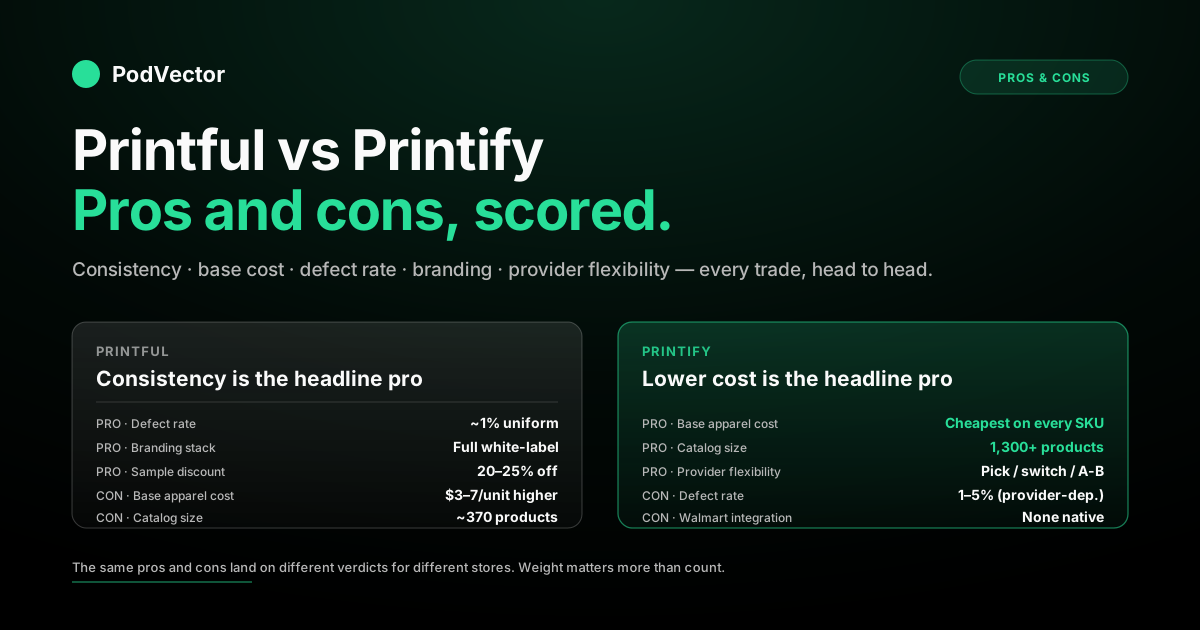
Quick Answer: Printful's biggest pro is consistency — one in-house facility set, ~1% defect rate, white-label branding, and one shipping policy. Its biggest con is base cost: $3–7 per unit higher than Printify on most apparel.
Printify's biggest pro is the inverse — lower base cost across 1,300+ products and a flexible provider network. Its biggest con is the variance that flexibility creates: defect rates run 1–5% depending on which provider you list through.
The right pick depends on your catalog, your channel mix, and your appetite for provider vetting. Below: every pro and con worth weighting, plus the decision rules that actually map to a POD seller's unit economics.
Pros and cons at a glance
Every Printful vs Printify pros-cons list looks similar at the top level. The differences show up when you weight each line against your specific store.
The snapshot below is the 30-second version. Each line gets unpacked further down, with the math on how much it actually costs or saves.
| Dimension | Printful | Printify |
|---|---|---|
| Base product cost | Con — $3–7/unit higher on apparel | Pro — cheapest on every benchmark SKU |
| Defect / reprint rate | Pro — ~1% uniform across facilities | Con — 1–5%, provider-dependent |
| Product catalog size | Con — ~370 products | Pro — 1,300+ products |
| Branding (labels, packaging) | Pro — broad white-label support | Con — limited, provider-by-provider |
| Sample-order pricing | Pro — 20–25% discount | Con — full price, no discount tier |
| International shipping | Pro — auto-routed to 5+ facilities | Mixed — cheaper with multi-region listings, worse without |
| Subscription value | Mixed — Growth ($24.99) up to 33% off, ~8-unit break-even | Mixed — Premium ($24.99) flat 20% off, ~12-unit break-even |
| Integrations / marketplaces | Pro — 19 platforms incl. Walmart, Amazon native | Con — 10 platforms, no Walmart |
| Customer support | Pro — 24/7, can act on the order directly | Mixed — Printify support routes you to the provider |
| Provider control | Con — no choice, one facility set | Pro — pick by price, region, or quality |
| Free standalone storefront | Con — none; bring your own channel | Pro — free Pop-Up Store, no platform fees |
Read this table like a P&L, not a scoreboard. Three "pros" on items that don't matter for your store can lose to one "con" that hits your dominant SKU. The weighting section below covers how to score the lines that count.
Printful pros — what it does best
Printful's pro list is shorter than Printify's, but the items hit harder once you scale.
Consistent quality across every SKU
Printful runs its own fulfillment facilities. Same DTG printers, same Bella+Canvas tee blanks, same ink batches across Charlotte, Tijuana, Riga, Barcelona, and Toronto. The result is a defect rate that sits around 1% on average — and stays there.
For a seller running 1,000 orders a month at a 1% defect rate, that's about 10 reprints to eat. At a 4% rate on a lower-tier Printify provider, the same volume produces 40 reprints. The base-cost spread has to clear roughly $510 in defect-rate cost before it counts as a win.
White-label branding most providers can't match
Inside labels, neck prints, packing slips with your logo, custom packaging inserts, branded mailers — Printful supports all of it across its catalog. Print providers on the Printify network support fragments of this list, and the supported features vary provider by provider.
If your store sells on Etsy or Shopify and competes on "this feels like a real brand, not a print-on-demand drop," Printful's branding stack is the lower-friction path. The friction shows up in the catalog: you don't need to maintain a per-provider matrix of which custom-pack-in is supported where.
Sample-order pricing that subsidizes iteration
Free Printful accounts get 20% off sample orders. Growth subscribers get 25% off. There's a 12-sample-per-month cap, but it's generous enough to test a full season's worth of variants. Printify charges full base price plus full shipping on every sample.
The math: a Printful Growth seller can sample-test 12 SKU variants for roughly $90–110 a month. The equivalent on Printify runs $130–160 — and that's before the provider-by-provider sample discipline Printify actually requires. Cheap samples mean more iteration, and more iteration is how POD sellers find the SKU that prints money.
Set-and-forget international shipping
Printful auto-routes orders to whichever facility is closest to the customer. A buyer in Berlin gets the order from Riga or Barcelona. A Sydney customer gets it from Brisbane. No multi-region listing setup, no SKU duplication, no per-region price logic.
For stores with meaningful international traffic — common on Etsy and TikTok Shop — this saves both shipping cost and dashboard complexity. The Printify equivalent is cheaper per shipment, but only if you've built out multi-region listings. The lazy setup costs Printify sellers $4–8 per international order.
Native marketplace integrations including Walmart
Printful integrates natively with 19 sales channels including Shopify, Etsy, Amazon, eBay, Wix, Squarespace, BigCommerce, WooCommerce, and Walmart Marketplace. Printify covers most of the same list but skips Walmart — a meaningful gap for sellers chasing the marketplace's lower competition and rising POD traffic.
The integrations are also more granular on Printful. Per-channel pricing rules, currency rules, and tax behavior are configurable from inside Printful's dashboard rather than from each channel.
Customer support that can resolve the issue, not just route it
Printful runs its own facilities, so its support team can act on the order directly. Damaged in transit, wrong color, missing label — one ticket, one resolution. Printify's support team is one layer removed from production. They route the issue to the provider, then back to you. The loop is longer, and the SLA varies by provider.
At low order volume the difference is invisible. At 500+ orders a month with a 1–2% issue rate, the second-tier routing burns hours of operator time per week.
Printful cons — where it loses
The flip side of Printful's "one facility set, one quality bar" model is that you pay for the consistency on every unit.
Base cost runs $3–7 per unit higher
The headline con. Bella+Canvas 3001 tees run $9.50 on Printful Growth versus $8.95 on Printify Premium — a small gap on tees, but it widens fast. Gildan 18500 hoodies run $24.50 versus $19.36 — a $5.14 gap. Ceramic mugs run $9.49 versus $6.21 — a $3.28 gap. Across most apparel and accessory categories, Printify is cheaper before any other variable enters the math.
The base-cost difference compounds across a catalog. A store running 1,000 orders a month with a mix-weighted average gap of $2.50 per unit pays $2,500 a month more in product cost on Printful. That's real money to weigh against the defect-rate and branding pros.
Smaller catalog — roughly 370 products
Printful's catalog is curated. Printify's is a market. If your design works on tees, hoodies, mugs, and posters, that won't matter — both platforms cover the standard set. If you want to sell niche items (laptop sleeves with specific size cutouts, pet bandanas in particular weights, neoprene koozies), Printify has more options.
The catalog gap also matters when you're scaling. A store testing new product categories burns through Printful's curation faster than Printify's network of 90+ providers.
No provider selection
Printful's "one facility set" pro is also Printful's "no choice" con. If a Printful facility is slow, has a quality issue, or runs out of stock on a blank, you can't route around it. You're locked into Printful's operational state.
Printify lets you list the same SKU through multiple providers and switch on the fly. If Monster Digital is hitting 6-day fulfillment, you can move that SKU to SwiftPOD. The flexibility is invisible on a quiet week and decisive when a holiday-season backlog hits.
Subscription discount is conditional, not flat
Printful Growth advertises "up to 33% off." The 33% number is the ceiling, not the average. Most apparel SKUs sit at 20–28% off Growth pricing. The product-by-product discount table reads more like a margin gradient than a flat discount. Printify Premium is a flat 20% off every product — simpler math at the planning stage.
Growth still pays off faster than Premium for most stores (the 8-unit break-even is roughly 4 units below Premium's), but the conditional discount makes catalog planning more work.
Limited niche category coverage
Printful's growth has been in apparel and tier-1 accessories. Niche categories — embroidered pet apparel, kids-specific blanks, sustainable/organic fabric SKUs, custom-shape stickers — are sparser than on Printify's provider network. For a single-niche store this is invisible; for a multi-niche operator, it's a ceiling.
Printify pros — what it does best
Printify's pros all stem from the same architectural choice: it's a marketplace, not a manufacturer.
Lowest base cost on every benchmark SKU
On apparel, drinkware, posters, phone cases, and totes — Printify Premium is cheaper than Printful Growth on every benchmark we ran. The gap is smallest on tees and widest on hoodies, all-over-print SKUs, and accessory categories.
For a high-volume seller, the cost win is the biggest single lever in POD economics. A $4-per-unit base-cost difference at 1,000 orders a month is $4,000 in monthly margin before any other variable enters the math. That's bigger than most marketing optimizations.
1,300+ products including deep niche coverage
Printify's catalog runs roughly four times Printful's by SKU count. Phone cases for every device generation, swimwear, organic kids apparel, embroidered pet bandanas, neoprene drinkware — categories Printful either skips or carries thin coverage of.
The depth matters for two patterns: stores running multiple seasonal niches (Q4 holiday gifting versus summer apparel), and stores that bundle complementary SKUs (matching mug-tee-tote sets where Printful might cover two of three).
Provider flexibility — pick, switch, A/B test
Same SKU, multiple providers, different price points. Printify lets you list a Bella+Canvas 3001 through Monster Digital, SwiftPOD, and Marco Fine Arts simultaneously — each with their own price, quality, and fulfillment SLA. If one slows down at peak season, you reroute. If quality drifts, you A/B test.
Printful can't do this by design. The flexibility is most valuable for stores with peaky demand (Black Friday, Mother's Day, viral TikTok moments) where supplier reliability is the actual constraint.
Free plan is genuinely usable
Printify Free is fully featured: unlimited products, all integrations, full provider network. The only difference versus Premium is a 20% discount that you only need once volume justifies it. Printful Free is similar in feature breadth, but Printify Free at low volume is cheaper end-to-end because the base prices are lower.
For a seller still validating a niche — first 30 orders a month, no subscription — Printify Free is the lower-risk starting point.
Region-optimized shipping when set up right
Configured properly, Printify is cheaper than Printful on international shipping. The setup is per-SKU per-region multi-listing: same Bella+Canvas tee listed through Monster Digital for US orders and through Print Logistic for EU orders. Each routes through a local provider, each ships local rate.
This is a real pro for sellers with international traffic — but only if you've done the multi-region setup. The unconfigured default ships everything from one provider, often US-only, which makes Printify worse on international than Printful.
Pop-Up Store — a free standalone storefront
Printify's Pop-Up Store lets you spin up a free, hosted storefront without a Shopify or Etsy account — Printify handles checkout and payment. For a seller validating a niche before committing to a paid platform subscription, it's a zero-cost way to put SKUs in front of buyers. Printful has no equivalent free standalone storefront; you bring your own channel.
The con hiding in the pro: a Pop-Up Store is a thin storefront, not a brand home. It's a launchpad for testing demand, not the place you build evergreen Etsy or Shopify SEO. Treat it as a sandbox, then graduate the winners to a real channel.
Bigger ecosystem and seller community
Printify's seller community is larger and more active by most measures — forum activity, third-party tutorial volume, YouTube content. For a new POD seller learning the workflow, the search-and-learn surface is bigger.
Printify cons — where it loses
The marketplace model creates variance, and variance creates costs.
Defect rate varies — 1% to 5% by provider
Top-tier Printify providers (Monster Digital, SwiftPOD on premium tier) run defect rates close to Printful's 1% floor. Lower-tier providers in the same catalog run 4–5%. The catch: the average seller picking on price will land on the lower-tier providers.
A 3-point defect-rate gap at 1,000 orders a month costs roughly $510 a month in reprints and reshipments. That's before factoring the customer-experience cost — negative reviews, refund-rate impact on Etsy's algorithm, Meta ad ROAS drag from poor LTV.
Branding is provider-by-provider
Custom packaging, inside labels, branded inserts — most Printify providers support some of these, none support all of them, and the supported set varies by provider. If you list a SKU through four providers, you maintain a four-variant branding matrix.
For a store running a strong brand on Etsy or Shopify, this is operationally painful. Either you accept inconsistent unboxing experience or you constrain yourself to the providers that support your full branding spec — narrowing the cost win.
No sample-order discount
Every Printify sample order runs full base price plus full shipping. There's no per-month allotment, no Premium discount, no perks. The implicit argument is that Premium's 20% off already discounts the sample. That argument breaks once you account for provider-vetting discipline — to do Printify right, you sample-test every provider for every SKU before listing.
Most sellers skip the discipline because samples are expensive, then pay for the skip in production defects. Either way, the cost shows up.
Support is one layer removed from production
Printify's support team doesn't own the printer. When a customer issue comes in, support routes it to the provider, then back to you. The loop is functional but slow, and the SLA varies by provider's responsiveness.
For a side-hustle seller at low volume, this is a few extra emails. For an operator at 500+ orders a month, it's hours of weekly back-and-forth instead of one ticket per issue.
Premium discount is flat 20%, not graduated
Printify Premium is one price, one discount tier. There's no Pro plan with deeper discounts for higher volume. Printful's Plus tier ($49/mo) and Pro tier ($99/mo) carry deeper discounts plus expedited support and additional sample-order limits — relevant for high-volume sellers.
No native Walmart integration
Walmart Marketplace is one of the fastest-growing POD channels in 2026 — lower competition than Amazon, lower listing fees than Etsy. Printful integrates natively. Printify requires third-party middleware (or a manual fulfillment workflow), which adds operational cost and breaks the SLA story Walmart enforces on sellers.
Quality control is your job, not the platform's
Printful's 1% defect rate is something the platform owns. Printify's defect rate is something you manage by picking providers, ordering samples, and pulling listings when quality drifts. The work is real. Sellers who skip it eat the variance; sellers who do it well still spend 2–4 hours a week on provider discipline at moderate volume.
How to weight the pros and cons for your store
A pros-cons list is a starting weight, not a verdict. The same list lands on different verdicts for different stores because the weights change.
The weighting framework below scores each dimension by how much it actually moves your unit P&L.
Weight base cost heaviest if you're scale-stage
Past 300 orders a month, base cost is the biggest variable in your contribution margin. A $3 per-unit gap at 500 orders is $1,500 a month. At 2,000 orders, $6,000 a month. That dwarfs every other dimension on the list.
At sub-100-orders-per-month, base cost matters less — the absolute dollar gap is small enough that other variables (branding, support, integration speed) outweigh it.
Weight defect rate heaviest if you sell on paid social
Paid social margins are tighter than organic Etsy or Shopify SEO traffic. A 4% defect rate at $5 customer acquisition cost and $20 retail produces a contribution loss that compounds across the cohort — defects produce negative LTV customers, and the Meta algorithm punishes negative-LTV cohorts in subsequent auctions.
Printful's defect-rate floor is worth a $2–3 per-unit premium for paid-social-driven stores. For organic-traffic stores, the same gap is worth $0.50–1 per unit.
Weight branding heaviest if your retail price is > $30
Premium pricing requires premium unboxing. White-label labels, branded inserts, premium packaging are the difference between a $35 tee that retains and a $35 tee that gets refunded. Printful's branding stack is worth real weight at high retail prices; almost nothing at low retail prices.
Weight provider flexibility heaviest if you peak hard
Stores that do 80% of annual revenue in November–December run a different supplier-risk profile than stores with flat year-round volume. Provider flexibility — the ability to reroute a SKU when a supplier slows — is worth a premium during peak weeks. Printify's marketplace model is the cleaner fit for peaky businesses.
Weight Walmart integration heaviest if you have a Walmart-eligible niche
Walmart Marketplace is selective on approvals. If your niche fits (home decor, custom drinkware, character apparel for kids), Printful's native integration is worth more than every other delta combined. If your niche doesn't fit, the line is worth zero.
Weight sample discount heaviest if you iterate fast
Stores that launch 5+ new SKUs a month rely on sample testing to keep quality high. Printful's 20–25% sample discount cuts iteration cost meaningfully. Stores that launch a SKU a quarter don't notice the discount.
When to pick Printful, Printify, or both
Collapsing the pros-cons math into decision rules.
Pick Printful if
- Your retail price runs $30+ and branding-led unboxing is part of the product.
- You sell mostly through paid social and the LTV math punishes defects hard.
- You sell on Walmart Marketplace, or you're in a Walmart-eligible niche.
- You ship 30%+ international and don't want to maintain multi-region listings.
- You iterate fast on samples and want the 20–25% sample discount.
- You value support that can act on the order without routing to a third party.
Pick Printify if
- Your monthly volume sits north of 300 orders and base cost is the dominant variable.
- Your catalog includes niche products (organic apparel, kids gear, neoprene drinkware, etc.).
- You have peaky demand and provider flexibility is genuinely useful, not theoretical.
- You're at sub-50 orders a month and Printify Free's lower base prices beat Printful Free for early-stage cash flow.
- You have the operational discipline to sample-test providers before listing.
- You don't need Walmart and your branding stack tolerates provider variance.
Pick both if
- You're running 20+ SKUs across multiple categories — the optimal supplier varies by SKU, and a single-supplier choice leaves money on the table.
- You ship across multiple regions — Printful for set-and-forget international, Printify multi-region listings where the cost win is decisive.
- You sell on multiple channels with different margin structures — Etsy, Shopify, TikTok Shop, and Walmart can each favor different suppliers for the same SKU.
For more granular cluster context, the Printful vs Printify features comparison covers the integration and feature surface, and the Printful vs Printify for Etsy piece narrows the lens to one specific channel. For the line-by-line cost work, see the Printful vs Printify pricing comparison.
The pros and cons nobody publishes
Every public pros-cons list covers the same surface dimensions: catalog size, base cost, branding, integrations. The trade-offs that actually decide stores live one layer deeper.
Provider concentration risk
Printful is a single point of failure. If Printful has an outage, your entire catalog is paused. Printify spreads the risk across 90+ providers, but introduces a different concentration: most high-volume Printify sellers list 80%+ of their catalog through 2–3 top-tier providers. The "1% defect rate top-tier" providers are also the ones that get capacity-constrained during peak.
Neither platform's marketing materials surface this. It only shows up in November.
Pricing volatility
Printful adjusts its base pricing roughly once or twice a year — predictable, telegraphed, applied uniformly. Printify's pricing changes provider by provider, and individual providers have raised prices mid-season with limited notice. For a seller running listings that depend on a specific cost line in a P&L, the volatility is a real con.
Catalog drift
Printify providers add and drop SKUs constantly. A Bella+Canvas 3001 you've sold through Monster Digital for 18 months can suddenly be dropped — and your listings go dark. Printful's catalog is more stable. The trade matters most for stores that build evergreen listings on Etsy or Shopify SEO.
Returns and refunds policy variance
Printful's return policy is uniform. Printify's varies by provider. Stores that take any meaningful share of returns end up writing per-provider customer-service playbooks. That's hidden operational cost the pros-cons table never surfaces.
Membership-cost ROI by SKU mix
Printful Growth pays off fastest if your catalog is hoodie-heavy (deeper discount tier). Printify Premium pays off fastest if your catalog is mug- or accessory-heavy (flat 20% on items where Printful's discount runs thinner). The "which subscription is worth it" answer depends on your specific SKU mix, not the headline percentage. For deeper detail on the membership math, see the Printful Plus membership August 2024 breakdown and the Printful Plus membership benefits 2024 breakdown.
The pros-cons trade nobody can solve for you
Every list above produces an average. Your store does not run on averages.
The pros that matter are the ones that hit your dominant SKUs in your dominant channel for your dominant customer region. A "Printify wins on base cost" line is worth zero if your top SKU is a Walmart-listed embroidered hoodie shipping to a US customer — that's Printful's strongest configuration. A "Printful wins on consistency" line is worth zero if your store is 95% drinkware sold to US Etsy buyers at $18 retail — Printify Premium is the cleaner fit.
The right comparison is per-SKU. It means tracking every order's supplier-charged cost, shipping line, defect status, and refund alongside revenue and ad spend in one source of truth. Running the math per-SKU and per-supplier. Surfacing the answer fast enough to act on — moving a single SKU's supplier mid-season is high-leverage if the data is fresh, useless if it lags a quarter behind.
This is the architecture PodVector AI built Victor on. A unified live data warehouse ingests Shopify, Printful, Printify, Meta, and Google per-order data, then lets you ask "which supplier wins on my hoodies shipping to the EU at $32 retail?" in plain English. The answer changes by SKU. A POD seller without per-SKU supplier data is guessing on the most expensive lever in their business. For a slightly different framing of the same trade-offs, the 2026 Printful vs Printify breakdown from Merch Titans covers similar ground with a margin-math angle.
For the cluster-wide framing of how comparison decisions roll up to operator strategy, see the Printful comparison hub. For the broader topic, the Printful topic hub pulls together every pricing, integration, and operational angle.
FAQs
What is the single biggest pro for Printful?
Consistency. One facility set, ~1% defect rate uniform across the catalog, unified support, set-and-forget international routing. The downstream effect is fewer customer-service hours and fewer LTV-killing defects in your cohort.
What is the single biggest pro for Printify?
Lower base cost. Printify Premium beats Printful Growth on every benchmark SKU, with the gap running $0.55 on tees to $5+ on hoodies and all-over-print. At scale, that's the single largest contribution-margin lever in POD.
What is the single biggest con for Printful?
Base cost runs $3–7 per unit higher on most apparel. At 1,000 orders a month with a $2.50 mix-weighted gap, that's $2,500 in monthly margin given up to Printify.
What is the single biggest con for Printify?
Defect rate variance. Top-tier providers run close to Printful's 1% floor; lower-tier providers run 4–5%. The seller who picks providers on price alone gives back much of the base-cost win in reprints and refunds.
Is Printful or Printify better for beginners?
Printify Free at low volume — simpler base cost math, no subscription decision yet, and a larger learning-resource ecosystem. The flip is that Printify's provider-vetting discipline matters less at sub-30-orders-a-month volume, so the "Printify is harder to run right" con barely registers at that stage.
Is Printful or Printify better for high-volume sellers?
It depends on the catalog. Apparel-heavy and accessory-heavy stores with provider-selection discipline lean Printify. Branding-heavy or paid-social-driven stores lean Printful. Most stores running 1,000+ orders a month end up using both for different SKUs.
Does the 2024 Printful–Printify merger change the pros and cons?
Not yet, as of mid-2026. Both platforms continue operating separately with separate dashboards, pricing structures, and provider relationships. The pros-cons list is unchanged. The merger does increase the case for piloting a non-merged third supplier (Gelato, Gooten, CustomCat) as a hedge against post-integration policy changes.
Which platform has the bigger product catalog?
Printify, by about 4x. Roughly 1,300+ products versus Printful's ~370. The gap matters most for stores running niche categories or multi-niche seasonal mixes.
Which platform has better branding options?
Printful. White-label labels, custom inserts, branded packaging are supported broadly across the catalog. Printify supports fragments of the same list, with the supported set varying provider by provider.
Which has better integrations?
Printful — 19 sales channels including Walmart Marketplace, native Amazon and Etsy. Printify covers most of the same list but skips Walmart, which matters for sellers chasing that channel's growing POD traffic.
Should I use both Printful and Printify?
For most stores running 20+ SKUs, yes. The optimal supplier varies by SKU, region, and channel. A single-supplier decision leaves margin on the table. The real question is how to decide per-SKU — and that requires per-SKU unit economics, not a platform-level pros-cons list.
Stop reading pros and cons. Run the numbers per SKU.
Printful's pros win for some SKUs. Printify's pros win for others. The answer changes by garment, region, channel, and season — and a static list goes stale in weeks. Victor pulls every order, every supplier-charged cost, every shipping line, every refund into one live data warehouse — then lets you ask "which supplier is actually more profitable on my hoodies shipping to the EU?" in plain English. POD-native unit economics, no spreadsheets.
Try Victor free