
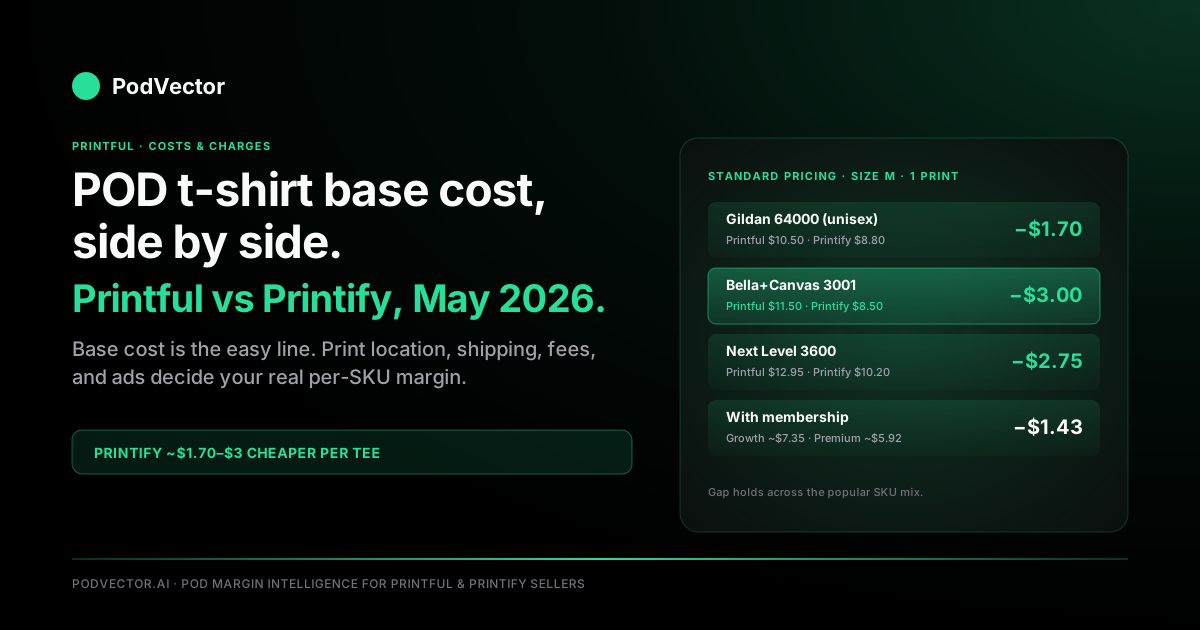
Quick Answer: A standard unisex t-shirt costs around $10.50 on Printful and around $8.80 on Printify at base price (May 2026). With membership discounts those drop to roughly $7.35 (Printful Growth) and $5.92 (Printify Premium).
The base cost is only part of the math. Print location surcharges, shipping, transaction fees, and ad spend all sit on top — and that's where most POD margin calculations break.
This breakdown gives you the actual numbers per t-shirt model, the side-by-side margin at $24.99 retail, and the cost lines most "Printful vs Printify" posts skip.
Base cost at a glance: Printful vs Printify (May 2026)
POD ("print on demand") suppliers charge a per-unit "base cost" — the wholesale price you pay them per shirt fulfilled. Everything else (your retail price, shipping, ads, fees) is on top.
Here's how the two big platforms price the most common t-shirt models. Single front-print, standard size (M):
| T-shirt model | Printful (standard) | Printful (Growth, ~20% off) | Printify (standard) | Printify (Premium, ~25% off) |
|---|---|---|---|---|
| Gildan 64000 (unisex softstyle) | $10.50 | ~$7.35 | $8.80 | ~$5.92 |
| Gildan 5000 (heavy cotton) | $10.95 | ~$7.67 | $8.50 | ~$5.70 |
| Bella+Canvas 3001 (unisex tee) | $11.50 | ~$8.05 | $8.50 | ~$5.70 |
| Next Level 3600 (premium cotton) | $12.95 | ~$9.07 | $10.20 | ~$6.85 |
| AS Colour Staple 5001 (premium) | $14.95 | ~$10.47 | $12.30 | ~$8.25 |
Three numbers to anchor on. The Bella+Canvas 3001 is the most popular POD shirt by volume — and Printify is roughly $3 cheaper per unit at standard pricing.
Gildan 64000 is the budget workhorse. Printify is ~$1.70 cheaper, which compounds fast on a 1,000-unit month.
And membership math is where it gets interesting: Printify Premium ($14/mo) hits ~25% off; Printful Growth ($9-$24/mo) gives ~20% off most products. The gap stays roughly the same on a percentage basis but widens in absolute dollars on premium fabrics.
What "base cost" actually includes — and what it doesn't
This is where most POD margin spreadsheets go wrong. "Base cost" is the wholesale unit price for a single-location front print at the standard color and size.
What's included in base cost:
- The blank garment
- One DTG ("direct-to-garment" — the digital printer used for short runs) print on one location (usually front)
- Standard size up to L or XL (varies by platform)
- Standard color (white or light)
What's not included:
- Shipping (charged separately — flat-rate on Printful, variable on Printify by provider)
- Sizes 2XL+ (size upcharge of $2-$5 per size step)
- Additional print locations: back print, sleeves, inside neck label
- All-over print (entirely different price tier)
- Premium color upcharge on some platforms
- Transaction fees on your storefront (Shopify, Etsy, etc.)
- Membership fees if you're on a paid plan
The result: the headline base cost is real, but the landed cost per SKU (what you actually pay Printful or Printify per fulfilled order) can be 30-60% higher once size, location, and shipping stack on.
This is the gap that wrecks first-year POD margins. Sellers price off the base cost they saw in the catalog, then find out at quarter-end why net margin doesn't match the gross.
Printful t-shirt base costs, by model
Printful owns its fulfillment network. One catalog, one price per SKU, no provider variability. That makes the cost easy to read — and easy to predict on a per-order basis.
Here are Printful's most common t-shirt base costs at standard (no-membership) pricing in May 2026:
| Model | Base cost | 2XL upcharge | 3XL upcharge |
|---|---|---|---|
| Gildan 64000 unisex softstyle | $10.50 | +$2.50 | +$3.50 |
| Gildan 5000 heavy cotton | $10.95 | +$2.50 | +$3.50 |
| Bella+Canvas 3001 unisex jersey | $11.50 | +$3.00 | +$4.00 |
| Bella+Canvas 3413 triblend | $13.95 | +$3.00 | +$4.00 |
| Next Level 3600 premium cotton | $12.95 | +$3.00 | +$4.00 |
| AS Colour Staple 5001 | $14.95 | +$3.50 | +$4.50 |
| Champion AO200 heavyweight tee | $16.50 | +$4.00 | +$5.00 |
Printful's pitch is consistency. Same factory, same print quality, same fulfillment window across the catalog. You pay more per shirt and get fewer surprises per order.
The Printful Growth and Business plans apply a ~7% to ~20%+ discount across the catalog (more on higher tiers, escalating with monthly volume). On a Gildan 64000, that's $10.50 → ~$9.77 on Growth, ~$8.40 on Business. The discount applies to product cost only, not shipping.
For full breakdowns of the membership math at different volume bands, see the Printful Premium benefits guide.
Printify t-shirt base costs, by model and provider
Printify is a marketplace. The same t-shirt model can come from 3-12 different print providers, each with their own base cost, print method, and shipping rate.
That makes the pricing more confusing — but also cheaper at the floor. Here are typical Printify prices for the most-popular t-shirts in May 2026:
| Model | Lowest provider | Typical provider | Premium provider |
|---|---|---|---|
| Gildan 64000 unisex | $7.50 (Drive Fulfillment) | $8.80 (Monster Digital) | $10.20 (Print Geek) |
| Gildan 5000 heavy cotton | $7.40 (Awkward Styles) | $8.50 (Marco Fine Arts) | $9.90 (Print Geek) |
| Bella+Canvas 3001 | $7.50 (Underground Threads) | $8.50 (SwiftPOD) | $10.98 (My Locker) |
| Next Level 3600 | $9.50 (Print Bar) | $10.20 (SwiftPOD) | $11.80 (My Locker) |
Three things to understand about Printify's provider model:
1. Quality varies by provider, not just by garment. The same Gildan 64000 printed by Provider A and Provider B can look noticeably different in color saturation and feel. The blank is identical; the printer is not.
2. Shipping rates vary by provider too. A $7.50 shirt from a low-cost provider can have $5.49 shipping. A $9.20 shirt from a mid-tier provider might ship at $4.29. Always check the landed cost.
3. Premium ($14/mo) gives ~25% off most providers, not all. A handful of providers don't participate in Premium pricing. Filter on "Premium discount applies" in the catalog before committing a hero SKU.
The catalog-level conclusion: Printify is cheaper at the floor, but you're managing variance. Printful is more expensive but predictable.
Print location surcharges: where the sticker price changes
Both platforms quote the base cost for a single front print. The moment you add a back print, a sleeve print, or inside-neck branding, the SKU repriced silently.
Typical surcharges per location, on top of base:
| Print location | Printful | Printify (avg) |
|---|---|---|
| Front (standard) | included | included |
| Back print | +$5.95 | +$3.50 to +$5.00 |
| Sleeve print (each) | +$2.49 | +$1.50 to +$3.00 |
| Inside neck label | +$2.49 | +$1.00 to +$2.50 |
| All-over print (AOP) | separate catalog tier | separate catalog tier |
So a "$10.50" Gildan 64000 on Printful with front + back + sleeve prints lands at $10.50 + $5.95 + $2.49 = $18.94. Almost double the headline.
This is the most common margin leak in POD. Sellers list a "two-sided design" tee at $24.99 expecting a $10.50 cost — and find out the actual fulfillment bill is $18.94.
Bake every print location into your product cost before pricing the retail. Or restrict your catalog to single-location prints and absorb the design simplicity for the margin clarity.
The hidden costs that move real margin
Base cost is the line you see. Four other lines move your net margin per t-shirt sold:
Shipping. Printful charges flat rates per category in the US — $4.75 first tee, +$2.20 each additional. Printify varies by provider; expect $4.29-$5.99 first-item rates. Full breakdown in our Printful US shipping cost guide.
Transaction fees. Your storefront takes a cut. Shopify: 2.9% + $0.30 per order. Etsy: 6.5% transaction fee + listing fees + payment processing. On a $24.99 tee, that's $0.92 (Shopify) or $2.04+ (Etsy) gone before you see margin.
Returns and reprints. POD doesn't accept buyer's-remorse returns, but you eat misprints, wrong sizes, and damage. Industry-typical reprint rate is 2-4% of orders. On a 1,000-unit month, that's 20-40 free reprints absorbed.
Ad spend. The cost of acquiring the order. POD averages $4-$12 customer acquisition cost (CAC) per t-shirt sale depending on niche and platform. This is the biggest variable, and the one most often left out of "POD profit calculator" templates.
Add it up. A $24.99 Bella+Canvas 3001 on Printful: $11.50 product + $4.75 shipping + $0.92 fees + $0.30 reprint allocation + $8 CAC = $25.47 landed. You're underwater by $0.48 per sale before you charge for shipping at checkout.
That's why the right question isn't "what's the base cost?" The right question is "what's my net margin per SKU after all five lines?"
Side-by-side margin math at $24.99 retail
Let's run the same Gildan 64000 unisex tee at $24.99 retail through both platforms. Single front print. US fulfillment. No membership.
| Line | Printful | Printify (mid-tier) |
|---|---|---|
| Retail | $24.99 | $24.99 |
| Product cost | −$10.50 | −$8.80 |
| Shipping (passed to buyer = $0 net) | $0.00 | $0.00 |
| Storefront fee (Shopify 2.9% + $0.30) | −$1.02 | −$1.02 |
| Reprint allocation (3% of cost) | −$0.32 | −$0.26 |
| CAC at $6 average | −$6.00 | −$6.00 |
| Net margin per shirt | $7.15 | $8.91 |
| Net margin % | 28.6% | 35.7% |
Printify wins by $1.76 per shirt on this baseline. Across a 500-shirt month, that's $880 of net margin difference for the same retail price.
But this changes once you layer in membership and volume:
| Scenario | Printful net margin | Printify net margin |
|---|---|---|
| No membership | $7.15 (28.6%) | $8.91 (35.7%) |
| Printful Growth / Printify Premium | $10.30 (41.2%) | $11.79 (47.2%) |
| Plus back print added | $4.35 (17.4%) | $5.41 (21.6%) |
| Bella+Canvas 3001 (premium tee) | $6.15 (24.6%) | $8.91 (35.7%) |
| CAC at $10 (paid ads heavy) | $3.15 (12.6%) | $4.91 (19.7%) |
The gap is consistent: Printify gives you ~4-7 percentage points more net margin at standard pricing. That gap narrows when Printful's discount tiers kick in at scale, but it never closes completely on the most-popular SKUs.
This is the cost story. Whether you choose Printful or Printify depends on what you trade for those margin points — covered in the next two sections.
When Printful's higher base is worth it
Printful costs more per shirt. You're buying three things with that premium:
1. Print consistency. Same printer, same operator training, same QA across the catalog. Repeat customers won't see color drift between orders three months apart.
2. Faster + more reliable fulfillment. 2-5 business day production windows, with a published on-time rate that's measurably higher than the Printify provider average. Important if your category cares about delivery promise (corporate, gifts).
3. Less catalog work. One SKU per garment. No comparing 8 providers, no quality-testing each one. You list the product and Printful fulfills it.
Printful makes sense when: you're scaling a brand, repeat purchase rate matters, your category is gift-time-sensitive, or you're running too thin operationally to manage provider variance.
It also wins for sellers on Growth or Business plans whose volume unlocks the meaningful discount tiers — at high volume the per-shirt premium shrinks and the operational savings widen.
When Printify wins on cost
Printify is structurally cheaper per shirt for most popular models. You're buying that cost advantage with:
1. More provider management. You pick the provider, test print quality, sometimes swap providers if quality drops or shipping slows. That's real operational time.
2. More variance between orders. If a customer orders the same shirt twice and gets fulfilled by two different providers, color and feel can shift visibly.
3. More catalog upside. Printify has more provider options, more obscure garments, and more pricing tiers — which means a savvy operator can find the exact niche shirt at the exact price point Printful doesn't stock.
Printify makes sense when: you're cost-sensitive (every dollar of base cost matters), you're a high-volume operator who can manage provider variance, you sell into price-elastic niches, or you want catalog breadth beyond Printful's curated selection.
It's also the right answer for sellers who haven't crossed Printful's Growth break-even — until you're doing the volume to justify the membership fee, Printful is structurally more expensive on every shirt.
How to track per-SKU margin without a spreadsheet that goes stale
Once you have base cost + shipping + fees + CAC across both platforms, the next question is which specific SKUs in your catalog are actually making money.
This is hard, because the data lives in three places that don't talk to each other:
- Printful or Printify has your product costs and fulfillment data
- Shopify, Etsy, or Amazon has your retail prices and transaction fees
- Meta Ads, Google Ads, TikTok Ads have your CAC per SKU (if you tag campaigns by product)
To answer "which 10 SKUs lost money last month after fulfillment and ads," you need all three joined. Most POD sellers do this in a spreadsheet they export to monthly, update for a week, and then abandon when the next month starts.
Three serious options for keeping it live:
Spreadsheet with weekly imports. Works at low SKU count, breaks past ~100 SKUs. Free, slow, brittle. Most operators start here and outgrow it within a quarter.
POD profitability tool (TrueProfit, Lifetimely, etc.). $30-$80/mo, decent for single-channel sellers (Shopify-only). Limited cross-platform views, weak for multi-store operators.
Unified data layer + AI employee. Wire your Printful, store, and ad data into one warehouse, then ask questions in plain English. No dashboards to maintain. We built one — see the CTA below.
The spec doesn't matter as much as the rhythm: a POD operation that can't answer "which SKUs are underwater" within 24 hours has a structural blindspot in pricing decisions.
FAQs
What's the cheapest t-shirt on Printful and Printify in 2026?
On Printful, the Gildan 64000 unisex softstyle at $10.50. On Printify, the cheapest provider for the same Gildan 64000 sits around $7.50 (Drive Fulfillment), with most mid-tier providers at $8.50-$8.80. Hanes and other budget brands occasionally dip below $7 on Printify but with longer fulfillment windows.
Why is Printify cheaper than Printful for t-shirts?
Printify is a marketplace of third-party print providers competing on price. Printful owns and operates its own facilities, which adds cost but removes provider variance. The cost gap is real and consistent — typically $1.50-$3 per shirt at standard pricing — but it's a tradeoff against fulfillment consistency, not a free lunch.
How much does a Bella+Canvas 3001 cost on each platform?
Bella+Canvas 3001 (the unisex jersey tee most popular in POD): around $11.50 on Printful at standard pricing, around $8.50 on Printify at mid-tier providers. With membership discounts that drops to ~$8.05 (Printful Growth) and ~$5.70 (Printify Premium).
Do Printful Growth and Printify Premium memberships actually pay back?
Yes, but only above a break-even volume. Printful Growth ($9-$24/mo) pays back at roughly 25-40 orders/month depending on product mix. Printify Premium ($14/mo) pays back at roughly 8-12 orders/month because the percentage discount is steeper. Full break-even math here.
What's the real landed cost of a t-shirt on Printful or Printify?
For a single front-print Gildan 64000 with US shipping: ~$15.25 on Printful ($10.50 product + $4.75 ship), ~$13.10 on Printify ($8.80 product + $4.30 ship average). Add 2XL upcharge, back print, or premium fabric and that landed cost climbs to $20-$25 fast.
Can you use both Printful and Printify in the same store?
Yes — and many serious POD operators do. The pattern is: route hero SKUs that demand consistency through Printful, and route volume / niche / price-sensitive SKUs through Printify. The friction is operational, not technical; your Shopify or Etsy store integrates with both simultaneously.
Does Printful's higher base cost ever beat Printify's lower one on net margin?
Rarely on raw per-shirt math. It can win on net margin when print consistency drives repeat purchase rate up — a 5-point lift in returning-customer rate can outweigh a $2 per-unit cost difference. But you'd need to measure that, not assume it. Most categories don't show the lift.
What's the average POD profit margin per t-shirt?
Industry-realistic net margin per t-shirt (after product + shipping + fees + ads) is 25-40% on Printful at $24.99 retail without membership, 30-45% on Printify at the same retail. Operators who quote 50-60% margin usually leave out CAC, transaction fees, or reprints in their math.
Are there cheaper POD t-shirt suppliers than Printful and Printify?
Yes — CustomCat, Gelato, and SPOD often beat both on per-unit cost for specific garments. The tradeoffs are catalog breadth (smaller), integration depth (varies), and quality consistency (CustomCat strong; smaller players uneven). Printful and Printify are the volume defaults because of integration maturity, not because they're cheapest.
Want to know which t-shirts in your catalog actually make money?
Base cost is the easy line. Real per-SKU margin needs your Printful or Printify costs joined to your store revenue and your ad spend — three systems that don't natively talk to each other.
Victor is an AI employee that wires those systems into one live data layer, then answers questions in plain English. "Which 10 SKUs lost money this month after fulfillment and ads?" "What's my net margin on the Bella+Canvas catalog?" "Which Printify providers are over-shipping at $5+?"
No spreadsheets to keep current. No dashboards to maintain. Ask, get the answer.
Try Victor freeRelated reading: Printful integration cost: full breakdown · Printful mug base cost: full breakdown · Printful mug cost: full breakdown · Printful Premium membership benefits · Is Printful Premium worth it? · Printful Costs & Charges hub · All Printful guides · external: Merch Titans' Printful vs Printify breakdown