
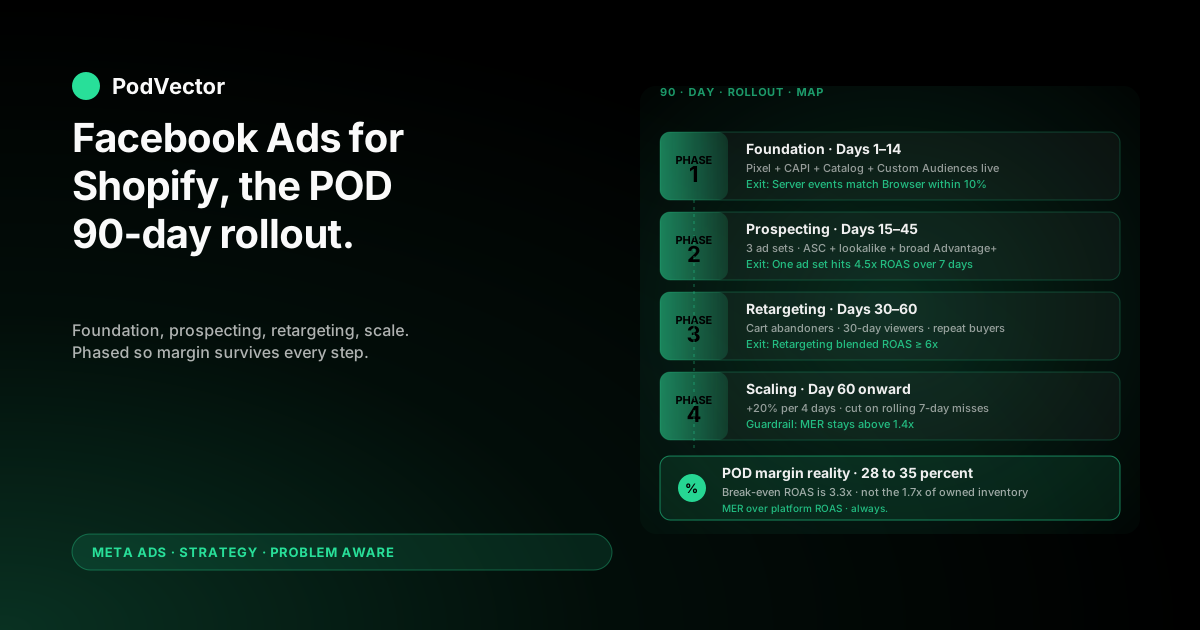
Quick Answer: A Facebook Ads for Shopify strategy that actually works for print-on-demand isn't a tactics list. It's a 90-day rollout: build the data foundation in weeks 1–2, run a structured prospecting test in weeks 3–6, layer retargeting once data is flowing, then scale only after the unit economics survive a margin check.
Most published "Shopify Facebook ads" advice assumes 50–60% gross margin. POD operates at 28–35% contribution margin after Printify or Printful supplier costs. The whole playbook has to bend around that gap.
This article walks the rollout phase by phase, tells you which decisions to make at each spend tier, and explains why MER (marketing efficiency ratio) — not platform-reported ROAS — is the only number that survives POD's thin margins.
Why generic "Facebook ads for Shopify" advice misfires for POD
Search "Facebook ads for Shopify" and you'll get strong, well-researched guides — AdCreate's 2026 sales guide, OptiMonk's beginner playbook, EasyApps' complete strategy guide. None of them are wrong. They're just calibrated for a Shopify store that owns its inventory.
POD is structurally different. Printify or Printful keeps 50–65% of the order subtotal as supplier cost before any ad spend touches the P&L. The remaining 35–50% has to absorb merchant fees, shipping uplifts, refunds, and CAC.
That math collapses three assumptions baked into every generic guide.
Assumption 1: A 2.5–4x ROAS is healthy
For an owned-inventory Shopify store, sure. For POD it's a guarantee of losing money on every order.
The break-even ROAS for a POD store running 30% contribution margin lands at roughly 3.3x. A 2.5x reported ROAS means you paid Meta to manufacture a loss.
You need 4.5x+ on prospecting to leave room for refunds and seasonality. Generic "Shopify Facebook ads" advice hides that bar.
Assumption 2: Meta's revenue-weighted optimization picks your winners
Meta's purchase optimization weights the order subtotal it sees. For POD that subtotal includes the Printify supplier cost — so Meta optimizes toward the orders Printify makes the most money on, which are not the orders you make the most money on.
A $42 hoodie with $26 supplier cost and an $18 t-shirt with $7 supplier cost both look like wins to Meta. To you, the t-shirt's contribution margin is roughly $11; the hoodie's is roughly $16 pre-shipping. The ratio matters more than the headline.
Assumption 3: You can scale with creative testing alone
This is true for stores at 50% margin. At 30% margin, every $1,000 of misallocated budget is roughly $300 of lost contribution before you notice. Scaling without a profit-aware feedback loop digs the hole faster than creative iteration can fill it.
What survives all three? A phased rollout that builds the measurement layer first, then prospects, then retargets, then scales.
The 90-day Shopify-to-Meta strategy at a glance
The whole playbook sequenced over a quarter. Use this as the rollout map; the sections below unpack each phase.
| Phase | Days | Goal | Spend | Exit criteria |
|---|---|---|---|---|
| 1. Foundation | 1–14 | Pixel + CAPI + Catalog + Custom Audiences live and verified | $0–$200/day test traffic only | Server-side events match browser within 10% |
| 2. Prospecting | 15–45 | Find 1–3 audience-creative combos that hit break-even ROAS | $50–$150/day per ad set | One ad set delivers 4.5x+ ROAS over 7 days |
| 3. Retargeting | 30–60 | Add cart abandoner + 30-day visitor flows | 10–20% of total budget | Retargeting blended ROAS ≥ 6x |
| 4. Scaling | 60+ | Raise budgets on winners; cut losers fast | +20% per week per ad set | MER stays above 1.4 (POD-adjusted) |
Notice phases overlap. Retargeting starts at Day 30 even while prospecting is still proving itself, because the retargeting pool needs traffic to have any pool at all.
For the broader sequencing question across all your Meta campaigns, the cluster pillar — the complete Meta Ads playbook for POD sellers — frames the whole stack. This article zooms into the Shopify-specific tactics inside Phase 2 and beyond.
Phase 1 (Days 1–14): Foundation that survives iOS
Most failed Facebook-Shopify campaigns trace back to a broken or partial measurement setup. Fix it before you spend a meaningful dollar.
The four pieces that have to be live
Meta Pixel via Shopify's Facebook & Instagram channel app. Fires browser-side events: PageView, ViewContent, AddToCart, InitiateCheckout, Purchase.
Conversions API (CAPI) from Shopify's servers. Toggle it inside the same channel app — Shopify wires it without manual code. CAPI (Meta's server-side event channel) recovers the 30–50% of iOS conversions the Pixel alone misses.
Product catalog auto-synced to Commerce Manager. Default sync pushes every active SKU; for POD that's noise. Override to a curated 8–15 SKU list, picked from the top organic-orders decile of the last 90 days.
Custom audiences from your Shopify customer list and email subscribers. These are the seeds for every lookalike and retargeting layer downstream.
The verification step nobody does
Before you spend a real dollar, open Meta Events Manager and check the Server column against the Browser column on Purchase events. They should be within 10% of each other for the last 7 days.
If Server is blank, CAPI isn't actually firing. If Browser is 3x Server, you've got duplicate events that will inflate every reported metric.
Run $20/day of test traffic to a top product page for 3–5 days just to populate the events. Then verify before scaling.
The aggregated event measurement (AEM) ranking
Meta lets you rank up to 8 web events per domain. Order them by what matters to you, not what Meta defaults to.
For POD: Purchase > InitiateCheckout > AddToCart > ViewContent. Custom event for "high-margin SKU purchase" goes above generic Purchase if you have it set up. The first event in the rank is the only one Meta uses for opted-out iOS traffic, so put your money event on top.
Phase 2 (Days 15–45): Prospecting that learns fast
Phase 1 gives you data plumbing. Phase 2 finds the audience-creative combo that converts at a price your margin can absorb.
The three audience options to test
Advantage+ Shopping Campaign (ASC). Meta's automated catalog campaign. Hands the algorithm your full catalog and lets it pick. Strong floor, low ceiling. For POD, this is your baseline — almost always profitable, rarely the breakout winner.
Lookalike of past purchasers (1–3%). Built from your Shopify customer list of 200+ orders. Meta matches those identities to its user graph and finds nearby profiles. This is where POD wins live, because POD buyers don't share interests — they share taste, which behavior-based lookalikes capture and interest-targeting doesn't.
Broad Advantage+ Audience. No interest input; let Meta pick from its full user graph using your conversion signal. Surprisingly competitive at scale, but burns budget early before it learns. Run with caution at small budgets.
The campaign structure that fits a small POD account
One campaign, three ad sets, three creatives per ad set. Total: nine ads in market.
Budget allocation: $50/day per ad set, $150/day total for the prospecting test. Run for 7 full days minimum before judging — a Tuesday-to-Tuesday window catches both weekday and weekend buying behavior.
Optimization event: Purchase. Don't optimize for ViewContent or AddToCart even if Meta nudges you to "build data." Top-of-funnel optimization at low budget produces top-of-funnel results.
What to judge after 7 days
Cost per purchase, not ROAS. ROAS at low spend is so volatile it tells you nothing — one $80 sale can swing a $50/day ad set from 1.5x to 4x.
Cost per purchase ceiling for POD: $4–$7 on a $25–$45 average order value. If an ad set is hitting that band over 7 days with a sample of 20+ purchases, it's a candidate to scale. If not, kill it and rotate.
For a deeper read on which numbers to trust at this stage, see the complete guide to Meta Ads ROAS and attribution for POD.
Phase 3 (Days 30–60): Retargeting layer
Retargeting is the one place Meta still posts owned-inventory-grade ROAS for POD. Done well, it pulls 6–12x on a small fraction of total spend.
The three retargeting segments that actually convert
7-day cart abandoners. Highest intent, freshest signal. Meta knows these people clicked checkout and stopped — a reminder ad with the exact product, a soft trust cue (free shipping over $X, 60-day return guarantee), and a single CTA closes a meaningful share.
30-day product viewers (excluding purchasers). People who hit a product page but didn't add to cart. Lower intent than cart abandoners but a much larger pool. Run dynamic catalog ads — Meta auto-pairs the visitor with the product they viewed.
180-day past purchasers (for repeat). Smaller spend, but POD buyers who liked a design tend to come back for a second one. Run as a separate campaign with a "what's new in your size" angle.
Budget split
Retargeting should be 10–20% of total Meta spend. More than that and you're cannibalizing prospecting traffic — those people would have converted from your email flow anyway.
Less than 10% and you're leaving the highest-ROAS pocket of your account underbudgeted.
Frequency caps that actually save margin
Cap retargeting frequency at 3 impressions per 7 days for cart abandoners and 5 per 14 days for product viewers. Meta's default has no cap, which means a high-intent visitor can see the same creative 12 times in a week. That tanks both performance and brand perception.
Phase 4 (Day 60+): Scaling without burning the account
Scaling is where most POD operators undo the discipline of Phases 1–3 in two weeks.
The 20% rule
Raise budgets on a winning ad set by no more than 20% per 4-day window. Bigger jumps trigger Meta's learning phase, which resets the algorithm's calibration on that ad set and often produces 3–7 days of inflated CPMs and weaker ROAS before recovery.
A $50/day ad set goes to $60, then $72, then $86. Patient scaling beats panic scaling on every account I've seen.
The MER guardrail
Set a MER (marketing efficiency ratio) floor — total revenue divided by total ad spend, all channels — and refuse to scale past it.
For POD, the MER floor is roughly 1.4x at 30% contribution margin. Below 1.4x and you're in a position where scaling reveals you've been losing money slowly.
This is the metric the section below dives into.
When to cut
An ad set that hasn't hit break-even ROAS over a rolling 7-day window with at least 30 purchases gets cut. No "give it more time." Meta's algorithm has had its chance with statistically meaningful data; if it didn't find a profitable pocket, it won't.
The metric stack: MER over reported ROAS
The single most important reframe in POD Facebook ads is moving off platform-reported ROAS as the primary decision metric.
Why platform ROAS lies
Meta reports ROAS based on revenue (subtotal) it sees from its attributed conversions. Three things distort it:
Inflated revenue. Meta sees $42 on a $42 hoodie. You see $42 minus $26 in supplier cost minus $4 in payment processing. Meta's denominator is your gross; your decision-relevant denominator is contribution.
Over-attribution. Meta claims credit for purchases that would have happened from email, organic, or direct traffic. The platform's view-through and click-through windows overlap.
Channel myopia. Meta doesn't see what Google, TikTok, or your email flow contributed to the same buyer journey. Each channel reports the same purchase as their own.
What MER captures that platform ROAS doesn't
MER = total store revenue ÷ total ad spend across all channels. It's blunt, but it's the only number that survives all three distortions above.
If your store does $50,000/month and you spend $25,000 across Meta + Google + TikTok, your MER is 2.0x. At 30% contribution margin, your contribution is $15,000 — leaving $-10,000 after ad spend. Profitless growth.
The break-even MER for POD at 30% margin is roughly 3.3x. Sustainable growth lives at 4x+.
Why this is hard to operate by hand
MER calculation requires pulling Shopify revenue, Meta spend, Google spend, refund data, and Printify supplier costs into one view. Most POD operators have spreadsheets that do this monthly — usually too late to course-correct.
The leverage move is putting the same data into a unified live view so MER updates daily. Victor — PodVector AI's AI employee — connects your Shopify, Meta, Google, and Printify data so you can ask "what's our MER this week, by channel, after Printify costs?" and get an answer in seconds instead of opening a spreadsheet.
Victor answers the question. Tomorrow it'll act on the answer — pausing ad sets that drop MER below the floor, raising budgets on ones that beat it. The infrastructure to track is the same infrastructure that will eventually automate.
Creative cadence at each spend tier
Creative testing is the second-highest-leverage activity after measurement. The volume that's right depends on spend.
$50–$200/day: 2 new creatives per week
At low spend, fewer creatives let each one accumulate enough data to judge. Two new ones per week, three creatives in market at any time, rotate the bottom performer when a new winner emerges.
Format mix at this tier: one UGC video (15–30 seconds), one static lifestyle image, one product-on-white catalog ad.
$200–$500/day: 4 new creatives per week
Higher spend supports more parallel testing. Four new per week, six creatives in market, weekly creative review meeting.
Format mix: shift toward 60–70% video. Add carousel ads showing 3–5 products in one unit. Test one "creative angle" variation per week — a different hook, not just a different image.
$500+/day: 8+ new creatives per week
At this spend, creative fatigue is the primary cause of declining ROAS. Eight or more new per week, with retired creatives cycling back in 6–8 weeks later.
This is also the spend tier where in-house creative production starts paying for itself. The unit cost of one freelance UGC video drops below the daily ad spend it supports.
Five ways POD operators quietly break this strategy
1. Optimizing toward Meta's revenue, not your contribution
Letting Meta pick winners by reported revenue means letting it pick winners by Printify's revenue. The fix is the curated catalog (Phase 1) and the MER guardrail (Phase 4).
2. Scaling on platform ROAS during a soft week
Ad accounts have soft weeks — holiday weeks, payday gaps, news cycle distractions. Platform ROAS dips, then recovers. Scaling decisions made in the dip are the most expensive ones operators make.
Use a 14-day rolling window for scaling decisions, not a 7-day window. Half the noise smooths out.
3. Letting the catalog auto-sync default
A 200-SKU catalog at $150/day spreads learning so thin no SKU breaks out. Curate to 8–15 SKUs and re-curate quarterly.
4. Skipping CAPI verification
"CAPI is on" and "CAPI is firing" are different states. Until you've verified Server-side numbers in Events Manager, treat your data as half-broken and your ROAS as half-fictional.
5. Treating every product launch as a new account
POD operators sometimes launch a new design in a fresh ad account "to keep things clean." This throws away the lookalike seeds, the catalog signal, and 90 days of CAPI history. Launch new designs as new ad sets in the existing account, full stop.
The thread connecting all five
None of these are creative or targeting failures. They're measurement and architecture failures that creative work can't paper over. The phased rollout above prevents them by design.
For the next layer of detail on integration plumbing — the Shopify-Meta connection itself, not the campaign strategy — see the complete guide to Meta Ads + Shopify integration for POD. For the prior strategy article in this cluster covering the signal stack in more depth, see the Facebook Ads Shopify strategy article. The full strategy library lives at the Meta Ads strategy hub, and the broader topic at Meta Ads for POD.
FAQs
What ROAS should I aim for on Facebook ads for my Shopify POD store?
Break-even is roughly 3.3x at 30% contribution margin. Aim for 4.5x+ on prospecting and 6x+ on retargeting. Anything below 3.3x is a guaranteed loss after Printify or Printful supplier costs.
Should I use Advantage+ Shopping Campaigns for a POD store?
Yes, as your baseline ad set. ASC almost always delivers profitable spend at low budget. Pair it with a lookalike-of-purchasers ad set, which is where the breakout winners usually come from.
How long should I run a Facebook ad before judging it?
7 days minimum, 30+ purchases minimum. ROAS at low spend is too volatile to judge after 3–4 days — one outlier sale can swing the number. Use cost-per-purchase as the early indicator and ROAS as the confirming metric.
How much budget do I need to start Facebook ads on Shopify for POD?
$50/day per ad set is the realistic floor. Below that, learning data accumulates too slowly for the algorithm to optimize. $150/day total ($50 × 3 ad sets in your prospecting test) is the practical entry point.
Why is my Meta-reported ROAS higher than my Shopify dashboard shows?
Meta over-attributes. Its view-through window credits conversions that came from email, organic, or direct traffic, and its click-through window overlaps with other channels. Use MER (total revenue ÷ total ad spend across all channels) as the truth metric, not platform-reported ROAS.
How do I know if CAPI is actually working?
Open Meta Events Manager, look at the Purchase event over the last 7 days, and compare the Server column to the Browser column. They should be within 10% of each other. If Server is blank or wildly different, CAPI is broken — fix before you scale.
Is dynamic retargeting worth setting up for a small POD catalog?
Yes, even at 8–15 SKUs. Dynamic catalog ads auto-pair visitors with products they viewed, which removes the need for you to manually build retargeting creatives per SKU. Setup is one-time; the ROAS lift is ongoing.
Stop guessing whether your Facebook ads are profitable
Platform ROAS lies for POD. The real question is whether each ad set is profitable after Printify or Printful supplier costs, refunds, and processing fees — calculated daily, not when the spreadsheet gets updated.
Victor — PodVector AI's AI employee — connects your Shopify, Meta, Google, and Printify data into a live data warehouse and answers profit questions in seconds. And see your true MER by channel before your next budget decision.
Try Victor free