
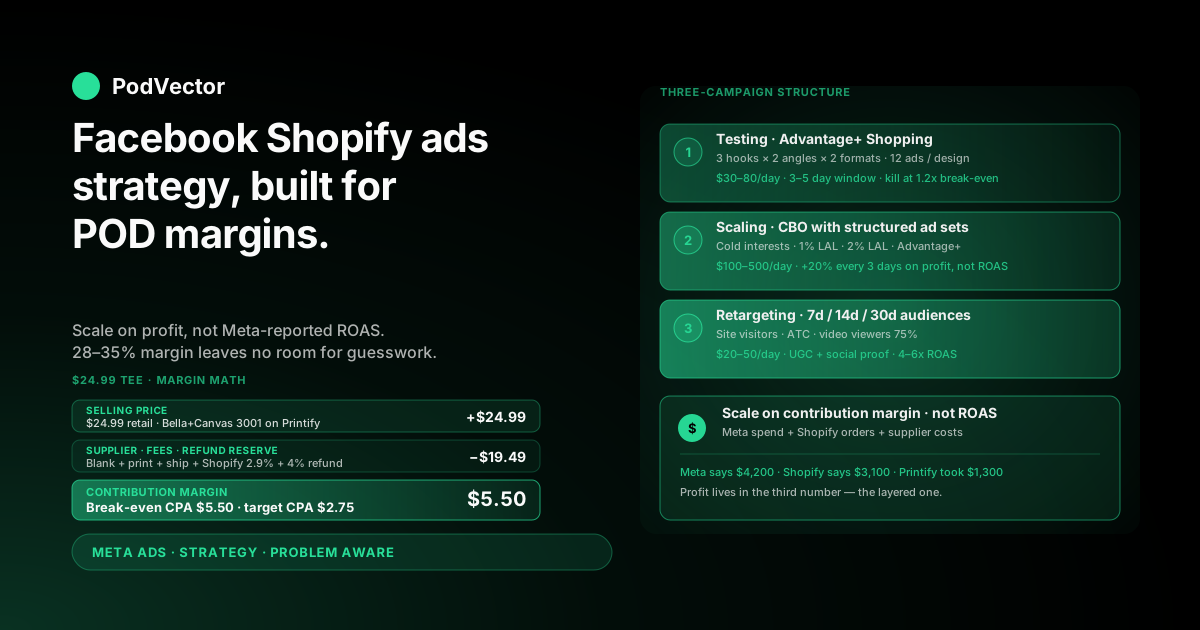
Quick Answer: A Facebook Shopify ads strategy for print-on-demand needs three layers most generic guides skip: a margin-led objective (not just ROAS), creative testing that filters on per-design profit, and a scaling rule based on contribution margin instead of platform-reported revenue.
POD sits at 28–35% net margin after the supplier's cut. That changes the math on every audience, creative, and budget decision compared to a 60%-margin brand. A 3.0 ROAS that looks healthy on Meta can be a $0.40-per-order loss once Printify or Printful royalties land.
The strategy below is built for that reality: a small, structured testing budget, profit-aware scaling, and a single source of truth that ties Meta, Shopify, and supplier costs together so you stop guessing which campaign is actually paying for itself.
Why most POD Facebook ad strategies fail at scale
Most Facebook ads guides for Shopify treat your store like a 60%-margin DTC brand. POD is not that. For a wider view of how Meta fits into a POD operation, see our Meta Ads for POD topic hub.
You sell a $24.99 t-shirt. Printify or Printful takes $11–14 for blank, print, and shipping. Shopify takes $0.85 in transaction fees. Meta charged $4.50 to acquire the customer. You have $4–6 left, before any return, refund, or apparel-policy chargeback.
That math means a strategy designed for higher-margin verticals will quietly bleed money even when the dashboard looks green. Meta's reporting overstates ad-driven revenue by 15–30% in most accounts. Layer that on top of POD's thin margins, and a "scaling" campaign can flip from profitable to loss-making for two weeks before you notice.
A real strategy for Shopify POD has to do two things the generic playbooks don't: build campaigns around profit per order, not just ROAS, and connect Meta, Shopify, and supplier data so the numbers you scale on are the numbers that hit your bank.
The strategy framework: start with margin, not ROAS
Before you launch a single ad, write down three numbers for each product you plan to advertise:
- True product cost: blank + print + shipping from Printify or Printful, plus any markup. For a Bella+Canvas 3001 tee on Printify, this is usually $11–13 delivered.
- Variable per-order cost: Shopify transaction fee (~2.9% + $0.30), refund/return reserve (assume 3–5% on apparel), and any app fees per order.
- Contribution margin: selling price minus the two above. This is what's left to pay for ads and profit.
Now the strategy question is no longer "what ROAS do I need?" It is "what break-even cost-per-acquisition (CPA) does my contribution margin allow, and how much of that margin am I willing to spend to acquire a customer?"
For a $24.99 tee with $5.50 contribution margin, your break-even CPA is $5.50. A 50% margin-share rule means your target CPA is $2.75 — at which point you keep half the margin and Meta keeps the other half. That is your testing target. That is your scaling target. ROAS is a downstream metric.
This shift is small in words and huge in practice. Most POD operators are scaling on a 2.5x ROAS rule and wondering why their bank balance keeps shrinking. The math says it would.
Audience strategy for POD products
POD wins on niche specificity. The tee that sells says something a specific group of people already believe about themselves — they're a nurse, a Bernese Mountain Dog owner, a recovering accountant. Your audiences should mirror that.
Three audience layers, in this order
1. Cold interest stack. Two to four narrow interests stacked into one ad set, audience size 500K–2M. For a "Bernese Mountain Dog mom" tee, stack the breed, breed clubs, and adjacent dog-mom interests. Wider audiences sound modern but Meta still rewards interest signal at low budgets.
2. Lookalike from purchasers. 1% lookalike off your last 90–180 days of buyers, once you have 100+ purchase events. This is your highest-intent cold audience. Build a 2% lookalike too, but only for scale — the 1% almost always outperforms.
3. Retargeting layers. 7-day site visitors, 14-day add-to-cart, 30-day video-viewers (75%+). Retargeting closes orders that interest cold audiences started.
What not to do
Don't broad-target on Day 1. "Open targeting" works for accounts with 500+ purchases of historical pixel data. New POD stores starve Meta of signal, and broad ad sets without that history burn budget on people who would never buy a $25 tee.
Don't stack 8+ interests into one ad set. The audience becomes too vague for Meta to optimize, and your CPM drops while your CPA explodes.
Creative testing the right way
Creative is the single largest lever for POD on Meta. Audiences, bid strategies, and placements barely move a campaign that has the wrong creative; the right creative makes mediocre audiences profitable.
Ad-platform veterans call this the "creative-first" era — and for POD, where the design is the product, it's even more true.
The 3-2-2 testing structure
3 hooks × 2 angles × 2 formats. For each design you test, build:
- 3 opening hooks (the first 1.5 seconds of a video or the headline of a static)
- 2 angles (gift framing vs. self-purchase framing, for example)
- 2 formats (UGC-style video and lifestyle static)
That's 12 ads. Run them in a single Advantage+ campaign with a $30–50/day budget for 3–5 days. Most will lose. One or two will win — usually by 2–3x the others on CPA.
What "winning" actually means
Don't kill ads on ROAS alone. Kill ads when their CPA exceeds your break-even CPA after 50–80 link clicks of data. That's a roughly 95% statistical confidence threshold for typical POD click-through rates, which protects you from killing a future winner on noise.
Promote ads that beat your target CPA, not just your break-even. The difference is the margin you actually take home.
Campaign structure: test, then scale
One of the cleanest structures for a POD Shopify store has three campaigns running simultaneously, each with a clear job:
Campaign 1: Testing (Advantage+ Shopping)
Budget: $30–80/day total. New creatives only. Optimization event: Purchase. Audience: Advantage+ broad, with your custom audience exclusions for buyers and recent visitors so you don't pay for retargeting traffic here.
Job: surface winners. Anything beating target CPA at 50+ clicks gets promoted to Campaign 2.
Campaign 2: Scaling (CBO with structured ad sets)
Budget: $100–500/day, scaled in 20% steps every 3 days. Two to four ad sets: one cold-interest stack, one 1% lookalike, one 2% lookalike, one Advantage+ shopping. Only winning creatives from Campaign 1.
Job: capture demand. This is where most of your spend should live once you have proven creatives.
Campaign 3: Retargeting
Budget: $20–50/day. Audiences: site visitors 7-day, add-to-cart 14-day, video-viewers 30-day. Creatives lean on social proof, urgency, and a small offer (free shipping over $50, for instance).
Job: convert warm traffic. Expect 4–6x ROAS here, but cap budget — the audience pool is finite.
This structure mirrors what most experienced POD operators converge on. For the deeper how-to on launching each piece, see our complete Meta Ads playbook and scaling Facebook ads with Shopify. The full Meta Ads strategy cluster covers each campaign type in detail. Shopify's own 5 winning Facebook ad strategies is a useful generalist primer if you want a non-POD baseline for comparison.
Budget pacing for low-margin products
POD margins force a slower scale than most YouTube gurus suggest. The "double the budget every day" advice destroys low-margin accounts because Meta's auction punishes sudden budget jumps with worse delivery.
A reasonable pace for Shopify POD:
- Days 1–3 of a winner: 20% increase per day if CPA stays under target.
- Days 4–7: 30% every 2 days, monitoring profit (not Meta-reported revenue).
- Week 2+: If profit stays positive on a 7-day rolling window, step up to a new creative refresh; if not, hold or cut.
Two pacing rules that protect margin:
First, never raise an ad set's budget the same day you change its creative. You can't tell whether a delivery shift came from the creative or the budget.
Second, kill aggressively on the way down. If a campaign's 3-day rolling CPA crosses 1.2x your break-even, pause it. Reaching break-even is not "almost profitable" for POD — it is a money-losing campaign with a refund liability still to land.
Retargeting and lookalike layers
Cold campaigns get most of the attention. The hidden margin in a Shopify POD account usually sits in the retargeting and lookalike layers, where ROAS is 3–5x what cold delivers.
Lookalike layering
Build three lookalike audiences from the most valuable signals you have, in this priority order:
- Purchasers (last 180 days)
- Add-to-cart, last 60 days
- View-content, last 30 days, value-based if you can
The 1% LAL of purchasers is almost always your highest-intent cold audience. Test a 2% LAL once you've stabilized at 100+ orders/month — it gives Meta room to scale without burning ad budget on near-random users.
Retargeting creative is different
Retargeting creative should not be the same ad you used to acquire the cold visitor. Cold creative establishes the design and the niche; retargeting creative addresses what stopped them from buying.
UGC reviews, customer photos, urgency around shipping cutoff, and a small offer (free shipping over $X) all outperform a re-run of your acquisition ad. Build 3–4 retargeting creatives and rotate every 2–3 weeks to fight ad fatigue.
Profit-aware optimization (the part nobody else writes about)
Here is what changes everything for a POD store and what almost every "Facebook ads strategy" guide misses: the number Meta reports is not the number that decides whether your campaign is profitable.
Meta Ads counts purchases by its own attribution model — 7-day click + 1-day view by default, with view-through credit, and with iOS 14.5+ aggregated event measurement papering over the gaps. Shopify counts the orders that actually happened. Supplier costs are visible in neither place.
To make scaling decisions on profit, you need three streams in one place:
- Meta Ads spend at the campaign/ad set/ad level
- Shopify orders with attribution and discounts applied
- Supplier costs per SKU from Printify, Printful, or your supplier of record
With those three layered, you can see contribution margin per campaign, per creative, and per design — not just ROAS. That's the data layer that turns a Facebook ads strategy from a hopeful exercise into a math problem you can win.
This is exactly the gap PodVector AI's AI employee, Victor, was built to close. Victor is an AI agent connected to a live data warehouse that unifies your Meta, Shopify, and Printify or Printful data, so when you ask "which creative is actually profitable this week, after supplier costs?" you get an answer in seconds — with the math shown, not a generic dashboard.
For more on the reporting gap itself, see the discrepancy between Facebook Ads and Shopify and the Meta Ads ROAS and attribution guide for POD.
Five mistakes that kill POD ad accounts
1. Scaling on Meta-reported ROAS
Meta's number is inflated by view-through credit and modeled conversions. Scale on Shopify-confirmed orders or — better — on contribution margin from a single source of truth.
2. Killing creatives too fast
POD click-through rates are noisy at low spend. Wait for 50+ link clicks before judging a creative's CPA, or you'll kill future winners on a 12-click bad luck streak.
3. Ignoring refund and chargeback rates
Apparel typically refunds at 3–6%. If your CPA math doesn't reserve for that, your reported margin is fiction. Bake the reserve into break-even CPA from day one.
4. One audience, one creative, one ad set
You're starving Meta of the variation it needs to learn. Three to five creatives per ad set, two to three ad sets per campaign — minimum.
5. Treating supplier choice as a fulfillment decision
Printify and Printful charge different prices for what looks like the same blank. A $1.20 difference per unit at 1,000 orders/month is $14,400/year — comfortably more than the spread between a "good" and "great" creative. See our Print-on-Demand costs and charges hub for the supplier-by-supplier breakdown.
FAQs
How much should I spend testing a new POD design on Facebook ads?
$30–80/day for 3–5 days, with 8–12 creative variants in a single Advantage+ campaign. That's enough budget to give Meta signal without committing real money to a design that hasn't proven demand yet.
What's a good ROAS target for Shopify POD?
Break-even ROAS depends on contribution margin. For a $25 tee at $5.50 margin, break-even is roughly 4.5x. Target ROAS for healthy profit is 5.5–6x. Anything below 4.5x is losing money once supplier costs and refunds land.
Should I use Advantage+ or manual campaigns for POD?
Both. Use Advantage+ Shopping campaigns for testing (Meta's machine learning is good at finding pockets of demand). Use manual campaigns with structured ad sets for scaling, where you want control over which audiences get the budget.
How long before a Facebook ads strategy starts working for POD?
Two to four weeks before you have stable winners and a working scaling rule. Faster than that is usually a fluke; slower is usually wasted creative volume or a margin problem masquerading as an ad problem.
How many ads should I run per campaign?
Three to six creatives per ad set during testing, two to three winners per ad set during scaling. Beyond that, Meta's algorithm spreads budget too thin and learning gets noisy.
Should I run Facebook ads for every Shopify POD product?
No. Run ads on the 20% of designs that have proven organic interest first — saves, shares, or any traffic that converted at all. Designs that don't sell organically rarely become winners through paid alone.
Stop scaling on the wrong number.
A Facebook Shopify ads strategy only works if the number you're scaling on is true. Meta says one thing. Shopify says another. Printify takes its cut from both.
Victor connects Meta, Shopify, and your supplier data into one live source of truth, then answers your strategy questions in plain English — "which creative is profitable after supplier costs this week?" — with the math shown.
Built for POD margins. No spreadsheets, no Looker license, no analyst on retainer.
Try Victor free