
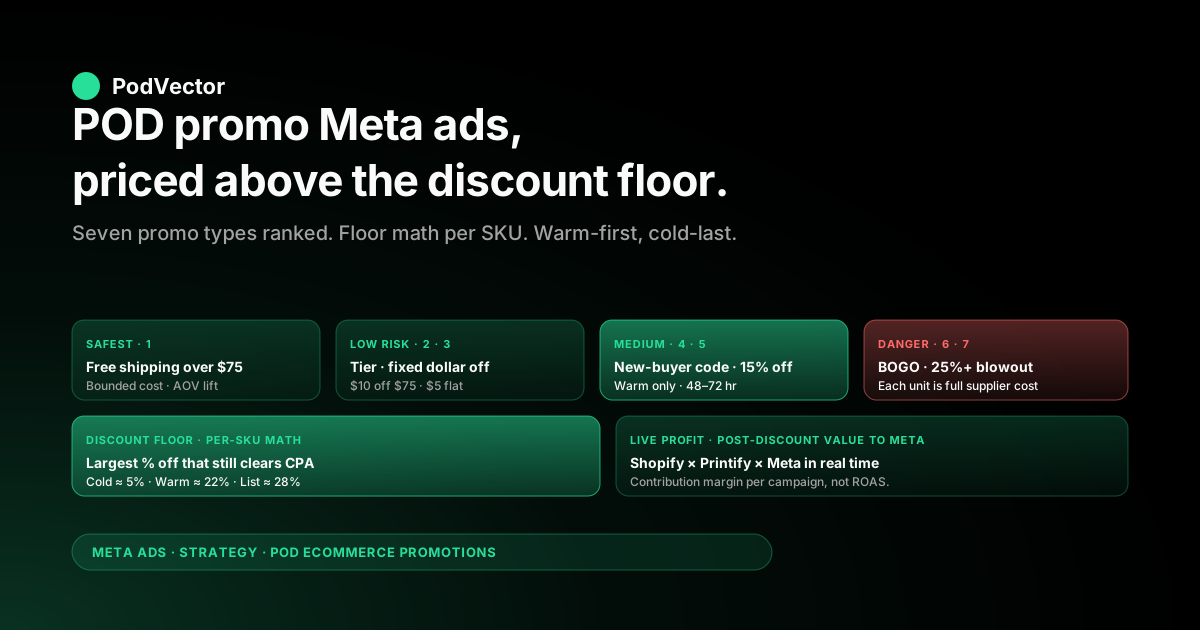
Quick Answer: Promotions on Facebook Ads work for print-on-demand stores, but only if the discount math respects POD margins. A 25% off site-wide promo on a $25 mug with $9 supplier cost and $4 fulfillment leaves about $0.75 of contribution margin per unit before ad spend — meaning a 4x ROAS still loses money.
The right POD promo strategy starts with a discount floor (the smallest discount you can offer and still clear acquisition cost), then layers warm audiences before cold, then tracks profit after the discount as the conversion value Meta optimizes for.
This guide ranks seven common ecommerce promotion types by POD margin safety, walks the floor-pricing math, and lays out the campaign structure, creative, and tracking layer that keep a Facebook Ads promo from quietly draining the bank.
Why generic promo playbooks misfire on POD margins
Most ecommerce promotion playbooks — including the comprehensive ones from the agency world like Convertcart's 26 Secrets to Running Successful Facebook Ads — assume owned-inventory economics. A $30 candle with $7 cost-of-goods sold, a $50 supplement with $9 raw-material cost, an apparel SKU stocked at wholesale.
Print-on-demand inverts that cost stack. Your supplier (Printify, Printful, Gelato, SPOD) charges a per-unit production fee that already eats 35–55% of retail. Add platform fees, payment processing, and a Meta CPM, and the contribution margin on a $25 unit usually sits between $5 and $9 before discounts.
That math has three implications for promotions.
Implication one: the discount floor is much higher than owned-inventory. A Shopify-native brand can shave 30% off a stocked SKU and still keep $6 of contribution. A POD store running the same 30% discount can land at negative contribution per unit. The floor is real, and most stores haven't calculated theirs.
Implication two: discount-driven traffic optimizes Meta toward the wrong SKUs. Promotions tend to attract gift-bundle buyers and multi-item carts. In a POD catalog those tend to be your highest-revenue, lowest-margin orders. If conversion value sent to Meta is order subtotal, the algorithm scales toward your worst margins.
Implication three: ROAS becomes a vanity metric. A 5x ROAS on a 30%-off site-wide promo can be a money-losing campaign once supplier cost and fulfillment land 3 days later. The number that matters is contribution margin per campaign — and almost no promo dashboard surfaces it natively.
Seven promo types ranked by POD margin safety
Not every promo type has the same POD risk profile. The list below ranks the seven most common ecommerce promotions from safest to riskiest, with the margin reasoning behind each.
| Rank | Promo type | POD margin risk | Best use |
|---|---|---|---|
| 1 | Free shipping above threshold | Lowest | AOV lift on warm audiences |
| 2 | Spend-tier discount ($10 off $75) | Low | Bundle-driven AOV expansion |
| 3 | Fixed dollar off ($5 / $10) | Low–medium | Predictable cost per redemption |
| 4 | New-customer-only code (10–15%) | Medium | Cold acquisition with built-in cap |
| 5 | Site-wide percent off (15–20%) | Medium–high | Short-window sales events only |
| 6 | BOGO / 2-for-1 | High | Almost never works on pure POD |
| 7 | Site-wide blowout (25%+) | Highest | Inventory-clearance brands only |
1. Free shipping above threshold
Shipping is a fixed cost line in your POD unit economics — usually $4–$8 per order through Printify or Printful. Absorbing it as a promo on orders above $60–$75 lifts AOV (average order value) without compressing per-unit margin on the product itself.
Why it's the safest: the cost of the promo is bounded by your shipping bill, which doesn't compound the way a percent-off discount does. A 20% lift in AOV typically pays for the shipping absorption and then some.
2. Spend-tier discount
"$10 off orders over $75" works the same way in math: a fixed cap on the discount cost paired with a floor on the order size. The buyer self-selects into a higher AOV bracket where your unit margin can absorb the discount.
This is the format that scales cleanest in Meta Ads — the offer is concrete, the headline writes itself ("$10 off when you spend $75"), and the discount math is bounded.
3. Fixed dollar off
A flat $5 off any order is predictable. Unlike a percent-off promo, the cost per redemption doesn't grow with the order subtotal. That makes profit-per-order modeling cleaner for a POD store running on tight unit margins.
Trade-off: the promo headline is less punchy. "$5 off" tests below "20% off" on cold audiences in most A/B tests. If you go this route, the creative has to carry the conversion lift through urgency or social proof, not the offer itself.
4. New-customer-only code
A 10–15% discount gated to first-time buyers serves two purposes. It caps the bleed (returning customers don't redeem it), and it converts the discount cost into a customer-acquisition cost line you can track per cohort.
The risk for POD: the gating only works if your platform actually enforces it. Shopify's native discount-code engine handles new-customer-only codes well; most third-party promo apps do not, and a leaked code will show up across your warm audience inside 48 hours.
5. Site-wide percent off (15–20%)
The most-requested format and the second-riskiest. A 20% off promo on a $25 SKU with $14 of all-in cost compresses contribution margin from $11 to $6. After CPM and fees, you may walk away with $2 per unit on what felt like a strong promo.
The way to make it work: short windows (48–72 hours, not a week), warm audiences only, and an explicit floor on which SKUs are eligible. If your floor pricing math (next section) flags certain SKUs as below break-even at 20% off, exclude them from the promo entirely.
6. BOGO / 2-for-1
BOGO almost never works on pure POD because every unit you give away still costs the supplier. A BOGO on a $25 shirt with $11 supplier cost is a $11 loss per redemption, not a marginal-cost giveaway like it is for a brand with $2 wholesale T-shirts.
The rare exceptions: BOGO on a high-margin digital add-on (downloadable poster, sticker, gift card) bundled with the physical product, or BOGO on a SKU with unusually low supplier cost where the bundle still clears margin. Most stores should treat BOGO as not-for-POD.
7. Site-wide blowout (25%+)
The danger zone. A 25% off site-wide on a 35% gross-margin POD catalog leaves 10 points of contribution before CPM, fees, and shipping absorption. After those three lines, most stores are at or below breakeven on every unit sold during the promo.
The narrow case where it works: a deliberate awareness investment where you accept 1–2 weeks of below-breakeven economics in exchange for warm audience growth that monetizes over the next 90 days. This is a strategic decision, not a promo decision — and it should be modeled before it runs.
The discount floor: the math behind your real promo limit
Every POD store has a discount floor: the largest percentage discount you can apply and still clear breakeven on a single unit after the cost of acquiring the order. Almost no operator has calculated theirs explicitly.
The breakeven formula
The math for a single unit looks like this:
Contribution margin = (Price × (1 − discount)) − Supplier cost − Fulfillment − Payment fees − (Ad spend ÷ Conversions)
You want contribution margin above zero on every unit. Below is a worked example for a typical POD shirt.
| Line | Value |
|---|---|
| Retail price | $28.00 |
| Supplier cost (Printify) | $11.20 |
| Fulfillment / shipping (paid by store) | $0.00 (passed to buyer) |
| Payment processing (2.9% + $0.30) | $1.11 |
| Ad CPA at $20 cost-per-acquisition | $20.00 |
| Net contribution (no discount) | −$4.31 |
That's already negative at full price with a $20 CPA — the example is calibrated to the kind of squeeze a lot of POD stores live in when they're scaling acquisition aggressively.
Now layer in a 15% discount: retail drops to $23.80, payment processing to $0.99, contribution flips to −$8.39. The promo made the loss bigger, not smaller.
Where the floor actually sits
For a healthier POD unit (lower CPA from a warm audience, higher AOV, lower supplier cost), the floor lands somewhere between 8% and 18% before contribution turns negative. A few specific patterns:
- Warm-audience retargeting at $7 CPA, $35 AOV, 40% gross margin: floor sits around 22% off.
- Cold prospecting at $24 CPA, $28 AOV, 35% gross margin: floor sits around 5% off — barely worth promoting.
- Customer-list at $3 CPA, $40 AOV, 38% gross margin: floor sits around 28% off.
The implication: cold audiences can almost never afford a meaningful percent-off promo. Warm audiences can. Promo strategy follows.
SKU-level floors
The floor isn't store-wide — it's SKU-level. Mugs, hoodies, shirts, and posters all have different supplier-cost ratios on Printify and Printful. A 20% off promo can be safe on hoodies (lower cost ratio, higher absolute price) and disastrous on mugs (higher cost ratio, lower absolute price).
Practical fix: maintain a per-SKU floor table that joins your Printify or Printful invoices to your Shopify retail prices and recomputes weekly. The supplier prices shift more often than most operators realize — production-time premiums, regional fulfillment changes, and supplier-side margin moves all show up there. The complete Meta Ads playbook for POD sellers covers the supplier-cost ingest layer in detail.
Audience strategy: warm first, cold last
Generic ecommerce promo advice splits ad spend roughly 70% cold prospecting, 30% warm retargeting. For a POD promo that ratio inverts, for one structural reason: cold buyers can't usually clear the discount floor, but warm buyers can.
Promo audience priority order
Rank your promo audiences in this order, top to bottom, and allocate budget accordingly:
- Customer list (90-day buyers, 365-day buyers). Cheapest CPA you'll get. Promo discount slots above your floor easily. 35% of promo budget.
- Email subscribers (Shopify customer accounts, opt-in list). Already warm to brand, often the most discount-elastic audience you have. 20% of promo budget.
- 7-day site visitors and add-to-cart abandoners. Pre-qualified intent, warm Pixel signal. 25% of promo budget.
- Lookalike audiences from customer list. The closest cold audience to converting at warm-audience economics. 15% of promo budget.
- Cold prospecting on broad targeting. Kept on but with creative that doesn't lead with the discount — discount becomes a closer, not the headline. 5% of promo budget.
If this ratio feels unusually warm-heavy, that's the point. POD margins force the math.
Email-first promo motion
The cleanest POD promo motion runs email and Meta together. Email opens the promo to your existing list 24 hours before it goes public on Facebook Ads. By the time the Meta campaign launches, you have an early redemption signal that tells you whether the offer is working before you spend any cold-acquisition budget.
If email day 1 underperforms expected redemption by more than 30%, kill or rework the offer before the Meta budget loads. This single discipline saves more POD stores from money-losing promo windows than any creative tweak.
Creative formats that convert on a discount offer
Promo creative is different from evergreen creative. The job isn't to introduce a brand — it's to make a known offer feel time-bound, social-proof-backed, and frictionless to redeem.
Static creative that works
The strongest static promo ads share three traits: a single-product hero (not a collage), the offer in plain numbers (not "limited time" abstractions), and an explicit countdown reference (date or hours).
"$10 off any order over $75 — Sunday only" outperforms "Big sale this weekend" by 30–50% on CTR in cold-to-warm Meta auctions, year over year. Specificity is the conversion lever.
Vertical video for placement arbitrage
Reels-native 9:16 video continues to carry cheaper CPMs than Feed placement in 2026 — typically 20–35% cheaper for ecommerce promo ads. A 12-second vertical with the offer onscreen at the 2-second mark, social proof at 6 seconds, and a clear close at 10 seconds is the format Meta currently rewards.
Most POD stores ship square creative because it's easier to produce. Reformatting to 9:16 unlocks meaningful CPM savings during a promo window — usually 15–25% lift in delivered impressions per dollar.
UGC for trust on the discount
A surprising pattern: discount-led ads convert better with UGC (user-generated content) overlay than with polished brand creative. The mechanism is trust — a buyer who sees a 20% off promo from a brand they don't know defaults to skepticism. A UGC clip with a real customer and the discount overlaid on screen converts cold buyers at noticeably higher rates than glossy brand video with the same offer.
Carousel for bundle promos
If your promo is a tiered or bundle offer ("Buy 2 get $15 off, buy 3 get $30 off"), carousels outperform single statics by significant margins. The format mirrors the offer — multiple cards, multiple price points, swipe-driven engagement.
Campaign structure during a promo window
A POD promo window typically runs 48–96 hours. The campaign structure should match that timing — too many ad sets and you'll never escape Meta's learning phase, too few and you can't separate winners from losers.
Three-campaign structure
The structure that consistently performs across POD promo windows:
- Warm retargeting campaign (Conversion / Purchase optimization). 60% of promo budget. Two ad sets: 90-day customer list, 7-day site visitors. Promo creative leads with the offer.
- Lookalike campaign (Conversion / Purchase optimization). 25% of promo budget. One ad set, 1–3% lookalike on customer list. Mixed creative — some offer-led, some product-led with offer as closer.
- Cold prospecting campaign (Conversion / Purchase optimization). 15% of promo budget. Broad targeting, product-led creative with the offer in the description rather than the hook. Goal here is buyer acquisition, not promo redemption.
Bid strategy
For a 48–96 hour promo window, leave bid strategy on Highest Volume. Cost Cap requires too long a learning phase for the time you have, and Bid Cap risks under-delivery in the back half of the window when CPMs typically rise.
Daily budget: 2–3x normal evergreen levels for the warm campaign, 1.5x for the lookalike, normal for the cold prospecting. The bulk of the spend lift goes where the math works.
Creative rotation discipline
Promo creative fatigues fast — frequency above 2.0 in 48 hours is normal during a promo window, and CTR degrades visibly past frequency 2.5. Rotate creatives mid-window if the data flags fatigue. This is why seasonal POD playbooks emphasize building a deep creative library before the window opens.
Tracking profit when the discount eats the margin
Standard Meta reporting will tell you the promo "worked" the moment ROAS goes above 3.0. That number is misleading on a POD promo. The number you need is contribution margin per campaign after the discount, after supplier cost, after fulfillment, after fees.
The four tracking layers
- Pixel + Conversions API in dual-track mode. Server-side via CAPI catches what the browser-side Pixel misses. Without it, your promo data underreports purchase volume by 18–35% and the algorithm misallocates spend toward worse-performing ad sets. The Pixel and Conversions API setup guide walks the wiring detail.
- Discount-aware conversion value. Send the post-discount order total to Meta as the value parameter, not the pre-discount subtotal. Without this override, the algorithm optimizes against revenue that doesn't actually exist.
- Supplier cost ingest. Pull Printify and Printful invoices into a single source of truth. Production-time premiums and surcharges shift unit cost by $0.50–$1.50 in promo periods. Stale supplier costs make your "profit-as-value" number wrong by 5–10%.
- Profit-by-campaign attribution model. The metric that actually decides whether the promo worked: contribution margin per campaign, computed nightly across the promo window. A 4x ROAS campaign with negative contribution gets killed; a 2.7x ROAS campaign with $4 contribution per unit gets scaled.
The hourly decision window
A 48-hour promo window has roughly two business decisions worth making per hour during peak: pause an underperforming ad set, shift budget to a winner, rotate a creative crossing fatigue threshold. A spreadsheet that refreshes daily can't surface those signals fast enough.
The tracking layer that solves this is a live data warehouse: a unified data layer that joins Shopify orders, Printify or Printful supplier costs, and Meta ad spend in near-real-time. With that infrastructure in place, the promo dashboard moves from "yesterday's numbers" to "the last 30 minutes."
Victor — PodVector AI's AI employee for POD sellers — sits on top of that warehouse. During a promo window, you can ask "which campaign's actually profitable in the last 6 hours, after Printify costs land?" and get a concrete number rather than a Monday-morning recap.
Six promo mistakes that drain a POD ad budget
- Running the same promo across cold and warm audiences. Cold audiences can't clear the discount floor. Cold campaigns should lead with product, not promo, and use the discount as a closer.
- Forgetting to override conversion value with post-discount totals. Optimizing on pre-discount subtotal sends Meta a signal that doesn't match cash. The algorithm then scales toward orders that look profitable on paper but lose money in the bank account.
- Running a 7-day promo window. By day 4, frequency has crossed 4.0, CTR has collapsed, and your creative library is exhausted. Two-day windows work better and don't feel like a permanent discount to the brand.
- Not setting a per-SKU floor. A 20%-off site-wide promo will be safe on hoodies and lossy on mugs. Without a SKU-level floor table, you're discounting the worst-margin units the hardest.
- Treating BOGO as marginal cost. Every BOGO unit on POD is a fully-loaded supplier cost. Stores that run BOGO on $11-supplier-cost shirts learn the hard way.
- Ignoring the customer-list audience. Customer-list retargeting is the cheapest CPA in the building. Skipping it during a promo window is leaving 30–40% of contribution margin on the table.
FAQs
What's the smallest discount worth advertising on Facebook for a POD store?
For warm audiences, 10–15% is the lower bound where the discount is meaningful enough to drive redemption. For cold audiences, percent-off promos almost never clear the floor; lead with product or free-shipping-above-threshold instead.
Should I run a site-wide 20% off Black Friday promo?
Yes — but only on warm audiences, with SKU exclusions where the floor flags negative contribution, and with the 48–72 hour window. Running it cold and store-wide for a full week is the format that loses the most POD money on Black Friday. The seasonal Facebook Ads playbook covers the full Q4 cadence.
Is free shipping a promo or a permanent feature?
Treat it as a promo with a threshold ("free shipping over $50"), not a permanent feature. Permanent free shipping eats into every order's margin; threshold-based free shipping lifts AOV and pays for itself.
Why do my Facebook Ads ROAS numbers look strong on a promo but my bank account looks weak?
The classic POD promo trap. ROAS uses pre-discount, pre-COGS revenue. Your bank deposit is post-discount, post-supplier-cost, post-payment-processing. The fix is to track contribution margin per campaign — not ROAS — and to send post-discount profit to Meta as the conversion value.
How do I prevent my new-customer promo code from leaking?
Use Shopify's native discount engine with the "first order only" rule, never a generic code in your ad copy. Public-facing codes leak across warm audiences inside 48 hours; gated codes require an account and stay clean. Most third-party promo apps have weaker gating than Shopify's native engine, even when they advertise the feature.
What's the right ad spend during a 48-hour promo window?
2–3x your evergreen daily on warm campaigns, 1.5x on lookalikes, normal on cold prospecting. The lift goes where the math works. Doubling cold prospecting during a promo is usually a money-loser for POD because cold CPAs don't clear the floor.
Should I use Advantage+ Shopping Campaigns for promos?
Yes, with two caveats. First, send post-discount value to Meta via the Conversions API. Second, build a custom audience exclusion for SKUs you've flagged below the discount floor — Advantage+ will otherwise blend the whole catalog. Without those two guardrails, ASC will scale toward your worst-margin promo orders.
How does Meta's ad delivery change when I'm running a promo?
CPMs typically lift 8–15% during a heavy promo window because more advertisers crowd the auction with similar offers. Plan for that lift in your floor math — a 20% promo at peak-CPM week may behave like a 25% promo in margin terms once delivery costs land.
How is a promo strategy different from a product launch?
A launch builds awareness around a new SKU and usually doesn't lead with discount. A promo monetizes an existing catalog with a time-bound offer. The audience strategy inverts: launches lean cold, promos lean warm. The Facebook Ads launch playbook for POD covers the launch motion in detail.
Should I run promos year-round or save them for big windows?
Year-round but rare. Two to four small windows per quarter on warm audiences only, with one or two larger windows around BFCM and end-of-year. Permanent promo state desensitizes your buyers and makes evergreen campaigns harder to run profitably the rest of the year.
See your real promo profit, not just your promo ROAS
The reason most POD promos look profitable on the dashboard and unprofitable in the bank: ROAS uses pre-discount revenue, your deposit is post-discount, post-supplier-cost cash. The two numbers can disagree by 30%+ during a promo window.
Victor is the AI employee for POD sellers that joins your Shopify orders, Printify and Printful supplier costs, and Meta ad spend into a live profit view — so during a 48-hour promo you can ask "which campaign's actually profitable right now after the discount?" and get a numerical answer in seconds.
Free to start. Five-minute setup.
Try Victor free