
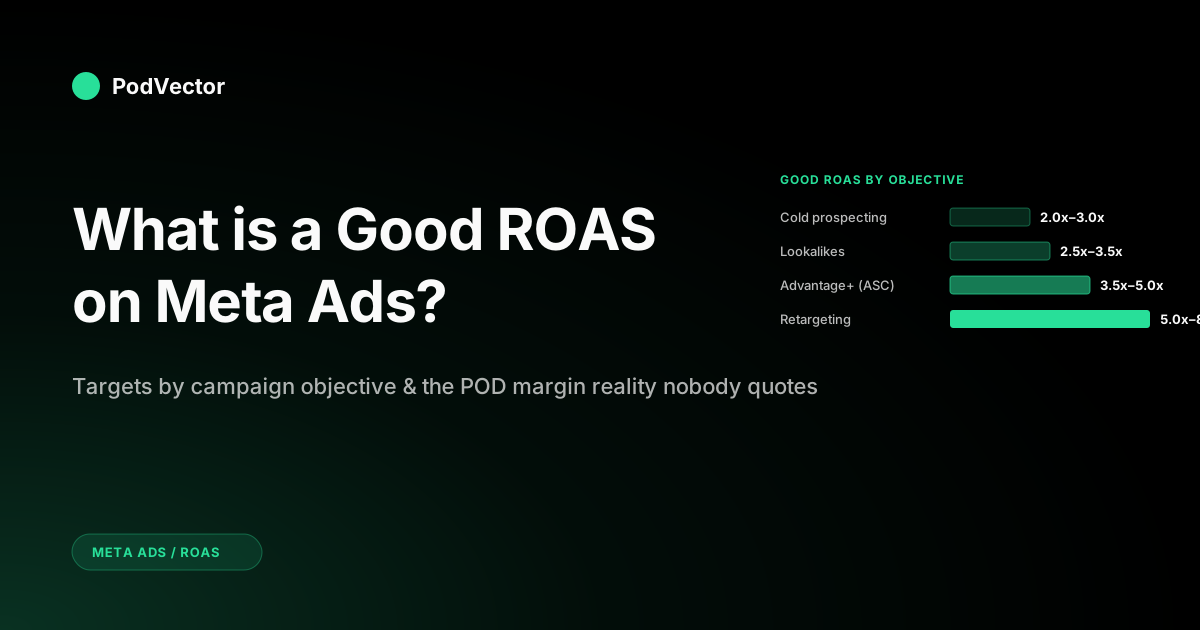
Quick Answer: A good ROAS on Meta Ads is usually 3.5x–5x reported ROAS for POD stores, not the lower average benchmark, because POD margins are thinner after supplier cost, payment fees, and refunds. On Meta Ads in 2026, the average ecommerce account runs about 2.79x reported ROAS, with 3.5x–4.5x considered "good" for direct-to-consumer brands and 5x+ marking the top quartile.
Those numbers were modeled on 50%–70% margin DTC brands. Print-on-demand sits at 20%–35% margin after supplier cost, payment fees, and refunds — so the same reported ROAS that says "good" for a candle brand says "losing money" for a POD store.
Good on Meta Ads, for a POD seller, is a number that clears 1 ÷ post-fulfillment margin with a buffer for overhead. For most POD stores that lands at 3.5x–5x reported ROAS — and the only number that tells you the truth is true ROAS measured after supplier cost.
What "ROAS" actually shows on Meta Ads
ROAS in Meta Ads Manager is a single column: attributed conversion value divided by spend. A 3.0 in that cell means Meta credits $3 of revenue for every $1 you paid the platform.
The catch is that "attributed" does heavy lifting. Meta uses its own attribution window (default: 7-day click + 1-day view), its own modeling for iOS users who opted out, and its own definition of which event counts as a conversion.
None of those choices are wrong. They're just not the same thing as cash in your bank account. Treat the Ads Manager ROAS column as a directional signal — useful for comparing campaigns inside the platform, untrustworthy as a profit metric.
2026 ROAS benchmarks on Meta Ads
Across the 2026 benchmark studies (AdAmigo, Zentric, Ryze, TrueProfit), the consensus shape on Meta Ads looks like this:
- Account average: 2.79x reported ROAS for ecommerce
- "Good" range: 3.5x–4.5x for DTC on a 7-day click window
- Top quartile: 4x–6x
- Bottom quartile: below 1.8x
Sub-niche shifts the numbers more than the platform does. Apparel and accessories — where most POD operators play — typically run 2.3x–3.5x reported. Beauty runs lower because cold-acquisition CPMs are higher. Home goods sit roughly in the middle.
| Niche | Below average | Average | Good | Top quartile |
|---|---|---|---|---|
| Ecommerce blended | < 2.0x | 2.5x–3.0x | 3.5x–4.5x | > 5.0x |
| Apparel and accessories (typical POD) | < 2.0x | 2.3x–3.0x | 3.0x–4.0x | > 4.5x |
| POD with healthy AOV ($45+) | < 2.5x | 3.0x–4.0x | 4.0x–5.0x | > 5.5x |
| Beauty and personal care | < 1.3x | 1.5x–2.0x | 2.0x–3.0x | > 3.5x |
| Home and garden | < 1.8x | 2.0x–2.8x | 3.0x–4.0x | > 4.5x |
The numbers above sit on top of 2026 industry benchmark data from AdAmigo and align with the consensus across the other major reports. Use them as a directional reference, not a target.
Why "good on Meta Ads" looks different for POD
Public benchmarks model a typical DTC margin of 50%–70%. They quietly assume your supplier cost is one component among many — packaging, fulfillment, returns. POD inverts that assumption. Supplier cost is the single largest variable cost per order, and it eats most of your gross margin before any ad spend lands.
Run the math on a $26.99 t-shirt. Printify or Printful blank plus print plus shipping is roughly $13. That leaves $13.99 of gross before payment fees. Subtract Shopify or Etsy fees, payment processing, and a 3% refund reserve — the post-fulfillment margin lands near 38%–42%.
That's optimistic. All-over-print products, hoodies, or premium garments push supplier cost above $20 and drop margin into the 25%–32% band. The 50%-margin assumption baked into public benchmarks doesn't apply to most POD catalogs.
The practical translation: on Meta Ads, a 3.0x reported ROAS is comfortably profitable for a candle brand at 65% margin. For a POD store at 30% margin, 3.0x is roughly breakeven before app fees, design costs, and your own time.
For the underlying breakeven math worked through with multiple POD product types, see our companion piece on what is a good ROAS for Meta Ads and the cluster sibling complete guide to Meta Ads ROAS and attribution for POD.
Good ROAS by Meta Ads campaign objective
"What's a good ROAS" depends on which campaign objective you picked in Ads Manager. Each objective optimizes toward a different signal, and Meta's algorithm trades reach against ROAS differently in each one.
| Campaign objective | Reported ROAS target (POD) | What's happening under the hood |
|---|---|---|
| Sales (broad cold) | 2.0x–3.0x | Acquiring net-new buyers; Meta optimizes against the widest pool |
| Sales (lookalike audiences) | 2.5x–3.5x | Higher intent than broad, lower than retargeting |
| Sales (engagement custom audiences) | 3.5x–4.5x | People who already touched the brand on Meta-owned surfaces |
| Sales (retargeting cart abandoners) | 5.0x–8.0x+ | Highest intent; budget should be capped, not scaled |
| Advantage+ Shopping (ASC) | 3.5x–5.0x | Mixes prospecting and retargeting inside one campaign |
| Traffic (sending to product page) | 1.0x–2.0x | Optimizes for clicks, not purchases — ROAS is an output, not a goal |
| Engagement (post or page) | 0.5x–1.5x | Optimized away from purchase intent; do not benchmark on ROAS |
The trap most operators fall into: pulling a "blended ROAS" across all objectives and judging the number against a 3.5x ecommerce benchmark. A blended 2.4x with 70% spend in cold prospecting and 30% in retargeting is a healthy mix. A blended 2.4x with 90% spend in retargeting is a business that has stopped acquiring new customers.
For an objective-by-objective walkthrough with creative recommendations, see our cluster sibling on the best Meta Ads for maximizing ROAS.
How Meta Ads features change what "good" means
Three Meta features dominate 2026 ROAS conversations. Each one moves the goalposts.
Advantage+ Shopping Campaigns (ASC). ASC blends prospecting and retargeting inside a single campaign with Meta's algorithm choosing the mix. Reported ROAS for ASC typically lands at 3.5x–5x for POD when value tracking is set up correctly. Lower than that usually means the conversion-value parameter is sending revenue rather than margin — Meta is then optimizing toward the highest-revenue orders, which are not always the highest-margin.
Lookalike audiences. Lookalikes built from a 1%–2% seed of existing customers should produce ROAS within 0.5x–1.0x of broad targeting. If your lookalike is dramatically higher than broad, you probably built it from a low-quality seed and are essentially retargeting. If it's dramatically lower, the seed audience isn't representative of your buyers.
Conversions API (CAPI). CAPI is the server-side companion to the browser Pixel. With CAPI implemented and deduplicated, accounts typically see attributed ROAS rise 10%–25% on the same campaigns — not because the campaigns improved, but because Meta is now attributing conversions it previously missed (especially iOS users). If you do not run CAPI in 2026, your reported ROAS is artificially low.
The setup details for both CAPI and the underlying Pixel are covered in our Meta Ads topic hub, which links out to the integration cluster for the full walkthrough.
When low ROAS on Meta Ads is actually fine
Not every campaign should clear 4x. Three situations where a low ROAS on Meta Ads is the right answer:
1. Cold prospecting at scale. If you're scaling cold acquisition past $300/day, ROAS will compress as you exhaust the high-intent audience and reach colder traffic. A 2.2x cold campaign that pushes 200 new customers through the door is more valuable than a 5x retargeting campaign that recycles 40 existing visitors.
2. New creative testing. Test campaigns running 5–8 fresh creatives against a small audience for 5–7 days will frequently sit at 1.5x–2.0x while Meta learns. Killing the test on ROAS alone after three days is the most common reason POD accounts run out of creative inventory by Q4.
3. New product launches. A new SKU's first 14 days on Meta typically run sub-2.5x as the algorithm finds buyers. Established SKUs from the same store can run 4x in parallel. Judge launch campaigns on cost-per-acquisition, not ROAS, until the conversion volume stabilizes.
The pattern: ROAS is a useful steady-state metric and a misleading transient one. Meta's algorithm needs about 50 conversions per ad set per week to learn well. Anything below that threshold should be judged on different signals.
Three diagnostic checks before judging your number
Before you decide your Meta Ads ROAS is good or bad, run these three checks. Each one will save you from killing a profitable campaign or scaling an unprofitable one.
Check 1: What attribution window are you reading? Meta defaults to 7-day click + 1-day view in 2026. The same campaign on a 1-day click window typically reports 25%–40% lower ROAS. Neither is "right" — but you need to compare apples to apples across campaigns and across weeks.
Check 2: What's your CAPI deduplication rate? In Events Manager, the deduplication match score for purchases should sit above 90%. Below 80% means events are being double-counted (inflated ROAS) or missed (deflated ROAS). Both make the reported number unreliable.
Check 3: What conversion value are you sending? If the value parameter on your Purchase event is order revenue (the default Shopify implementation), Meta will optimize toward expensive orders. If it's contribution margin (revenue minus supplier cost), Meta will optimize toward profitable orders. Same campaign, same spend — wildly different outcomes.
For the cluster's deep-dive on each check, the ROAS and attribution cluster hub indexes the relevant walkthroughs.
Raising ROAS on Meta Ads without gaming it
"Improving ROAS" is trivially easy if you're willing to lie to yourself. Cut all cold prospecting, run only retargeting, post a 7x ROAS to LinkedIn, and watch your business plateau. The harder, durable version:
Send margin signals, not revenue signals. Pass revenue minus supplier cost as the conversion value through CAPI. Meta's algorithm now scales toward profitable orders, which lifts true ROAS even when reported ROAS dips slightly.
Cut the bottom 30% of your SKU catalog. POD catalogs accumulate dead products that absorb creative budget without earning it. Concentrating spend on proven SKUs typically lifts blended ROAS by 0.5x–1.0x with no other change.
Move AOV before touching creative. A "Buy 2, save 10%" prompt at cart often outperforms two weeks of new creative testing. AOV gains compound across every active campaign — creative gains apply to one ad set at a time.
Match objective to volume. Below 50 purchase events per ad set per week, value-optimized bidding cannot learn. Use Highest Volume bidding until you cross threshold, then switch to Maximize Value.
Watch frequency, not just ROAS. If 7-day frequency is climbing past 4 and ROAS is sliding, you've saturated the audience. New creative is the answer; more spend makes it worse.
For a longer step-by-step playbook, see our cluster sibling how to boost ROAS on Meta Ads with 2026 best practices.
Tracking true ROAS on Meta Ads
Meta Ads Manager will show you reported ROAS by campaign and ad set. It will not show you ROAS net of supplier cost — and supplier cost is the single biggest variable expense for a POD seller.
The standard manual workflow: pull a Meta Ads Manager spend export, pull a Shopify orders report, pull Printify or Printful supplier-cost data, reconcile by date, divide. It works. It also burns 2–4 hours a week and breaks the moment you run more than three concurrent campaigns or sell on a second channel.
That's the gap PodVector AI exists to close. Victor — our AI agent for POD sellers — connects Meta, Shopify, and your fulfillment provider into a single live data layer, then answers questions like "which Meta Ads campaigns are unprofitable after supplier cost and refunds in the last 30 days?" in seconds rather than hours.
The architecture and what it changes about ROAS reporting are covered in the ROAS and attribution cluster and the cross-cluster Meta Ads + Shopify integration guide.
FAQs
What is a good ROAS on Meta Ads in 2026?
For DTC ecommerce in general, 3.5x–4.5x reported ROAS on a 7-day click window is "good." For print-on-demand specifically, the same band is closer to breakeven because POD margins run 20%–35% versus the 50%–70% baked into public benchmarks. Most POD stores need 4x+ reported ROAS to be sustainably profitable after supplier cost, fees, and refunds.
Is 2x a good ROAS on Meta Ads?
Not for print-on-demand. A 2x reported ROAS at 30% margin works out to roughly 0.6x on margin — every campaign is losing money. For a 70%-margin DTC brand, 2x can be acceptable if customer lifetime value is strong. For POD, 2x sits below the breakeven floor and signals either a margin problem or an attribution problem.
What's a realistic ROAS for a new POD store on Meta Ads?
The first 60–90 days, expect blended ROAS in the 1.5x–2.5x band while Meta learns your account and you iterate on creative. The fastest path to 3x+ is clean CAPI tracking from day one and a tight catalog of 5–10 winning SKUs rather than 50 mediocre ones.
Why is my Meta-reported ROAS higher than Shopify revenue suggests?
Meta uses a 7-day click + 1-day view attribution window by default and counts modeled conversions for iOS users who opted out of tracking. Both inflate the reported number versus what Shopify recorded for the same window. Don't fight Meta on this — track true ROAS after supplier cost in your own data layer as the source of truth, and use Meta's number for in-platform comparisons only.
Should POD sellers chase higher ROAS or lower CPA on Meta Ads?
Neither in isolation. The right metric is contribution margin per ad dollar — what you keep, not what attributes. ROAS and CPA are useful guardrails; profit per order minus ad cost is the answer. A campaign with 4x ROAS and $14 CPA on a low-margin SKU can be less profitable than a 3x ROAS campaign at $9 CPA on a high-margin SKU.
How does Advantage+ Shopping change what "good" ROAS means?
Advantage+ Shopping (ASC) blends prospecting and retargeting in one campaign, so its ROAS sits between the two — typically 3.5x–5x for POD with proper value tracking. If yours is materially lower, the most common cause is sending revenue rather than margin as the conversion value. Switch to margin-based value tracking before increasing spend.
Does iOS 14+ still suppress Meta Ads ROAS in 2026?
Less than it did in 2022, but yes. Meta's modeled conversions and Aggregated Event Measurement have closed most of the gap on reported ROAS. The actual cash gap — what you can measure server-side via CAPI versus what shows in Ads Manager — sits at 5%–15% for most apparel accounts. Without CAPI, that gap can hit 25%+.
What ROAS should I expect for retargeting vs prospecting on Meta?
Retargeting ROAS for POD typically runs 5x–10x, prospecting 2x–3.5x. The mistake is comparing them as if they're substitutes. Retargeting cannot scale (you can only re-show ads to people who already saw them), so a high retargeting ROAS is a ceiling, not a strategy. Prospecting is where growth lives, even at lower ROAS.
Stop guessing whether your Meta Ads ROAS is "good"
Reported ROAS hides supplier cost, fees, and refunds. PodVector AI connects Meta, Shopify, and Printify or Printful into a single live data layer so Victor can answer "which campaigns are profitable after fulfillment?" the way you'd ask a CFO.
Try Victor free