
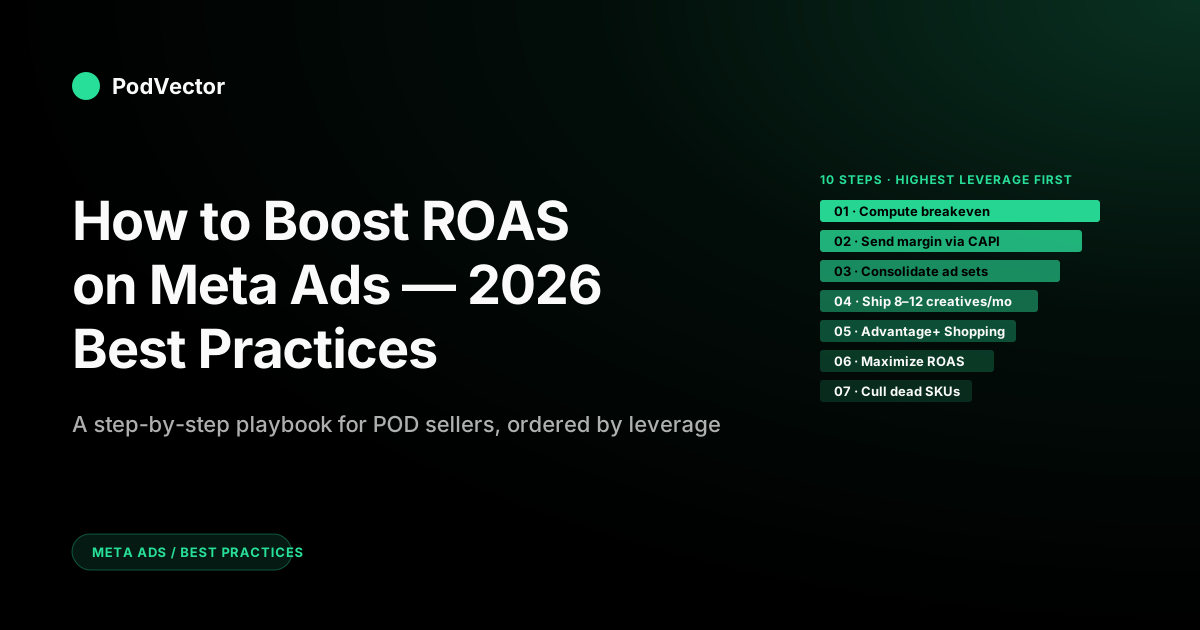
Quick Answer: The 2026 best-practice playbook for boosting Meta Ads ROAS is a ten-step loop: send margin (not revenue) to Meta via the Conversions API, consolidate to fewer ad sets so the algorithm exits the learning phase, ship 8–12 fresh creatives per month, lean on Advantage+ Shopping for the prospecting layer, and review performance against breakeven ROAS — not Meta's reported ROAS.
For print-on-demand stores, the order matters more than the list. POD margins are 20%–35%, not the 50%–70% the SERP benchmarks assume. Optimising on reported ROAS without subtracting Printify or Printful supplier cost first is how stores scale themselves into a loss.
The steps below go from highest leverage to lowest, with the POD-specific math nobody else covers.
Why "boost ROAS" means something different for POD
Most 2026 best-practice guides assume a 50%–70% gross margin. They tell you 3.0x reported ROAS is profitable. For a print-on-demand store, that advice is dangerous.
A $24.99 t-shirt with a $13 supplier cost (Printify or Printful blank, print, and shipping) leaves $11.99 of gross. After Shopify fees, payment processing, and a typical 3% return rate, the post-fulfillment margin lands closer to 30%. That puts breakeven on ad spend at 3.33x reported ROAS — before you've covered apps, design, or your own time.
So the question isn't "how do I push reported ROAS higher?" It's "how do I push true ROAS after COGS above the floor my margins demand?" Every step below answers that question.
Step 1: Compute breakeven ROAS before touching anything
Skip this and you're optimising blind. The formula:
Breakeven ROAS = 1 ÷ Post-fulfillment gross margin %
Post-fulfillment margin = retail price minus supplier cost minus payment fees minus expected refund cost, divided by retail price. For most POD apparel stores, that lands between 25% and 35%, putting breakeven at 2.9x–4.0x reported ROAS.
Add a buffer for fixed costs Meta doesn't see (apps, design fees, your salary). A 0.4x–0.8x buffer is reasonable. So a 30%-margin store should treat anything under 3.7x–4.1x reported ROAS as a campaign that needs work, not one that's "average."
For the long form on this calculation with worked examples, see break-even ROAS in POD.
Step 2: Send margin, not revenue, through CAPI
This is the single highest-leverage move on this list. Most POD stores send order.total as the conversion value to Meta. That tells the algorithm to scale toward the highest-revenue orders — which on a multi-SKU catalog is rarely the same as the highest-margin orders.
Switch the value parameter to revenue minus supplier cost. The Conversions API (CAPI — Meta's server-side event channel that complements the browser pixel) accepts a value field per event. Pass margin instead of total.
The downstream effect: Maximize ROAS bidding now optimises for profit-weighted purchases. We've seen this single change move blended true ROAS by 0.5x–1.0x within 14 days on accounts that had already exited the learning phase.
Implementation note: most Shopify apps that handle CAPI don't subtract supplier cost out of the box. You'll need a custom server-side step that joins the order to your fulfillment provider's cost data before firing the event. If you can't run that today, set it up as the next 30-day project — the ROI dwarfs almost any other Meta best practice.
For the broader attribution context, see our complete guide to Meta Ads ROAS and attribution for POD.
Step 3: Consolidate ad sets to exit learning phase
Meta's learning phase requires 50 optimization events per ad set per week. An ad set stuck in learning is an ad set Meta is still guessing at — costs run higher and ROAS sits lower than it will at steady state.
POD operators routinely fragment budget across 8–12 ad sets, none of which clear 50 events. The fix is brutal: cut to 2–4 ad sets, pool the budget, and let the algorithm find pockets inside one larger audience instead of forcing it across many small ones.
Practical math. If your CPA is $20 and you need 50 events per ad set per week, that's $1,000 of weekly spend per ad set. Two ad sets at $1,000 each will outperform six at $300 each almost every time.
This goes against years of "test 5 audiences in parallel" advice. In 2026, Meta's algorithm is good enough that audience hyper-segmentation is the wrong unit of testing. Test creatives inside a consolidated ad set instead.
Step 4: Ship 8–12 fresh creatives per month
The 2026 reality: Meta's creative-ranking system rewards variant volume. A single static ad rotated in a single ad set hits frequency 4+ in 7–10 days for an active POD audience, and ROAS slides hard from there.
The replacement isn't bigger budgets — it's more variants. A practical rotation:
- 4–6 video hooks per month. First 0.5 seconds is what determines scroll-stop; the next 3 seconds determine watch-through. Shoot or AI-generate the first 3 seconds with intent.
- 3–4 static image variants. Lifestyle, product-on-white, and design-zoom. POD wins on design specificity — show the design.
- 1–2 UGC-style variants. Even AI-generated UGC outperforms studio creative on apparel acquisition campaigns in our reads.
Run them inside one ad set, let Dynamic Creative pick winners, kill the bottom third every week. Then ship the next batch. Most POD stores stuck below their breakeven floor are stuck on creative volume, not bidding strategy.
Step 5: Use Advantage+ Shopping for prospecting
Advantage+ Shopping Campaigns (ASC — Meta's automated campaign type that pools prospecting and retargeting under algorithmic control) outperformed manual broad prospecting in most 2025–2026 ecommerce reads. POD is not an exception.
Where ASC wins for POD: it folds your customer list as a "existing customer" segment, lets the algorithm decide who to retarget vs. acquire, and exits the learning phase faster because budget concentrates in one campaign.
Where it loses: if your CAPI is sending revenue instead of margin (Step 2), ASC scales toward your worst-margin SKUs aggressively. Get Step 2 right before turning ASC on, or you'll bake bad signal into bigger spend.
Practical setup for a POD store with $5K–$25K monthly Meta spend:
- One ASC campaign at 70%–80% of total budget
- One manual retargeting campaign for cart abandoners and 30-day site visitors at 15%–20%
- One creative-testing campaign with $30–$50/day at 5%–10%
For the deeper tradeoff between consolidation styles, see CBO vs ABO for POD ROAS.
Step 6: Switch to Maximize ROAS bidding when volume allows
Meta's Maximize ROAS bid strategy is the 2026 default for accounts that can sustain it. It tells the algorithm to weight conversions by their value, not just count them.
The catch: it needs volume. Below ~50 purchase events per week per ad set, value-based bidding can't learn the distribution well enough to outperform Highest Volume bidding. So the order is:
- Start on Highest Volume until the ad set clears 50 weekly purchases
- Switch to Maximize ROAS with a soft floor (e.g. 2.5x) while learning
- Tighten the ROAS floor up toward your breakeven once stable for 14 days
This is also where Step 2 pays off again. Maximize ROAS optimising on margin-as-value will scale your high-margin SKUs first; the same bid strategy on revenue-as-value will scale your highest-priced SKUs first, which on a POD catalog is often the lowest-margin product.
Step 7: Cull dead SKUs before scaling
POD catalogs accumulate. The Pareto reality: in most stores we've audited, 15%–25% of SKUs drive 75%–85% of profit. The long tail looks busy in Shopify's product list and contributes nothing in ad performance.
Worse, dead SKUs poison Advantage+ catalog campaigns. The algorithm will dynamically serve any product feed entry that has clicks; if half your catalog is low-margin or low-converting, you've handed Meta inventory that hurts blended ROAS.
The 30-day cull:
- Pull 90 days of orders by SKU with supplier cost subtracted
- Sort by gross profit dollars (not units)
- Pause or hide every SKU below the 80th-percentile cutoff
- Re-sync the product feed; let Advantage+ catalog campaigns re-learn
This is the cheapest ROAS lift on the list. No new ads, no new audiences, no new spend — just less garbage in the catalog.
Step 8: Raise AOV before raising spend
Average order value is a multiplier on every dollar of ad spend. A 25% lift in AOV moves blended ROAS by roughly 25% with no change to creative or bidding.
The fastest AOV moves on a POD store:
- Volume discount at cart. "Buy 2, save 10% / Buy 3, save 15%" — typically lifts AOV 15%–30% on apparel
- Cross-sell on the product page. Match a tee with a hoodie of the same design
- Free shipping threshold. Set the threshold ~25% above current AOV
- Bundle SKUs. Bundle 2-3 high-margin designs as a single SKU at a discount that still exceeds margin floor
Operators jump straight to "I need better ads" when AOV is the cheaper lever. Test the cart-level changes for 14 days before another creative sprint.
Step 9: Watch frequency, not just ROAS
Frequency above 3.5–4.0 in a 7-day window is when ROAS slides on a POD audience. The cause-and-effect: people who'd convert have, the rest are seeing the same ad three times a week with no new reason to buy.
The wrong fix is more budget. The right fix is more creative variants (Step 4), or expanding the audience pool. Adding budget to a saturated ad set just buys you frequency 5+ at a worse cost per click.
Set a weekly review for any ad set above $500/week of spend. If frequency is climbing past 4 and 7-day ROAS is sliding, ship new creative or pause and reset the audience.
Step 10: Review against breakeven weekly
The wrap-around step. Most POD stores review Meta Ads Manager dashboards. They're looking at reported ROAS — Meta's number, on Meta's attribution window, before supplier cost.
The number that should drive scale-up vs. shut-down decisions is true ROAS after COGS, refunds, and platform fees. The standard manual workflow:
- Pull a Meta Ads Manager spend report
- Pull a Shopify orders export for the same window
- Pull Printify or Printful supplier costs
- Reconcile by date, by SKU
- Subtract supplier cost from Shopify revenue
- Divide by Meta spend
It works. It also takes 2–4 hours every Monday and falls apart the moment you run more than three concurrent campaigns. We come back to that in the next section.
Common mistakes that quietly tank ROAS
Five patterns we see weekly in POD audits:
Optimising on a 7-day attribution window when sales cycle is 1 day. POD impulse purchases close fast. A 1-day click attribution window paints a more honest picture of which campaigns are actually driving cash. Run both windows in parallel and compare.
Running prospecting and retargeting on the same dashboard. Retargeting at 8x and prospecting at 2.5x average to a 4x blended ROAS. Looks fine. Hides the fact that prospecting is breakeven at best.
Killing creatives on day 3. A new creative needs 7–10 days and ~50 conversions before its true performance settles. Killing on day 3 because ROAS is 1.8x kills creatives that would have stabilized at 4x.
Sending all orders to Meta as conversions. Subscription orders, refunded orders, and friends-and-family discount orders shouldn't all fire purchase events. They poison the value signal.
Not deduplicating Pixel and CAPI events. If both fire for the same purchase without an event_id, Meta double-counts and reports inflated ROAS. The truth shows up later when revenue doesn't match Shopify.
Tracking the right number
Meta Ads Manager shows you reported ROAS by campaign and ad set. It doesn't show you ROAS net of supplier cost, refunds, and platform fees — the only number that tells a POD seller whether to scale or kill.
The manual workflow from Step 10 (Meta export + Shopify export + Printify export, reconciled in a spreadsheet) is what every POD operator we've talked to does on Mondays. It works at 2–3 active campaigns. It collapses at 6+.
That's the gap PodVector AI exists to fill. Victor — our AI agent for POD sellers — connects Meta, Shopify, and your fulfillment provider into a single live data layer, then answers "which Meta campaigns are unprofitable after COGS and refunds last 30 days?" in seconds, the way you'd ask a CFO. Same data, plain English, no weekly reconciliation tax.
The agent is question-answer today. The roadmap is action: Victor flags the campaigns that breach your breakeven floor, then proposes the bid changes — eventually executes them with your approval. Step-by-step best practices stop being a checklist you run on Mondays and become a loop the agent maintains for you.
For the wider context, see our Meta Ads topic hub and the ROAS & attribution cluster.
FAQs
What's the single most impactful change to boost Meta Ads ROAS in 2026?
Sending margin instead of revenue through the Conversions API (Step 2). It changes what Meta optimises toward — high-margin orders instead of high-revenue orders — which compounds across every campaign downstream. Most POD stores haven't done this yet.
How long does it take to see ROAS improvement after applying these best practices?
The learning-phase reset (Step 3) and CAPI margin signal (Step 2) typically show measurable lift within 10–14 days. Creative volume (Step 4) compounds over 30–60 days. SKU culling (Step 7) shows up in Advantage+ within a week. Don't expect day-3 results — Meta needs the full learning window to settle.
Should POD sellers use Advantage+ Shopping or manual campaigns?
Advantage+ Shopping for prospecting, manual campaigns for retargeting and creative testing. Mixing both wins more than picking one. The exception is accounts under ~$3K monthly spend, where Advantage+ alone is usually enough.
What's a realistic ROAS target for a POD store on Meta in 2026?
Reported ROAS of 3.5x–5.0x is the band most profitable POD stores sit in, depending on margin. The honest target is 1.2x–1.6x on margin-based true ROAS — that's what cash flow looks like after supplier cost and fees. For benchmarks by stage, see what is a good ROAS for Meta Ads.
How often should I refresh creatives to maintain ROAS?
Ship 8–12 new variants per month per active ad set. Kill the bottom third weekly. Frequency above 4 in a 7-day window is the trigger to refresh, regardless of calendar.
Does Maximize ROAS bidding work on small budgets?
Not below ~50 weekly purchase events per ad set. Below that threshold, Highest Volume bidding outperforms Maximize ROAS because the algorithm doesn't have enough conversions to weight values reliably. Once volume is steady, switch.
Why is my Meta-reported ROAS higher than my Shopify revenue suggests?
Meta uses a 7-day click + 1-day view attribution window by default and counts modeled conversions for opted-out users. Both inflate reported ROAS versus what Shopify recorded for the same window. The fix is to track true ROAS after COGS in your own system as the source of truth, not to fight Meta's number. See Shopify ROAS reporting integration for the deeper plumbing.
What's the right ratio of prospecting to retargeting spend?
For most POD stores, 70%–80% prospecting (or Advantage+ Shopping which mixes both), 15%–20% explicit retargeting, 5%–10% creative testing. Retargeting can't scale past your existing audience pool — high ROAS there is a ceiling, not a strategy.
Are creative best practices different for POD vs general DTC?
Yes. POD wins on design specificity — show the actual design, large, in the first frame. Generic lifestyle shots that work for fashion brands underperform for POD because the design is the product. Hook in 0.5 seconds, design visible by 1 second, hand or wear context by 3 seconds.
How do I know when an ad set is past the learning phase?
Meta marks it explicitly in Ads Manager once 50 weekly optimization events are sustained. The performance signal is more reliable: CPM stabilizes, frequency rises smoothly instead of jumping, and 7-day ROAS variance drops. If you see those three, you're out of learning regardless of what the UI says.
Stop running these checks on Mondays
Every step above is something a POD operator can do manually. Most operators end up doing none of them weekly because the reconciliation cost is brutal. PodVector AI connects Meta, Shopify, and Printify or Printful into a live data layer, so Victor can answer "which campaigns are unprofitable after COGS this week?" in plain English. Best practices become a loop, not a Monday checklist.
Try Victor free