
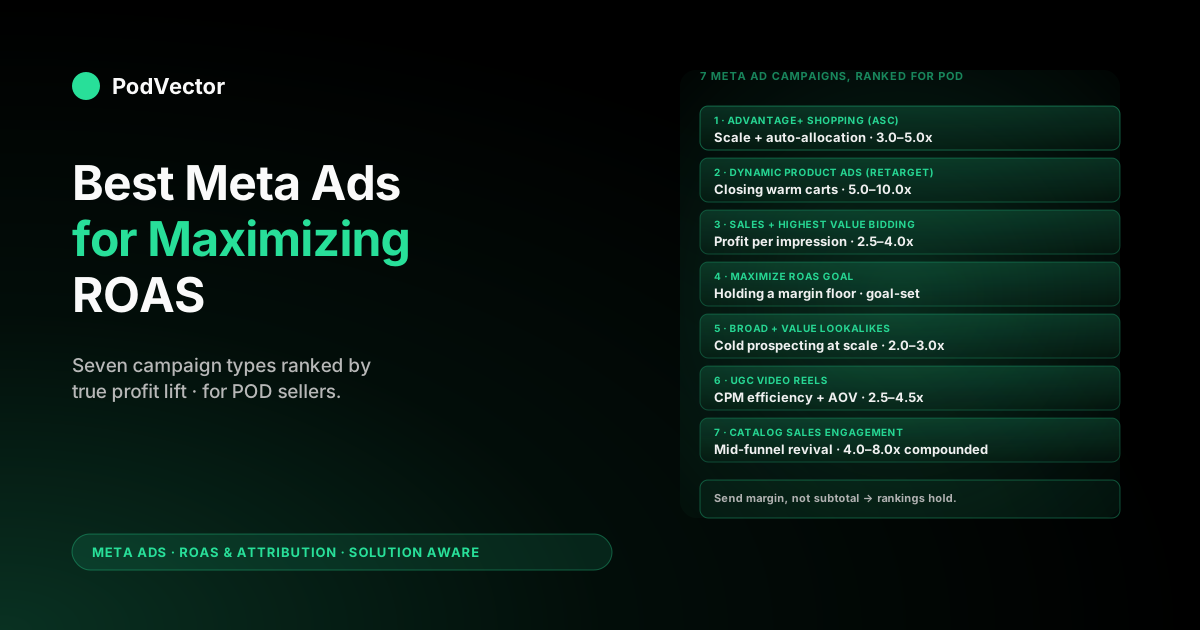
Quick Answer: The seven Meta ad campaigns that consistently produce the highest ROAS — ranked for print-on-demand stores — are Advantage+ Shopping (ASC), Dynamic Product Ads (DPA) for retargeting, Conversion campaigns with Highest Value bidding, the new Maximize ROAS goal, broad-targeted Sales campaigns with value-based lookalikes, UGC video Reels, and Catalog Sales Engagement campaigns against warm audiences.
None of those rankings come from raw "campaign type" alone. A Sales campaign sending order subtotal as the value parameter looks profitable on Meta's dashboard and unprofitable in your bank account. A Sales campaign sending contribution margin behaves the opposite way.
Below: each campaign type ranked, what it's actually good at, the POD-specific way to set it up, and how to read the dashboard so you don't scale a winner that's losing money.
The 7 best Meta ad campaigns for ROAS, ranked
Most "best Meta ads for ROAS" lists rank campaign types by reported ROAS averages from public case studies. That ranking would put Dynamic Product Ads at the top because retargeting always reports a 3–4x higher ROAS than prospecting.
That's not the same as which campaign drives the most profit. DPA's reported ROAS includes customers who would have bought anyway. Strip them out and the picture changes.
The table below ranks each campaign type by how reliably it generates incremental profit on a print-on-demand apparel store, not by the dashboard number.
| Campaign type | Best at | Typical reported ROAS | POD true ROAS gap |
|---|---|---|---|
| 1. Advantage+ Shopping (ASC) | Scale + auto-allocation | 3.0–5.0x | 40–60% lower |
| 2. Dynamic Product Ads (retargeting) | Closing warm carts | 5.0–10.0x | 30–40% lower |
| 3. Sales + Highest Value bidding | Profit per impression | 2.5–4.0x | 25–35% lower |
| 4. Maximize ROAS goal | Holding a margin floor | Set by goal | Goal must use margin |
| 5. Broad + value lookalikes | Cold prospecting at scale | 2.0–3.0x | 40–60% lower |
| 6. UGC video Reels | CPM efficiency + AOV | 2.5–4.5x | 40–50% lower |
| 7. Catalog Sales Engagement | Mid-funnel revival | 4.0–8.0x | 30–40% lower |
The "POD true ROAS gap" column is the part missing from every public roundup. Reported ROAS uses order subtotal as the conversion value. For Printify or Printful, that ignores 50–65% of revenue (base cost, shipping, fees) leaving the store before a dollar of profit lands.
1. Advantage+ Shopping Campaigns (ASC)
Advantage+ Shopping is Meta's auto-targeted, auto-optimized ecommerce campaign. You hand over budget, creative, and a destination — Meta picks the audience and rotates the creative against its full prospecting + retargeting graph.
Public benchmark: Meta's own data cites a 32% ROAS lift from ASC versus manual prospecting campaigns. Independent agency case studies put the lift between 20–45%, depending on how good the manual baseline was.
For POD, ASC is the default first campaign for two reasons. It removes the worst operator mistake (over-tight interest targeting) and it routes spend toward the products and audiences your catalog can actually convert.
The setup that matters: feed ASC the full catalog, not a curated subset. The algorithm needs the variant breadth to find pockets of demand. Cap manual prospecting alongside ASC at 30% of total spend per Meta's documented best practice.
Where ASC fails: stores with fewer than 30–50 conversions per week feed too sparse a signal for the algorithm to optimize against. ASC is for the $20K/month and up tier, not for stores still finding product-market fit.
2. Dynamic Product Ads for retargeting
Dynamic Product Ads (DPA) pull from your product catalog and serve the specific items a visitor viewed or added to cart. Meta picks the product, the placement, and the format from a single creative template you set once.
DPA against retargeting audiences (page viewers, add-to-cart, initiated checkout) consistently posts the highest reported ROAS of any Meta campaign — typically 5x to 10x. The mechanism is straightforward: you're showing the exact product to someone who already wanted it.
The ranking caveat: most of that ROAS is conversion that would have happened anyway. Independent incrementality studies on DPA retargeting put the true incremental lift at 20–40% of the reported number.
For POD, DPA still earns the second slot because the cost per click on retargeting is so low that even at 25% incrementality, the math works. A $30 CPM against a 5% click-through warm audience and a 4% checkout rate produces real, profit-positive orders.
Setup that matters for POD: include a 14-day window (longer than the 7-day default) and exclude past-30-day purchasers. The 14-day window captures the consideration cycle for $25–40 apparel; the exclusion keeps you from showing buyers their own purchase. See the DPA Shopify strategy guide for the full feed setup.
3. Sales campaigns with Highest Value bidding
Sales objective campaigns let you bid four ways: Lowest Cost (default), Cost Cap, Bid Cap, and Highest Value. Highest Value tells Meta to prioritize the impressions most likely to produce the biggest order, not just the most orders.
The reason this matters more for POD than for most ecommerce: POD stores live or die on AOV. A 1-tee order at $24 produces $4 of margin. A 3-tee order at $66 produces $22. Same prospecting cost, 5x the margin.
Highest Value bidding pushes Meta toward the multi-item buyer — but only if your value parameter is correct. If you're sending order subtotal, Meta optimizes toward big-subtotal customers. If you're sending contribution margin, it optimizes toward profitable customers.
The difference compounds. A POD store that switched from Lowest Cost to Highest Value with a margin-correct value parameter typically posts a 25–40% lift in true ROAS over 30 days, not because more people bought, but because the orders that came in were larger and more profitable.
Setup that matters: Highest Value needs at least 50 conversions per week per ad set to optimize. Below that threshold it falls back to behavior similar to Lowest Cost, just with higher CPMs.
4. The new Maximize ROAS performance goal
Meta rolled out Maximize ROAS as a top-level performance goal in 2025. It's the bidding equivalent of Highest Value plus a hard floor — Meta only shows your ad to users it predicts will hit your minimum ROAS target.
The strategic shift: previous goals optimized for volume (Maximize Conversion Value). Maximize ROAS optimizes for efficiency. Meta will spend less of your daily budget if it can't find prospects who clear the floor — which sounds bad until you look at what that does to true ROAS.
For POD, Maximize ROAS is the most direct way to operationalize a margin floor. Set the goal to your post-COGS break-even multiplier (often 2.0–2.4x reported, depending on supplier mix), and Meta enforces it automatically.
The catch: setting the floor too high starves the campaign. Meta needs delivery to learn. A floor 30% above your historical average ROAS will collapse delivery and produce an "underdelivering" warning within 48 hours.
The deeper catch is the same as Highest Value: the floor is meaningless if your value parameter is subtotal. A 3.0x ROAS floor on subtotal is a 1.4x floor on margin, which is a money-loser. Fix the value parameter first, then set the goal.
5. Broad-targeted Sales campaigns with value-based lookalikes
Broad targeting plus a value-based lookalike audience is the highest-leverage prospecting setup in 2026. Meta's machine learning has reached the point where interest targeting actively hurts most campaigns by narrowing the prospect pool below what the algorithm can efficiently optimize.
The "value-based" part is the unlock. A standard 1% lookalike weights all customers equally — every buyer counts the same. A value-based lookalike weights customers by the LTV signal you provide, so Meta finds prospects who look like your high-margin repeat buyers, not your one-time low-margin ones.
For POD, this is where customer-lifetime data starts to matter. If you can rank customers by post-COGS profit and feed that as the value, Meta finds the 20% of prospects who become the 80% of profit.
What "broad" looks like in practice: location only, no interest stack, age 25-65, all genders for unisex apparel. Layer the value-based lookalike on top as the audience definition. Let Advantage+ Audience expand from there if you want a wider net.
Public benchmark: broad targeting generates 113% more ROAS than highly specific audience selections in the AdAmigo benchmark cohort. The number's directionally right; the implementation detail is the value-based lookalike, not the breadth alone.
6. UGC video Reels
Reels has the lowest CPM of any Meta placement — typically 30–50% below Feed and Stories on equivalent audiences. UGC-style video (handheld, native creator voice, not polished brand spots) outperforms studio video on Reels by 2x to 3x on click-through.
The combination of low CPM and high CTR is where the ROAS shows up. A UGC Reel ad on a Sales campaign produces the same order at 40–60% of the cost a Feed ad would.
For POD, the creative angle is specific: design-led storytelling. The customer who buys a niche-design tee is buying the design's emotional resonance. UGC creators saying "this design said exactly what I felt" outperforms product-shot ads by an order of magnitude on niche apparel.
The constraint is production. UGC needs 4–8 fresh variants per month per active design to fight creative fatigue, which means either a creator network or an in-house production cadence. Meta's full ad-type catalog includes formats that need less creative volume; UGC isn't one of them.
The setup tactic: run UGC variants inside Dynamic Creative ad sets so Meta auto-mixes hooks, body, and CTA across the variants. That way a single ad set can carry six creators without you splitting the conversion data across six ad sets.
7. Catalog Sales Engagement campaigns
Catalog Sales with the Engagement objective is the underrated POD play. Instead of optimizing for purchase events (which Meta's algorithm needs many of to learn from), it optimizes for ad engagement — saves, comments, shares, dwell time.
This works for POD because most niche-design buyers don't convert on the first session. They engage, leave, come back via direct or organic, and convert outside Meta's attribution window. An Engagement campaign builds the warm audience that DPA retargeting (#2 above) then closes.
The reported ROAS on the Engagement campaign itself looks modest — often 1.5x to 3.0x. The compounded ROAS, when you measure the downstream conversions on retargeting, lands at 4x to 8x.
For POD, this is how you build a sustainable customer pipeline at the $5K–20K/month tier where ASC (slot #1) is too data-hungry. You're building the warm audience that ASC needs to optimize against in 6–12 months.
Setup that matters: pair the Engagement campaign with a custom audience of "engaged with content in the last 30 days" feeding the DPA retargeting campaign. The two campaigns are not separate experiments — they're a funnel.
Which to pick first by store size
The ranking above is the average. Which campaign you should run first depends on where you are.
| Monthly revenue | Run first | Add at the next tier |
|---|---|---|
| Under $5K/mo | UGC Reels (#6) + Engagement (#7) | Build warm audience for DPA |
| $5K–20K/mo | DPA retargeting (#2) + Sales/Highest Value (#3) | Add Engagement as the warm-audience feeder |
| $20K–100K/mo | ASC (#1) + DPA (#2) | Layer Maximize ROAS (#4) once value param is fixed |
| $100K+/mo | ASC (#1) + Maximize ROAS (#4) | Value-based lookalikes (#5) for incremental scale |
The order matters. Running ASC under $20K/month wastes spend in the learning phase because Meta can't get enough conversion signal. Running UGC Reels above $100K/month leaves money on the table because catalog-driven ASC scales further than any single creative angle.
Why "best" depends on which ROAS you're measuring
Every campaign type above can show a profitable reported ROAS while losing money on a true ROAS basis. Reported ROAS uses Meta's purchase value parameter, which by default is order subtotal.
For a POD store on Printify or Printful, order subtotal includes ~50–65% pass-through cost. A $30 t-shirt order has roughly $16 of supplier base cost plus shipping, $1.20 in payment processing, and your ad cost on top. The "$30 ROAS" Meta sees is closer to a "$12 contribution margin ROAS" in reality.
That's not a 10% difference. It's the difference between a 4.0x reported ROAS that looks great and a 2.0x true ROAS that's break-even after fixed costs. The Meta ROAS definition Meta publishes is mathematically correct but financially incomplete.
The fix is one of two paths. Either pipe contribution margin (not subtotal) to Meta as the value parameter, or pull true ROAS from a unified data warehouse that joins ad spend to supplier cost. Most POD operators do neither, which is why the dashboard ROAS and the bank account ROAS keep diverging.
An AI employee sitting on top of a unified data warehouse can answer "which Meta campaigns are unprofitable after COGS this week?" in plain English. That's the difference between scaling what looks profitable and scaling what is profitable. The complete ROAS and attribution guide walks through the warehouse setup.
Worked example: a $30K/month POD store
A POD apparel store doing $30K/month on Printify pays roughly $14,500 in supplier base + shipping (48% pass-through), $900 in payment processing, $300 in app subscriptions, and $7,500 in ad spend. Gross margin before ad spend: $14,300 (48%).
Reported blended ROAS at $7,500 spend → $30K revenue is 4.0x. True ROAS, post-supplier and fees, is $14,300 / $7,500 = 1.91x.
Now apply the campaign mix from the table. ASC (#1) carries 50% of spend, DPA retargeting (#2) carries 25%, Sales/Highest Value (#3) carries 15%, UGC Reels (#6) carries 10%.
The reported ROAS by campaign would look like: ASC 3.5x, DPA 8.0x, Sales/HV 3.2x, UGC 3.8x. The true ROAS, after applying the 48% pass-through plus 3% fees: ASC 1.67x, DPA 3.84x, Sales/HV 1.54x, UGC 1.83x.
Sales/Highest Value at 1.54x is profit-negative once you allocate fixed costs. The dashboard shows it as a winner. The bank account shows it as a leak.
The single move that fixes this: stop sending order subtotal as the value parameter to Meta. Send contribution margin. Meta starts optimizing toward 3-tee orders instead of 1-tee orders, and Sales/HV's true ROAS lifts from 1.54x to 2.6x without a single change to creative or audience. All ROAS and attribution articles in this cluster are stress tests of that one move from different angles.
FAQs
Which Meta ad campaign type has the highest ROAS?
Dynamic Product Ads to retargeting audiences post the highest reported ROAS — typically 5x to 10x — but most of that is non-incremental. For incremental ROAS, Advantage+ Shopping (ASC) ranks higher because it's the only campaign type with the data breadth to optimize against true prospecting.
Is Advantage+ Shopping better than manual campaigns for ROAS?
For stores above $20K/month, yes. Meta's published data shows a 32% ROAS lift versus manual prospecting; agency case studies put it between 20–45%. Below $20K/month, ASC starves on too few conversions and underperforms manual setups.
What's a good ROAS target for Meta Ads on a POD store?
Set the target on contribution margin, not subtotal. A POD store with 50% gross margin breaks even at a 2.0x margin-ROAS, which corresponds to roughly 4.0x subtotal-ROAS. A profitable target is 2.5x margin-ROAS or 5.0x subtotal-ROAS.
Should I run prospecting and retargeting in the same campaign or separate them?
Separate. Meta's algorithm needs distinct optimization targets — a prospecting campaign optimizing toward $0 customers cannot also optimize toward warm-cart closers. ASC is the only exception; it routes both internally.
How long does Meta need to learn a new campaign before ROAS stabilizes?
Meta's documented learning phase is 50 conversions per ad set in 7 days. For most POD stores that's 7–14 days at typical spend. Don't change the campaign mid-learning — every edit resets the clock.
Does Maximize ROAS work for low-volume POD stores?
No, because the goal needs delivery to enforce. A store doing under 50 conversions per week per ad set will see Meta refuse to spend the budget rather than risk the floor. Run Lowest Cost or Highest Value until conversion volume supports the goal.
Why is my Meta-reported ROAS higher than my Shopify ROAS?
Three reasons: Meta's default attribution window is 7-day-click-1-day-view (Shopify's is usually last-click), Meta deduplicates poorly without CAPI, and Meta uses order subtotal whereas Shopify can use net revenue. The Shopify number is closer to truth, but neither matches contribution margin until you wire the value parameter to it.
How often should I refresh creative on these campaign types?
UGC Reels: 4–8 new variants per month per design. ASC: 6+ creative variants in the campaign's creative pool. DPA: rotate the catalog template every 30–45 days. Highest Value and Maximize ROAS care less about creative refresh; they're optimizing on signal, not novelty.
Stop ranking campaigns on dashboard ROAS
Meta's dashboard says the campaign is winning. Your Stripe payouts say otherwise. The gap is supplier cost and fees Meta can't see.
Victor is the AI employee that joins your Meta ad spend to your Printify or Printful supplier costs in a unified data warehouse. Ask "which Meta campaigns are unprofitable after COGS?" in plain English and get the answer in seconds.
Try Victor free