
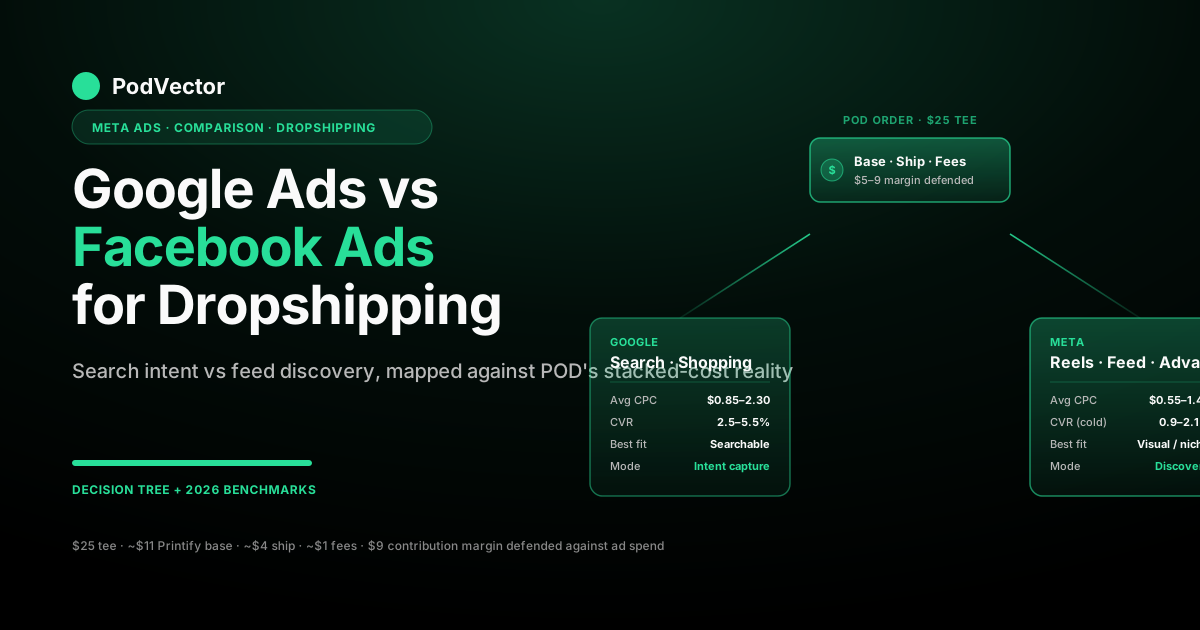
Quick Answer: For dropshipping in 2026, Google Ads wins for branded or commodity products people search by name, and Facebook Ads wins for visual or impulse-driven products that rely on discovery. Most generic dropshipping advice tells you to start with Facebook because it is cheaper per click and faster to scale a winner.
That advice is half right for print-on-demand. POD is dropshipping with a tighter cost structure — your base item plus shipping eats $11–$16 of every $25 sale, leaving $5–$9 of contribution margin to fund the ad. That changes which platform wins on actual profit, not platform-reported ROAS.
This guide reframes the dropshipping comparison through POD's stacked-cost reality, then walks through the decision channel-by-channel so you can pick the one that matches your design portfolio and target audience.
Why POD is dropshipping with worse margins
Most "Google vs Facebook for dropshipping" articles assume a $20 product sourced from AliExpress for $4. Margin: $16. That kind of math lets a beginner test five products at a $20 daily budget and survive a few losers.
Print-on-demand is a different animal. A $25 t-shirt printed through Printify costs roughly $11 for the base garment plus $4.25 for shipping. After processing fees, you keep about $8.50. That means your ad has to convert at well under $8 fully-loaded CPA or you lose money on every sale.
This single fact changes the Google Ads vs Facebook Ads decision. The platform that wins for cheap-source dropshipping is not always the one that wins for POD, because POD operators cannot afford a learning phase that burns 50% of spend on losing creatives. The margin headroom is not there.
Before picking a platform, model your real per-order math. If you have not done that yet, see our breakdown of Google Ads vs Facebook Ads cost for POD sellers for the full unit economics walkthrough.
The dropshipping comparison at a glance
The table below uses 2026 ranges from public ecommerce benchmark data and our own POD-operator client cohort. Numbers shown are blended apparel and accessory verticals — your category may sit at the high or low end.
| Axis | Google Ads | Facebook Ads (Meta) | Dropshipping verdict |
|---|---|---|---|
| Average CPC | $0.85–$2.30 | $0.55–$1.45 | Meta cheaper at the click level |
| Average CPM | $8–$22 (Display); $35+ (Search) | $11–$28 | Display network cheaper for reach |
| Conversion rate | 2.5%–5.5% (Search/Shopping) | 0.9%–2.1% (cold) | Google wins on intent |
| Time to first sale | 1–7 days (Shopping) | 3–14 days (testing) | Google faster if demand exists |
| Creative needed | Product feed only | 3–10 video/image variants per test | Google lower production cost |
| Best for | Searchable, named demand | Visual, impulse, niche identity | Different lanes |
| Worst for | Brand-new categories nobody searches | High-AOV considered purchases | Don't fight the platform |
The headline pattern repeats across every dropshipping comparison: Facebook is cheaper per click, Google converts harder per visitor. The right answer depends on whether your product has search demand or needs to manufacture interest.
Where Google Ads wins for dropshipping
Google's whole machine is built around capturing existing demand. If a person types "funny dad t-shirt fishing," Shopping ads put your product two pixels above the organic results with a price and a photo. That is intent capture, not interruption.
For dropshippers selling categories with established search volume — pet products, fitness accessories, kitchen gadgets, branded fan merch — Google Shopping and Performance Max usually deliver positive ROAS faster. The ad platform does the matching; your product feed does the selling.
Three structural advantages drop straight to the bottom line:
- Lower creative load. One product photo plus a clean title and description does the work that Meta needs three video variants to do. For solo POD sellers without a video editor, that is hours saved per launch.
- Higher intent traffic. Search clicks already-want-it. Conversion rate runs 2.5–5.5% on Shopping versus 0.9–2.1% on Meta cold prospecting.
- Cleaner attribution. Google's last-click model and Enhanced Conversions handle iOS and cookie restrictions better than Meta's view-through-heavy model. Reported numbers match Shopify revenue more closely.
Where Google loses for dropshipping is brand-new categories. If nobody is searching for "left-handed coffee mug for cat lovers," there is no demand to capture and Search burns budget on broad matches. That is the lane Facebook owns.
Where Facebook Ads wins for dropshipping
Meta's discovery-first model is built for products that look good and feel personal. The user did not wake up wanting your shirt — they saw it on the feed, recognized themselves, and bought.
For original POD designs in identity-driven niches — nurses, teachers, dog breeds, hobbies, in-jokes — Facebook is structurally where the demand lives. Search volume for "registered nurse coffee tumbler" is thin. Targeted Meta ads against the Nursing Lookalike audience is fat.
Three things Meta does that Google cannot:
- Audience targeting from interests and lookalikes. Even after iOS 14 narrowed the data flow, Meta's signal density on user interests outpaces Google's contextual targeting for visual products.
- Video-native creative format. A 15-second product video showing the design on a model converts impulse buyers in a way a static Shopping listing cannot.
- Cheaper top-of-funnel reach. CPMs of $11–$28 mean you can test 3–4 designs at $20/day each and find your winner within a week. That speed matters when most designs fail.
Where Meta loses for dropshipping is high-consideration purchases. People do not buy a $400 ergonomic chair from a 15-second feed video — they research, compare, and search. POD products mostly sit in the cheap-impulse range, which is why Meta usually wins for original-design POD even when generic dropshipping articles are split.
Cost reality: CPC, CPM, CVR by platform
Generic dropshipping articles cite single-number averages — "$2.69 Google CPC, $1 Facebook CPC" — that hide the variance. Real POD operator numbers run wider than that.
Here are the 2026 ranges we see across our client cohort, segmented by ad type rather than platform-wide:
| Ad type | CPC range | CPM range | CVR range | Best fit |
|---|---|---|---|---|
| Google Search | $1.20–$3.50 | $35–$80 | 3.5%–7.0% | Branded queries, gift keywords |
| Google Shopping | $0.85–$2.10 | $8–$22 | 2.5%–5.5% | Search-led product discovery |
| Performance Max | $0.95–$2.40 | $12–$28 | 2.0%–4.5% | Mature stores with feed quality |
| Meta cold prospecting | $0.55–$1.45 | $11–$28 | 0.9%–2.1% | Niche identity audiences |
| Meta retargeting | $0.75–$1.80 | $15–$40 | 3.5%–8.5% | Recovering abandoned carts |
| Advantage+ Shopping | $0.90–$2.10 | $18–$45 | 1.8%–3.8% | Catalogs of 20+ designs |
Two patterns to notice. First, Meta retargeting converts at Google-Search levels because the audience already qualified themselves on your site. Second, Performance Max numbers track Google Shopping closely because most of PMax's volume routes through the Shopping inventory, despite the multi-channel marketing.
For deeper benchmarks segmented by funnel stage, see our coverage of Google Ads vs Facebook Ads performance for POD sellers.
The POD overlay: where dropshipping advice breaks
Generic dropshipping content treats your cost as a single number — usually a low one, since AliExpress sourcing assumes $3–$5 unit cost. POD does not work like that.
For POD, every order has three stacked costs that platform-reported ROAS does not see:
- Base product cost from Printify or Printful, which varies by garment, blank, and supplier.
- Per-item shipping charged on top, which does not scale down on multi-item orders.
- Processing fee on the gross transaction (Stripe, PayPal, Shop Pay all take a cut).
The result: a Meta-reported 3.5x ROAS on a $25 product line can be a 1.1x contribution-margin ROAS once base, shipping, and processing land. The ad platform thinks you are profitable. Your bank account disagrees.
This is the gap that breaks dropshipping advice for POD. The article telling you "Facebook scales faster on cheap dropshipping wins" is right about CPC. It is wrong about whether you actually made money on the sale.
For POD operators, the single most valuable instrument is contribution-margin reporting that subtracts real Printify or Printful costs from real revenue, per channel, per design. That is the layer most generic ad-comparison articles ignore. For full coverage of how POD economics differ from generic dropshipping, see our Google Ads vs Facebook Ads comparison guide for POD.
Decision tree by product and audience
Strip the platform marketing and the choice comes down to a few questions about your portfolio.
Question 1: Is your product searchable by name or category?
If yes — branded fan merch, named occupations, hobby gear, gift keywords with volume — Google Search and Shopping start. You are buying existing demand at a known cost. Add Meta later for retargeting.
If no — original designs, micro-niche identities, in-jokes that nobody types into Google — Meta starts. You need the discovery surface to find the audience, because the audience is not searching.
Question 2: Do you have video creative or just product photos?
Static photo only: Google Shopping is the fast lane. PMax and Meta will both demand creative variants you do not have.
Video plus photo: Meta has more upside ceiling. Cold prospecting on Reels and Feed video unlocks audiences you cannot reach through Search.
Question 3: What is your monthly ad budget?
Under $1,000/month: pick one platform. Splitting kills both campaigns' learning data. Pick the platform that matches your product and creative answer above.
$1,000–$5,000/month: one primary platform plus retargeting on the other. Usually Meta as primary for visual designs, Google retargeting on the searchers.
$5,000+/month: both, with clear lane separation. Google captures named demand, Meta drives discovery, retargeting on both. Track combined contribution margin in one warehouse.
Question 4: What is your contribution margin per order?
Under $5: walk away from paid ads or raise prices. The math will not work at any platform's CPA.
$5–$9 (typical POD): Meta first if discovery-driven, Google first if search-driven. Tight CPA tolerance. Test small.
$10+: both platforms have headroom. The question becomes scale and creative supply, not survival.
Running both without burning budget
The "use both" advice is right for POD operators with $3K+ monthly spend and wrong for everyone smaller. Splitting a $1,000 budget across two platforms gives each one $500 — neither hits learning-phase thresholds, both run inefficient.
The realistic stack at $3K+ is three lanes:
- Google Shopping or PMax (40–55% of budget): captures named-demand searches, runs on autopilot once feed quality is solid.
- Meta cold prospecting (25–35% of budget): tests new designs against lookalikes and interest stacks, finds your next winner before the existing one fatigues.
- Combined retargeting (15–25% of budget): hits site visitors who did not buy, split across both platforms based on traffic source.
This split assumes you can answer the meta question — where is the next dollar best spent — across all three lanes daily. That answer is hard to compute manually because each platform reports its own ROAS in isolation, ignoring overlap and ignoring your real Printify costs.
POD operators running this stack without a unified margin layer end up over-funding whichever platform reports the highest ROAS that week, which is usually the platform double-counting overlapping conversions. The cure is treating ad data, store data, and POD cost data as one dataset, not three.
Mistakes POD sellers copy from dropshipping advice
Trusting platform-reported ROAS as profit
A 3x platform ROAS on a 35% gross-margin POD product is roughly break-even. Generic dropshipping advice assumes 70%+ gross margin and a 3x ROAS clears profit. Apply the same threshold to POD and you bleed.
Testing five products at once on Meta
The classic dropshipping play of testing 5–10 products simultaneously fails for POD because POD margins cannot subsidize four losers. Test one or two designs at a time, kill fast, scale slow.
Ignoring Google because "Facebook is cheaper"
The cheap-CPC argument is platform-level. At the conversion-rate level, Google's intent traffic often beats Meta on effective CPA for searchable POD categories like personalized gifts or hobby gear. Run the unit economics, not the platform meme.
Not segmenting POD costs from gross revenue
Every POD operator should know contribution margin per channel, per design, weekly. Most still look at Shopify gross sales and ad-platform ROAS in different tabs and try to mentally subtract. The mental math is wrong roughly half the time.
Skipping retargeting
POD sites convert at 1–2.5% on cold traffic. The 97% who left without buying are the cheapest sales available to you, and they are the same audience on Google as on Meta. Both platforms' retargeting CVRs run 3.5–8.5% — too high to leave on the table.
For more on attribution gaps and how they distort the comparison, see our complete guide to Meta Ads ROAS and attribution for POD.
FAQs
Is Google Ads or Facebook Ads cheaper for dropshipping in 2026?
Per click, Facebook stays cheaper — average CPC of $0.55–$1.45 vs Google's $0.85–$2.30. Per conversion the gap closes because Google's search traffic converts 2–3x harder. Effective CPA usually lands within 25% of each other on a tuned account, with Google leading on searchable categories.
Which is better for beginner dropshippers?
For pure low-cost dropshipping with $4 unit cost, Facebook usually wins for beginners because creative is faster to test and CPCs are lower. For POD beginners, Google Shopping is often the safer first move because tighter margins cannot absorb Meta's longer learning phase.
Can I run both Google Ads and Facebook Ads at the same time?
Yes, and at $3K+ monthly spend you should. Below that, focus on one platform until you are profitable, then add the second. Splitting a small budget across both leaves neither in a working learning phase.
How does POD differ from cheap-source dropshipping for ad strategy?
POD has roughly half the gross margin of AliExpress dropshipping ($5–$9 per order vs $12–$18). That means tighter CPA tolerance, less room for testing failures, and a stronger need for itemized cost tracking. Generic dropshipping advice over-estimates the room for error.
What is a healthy ROAS target for POD on Google or Facebook?
Platform-reported: 2.5x–3.5x to break even, 4x+ to be clearly profitable on most POD price points. Contribution-margin ROAS (after Printify costs and shipping): 1.3x–1.5x to break even, 2x+ to be clearly profitable. Always plan against the second number.
How do I track real profit across both platforms?
Pull Shopify orders, Printify or Printful costs, Google Ads spend, and Meta Ads spend into one warehouse. Join on order ID. Compute revenue minus production cost minus ad spend per channel. That is the real contribution margin number that platform dashboards cannot show you.
Should I use Performance Max or stick with Shopping for dropshipping?
If your product feed is clean and your conversion data is strong, PMax can outperform standard Shopping for the first 60 days. After that, most POD stores see PMax plateau. Many operators run both — PMax for breadth, standard Shopping for fine control on hero products.
Do I need a video for Facebook Ads to work for dropshipping?
Mostly yes. Static images can find a small initial audience, but Meta's algorithm rewards video creative with cheaper CPMs and broader reach. A 15-second product video showing the design in use is the minimum viable creative for cold prospecting.
Does dropshipping ad strategy translate to print-on-demand?
Partially. Channel selection rules transfer (search intent for searchable products, discovery for visual products). Margin and testing rules do not — POD's stacked cost structure forces a more conservative approach to creative testing and a much sharper focus on contribution-margin attribution. For broader context, see the Meta Ads comparison cluster and the full Meta Ads topic hub.
Where do these benchmark numbers come from?
The CPC, CPM, and conversion ranges in this guide are 2026 figures from public ecommerce benchmarks cross-referenced against our own POD-operator client cohort. For a third-party perspective with named campaign examples, Spocket's Google Ads vs Facebook Ads for Dropshipping guide is one of the most-cited general-ecommerce references.
Stop guessing which channel is actually profitable.
Generic dropshipping advice tells you Facebook is cheaper. Your Printify invoice tells you the cheapest CPM still loses money on a $25 t-shirt. Platform-reported ROAS double-counts. Shopify reports something else.
Victor unifies your store orders, Printify or Printful costs, Google Ads, and Meta Ads into one live data layer — and answers contribution-margin questions in plain English. No SQL, no spreadsheets, no platform-by-platform ROAS chasing.
Try Victor free