
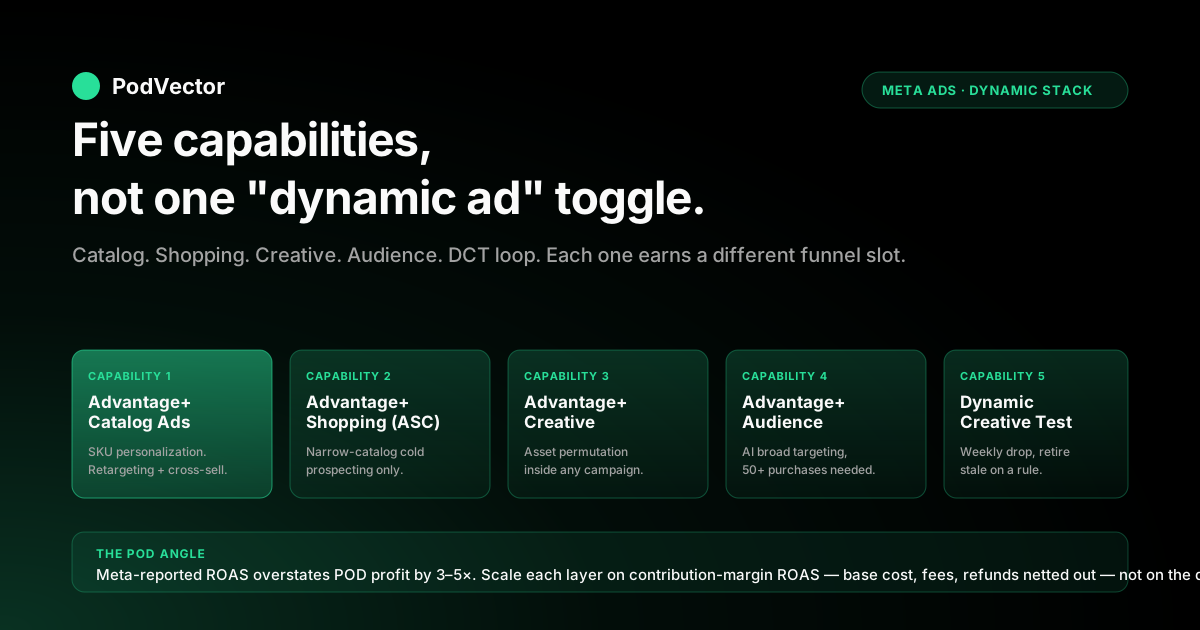
Quick Answer: "Facebook dynamic ads" in 2026 is no longer one ad type — it is a stack of five Meta capabilities (Advantage+ Catalog Ads, Advantage+ Creative, Advantage+ Audience, Advantage+ Shopping Campaigns, and dynamic creative testing) and the strategic question for a Shopify POD store is which capability runs at which funnel stage, not whether to "turn on dynamic ads." Most guides equate dynamic ads with catalog-driven retargeting; that is one slot in a five-slot stack. The right Shopify POD setup runs Advantage+ Catalog Ads against warm intent, Advantage+ Shopping Campaigns against cold prospecting, Advantage+ Creative inside both to permute headlines and primary images, dynamic creative testing as a fast-cycle creative iteration loop on top of the Advantage+ stack, and Advantage+ Audience only after the Custom Audience source has 50+ purchases of usable signal. The other half of the playbook is profit measurement: every dynamic capability reports a Meta-dashboard ROAS that for a POD store overstates contribution-margin ROAS by 3–5× because Printify or Printful base costs, Shopify transaction fees, and refund rates never enter Meta's calculation. The strategy below covers the stack, the funnel mapping, the catalog and tracking prerequisites, and the contribution-margin math that makes the whole thing actually profitable.
What "Facebook dynamic ads" actually means in 2026
Three years ago, "Facebook dynamic ads" meant one product: dynamic product ads, a catalog-driven format that personalized whichever SKU from a product feed was most likely to convert for each viewer. The phrase still gets used that way in most setup guides, including the official Shopify dynamic ads walkthrough, but the underlying Meta product surface has fragmented into five distinct capabilities that all behave dynamically in different senses. A 2026 strategy that maps "dynamic ads" to "DPA retargeting" is leaving four of the five Meta capabilities switched off.
The five capabilities the Meta surface currently calls "dynamic" or "Advantage+" — and that this guide treats as the actual dynamic-ads stack — are Advantage+ Catalog Ads (the renamed DPA), Advantage+ Shopping Campaigns (the new cold-prospecting AI campaign), Advantage+ Creative (asset-level dynamic permutation inside any campaign), Advantage+ Audience (broad AI-driven targeting that replaces lookalikes for many use cases), and dynamic creative testing as a workflow on top of Advantage+ Creative. Each one optimizes a different decision: which product to show, who to show it to, which creative variant resonates, which audience signal weighs heaviest, and which creative experiments to retire.
They are complementary, not substitutes. The strategic mistake most Shopify POD operators make is bundling them implicitly inside one Advantage+ Shopping Campaign and assuming the AI will figure it out. It will not — because the AI is optimizing for Meta-defined ROAS, not your contribution-margin ROAS.
For where this piece sits in the broader Meta context, the Meta Ads for POD topic hub is the topic entry point and the Meta ad types cluster is where this article lives alongside the complete guide to Meta ad types for POD sellers that frames dynamic ads against video, lead, and static formats.
The five dynamic capabilities and what each is for
Each capability optimizes a different axis. Learning the five-axis vocabulary is the precondition for the funnel mapping in the next section.
- Advantage+ Catalog Ads (formerly DPA). Personalizes which SKU from your Shopify product catalog is shown to each viewer based on their browsing history, lookalike behavior, or catalog interaction signal. Best for retargeting and lookalike-of-purchasers prospecting where the question Meta is solving is "of the 500+ SKUs in this catalog, which one converts this user." The campaign-architecture deep-dive lives in the Facebook dynamic product ads Shopify strategy; this article covers where Catalog Ads sit in the broader stack.
- Advantage+ Shopping Campaigns (ASC). A simplified campaign type Meta launched as the cold-prospecting answer to Google Performance Max. It bundles audience selection, creative permutation, and placement allocation into one Meta-controlled black box optimized for Purchase events. Strong for new-customer acquisition when the product catalog is reasonably narrow (under 200 active SKUs); weaker for sprawling POD catalogs where it tends to over-spend on longtail SKUs with poor unit economics.
- Advantage+ Creative. Asset-level dynamic permutation. Inside any campaign — including manual non-dynamic ones — you can upload a base set of headlines, primary texts, images, and CTAs, and Meta combinatorially serves variants and learns which combinations perform per audience segment. This is the only "dynamic" capability that runs on top of every other one. Used alongside Catalog Ads, it permutes the surrounding ad copy while Catalog Ads permutes the SKU. Used alongside ASC, it gives ASC more variants to learn from.
- Advantage+ Audience. Meta's AI-driven broad targeting that uses modeled signals (Custom Audience seed, lookalike behavior, pixel data, page-engagement data) to select the audience without explicit lookalike or interest definitions. For POD stores, Advantage+ Audience outperforms manually-built 1% lookalikes when the seed Custom Audience has 50+ purchases in 30 days, and underperforms below that threshold. A POD store doing 10 sales a week should not yet rely on Advantage+ Audience.
- Dynamic creative testing (DCT) workflow. Not technically a separate Meta product — it is a workflow built on top of Advantage+ Creative that systematically introduces new asset variants on a fixed cadence (weekly or bi-weekly), retires the worst-performing variants by a quantitative rule, and feeds the winners forward. Without DCT, Advantage+ Creative quickly converges on a local maximum from the initial asset pool and the campaign creative goes stale. With DCT, the same campaign keeps refreshing creative without resetting the learning phase.
Funnel-stage mapping: which dynamic capability for which job
The mapping is the strategic core of the playbook. Each funnel stage has a different conversion job, and the right dynamic capability is the one that solves that job's specific question.
- Cold prospecting (top of funnel). Use Advantage+ Shopping Campaigns as the primary cold-acquisition vehicle if your active catalog is under 200 SKUs. If it is larger, use Advantage+ Catalog Ads with a bestseller-tagged custom_label filter applied at the ad-set level instead — ASC's broad-catalog default tends to over-spend on longtail. Layer Advantage+ Creative and Advantage+ Audience inside whichever you choose. Dynamic creative testing runs weekly with 3–5 new asset variants.
- Mid-funnel retargeting (warm visitors who have not purchased). Use Advantage+ Catalog Ads exclusively. ASC is the wrong tool because retargeting needs the full catalog available so the ad can show the exact SKU the viewer engaged with; ASC's catalog filtering is opaque. Layer Advantage+ Creative for asset permutation and skip Advantage+ Audience because the audience is explicitly defined by website-event Custom Audiences.
- Bottom-of-funnel (add-to-cart and initiate-checkout abandoners). Advantage+ Catalog Ads with a 7–14 day window, narrow Custom Audience, full catalog, and tighter frequency cap. Skip Advantage+ Creative here — single creative variant performs better at this stage because the message is "the exact item you nearly bought, with a small social proof or shipping reassurance." Variant rotation introduces noise.
- Cross-sell (existing customers, 14–60 days post-purchase). Advantage+ Catalog Ads filtered to complementary-niche SKUs only. Layer Advantage+ Creative with bundle-pricing and "complete the look" copy variants. Advantage+ Audience does not apply because the audience is your purchaser Custom Audience.
- Re-engagement (lapsed customers 90+ days). Advantage+ Catalog Ads with a refreshed-stock or seasonal-collection custom_label filter, plus Advantage+ Creative with explicit "we miss you" or "new drop" variants. Goal here is not ROAS scaling but reactivation rate; budget caps belong at the campaign level not the ad-set level.
The non-obvious takeaway: most POD stores should not be using ASC at all if their active catalog exceeds 200 SKUs. The default impulse to "let Meta optimize" pushes operators toward ASC, but the structural mismatch between ASC's preference for letting all SKUs compete and a POD catalog's wide variation in unit economics produces a campaign that scales gross revenue while scaling losses on longtail SKUs.
Shopify POD prerequisites the stack assumes
The playbook above produces nothing usable if the underlying Shopify-to-Meta plumbing is missing or wrong. The four prerequisites:
- Meta Pixel and Conversions API both firing on the standard event set. ViewContent, AddToCart, InitiateCheckout, and Purchase are required for catalog audiences to populate; the iOS-14.5+ signal loss makes CAPI mandatory, not optional. Aim for a 70%+ event match quality on the Meta Events Manager dashboard. Below that, retargeting audiences are 30%+ smaller than they should be and dynamic ads underperform from a sample-size problem rather than a strategy problem. The full instrumentation walkthrough is in the complete guide to Meta Ads + Shopify integration for POD.
- A Shopify-to-Meta product catalog with the four custom_label fields populated. The native Facebook & Instagram Shopify channel handles basic catalog sync but populates only the default fields. POD-specific filtering — by base-cost tier, niche, provider, season, bestseller flag — requires either a third-party feed app (Flexify, Simprosys, Multifeeds) or a supplementary feed appended to the native sync. The Shopify dynamic Facebook ads product feed strategy walks the four feed-build routes and which fits a store at each spend level.
- A working contribution-margin model that joins Shopify orders to provider base costs to Meta ad spend. Without it, every Meta-reported ROAS number is gross-revenue / ad-spend, which for POD inflates real profitability by 3–5×. The math and the spreadsheet stack most operators run on are in the complete guide to Meta Ads ROAS and attribution for POD.
- At least 50 Purchase events in the trailing 30 days for Advantage+ Audience to outperform manual lookalikes. Below that volume, Advantage+ Audience is operating on insufficient signal and 1% lookalikes of purchasers built manually outperform it. Most POD stores cross the 50-purchase threshold around $3,000–$5,000 per month in revenue depending on AOV.
Catalog hygiene: the POD variant explosion and how to tame it
The single biggest difference between dynamic ads for a 50-SKU traditional Shopify store and dynamic ads for a Shopify POD store is the variant explosion. A POD catalog frequently expands a 100-design active line into 4,000+ catalog rows once you multiply (color × size × placement × provider).
Meta's catalog system treats each row as a separately optimizable item. The dynamic algorithm will sometimes pick a 4XL color variant that has never sold to serve into a cold audience because the creative looks novel — and the campaign loses money on a SKU that should never have been ad-eligible.
The two catalog hygiene fixes that prevent this:
- Use item_group_id correctly. Every variant of the same product (color, size) should share an item_group_id matching the Shopify product ID. This tells Meta "these 24 catalog rows are one product with 24 variants" — and the dynamic ad picks the parent product image, then offers variants only after click-through. Without item_group_id, Meta treats each variant as a separate product and the auction can fragment spend across 24 near-identical rows. The Shopify native catalog channel sets item_group_id by default; supplementary feeds need to preserve it.
- Populate custom_label_0 through custom_label_4 with POD-relevant tags. The convention that works for most POD stores:
custom_label_0= base-cost tier (under-$10, $10-$15, $15-$25, $25+),custom_label_1= niche or design family,custom_label_2= provider (Printify, Printful, SPOD),custom_label_3= season tag,custom_label_4= bestseller flag (top-10, top-50, longtail). Then the ad-set Catalog Filter restricts which rows are eligible for that ad set. Cold prospecting filters to bestseller-top-50 + base-cost-tier-not-$25+. Retargeting uses the full catalog. Cross-sell filters to specific custom_label_1 niches. The filtering is the leverage point that makes a 4,000-row POD catalog as ad-friendly as a 50-row retail catalog.
The hybrid Advantage+ stack: Catalog + Shopping + Creative
The recommended stack for a POD store doing $20K/month or more in Shopify revenue:
- Campaign 1 — Cold prospecting via ASC (if catalog ≤ 200 SKUs) or Advantage+ Catalog Ads with bestseller filter (if catalog > 200 SKUs). Budget: 60–70% of total Meta spend. Audience: Advantage+ Audience or 1% lookalike-of-purchasers if Advantage+ Audience underperforms. Creative: Advantage+ Creative enabled, 5–8 image assets, 4–6 headlines, 3 primary texts. Optimization: Purchase, 7-day click + 1-day view. Frequency cap: not set (Meta will manage).
- Campaign 2 — Mid-funnel retargeting via Advantage+ Catalog Ads. Budget: 15–25% of total Meta spend. Audience: ViewContent-30d-exclude-Purchase-30d. Creative: Advantage+ Creative enabled with retargeting-specific copy variants ("still thinking about it?", "limited stock"). Optimization: Purchase, 7-day click. Frequency cap: 2/day.
- Campaign 3 — Bottom-of-funnel via Advantage+ Catalog Ads, single-creative. Budget: 5–10% of total Meta spend. Audience: AddToCart-14d-exclude-Purchase-14d + InitiateCheckout-7d-exclude-Purchase-7d. Creative: Advantage+ Creative disabled, single creative variant per audience. Optimization: Purchase, 7-day click. Frequency cap: 3/day.
- Campaign 4 — Cross-sell via Advantage+ Catalog Ads with niche filter. Budget: 5–10% of total Meta spend. Audience: Purchase-14-60d Custom Audience. Creative: Advantage+ Creative enabled with bundle/upsell copy. Optimization: Purchase, 7-day click. Frequency cap: 1/day.
The structural decision behind this layout is to keep each Advantage+ capability isolated to the campaign role it is best at. ASC handles cold prospecting where its broad-audience optimizer outperforms manual targeting.
Advantage+ Catalog Ads handles every retargeting and cross-sell role because the SKU-personalization is the core value. Advantage+ Creative is layered into all campaigns except bottom-of-funnel single-creative ad sets where variant rotation hurts.
Advantage+ Audience is layered into ASC and prospecting Catalog Ads only. Dynamic creative testing — covered next — is a workflow that sits across all of these.
Dynamic creative testing on top of the Advantage+ stack
Advantage+ Creative without a dynamic creative testing workflow goes stale within 4–6 weeks. The Meta optimizer converges on the best 2–3 combinations from the original asset pool, the rest of the variants stop serving, and creative fatigue starts dragging down CTR. Dynamic creative testing — DCT — is the workflow that keeps fresh assets entering the pool on a cadence and stale assets retiring on a quantitative rule.
The cadence that works for most POD stores:
- Weekly creative drop, 3–5 new variants per Advantage+ Creative-enabled ad set. The drop should rotate through asset types — one week new lifestyle photography, next week new headline copy, next week new video angles. Single-week drops focused on one asset type let you see whether the lift is from that asset type or from general novelty.
- Bi-weekly retirement rule: variants below 0.5% CTR or below the campaign's median CPA over a 7-day window get paused. The threshold is calibrated to the campaign's overall performance, not an absolute number. A campaign running at $25 CPA retires variants above $40 CPA; a campaign at $12 CPA retires variants above $20 CPA.
- Monthly tournament: top 3 variants by attributable purchase volume get re-introduced as fresh ad-set creative starting points the following month. This compounds the winners across cycles instead of letting them age out.
The DCT loop is one of the highest-leverage workflow disciplines in 2026 Meta advertising and it is almost universally skipped by POD operators because it requires a creative production pipeline (designer or AI tool generating 12–20 variants per month) that most solo operators do not have. Operators who outsource the creative production to a freelance designer at $400–600/month see contribution-margin ROAS lift of 15–25% within 60 days because the DCT loop concentrates spend on consistently-fresh winners. Operators who skip the DCT loop watch their dynamic-ads ROAS decay 20% over the same 60 days as creative fatigues.
Profit measurement: dashboard ROAS vs contribution-margin ROAS
Meta's reporting interface shows a number labeled "Purchase ROAS" or "Website Purchase ROAS" — the ratio of Meta-attributed purchase value to ad spend. For a POD store, that number is structurally inflated relative to what the bank account actually sees because four costs never enter Meta's calculation:
- The Printify or Printful base cost on each item (typically 35–55% of retail).
- Shipping cost where the customer paid less than the actual fulfillment shipping (common with free-shipping promos).
- Shopify transaction fee (2.9% + $0.30 typical).
- Refund and chargeback rate (2–5% on POD apparel).
A Meta-reported 4× ROAS on a POD store with 45% base cost, 3% Shopify fee, and 3% refund rate translates to roughly 1.4× contribution-margin ROAS on the actual bank deposit — which is the number that determines whether scaling spend creates or destroys money. Most POD operators who feel "stuck" at the same revenue level despite increasing Meta spend are running campaigns that look profitable on the Meta dashboard and unprofitable in the contribution-margin spreadsheet. The dynamic-ads stack above does not fix this on its own; it surfaces the problem clearly because each campaign role has a different contribution-margin ROAS profile.
The minimum measurement loop for a POD dynamic-ads campaign:
- Pull Meta-attributed purchases by campaign nightly. Either Meta Ads Reporting export or the API.
- Join to Shopify orders by order ID. Match Meta's attributed purchases to actual Shopify line-item-level cost data. The native Shopify channel emits order ID into the Purchase pixel event; the join is straightforward if the pixel is firing correctly.
- Subtract item-level base cost (Printify, Printful, or other provider) from the line-item revenue. Both providers expose this through their order API, or you can store it as item metafields and compute locally.
- Subtract Shopify transaction fee, expected refund rate, and shipping shortfall. Shipping shortfall is non-zero for free-shipping promo orders; treat the gap as a campaign-attributable cost.
- Compute contribution-margin ROAS by campaign and compare to scaling thresholds. Cold prospecting healthy at 1.5–2× contribution-margin ROAS; retargeting healthy at 4–6×; cross-sell healthy at 2–3×; bottom-of-funnel highest at 6–10×.
This is the loop that Victor automates against live data — it joins Shopify, Meta, and Printify or Printful base-cost data into one contribution-margin number per campaign, ad set, and creative variant, and answers the scaling question on each layer of the dynamic-ads stack on demand. It is also possible to maintain manually in a spreadsheet refreshed daily; the manual version takes 30–45 minutes per day at the spend levels where the dynamic-ads stack starts to matter ($1,000+/month).
Shopify-specific failure modes for POD dynamic ads
Six failure modes show up repeatedly across POD stores running the dynamic-ads stack. The patterns are listed in roughly the order they appear as a store scales.
- Catalog item_group_id missing or inconsistent. The default Shopify channel sets it correctly; supplementary feeds and third-party feed apps sometimes break it. Symptom: Meta catalog fragments one product into 24 separate ads in the same auction. Fix: validate item_group_id in Meta Commerce Manager Diagnostics and re-sync.
- Pixel-only Purchase events without CAPI. Symptom: retargeting audiences populate at 60–70% of true size; reported ROAS is 30–40% below real ROAS. Fix: enable CAPI through the native Shopify channel or via a third-party gateway (Stape, Elevar) and re-validate in Events Manager.
- Active longtail SKUs in the prospecting catalog. Symptom: ASC or Advantage+ Catalog Ads serve a low-converting longtail SKU into cold audiences and the campaign average ROAS drifts down. Fix: bestseller-tagged custom_label_4 filter at the ad-set Catalog Filter level.
- Single-creative dynamic ads run for 6+ weeks without refresh. Symptom: CTR drops 20%+ over 6 weeks, CPA climbs proportionally. Fix: implement the DCT loop in the section above.
- Dashboard ROAS as the scaling input. Symptom: spend scales 50% month-over-month, gross revenue scales 30%, bank deposits flat or down. Fix: contribution-margin ROAS as the only scaling input, computed by campaign role.
- ASC running on a 4,000-row POD catalog. Symptom: high blended ROAS but extremely poor unit economics on the longtail SKUs that ASC ends up serving disproportionately. Fix: either narrow the catalog feed Meta sees by setting product visibility to "online" only on the bestsellers, or switch ASC for an Advantage+ Catalog Ads prospecting campaign with bestseller filtering.
Scaling decisions inside the stack
The scaling rule that survives over time at most POD stores is simple in form and hard to follow in practice: scale the campaign role that is below its target spend share but above its contribution-margin ROAS threshold; pause the campaign role that is above its target spend share but below its contribution-margin ROAS threshold. The targets are set by the role mapping in the hybrid-stack section above (60–70% prospecting, 15–25% retargeting, 5–10% bottom-of-funnel, 5–10% cross-sell).
The discipline that fails in practice is not over-scaling the retargeting layer when its contribution-margin ROAS looks attractive. Retargeting has a hard audience-size ceiling — once you have served the warm pool 2–3 times in 7 days, additional spend buys impressions on the same fatigued visitors and CPA climbs sharply.
The right move is to leave retargeting at its natural spend share and put the additional budget on the prospecting layer, which is where the scaling lift actually lives. Operators who instead double the retargeting budget see ROAS collapse over 14 days as frequency rises and the auction starts paying for marginal impressions.
The strategy-level companion to this piece — the complete Meta Ads playbook for print-on-demand sellers — covers the cross-channel scaling decisions: when to push spend from Meta into TikTok, Pinterest, or Google Performance Max as Meta's diminishing returns kick in. Inside the Meta dynamic-ads stack alone, the answer is almost always "scale prospecting harder before adding more retargeting," and the reason is the contribution-margin math from the previous section: prospecting ROAS converges faster to its true contribution-margin floor than retargeting does, so prospecting tells you sooner whether more spend creates more profit.
FAQs
Are Facebook dynamic ads the same as Advantage+ Catalog Ads?
Not quite. Advantage+ Catalog Ads is the renamed dynamic product ads (DPA) — one of the five capabilities Meta currently markets under the dynamic and Advantage+ umbrella.
The other four — Advantage+ Shopping Campaigns, Advantage+ Creative, Advantage+ Audience, and dynamic creative testing as a workflow — also behave dynamically in their own senses. Most setup guides equate "dynamic ads" with Advantage+ Catalog Ads only, which understates the surface area.
Should I run Advantage+ Shopping Campaigns instead of regular dynamic ads?
Depends on catalog size. ASC works well for narrow catalogs (under 200 active SKUs) where its broad-catalog default cannot stray onto longtail SKUs.
For sprawling POD catalogs (1,000+ catalog rows after variant expansion), ASC tends to serve longtail SKUs into cold audiences disproportionately, which drags down contribution-margin ROAS even when blended dashboard ROAS looks fine. POD stores with large catalogs should use Advantage+ Catalog Ads with a bestseller-tagged custom_label filter for cold prospecting and reserve ASC for narrow capsule collections.
How much does Facebook dynamic ads cost for a Shopify POD store?
The cost-per-purchase ranges $18–$45 across the dynamic-ads stack depending on niche, AOV, and creative quality. Retargeting typically reports $8–$20 CPA, prospecting $25–$50, cross-sell $15–$30, bottom-of-funnel $6–$15.
Note: those are Meta-reported numbers and the contribution-margin true CPA is 1.5–2× higher because of POD base costs and Shopify fees. A store with $25 AOV and 45% base cost cannot sustain a $35 contribution-margin CPA on prospecting; the same store can sustain $35 reported CPA on retargeting because retargeting CPA is closer to contribution-margin CPA.
Do Facebook dynamic ads work without a Shopify product catalog?
Advantage+ Catalog Ads explicitly require a product catalog. Advantage+ Shopping Campaigns and Advantage+ Creative do not strictly require one — they can run with manually uploaded creative — but for a Shopify POD store, the catalog is the leverage point that makes the stack work, because it is the data source the dynamic ads personalize against. A POD operator running dynamic ads without a clean catalog is leaving the personalization advantage on the table.
How long should I let Advantage+ Catalog Ads run before judging performance?
14 days minimum, 28 days for confidence. The Meta learning phase typically needs 50 conversion events per ad set to exit; below that, ROAS data is too noisy to act on.
For a POD store doing $50–$100/day per ad set, the learning phase usually completes around day 7–10 and ROAS stabilizes by day 14. Pausing or scaling before that point is acting on noise.
Can I run all five Meta dynamic capabilities simultaneously?
Yes — the recommended stack in the hybrid-stack section above runs four capabilities (Advantage+ Catalog Ads, Advantage+ Shopping Campaigns, Advantage+ Creative, Advantage+ Audience) simultaneously across 4 campaigns, plus the DCT workflow as a fifth capability sitting on top. The architecture isolates each capability to the campaign role it is best at instead of bundling them implicitly inside one Advantage+ Shopping Campaign.
What's the difference between dynamic creative testing (DCT) and Advantage+ Creative?
Advantage+ Creative is Meta's asset-permutation engine — you upload assets, Meta combinatorially serves variants, and the optimizer learns which combinations resonate. DCT is the workflow on top: a fixed cadence of new asset variants entering, retirement rules for stale variants, and a tournament of winners across cycles.
Without DCT, Advantage+ Creative converges on a local maximum from the initial asset pool and creative fatigues within 4–6 weeks. With DCT, the same campaign keeps refreshing creative without resetting the learning phase.
Run the dynamic-ads stack against contribution-margin ROAS, not Meta's dashboard
The strategy in this guide only works when each campaign role is judged against its real contribution-margin ROAS — Meta-reported numbers inflate by 3–5× for POD stores because Printify or Printful base costs, Shopify fees, and refund rates never enter Meta's calculation. Victor joins Meta, Shopify, and your provider's base-cost feeds into one live contribution-margin number per campaign, ad set, and creative variant — so the scaling decision on each layer of the stack is on the right number from day one. And see your dynamic-ads stack the way the bank account sees it.
Try Victor free