
Quick Answer: A Shopify Google Ads agency is a firm that runs Search, Shopping, and Performance Max campaigns specifically for stores on Shopify, typically for a monthly retainer. According to OuterBox's 2026 PPC management pricing guide, most small-to-mid-market management fees fall between $1,500 and $5,000 per month, scaling with ad spend. The Shopify-specific value is fluency with Shopify's native Google & YouTube channel, the Merchant Center sync, Shopify Pixel and GA4 wiring, and the storefront apps that touch ad performance.
The catch for print-on-demand operators: most "Shopify Google Ads agencies" are really generalist ecommerce agencies with a Shopify Partners badge, which means they understand Shopify's checkout but not Printify's per-order hoodie supplier cost or Printful's variable shipping math. This guide covers what a true Shopify specialist actually does, why the Shopify Partner badge isn't a quality signal for POD work, the tracking and measurement layer agencies routinely get wrong on Shopify, and the eight-question framework that separates a Shopify-fluent POD-aware agency from a retainer drain.
What a Shopify Google Ads agency actually does
A Shopify Google Ads agency manages your Search, Shopping, and Performance Max campaigns, but the work is meaningfully different from running ads for a custom-built ecommerce site. On Shopify, the agency interacts with a stack of Shopify-specific surfaces: the native Google & YouTube channel app that pushes products to Merchant Center, the Shopify Pixel that captures customer events for ad attribution, the GA4 + Shopify integration with its own data-shape quirks, and a storefront populated by apps that frequently touch the same data the ads system needs.
Done well, this means the agency speaks fluently to a familiar architecture and ships changes faster. Done badly, the agency treats Shopify as a black box and outsources the tricky parts back to you.
The honest definition: a Shopify Google Ads agency is one whose process is calibrated for the Shopify object model — products with variants, automatic collections, customer events, the discount stack, Shopify Markets for international, and the Shop Channel itself. A generalist ecommerce agency that happens to have Shopify clients is something different, and the difference matters most where Shopify diverges from the rest of ecommerce: feed automation, conversion tracking, and the friction between Shopify's native attribution and what Google Ads actually reports. For a deeper dive into how Shopify and Google Ads connect at the platform level, our complete guide to Google Ads + Shopify integration for POD covers the integration mechanics.
The agency websites that rank on the first page for this query are sales pages, not buyer education. They're useful for understanding what a real Shopify-specialist offer looks like in the wild; they're misleading as a basis for choosing one. The framework that follows is the buyer-side counterpart.
Why "Shopify Partner" alone isn't a quality signal
Most agency websites lead with the Shopify Partners logo. The badge is genuinely meaningful for some agency work — themes, custom apps, headless builds, checkout extensibility — but it is close to noise as a signal of Google Ads competence on POD-shaped catalogs. Three reasons.
First, the partner program qualifies firms that have built Shopify stores or apps; it does not qualify firms that have run paid acquisition profitably. Many Shopify Plus Partners are theme studios or development agencies that added Google Ads as a service line because clients asked. Their senior practitioners are developers, not media buyers, and the paid-media work is often delegated to a junior team or a contracted freelancer.
Second, the partner directory's filtering tools don't surface the things that matter for paid acquisition: actual managed media volume, retention by ad-spend tier, demonstrated POD experience. A "verified Shopify Plus Partner" badge tells you the agency cleared a vendor-relationship bar; it tells you nothing about whether they've reconciled an agency-reported ROAS against a Printify supplier export.
Third, the most experienced Shopify Google Ads operators frequently work in firms that don't lead with the partner badge at all. The badge skews toward generalist services agencies; the specialists who make their living running paid for Shopify-native catalogs often look more like five-person paid-media boutiques than full-service Shopify shops. Treat the badge as a hygiene check (the agency is a real business with Shopify familiarity) and not a quality signal. The deeper read of the agency landscape sits in our Google Ads agency for ecommerce guide, which covers the same vetting work for the broader ecommerce market.
The 4 Shopify Google Ads agency tiers in 2026
The market stratifies similarly to the broader ecommerce-agency landscape, with a few Shopify-specific wrinkles in each tier. The fee ranges below are consistent with OuterBox's 2026 PPC pricing guide and Groas's 2026 agency pricing breakdown.
Tier 1: Shopify-fluent boutiques — $1,500–$3,500/month
Two to ten people, frequently a former Shopify Plus account exec or a senior media buyer who left a larger agency. The Shopify fluency is real because the entire roster has run Shopify accounts; the upside is direct senior attention.
The cap is creative throughput and infrastructure work — they may not have an in-house developer to fix a Shopify Pixel issue or rebuild a feed app. Best fit for POD operators at lower-to-mid MRR who run on Shopify and want platform-fluent eyes on the account at a price the contribution margin can absorb.
Tier 2: Shopify Plus mid-tier agencies — $3,000–$6,000/month
Twenty to fifty people, often Shopify Plus Partners with named departments — paid media, creative, analytics, sometimes a Shopify dev practice. These are the firms that publish Shopify case studies and rank in the Shopify Plus Agency Directory.
Strong on PMax, Shopping, and YouTube production for fixed-COGS DTC apparel brands. The hidden cost: your account is one of many in an account manager's book, and the Shopify-native tooling is sometimes stale because they've optimized templates around what worked two years ago. Suitable for POD only at meaningful MRR scale with a P&L disciplined enough to challenge optimization choices on supplier-cost grounds.
Tier 3: Premium Shopify Plus full-service agencies — $5,000–$15,000/month
Fifty-plus people, branded service lines, retainers that include creative production, separate CRO and development arms, and frequently a strategic services group. The sales process feels like a B2B SaaS demo.
POD operators rarely belong here — the retainer math doesn't pencil out at typical POD revenue scales, and the agency's optimization muscle is calibrated for Shopify Plus brands with stable single-digit COGS percentages. Useful as a benchmark for what mature processes look like; rarely a fit as a buying decision.
Tier 4: POD-on-Shopify specialists — $2,500–$8,000/month
The smallest tier and the most worth finding. Three-to-fifteen-person agencies that have explicitly run Shopify + Printify or Shopify + Printful stacks, understand variable supplier cost per SKU, and report on contribution margin rather than reported ROAS.
They charge a meaningful premium per hour over generalist Shopify agencies and earn it inside two months. They rarely advertise the POD specialty prominently because the niche is small relative to broader DTC; you find them through operator referrals from high-revenue POD networks rather than agency directories. If you can find one and they have capacity, they're almost always the right hire once your store's revenue and ad spend can absorb the retainer.
Shopify's tracking layer: where most agencies cut corners
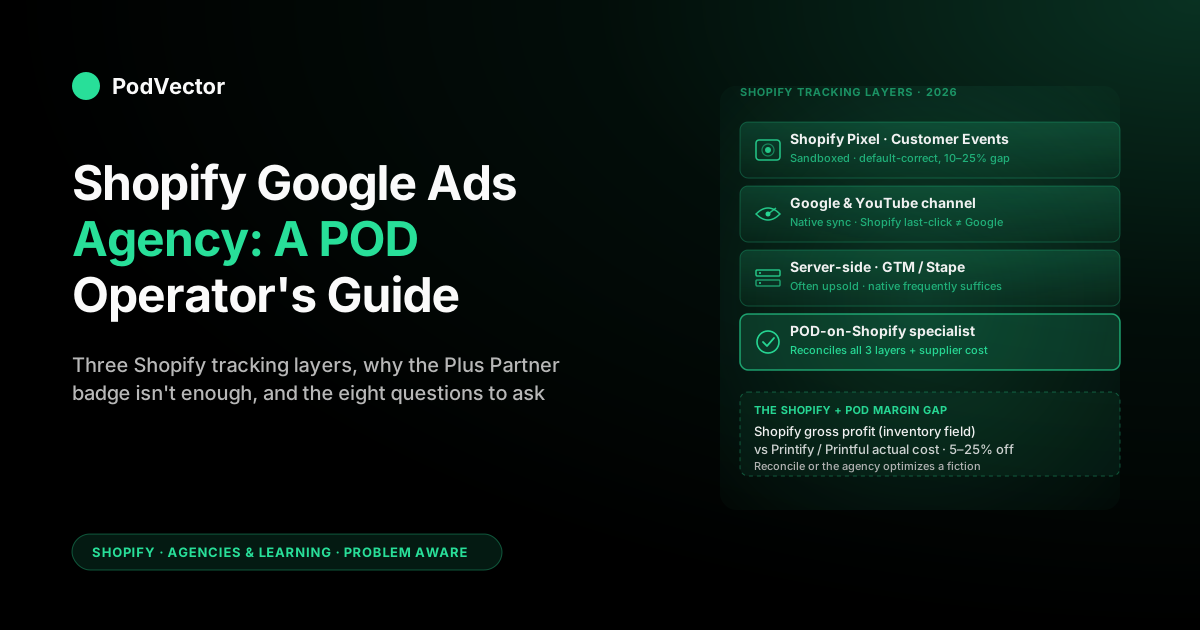
This is the section most worth reading in this guide, because the difference between a Shopify-fluent agency and a Shopify-pretending agency shows up here first. Shopify's conversion tracking for Google Ads runs through three overlapping layers, each with distinct failure modes.
Layer 1: The Shopify Customer Events / Shopify Pixel
Shopify's Customer Events sandbox runs ad-platform pixels in a Shopify-managed iframe that's lifecycle-aware (purchase, checkout, view product, etc.). It's the path of least resistance for a Google Ads conversion tag — paste in the tag template, fill in the conversion ID, done.
The trade-off is that the sandbox limits access to some DOM events, the cookie scope is constrained, and enhanced conversions need explicit configuration. A Shopify-fluent agency knows the limits and works inside them. A generalist agency frequently leaves the default tag in place and assumes it's correct, missing conversion signal that would have fired with proper setup — enhanced conversions and consent handling are the usual gaps.
Layer 2: Native Google & YouTube channel attribution
The Google & YouTube channel app pushes Shopify products to Merchant Center and reports back its own attribution numbers in Shopify admin. These numbers are not the same as Google Ads' reported conversions — Shopify uses its own last-click attribution window with a Shopify-flavored definition of "conversion." Less-experienced agencies will reconcile against Shopify's number because it's visually convenient; more experienced agencies treat it as one signal among several and reconcile against Google Ads' own conversions plus your bank statement. The gap between the two systems is routinely large enough to change budget decisions, and it's invisible to operators who never check.
Layer 3: Server-side tracking via GTM, Stape, or Shopify-native server-side
Shopify added native server-side tracking through Customer Events server-side, which works for most Google Ads use cases without a separate GTM container. For complex catalogs, agencies still recommend a Stape or self-hosted GTM server-side container for parameter enrichment, deduplication, and enhanced conversion consent.
The honest agency tells you when the native server-side path is enough; the less honest agency upsells a separate server-side GTM project regardless. For most stores at lower-to-mid ad spend with no custom event needs, the free native path does the job — a managed sGTM setup like Stape adds hosting cost before you count implementation hours. Ask whether your specific Shopify configuration actually needs server-side GTM or whether Customer Events server-side suffices — the answer changes by store and is worth a 30-minute conversation.
The single highest-signal vetting question for a Shopify Google Ads agency: ask them to walk you through the conversion-tracking architecture they'd recommend for a Shopify store running Printify and Printful, including how Shopify Pixel, the Google & YouTube channel, and any server-side layer interact. A fluent answer takes about three minutes and names the trade-offs at each layer. A non-fluent answer is generic ("we'd set up GA4 and conversions") and signals an agency that hasn't lived inside Shopify's tracking stack at depth.
For a complete breakdown of the four-layer tracking stack a POD store needs in 2026 — client tag, server-side relay, profit-as-value enrichment, and refund adjustments — see our Shopify Google Ads tracking strategy for POD.
Where Shopify + POD breaks the generalist agency model
Even a Shopify-fluent agency frequently fails POD clients on the same four assumptions that break generalist ecommerce agencies — and Shopify makes the failures more expensive because Shopify's native dashboards reinforce the wrong baseline.
Assumption 1: Shopify-reported revenue equals revenue you keep
Shopify Analytics reports gross sales, net sales, and gross profit. The "gross profit" calculation uses cost-per-item from your Shopify inventory record.
For Printify and Printful catalogs, that cost field is either blank, hand-set during product import, or out of date relative to the supplier's actual fulfillment price (which changes with promotions, base-product changes, and supplier price updates). Agencies that anchor on Shopify's gross-profit number are anchoring on a figure that can be materially wrong on any given week. Profit-aware POD agencies pull the actual order-line cost from Printify or Printful at reconciliation time, not from Shopify inventory. For a broader look at how to track incremental contribution properly, see our guide to incremental gross margin for ecommerce.
Assumption 2: Shopify's conversion attribution is the source of truth
Shopify's order attribution credits the most recent UTM-tagged source as the conversion driver. This is operationally fine for most agency reporting but creates a systematic mis-credit for Google Ads campaigns that interact with email and Meta — the same problem any single-touch attribution system has.
The POD-aware agency knows that and reports a multi-touch reconciliation quarterly. The generalist agency reports Shopify's attribution number as the contribution number and lets the bias compound. If you want a second attribution lens, see our review of Polar Analytics for POD stores — a tool that layers customer-level attribution on top of Shopify's native reporting.
Assumption 3: Performance Max scales naturally on Shopify catalogs
Generalist agencies default to "one PMax campaign with all products, let Google figure it out." On a Shopify + Printify catalog spanning many design niches, Google's optimizer reliably pushes spend toward the highest-revenue products, which on POD are systematically the worst-margin SKUs. As our Google Ads for Shopify store strategy guide explains, a basic unisex hoodie can sit at a very different gross margin than a ceramic mug — and if you tell Smart Bidding the conversion value is the order subtotal, it scales toward the wrong SKUs. A Shopify + POD-aware agency segments asset groups by margin tier or niche, excludes thin-margin SKUs at the campaign level, and rebuilds custom labels in the Merchant Center feed to reflect contribution rather than gross revenue. The work is mechanical once you know to do it; most agencies don't.
Assumption 4: Feed errors are the only feed work
Shopify's Google & YouTube channel auto-syncs your product catalog to Merchant Center. Most agencies treat the feed as a one-time setup — fix disapprovals, validate fields, move on.
POD catalogs need ongoing rationalization: aggressive exclusion of thin-margin variants, prioritization of evergreen designs over trending ones, alignment of product titles to niche-specific search queries, and rebuild of custom labels as the catalog rotates. Without that ongoing work, the feed becomes a gradual margin sink as you add new products faster than you exclude losers. Our Google Shopping Ads Shopify strategy for POD covers the feed-curation mechanics in detail.
The fix isn't finding a perfect agency — it's walking into the engagement with your real numbers and pushing for supplier-cost reconciliation as a contractual deliverable. The fuller treatment of why this gap exists structurally on POD is in our complete guide to Google Ads ROAS and attribution for POD.
The 8-question Shopify + POD vetting framework
The seven-question vetting framework we use for general ecommerce agencies (covered in the broader agency guide) extends with one Shopify-specific question, listed first because the answer disqualifies more agencies faster than any other.
- "Walk me through the conversion-tracking architecture you'd recommend on Shopify, given Customer Events, the Google & YouTube channel, and any server-side layer." Three minutes of fluent trade-off discussion is the bar. Generic "we'll set up GA4 and Google Ads conversions" is disqualifying. This is the single highest-signal question on the call.
- "How do you handle the divergence between Shopify-reported gross profit and actual margin after Printify/Printful supplier cost?" The right answer involves a concrete reconciliation process — a tool, a reporting layer, a quarterly tie-out against the supplier's order export. Anything else is disqualifying for POD.
- "Walk me through how you'd structure a PMax launch for a 200-SKU Shopify store with 15 design niches." POD-aware answers segment asset groups by margin tier or niche, exclude thin-margin SKUs explicitly, and pre-build brand-query exclusions at the campaign level. "One PMax campaign, all products" is the diagnostic for an agency that hasn't run POD-shaped catalogs.
- "What's your process when Merchant Center flags a trademark concern coming from a Shopify-synced product?" POD-native answers describe immediate feed-level exclusion of disputed SKUs (via the Google & YouTube channel's product-level exclusion), Shopify tag-based filtering to keep the SKU in store but out of the feed, and a process for preventing repeat appeals from triggering broader account scrutiny. Generic answers stop at "we'd file an appeal."
- "Show me a client report for a Shopify + Printify or Shopify + Printful account where Shopify-reported gross profit and contribution margin disagreed materially." Agencies with POD experience have these reports and can redact them; agencies without will offer a different example or demur.
- "What's your minimum commitment, and the first 90-day exit clause?" Reasonable: 3-month minimum, 30-day notice afterward. Aggressive but workable: 6-month minimum with quarterly review. Disqualifying: 12-month lockups with auto-renewal.
- "Who specifically would be running my account day-to-day, what's their tenure at the firm, and how many other accounts do they own?" A named human with meaningful agency tenure carrying a manageable account load. As Groas's 2026 agency pricing analysis notes, a typical mid-level PPC manager juggles many accounts simultaneously, meaning your campaigns get attention in bursts rather than continuously — so account load is a fair question to press.
- "Can you give me one current Shopify + POD client reference and one client you've parted ways with in the last six months?" Willingness to share a churned client says more about agency honesty than any case study. "We've never lost a client" is rarely true.
If an agency fails question 1 or 2, every other answer is decoration. Spend the call on those two and reschedule for follow-up only if the agency clears both.
Shopify apps an agency might recommend (and which to skip)
A Shopify-fluent agency will often recommend a small stack of apps to support paid-media work. The honest segmentation:
Worth installing on most Shopify + POD stores
- Google & YouTube channel (free) — the native Merchant Center sync. Required if you're running Shopping or PMax. Configure once, monitor for sync errors.
- A reconciliation/profit layer (Lifetimely, BeProfit, or similar) — pulls supplier cost from Printify/Printful and reconciles against Shopify orders. The agency should look at reconciled numbers, not Shopify's gross-profit field, when reporting. Or skip the standalone dashboard entirely and ask Victor the reconciliation questions directly — see the CTA below.
- A creative-workflow app — only if your creative cadence is high enough to need workflow tooling. Most stores don't.
Frequently recommended, often unnecessary
- AI ad-management apps (AdScale, Traffic Booster, etc.) — useful for owner-operators who want a hands-off PMax replacement, but they overlap with agency value. If you have a Shopify Google Ads agency, you usually don't also need an AI-ad app; pick one and run it. Stacking the two adds signal noise rather than performance.
- Third-party attribution tools (Triple Whale, Northbeam, etc.) — strong for stores running meaningful multi-channel paid spend, overkill for stores running single-channel at lower budgets. Don't let an agency push attribution tooling that costs more than your monthly ad spend. See our Polar Analytics review for a lower-cost alternative worth evaluating first.
- Shopify-native CRO apps (Shopify Magic, Shoplift, etc.) — landing-page optimization is real value but is usually outside the Google Ads retainer. If the agency bundles CRO into the retainer, ask for the scope in writing; if they don't, you'll need to budget separately.
Avoid unless your agency explicitly requires it
- Shopify-store-side conversion-tracking apps — Shopify's Customer Events server-side now covers most use cases natively. A third-party "enhanced tracking" app is rarely necessary in 2026, and several of them double-fire conversions, inflating reported numbers.
- Manual feed-management apps — for catalogs under 500 SKUs, the native Google channel handles feed work fine. Manual feed apps make sense only for catalogs in the thousands or for advanced custom-label schemes most stores don't need.
Pricing patterns specific to Shopify retainers
Shopify Google Ads agencies price somewhat differently from generalist ecommerce agencies, with a few patterns worth knowing in advance. The ranges below reflect current market data from OuterBox's 2026 PPC management pricing guide and Stackmatix's 2026 PPC agency pricing overview.
Setup fees are common
Many Shopify-specialist agencies charge an onboarding fee — often a low-four-figure line item — before the retainer kicks off. This usually covers an audit, conversion-tracking review, feed health pass, and initial campaign restructure. According to Stratagem Systems' 2026 fee breakdown, setup fees commonly range from $500 to $5,000 as a one-time charge for account creation and campaign setup. It's frequently money well spent — better to pay for the deep audit than to roll it into a vague monthly retainer.
Retainer + percent of spend hybrids
Smaller Shopify-fluent boutiques sometimes bill a base retainer plus a percentage of ad spend above a defined threshold. According to OuterBox's pricing guide, percentage-of-spend pricing commonly lands around 10–20% of monthly media spend market-wide; hybrids trade some of that percentage for a fixed base. Stackmatix's 2026 overview similarly puts most businesses at 10–20% of ad spend as management fees for mid-market accounts. The workable structure is fine for stores that scale ad spend predictably.
The trap: percent-of-spend misaligns incentives once thin-margin SKUs become tempting volume drivers. If you accept this structure, cap the percent at the lower end of market range and require quarterly reconciliation against your true contribution margin.
Project-fee creep
Shopify-specialist agencies frequently scope new work as project fees on top of retainer — feed rebuild, new conversion-tracking setup, headless storefront migration support, Shopify Markets launch. Budget a meaningful buffer above your annual retainer for project work in year one. Less than that and you're either lucky or under-investing in infrastructure.
Shopify Plus tier multipliers
Once you're on Shopify Plus (see Shopify's published pricing for current platform fees), agency retainers usually step up to reflect the higher account complexity, the access to Plus features the agency is now responsible for managing (Functions, Hydrogen, B2B), and the implicit signal that you're a higher-revenue client. Verify the multiplier is reflected in actual scope changes rather than just a Plus tax.
For the head-to-head comparison of named ecommerce agencies that work on Shopify and how each holds up under POD margin analysis, the best Google Ads agencies for ecommerce comparison covers the named-agency side. For lower-cost paths most stores should travel before retainer becomes viable, the Google Ads for ecommerce course guide covers the educational alternatives.
When a Shopify specialist beats a generalist ecommerce agency
Three conditions where a Shopify-specialist agency's premium is worth paying over a generalist:
Condition 1: Your store relies on Shopify-specific features
If you use Shopify Markets for international, a Hydrogen storefront, headless commerce via the Storefront API, Shopify Functions for discounting logic, or B2B on Shopify Plus, a generalist agency will spend the first month learning your stack. A Shopify specialist starts on day one. The cost of the learning curve usually exceeds the premium.
Condition 2: Your tracking is a known pain point
If you've seen Shopify-reported revenue diverge from Google Ads-reported conversions in ways you can't explain, the diagnostic work to fix it is faster with a Shopify specialist. Generalists will quote a full tracking-stack rebuild; specialists will identify the specific Shopify Pixel, Customer Events, or attribution-window misconfiguration and fix it in a half-day.
Condition 3: You expect to launch new Shopify-side features
If your roadmap includes new product types, new collections that depend on metafields, a checkout extension, or a B2B store launch, a Shopify specialist coordinates the paid-media side of those launches without you having to project-manage them. A generalist will treat each launch as a new scope item.
For POD operators running a relatively standard Shopify Basic store with Printify or Printful at lower MRR, a Shopify specialist's premium frequently isn't worth paying yet. The generalist or boutique tier covers the work. Once you're running meaningful platform complexity and your revenue can comfortably absorb a larger retainer, the specialist tier earns its premium consistently. The full landscape sits in our Google Ads services for POD buyer's guide, which compares agencies, freelancers, courses, in-house hires, and tooling on the same axes.
If you're evaluating whether to sell your store before committing to a large agency retainer, our guide on where to sell your Shopify store covers exit options and valuation considerations worth reviewing first.
FAQs
How much does a Shopify Google Ads agency cost in 2026?
According to OuterBox's 2026 PPC management pricing guide, most small-to-mid-market management fees fall between $1,500 and $5,000 per month, scaling with ad spend. Groas's 2026 agency pricing breakdown similarly puts most mid-market businesses between $1,500 and $5,000 monthly in management fees. Shopify-fluent boutiques tend toward the lower end of that range; Shopify Plus mid-tier agencies tend toward the upper end and beyond.
Premium Shopify Plus full-service agencies run higher still. POD-on-Shopify specialists occupy a wide range depending on scope. Add a meaningful buffer above your annual retainer for project work in year one. As a ceiling, agency retainer plus media-management overhead should not exceed a comfortable share of monthly contribution margin — the most common mistake in POD agency hiring is signing a retainer that consumes more contribution than the campaigns generate.
Is a Shopify-specialist agency worth it over a generalist Google Ads agency?
Yes if you depend on Shopify-specific features (Markets, Hydrogen, headless, Plus Functions), have known tracking issues, or expect to launch new Shopify-side features. No if you run a standard Shopify Basic store with Printify or Printful and your tracking is straightforward — a generalist boutique at the same retainer covers the work. The specialist premium is reliably worth it once your store carries meaningful platform complexity and the retainer overhead fits within your contribution margin.
Should I trust an agency just because they're a Shopify Plus Partner?
No. The partner badge qualifies firms that have built Shopify stores or apps; it does not qualify them on Google Ads. Many Shopify Plus Partners are theme studios with paid-media as a service line delegated to junior staff. Treat the badge as hygiene (a real Shopify-aware business) rather than as a quality signal. Vet on Google Ads work specifically — managed media volume, POD client experience, conversion-tracking fluency.
How do I check whether a Shopify Google Ads agency understands print-on-demand?
Three tests. First, ask them to walk through how they'd reconcile Shopify-reported gross profit against actual Printify or Printful supplier cost — POD-aware agencies answer fluently with a process.
Second, ask if they've run a Shopify + Printify or Shopify + Printful client and request to speak with that client. Third, ask how they'd structure PMax for a 200-SKU Shopify catalog with 15 niches; POD-aware answers segment asset groups by margin or niche, generic answers describe one campaign with everything. Failure on test one disqualifies regardless of the others.
What's the difference between a Shopify Google Ads agency and a freelance Shopify Google Ads expert?
According to Ryze's 2026 Google Ads management cost guide, freelance consultants typically charge $500–$3,000 per month, while agencies run $1,500–$5,000 or more. Freelancers are individual specialists often managing your account part-time; agencies are team-based firms offering depth across campaign ops, creative, analytics, and feed engineering. Freelancers trade team breadth for direct senior ownership and lower cost.
For POD stores at early-to-mid MRR on Shopify, freelancers almost always win on value. At higher MRR with infrastructure complexity, agencies become competitive again because you can absorb retainer overhead and need the team depth.
Should I let an agency manage my Shopify Google & YouTube channel app, or run it myself?
Let them manage it once you're paying retainer — the channel app is the agency's primary interface to Merchant Center and they should own its configuration. Maintain admin access yourself and audit the configuration quarterly. The most common mistake operators make is granting the agency channel-app access without retaining their own admin access, which becomes painful at the end of an engagement when account ownership is contested.
What about Shopify-native AI ad apps like AdScale or Traffic Booster — do I still need an agency?
The AI ad apps and a Shopify Google Ads agency overlap in value. For owner-operators at lower monthly ad spend, the AI app can outperform a mid-tier retainer because the AI handles tactical optimization at machine speed. Above a meaningful spend threshold, the agency's strategic and feed-engineering work pulls ahead — but stacking the AI app on top of an agency creates signal noise rather than additive performance. Pick one, run it for 90 days, evaluate.
How long should I commit to a Shopify Google Ads agency?
3-month minimum, 6-month maximum for an initial commitment. After 90 days you have enough data to evaluate fit. According to Stratagem Systems' 2026 fee breakdown, minimum contracts commonly run 3–12 months; the shorter end of that range is appropriate for initial engagements. 12-month minimums with auto-renewal were standard a decade ago; in 2026 they signal an agency that can't retain on results.
The honest contract is a 3-month minimum with 30-day notice afterward, plus a quarterly review built into the agreement. If a Shopify-specialist agency requires a longer initial commitment, push back; specialists in 2026 generally don't need lockups to retain.
Can I run Shopify Google Ads myself instead of hiring an agency?
Yes, and at earlier revenue stages most POD operators on Shopify should. The platform's automation does most tactical optimization, and a focused ecommerce course teaches the strategic layer. See our ecommerce small-business bookkeeping guide for building the financial foundation before agency spend becomes relevant.
Agencies become viable when ad spend is high enough that incremental improvements clearly clear the retainer — typically once your monthly ad spend is large enough that even a single-digit-percentage efficiency gain covers the management fee. The DIY phase is where unit economics get confirmed; skip it and you'll pay an agency to optimize against numbers that may not reflect a profitable business.
What's the role of AI in Shopify Google Ads agency work in 2026?
Google's campaign-side AI (PMax, Smart Bidding, Demand Gen) handles a large share of tactical optimization. What you're paying a Shopify agency for in 2026 has shifted from "bid management" to "Shopify integration fluency, feed engineering, measurement reconciliation, and exception handling." The biggest leverage gain for Shopify + POD operators is the post-campaign reconciliation layer that nets Shopify-reported gross profit against actual Printify or Printful supplier cost. Most agencies haven't built this layer; the operators who have it (whether self-built, with tooling, or via a POD-native specialist) make better strategic decisions across the board. For how AI-native tooling approaches this problem for POD stores specifically, see our guide to AI for print-on-demand businesses.
Walk into Shopify agency interviews with your real margin numbers
Most Shopify Google Ads agencies anchor their reporting on Shopify-reported gross profit — a number that uses your inventory cost-per-item field, which is often blank, hand-entered, or stale on Printify and Printful catalogs. Agencies optimize against whatever baseline you accept, which is why store owners who walk in with their true profit per campaign get better deals from agencies. PodVector AI's AI employee, Victor, pulls your real supplier costs from Printify and Printful before you ever make a sale, and lines them up with your Shopify sales and Google Ads spend. Ask him "what did my Google Ads campaigns actually make this month after every cost" and he'll tell you in plain English — no spreadsheets, no setup, and no waiting for an agency's quarterly reconciliation. Stop letting the platform set the baseline. And bring your own numbers to every Shopify agency conversation.
Try Victor free