
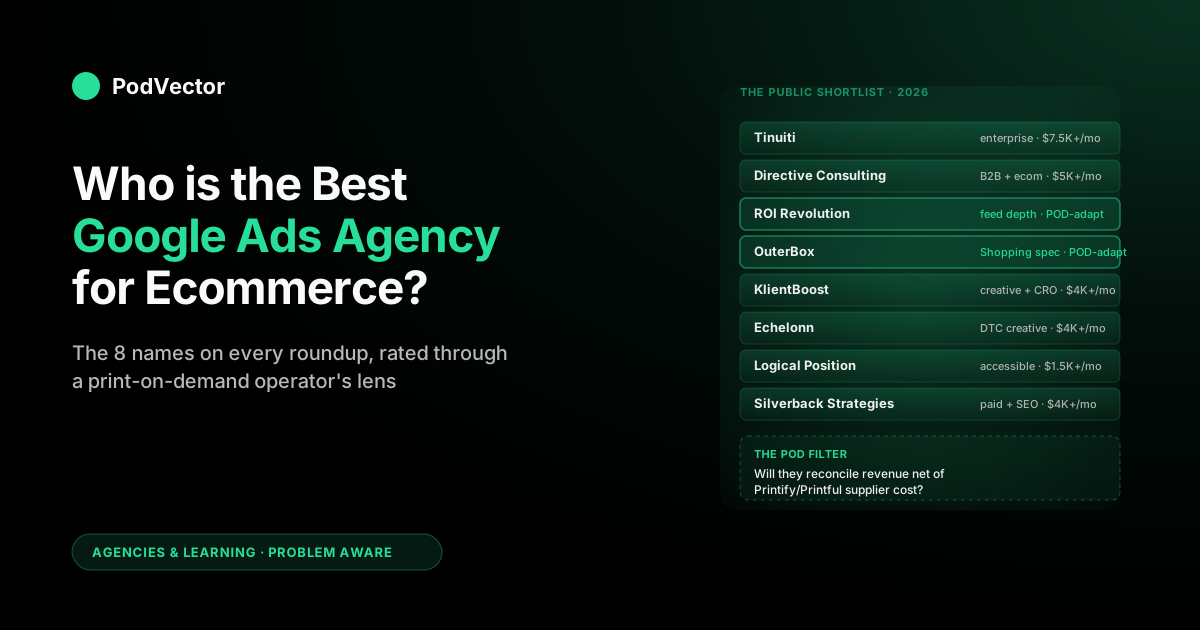
Quick Answer: There is no single "best" Google Ads agency for ecommerce — the right answer depends on your monthly ad spend, your margin profile, and whether your supplier cost is fixed or variable. The agencies that consistently rank in 2026 — Tinuiti, ROI Revolution, Directive, KlientBoost, OuterBox, Logical Position, Echelonn, and a handful of others — are excellent for stable-COGS DTC brands but almost universally optimize against Google-reported ROAS, which silently ignores Printify or Printful supplier costs and the resulting margin compression.
For print-on-demand sellers, the "best" agency is the one that contractually reconciles ad-attributed revenue against per-order supplier cost — a deliverable that fewer than one in ten ecommerce agencies has ever produced. This guide names the agencies that show up on every shortlist, rates each through the POD lens, and gives you the seven-question vetting framework that tells you which one will actually pay for itself.
Why "the best" depends entirely on your business shape
Every ecommerce operator who searches for "the best Google Ads agency" is looking for the wrong thing. The roundups that rank for this query — including Ecommerce Paradise's 2026 list, Silverback Strategies' ranked review, and Directive's 20-agency roundup — list the same 15 to 30 names in slightly different order. Each one is correct in its own narrow way; none of them answer the question a POD operator actually has.
The "best" agency for a $500K MRR DTC apparel brand on Shopify with stable cost-of-goods is Tinuiti or ROI Revolution. The "best" for a $40K MRR Printify store running 200 SKUs across niches is almost never on a public roundup.
The reason isn't that the public roundups are wrong — it's that they optimize for a profile that excludes about 80% of POD operators. They assume blended COGS percentages in the low double digits, fixed per-SKU costs, and a brand operator with the in-house finance discipline to push back on optimization choices. Three assumptions that a typical POD store violates on day one.
The honest framing is this: the agencies that consistently rank are good at running Google Ads accounts. Whether they're good at running your Google Ads account depends on whether they will adapt their measurement, bidding, and feed strategy to your actual contribution margin — not the platform-reported revenue.
Most won't. A handful will. Knowing which is which before you sign a 6-month contract is the entire game.
The 8 agencies that rank for every "best Google Ads agency" search
Across the three top-ranking roundups for this query in 2026, the same names appear repeatedly. Below is the consolidated shortlist — the agencies you will encounter on virtually every "best of" list, in alphabetical order to avoid implying a ranking that doesn't reliably hold across different store profiles.
Directive Consulting
Mid-to-large agency headquartered in Irvine, California, with a strong B2B SaaS pedigree that has expanded into ecommerce. Best known for pipeline-marketing frameworks (CAC-to-LTV, RevOps integration).
Suits ecommerce operators who think about paid acquisition like a B2B funnel — long consideration cycles, content-led SEO + paid coordination, large AOVs. Less optimized for fast-cycle apparel-style POD, where the funnel is impulse-led and the unit economics are thin.
Echelonn
Smaller, ecommerce-native agency built specifically around DTC brands and Google + YouTube Ads. Strong creative production muscle and named brand portfolio (Tabs, Obvi, Snow, Sundays).
Pricing typically aligns with the mid-tier band. The brand-DTC focus is a double-edged fit for POD: the creative depth is real, but the named portfolio is heavily branded-CPG, not POD-niche, which means their default playbook may not transfer cleanly to a Printify hoodie catalog.
KlientBoost
Costa Mesa-based mid-tier agency with a strong reputation for creative + CRO integration. Their pitch is that paid media wins are won at the landing page as much as in the auction, and they typically bundle CRO into their Google Ads engagements.
For POD operators on Shopify with a single-SKU or hero-product focus, KlientBoost's CRO emphasis can be high-leverage. For 200-SKU POD catalogs where the conversion challenge is product-fit rather than landing page, the CRO bundling is less unique.
Logical Position
Larger Pacific Northwest agency with an accessible pricing tier — one of the few mid-tier shops that takes accounts in the $1,500–$3,000/month range. Their volume model means individual account managers carry larger books, so attention-per-account is lower than at boutiques. A reasonable starting point for POD operators in the $30K–$50K MRR band who want named-agency credibility without the mid-tier minimum.
OuterBox
Cleveland-based agency with a clear ecommerce specialization, particularly strong on technical Merchant Center feed optimization and Shopping campaign engineering. Often shows up as a top pick when a roundup author is specifically writing about Google Shopping rather than Google Ads broadly. For POD stores where the bottleneck is feed structure (and it usually is, especially on large-catalog Printify accounts), OuterBox's technical depth is one of the most relevant fits on this list — provided they will adapt feed strategy to per-SKU margin rather than broad category rules.
ROI Revolution
Raleigh, North Carolina-based mid-sized agency with deep ecommerce focus and genuine Merchant Center fluency. One of the few agencies in the shortlist that talks about feed and Shopping with the same operational granularity as it talks about Search.
Suits ecommerce stores spending $10K+/month on Google Ads with multi-channel ambitions (Google + Meta coordination). For POD specifically, the strength is feed depth; the gap is the same as everyone else's — supplier cost reconciliation.
Silverback Strategies
Arlington, Virginia-based independent with a balanced ecommerce and B2B portfolio. They publish their own ranked roundup of competitors (a marketing tactic worth noticing — they self-rank #1 on their own list).
Strong on integrated paid + SEO programs. A reasonable pick for ecommerce stores that want one team handling both organic and paid; less of a unique fit for POD specifically, where the paid-acquisition challenge dominates.
Tinuiti
One of the largest independent performance marketing agencies in the U.S., with deep specialization in Google Shopping and Performance Max for enterprise ecommerce. Best for stores spending $20,000+/month on paid media with complex multi-channel needs.
Tinuiti is the closest thing to a default safe choice in the enterprise tier. For POD operators, that scale is usually the wrong fit — the retainer minimums are typically $10K+/month, and the agency's optimization process is calibrated for stable-COGS DTC brands at much higher monthly spend.
Each agency, rated through a POD operator's lens
The shortlist above is the public consensus. The table below is what those same agencies look like when you grade them against the variables that actually determine POD profitability: supplier cost reconciliation, feed-level margin awareness, willingness to take small accounts, and whether they have a referenceable POD client.
Rating dimensions
- Supplier cost reconciliation — will they contractually report on revenue net of Printify/Printful per-order cost?
- Feed margin awareness — do they restructure or exclude SKUs based on margin rather than just volume?
- Minimum account size — what's the lowest monthly retainer or ad-spend threshold they'll take?
- POD reference client — can they put you on a call with a current Printify or Printful Shopify operator?
The pattern across the shortlist
Of the eight agencies above, none publishes any of the four POD-specific commitments on their public site. That isn't proof they can't do them — it's proof they don't lead with them, which means a POD operator who signs without contracting for these explicitly will receive the agency's default playbook.
The default playbook optimizes Google-reported ROAS, treats feed structure as a configuration step, and reports on platform metrics rather than P&L. For a fixed-COGS DTC brand, that default playbook is usually fine. For POD, it routinely produces a "winning" account that loses money in the bank.
Three of the eight will adapt to POD-specific reporting if you push for it in the contract: ROI Revolution and OuterBox (both have the feed depth to do it), and to a lesser extent KlientBoost (their CRO emphasis makes them more receptive to operator-led measurement frameworks). The other five will either decline or quietly shelve the request after onboarding. None of this is dishonest; it's the natural consequence of agencies running playbooks built for the customer profile they primarily serve.
The deeper analysis of why generalist ecommerce agencies fail POD clients — and the four specific assumptions that break in the POD context — is in our Google Ads agency guide for POD operators, which goes into the four-tier agency landscape and the failure modes that don't appear in any public roundup.
What every shortlist agency has in common (and what they all miss for POD)
Look at the eight agencies side by side and the structural similarities are obvious. They all charge $3,000–$15,000+/month.
They all have named departments — paid media, creative, analytics, sometimes CRO. They all use Looker Studio (or a proprietary equivalent) for reporting.
They all have case studies on their site featuring CPG, apparel, beauty, or home brands. They all sell the same outcome: better reported ROAS, more efficient spend, scaled revenue.
What none of them publish — and what almost none of them quietly do — is reconcile their reported ROAS against the operator's actual P&L on a recurring basis. The reason is structural: agencies are paid against the platform's metrics because that's the surface they can see and influence.
The P&L is the operator's responsibility, sitting in a Shopify report or a QuickBooks export the agency never touches. For a brand with stable per-SKU cost structure, the gap between reported ROAS and true contribution margin is small enough to ignore. For a POD operator with $18.50 per-hoodie supplier cost on a $32 sale price, the gap is the entire margin.
This is the single biggest reason the "best" agencies on the public roundups disappoint POD clients. They are doing exactly the work they were hired to do — running good Google Ads accounts.
The work that POD operators actually need — running good Google Ads accounts against the right baseline — is a different scope, and almost nobody contracts for it explicitly. Walking into the agency conversation with that framing is the highest-leverage move a POD operator can make. The full ROAS-and-attribution treatment is in our Google Ads playbook for print-on-demand sellers, which builds the measurement layer that any agency engagement should sit on top of.
How to pick the right one for your store
The decision framework collapses to four questions about your store, asked in order. Answer them and the right tier — and usually the right two or three named agencies — falls out of the answers.
1. What is your monthly Google Ads spend?
Below $5,000/month: don't hire any of the shortlist agencies. The retainer math doesn't work.
Logical Position is the only one of the eight that will even take the account, and the attention-per-account ratio at that tier means you're paying for senior brand-association more than senior account work. A freelancer or self-managed account with tooling beats the agency at this spend level.
$5,000–$15,000/month: KlientBoost, OuterBox, ROI Revolution, Echelonn, or Logical Position. These are the agencies in the shortlist whose retainer structure plausibly clears at this spend, assuming a 10–20% lift in true contribution margin from the engagement.
$15,000–$50,000/month: ROI Revolution, OuterBox, Tinuiti, Directive, Silverback. These agencies have the operational capacity to give your account the senior attention it needs, and the retainer is small enough relative to spend that even modest improvements clear it.
$50,000+/month: Tinuiti or Directive at the enterprise end; ROI Revolution or OuterBox if you want a more hands-on mid-large fit. Above this spend, the bottleneck shifts from agency cost to the agency's ability to staff your account with senior people who actually move the needle.
2. What is your COGS structure?
Stable, fixed-percentage COGS (cut-and-sew apparel, contract-manufactured product, dropshipping with fixed supplier pricing): any of the shortlist agencies can run your account competently. Their default playbook works for you.
Variable per-order COGS (Printify, Printful, Gelato, Gooten, any POD model): your shortlist narrows to the agencies that will adapt their measurement framework. In practice that's ROI Revolution and OuterBox of the named eight, plus the broader category of POD-native or POD-adjacent specialists that don't appear on public roundups.
3. Where is your bottleneck?
If your bottleneck is feed structure (large catalog, mixed margin, lots of SKU sprawl): OuterBox or ROI Revolution.
If your bottleneck is creative (small catalog, hero product, conversion-rate problem): KlientBoost or Echelonn.
If your bottleneck is integrated channel coordination (Google + Meta + email): Tinuiti or Directive.
If your bottleneck is account hygiene and basic optimization (no one is watching): Logical Position is the cheapest path to "someone is watching" — but you should also consider a freelancer first.
4. Do you need a referenceable POD client?
If yes (and you should): none of the eight is a guaranteed yes. Ask the question in the discovery call.
The agency that can name a current Printify or Printful Shopify client and put you on a call with them is materially de-risked compared to one that says "we have plenty of ecommerce experience" without specifics. POD-specific reference is the single highest-signal qualifier in this market.
The 7 questions that disqualify 90% of contenders
The shortlist gets you into the right room. These seven questions get you out of it without signing the wrong contract. Ask all of them in the discovery call. Score each agency honestly. Disqualify any that fail more than two.
- "How will you report on revenue net of supplier cost on a per-order basis?" — A POD-aware agency answers fluently with a process. A generic agency deflects to "we'll work with your data" or pivots to platform-reported ROAS. Disqualifies most.
- "Can you put me on a call with a current Printify or Printful Shopify client?" — Either yes or no. "We have similar ecommerce experience" is no. Disqualifies most of the rest.
- "What's your default Performance Max bidding strategy for a 100+ SKU mixed-margin catalog?" — Maximize Conversion Value with no margin caveat is the wrong answer. Target ROAS with explicit per-product-group margin rationale is the right answer.
- "What's the cancellation notice on your contract?" — 30 days after a 3-month minimum is fair. 90+ days is a red flag. 12-month minimum without exit clauses signals an agency that can't retain on results.
- "Who specifically will work on my account, and what's their book size?" — Named senior practitioner with fewer than 12 accounts: green flag. Generic "team of specialists" with 25+ accounts per AM: yellow flag for POD where attention matters.
- "What's your fee structure — flat retainer or percentage of spend?" — Flat retainer is correct for POD. Percentage of spend misaligns incentives in a thin-margin business.
- "What does month-three success look like, written down, with thresholds?" — A real answer involves specific true-ROAS or contribution-margin lift ranges. A vague answer ("scaled spend, improved efficiency") signals an agency that won't be held to outcomes.
For a deeper view of which agencies, freelancers, courses, and tools are appropriate at which stage of POD growth — and how to calculate the breakeven retainer for your specific store — see our complete Google Ads services buyer's guide for POD, which puts the agency option side-by-side with the alternatives below.
If none of them fit: the agency alternatives worth pricing
For most POD operators below $30K MRR, none of the shortlist agencies is the right answer. Three alternatives consistently outperform a generalist agency retainer at this scale:
Specialist freelancer
$1,000–$2,500/month for a senior practitioner running your account part-time. The right freelancer for POD will have either personally run a Printify or Printful store or contracted with several. They'll do the supplier-cost reconciliation work as a matter of course because they're closer to the operator. Lower team breadth than an agency, but materially higher attention and POD-specific judgment.
Operator-focused course plus tooling
$500–$1,500 for a serious ecommerce-focused Google Ads course, plus $200–$500/month for analytics and reporting tooling that handles supplier-cost reconciliation. Total first-year cost is materially lower than three months of agency retainer, and the operator builds platform fluency that compounds across every future hire (agency, freelancer, or in-house).
The cost of a learning curve is real; the cost of being unable to evaluate whoever runs your account is much larger. Our breakdown of which courses earn the cost is in our Google Ads for ecommerce course guide.
POD-aware AI tooling
$50–$300/month for analytics infrastructure that integrates Shopify, Printify or Printful, and Google Ads at the per-order level. Doesn't replace human judgment, but eliminates the reconciliation gap that breaks generalist agency engagements. Pairs well with a freelancer or self-managed account; meaningfully improves any agency engagement by giving the operator the data to push back on optimization choices.
For the full landscape of agency, freelancer, course, in-house, and tooling options scored against POD margin math, see the agencies & learning hub. For the full Google Ads topic across strategy, ad types, integrations, and measurement, see the Google Ads topic hub.
FAQs
Who is the best Google Ads agency for ecommerce in 2026?
There is no single best — the right answer depends on monthly spend, COGS structure, and bottleneck. Tinuiti and Directive lead the enterprise category for stores spending $20K+/month with stable COGS.
ROI Revolution and OuterBox are the strongest mid-tier picks when feed engineering is the bottleneck. KlientBoost and Echelonn are strongest when creative and CRO are the bottleneck. For POD specifically, none of the public-roundup agencies is a guaranteed fit; the agency that contractually reconciles ad-attributed revenue against supplier cost wins, regardless of where it ranks on someone else's list.
Is Tinuiti the best Google Ads agency for ecommerce?
Tinuiti is the strongest enterprise-tier choice — large independent, deep Google Shopping specialization, and named-brand client roster. "Best" depends on store size: below ~$20K/month in ad spend, Tinuiti's retainer minimums and account-team structure aren't a fit. For POD operators specifically, Tinuiti is rarely the right answer because the agency's optimization framework is calibrated for stable-COGS DTC brands at materially higher spend levels.
What's the best Google Ads agency for a Shopify Printify store?
Almost never one of the agencies on the public roundups. The right fit is either (a) ROI Revolution or OuterBox among the named shortlist, with explicit contractual deliverables for supplier-cost reconciliation and per-margin feed structure, or (b) a POD-native specialist or POD-fluent freelancer who treats supplier-cost reporting as default rather than as a custom request. The single highest-signal qualifier is whether the agency can put you on a call with a current Printify Shopify client.
How much should a top Google Ads agency cost in 2026?
Across the shortlist: KlientBoost, Echelonn, ROI Revolution, OuterBox typically $3,000–$8,000/month. Logical Position takes accounts as low as $1,500–$3,000/month.
Tinuiti and Directive typically $7,500–$25,000+/month. Add 20–40% for project work outside standard scope. As a rule of thumb for POD: total agency cost (retainer plus project fees) should not exceed 20% of monthly contribution margin, or the agency is consuming the lift it's supposed to generate.
Are the agencies on roundup lists actually the best, or just the ones with the best SEO?
Both. Agencies that rank on multiple roundups have invested in content marketing, which correlates with operational maturity and willingness to be measured publicly.
It also correlates with the agency being optimized for the customer profile that searches for "best Google Ads agency" — typically mid-market DTC brands. The list is filtered for that profile, not for POD or other niche structures. The right way to use the roundups is as a starting shortlist, not a buying decision.
What's the difference between a "best Google Ads agency" and a "best Google Shopping agency"?
Google Shopping agencies are a subset focused on Merchant Center feed engineering, Shopping campaign structure, and Performance Max optimization for product feeds. Google Ads agencies span Search, Display, YouTube, Demand Gen, and Performance Max.
For ecommerce stores where 70%+ of paid revenue comes from Shopping (which is most), a Shopping-specialist agency like OuterBox often outperforms a generalist agency at the same retainer level. POD operators with large catalogs are usually in this Shopping-dominant category.
Should I trust an agency's case studies?
Cautiously. Case studies are marketing artifacts — accurate within their reporting frame but selectively chosen and selectively measured.
For POD operators specifically, ask: are any of these case studies POD stores? What's the COGS structure of the brand in this case study?
What baseline is the "+340% ROAS" measured against, and was supplier cost reconciled? An agency that can answer those questions about its own case studies is materially more credible than one that can't.
How long does an agency engagement need to run before I know if it's working?
90 days minimum. Google Ads needs 14–30 days to learn campaign changes, your account history needs to settle, and the agency needs at least one full quarter to ship substantive changes and measure results.
Holding an agency to performance in the first 30 days is statistically unfair. By day 90, you should have measurable improvement against an honest baseline (true ROAS, not platform-reported), or a concrete explanation for why not. If neither is true at day 90, give 30-day notice.
What's the cheapest credible Google Ads agency for a small ecommerce store?
Logical Position takes accounts in the $1,500–$3,000/month range and is the most accessible of the named shortlist. Below that price point, you're looking at solo freelancers or specialty boutiques that don't appear on public roundups. The cheapest credible path for a POD store under $30K MRR is usually a freelancer at $1,000–$2,000/month plus tooling — total cost lower than agency retainer, attention-per-account higher, POD-specific judgment usually better.
If I can only afford one of the shortlist agencies, which should I choose?
If your bottleneck is Shopping and feed: OuterBox. If your bottleneck is full-funnel measurement and multi-channel: ROI Revolution.
If your bottleneck is creative and conversion: KlientBoost. If you need enterprise-tier process and predictability: Tinuiti.
None of these is a guaranteed fit for POD without explicit contractual modifications, but each is the strongest answer to a specific bottleneck. The wrong move is choosing on brand reputation alone — ranking high on someone else's roundup says nothing about whether the agency will earn the retainer in your specific store.
Bring your true contribution margin to every agency interview
Every agency on every "best of" roundup will pitch you using Google's reported ROAS — a number that, for POD sellers, ignores Printify or Printful per-order supplier cost, shipping, refunds, and platform fees. The operators who walk away with engagements that actually pay for themselves are the ones who walk in with their true contribution margin per campaign already in hand. PodVector AI's AI employee, Victor, looks at your Shopify, Printify, Printful, and Google Ads data together and tells you "what did each Google Ads campaign actually make this month after every cost" in plain English — so you can hold any agency, freelancer, or in-house hire to a real baseline. And stop letting the platform's reported ROAS set the conversation.
Try Victor free