
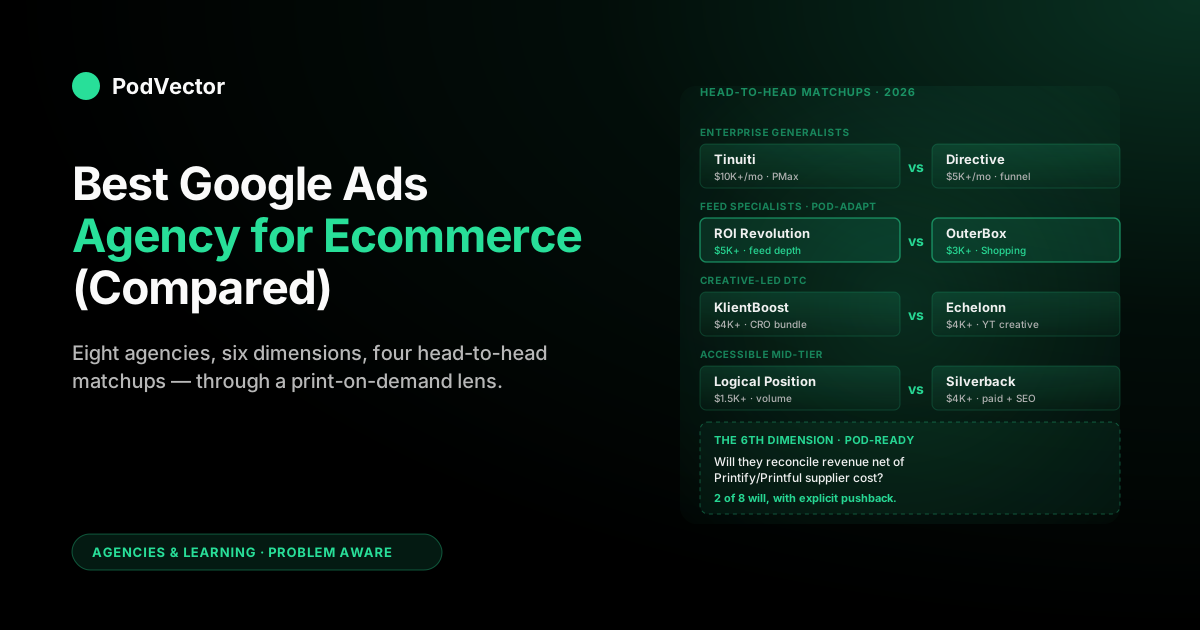
Quick Answer: Compared head-to-head, the eight agencies that ecommerce operators evaluate most often in 2026 — Tinuiti, Directive Consulting, ROI Revolution, OuterBox, KlientBoost, Echelonn, Logical Position, and Silverback Strategies — separate cleanly into four matchups: enterprise generalists (Tinuiti vs Directive), feed specialists (ROI Revolution vs OuterBox), creative-led DTC shops (KlientBoost vs Echelonn), and accessible mid-tier (Logical Position vs Silverback). As current roundups including the OneLittleWeb top-50 and Hustle Marketers' 12-pick list confirm, the best ecommerce agencies do four things well: rebuild the Shopping feed, structure Performance Max with real asset groups, separate branded from non-branded search, and optimize to contribution margin rather than platform ROAS. For a print-on-demand operator, the comparison collapses fast: only ROI Revolution and OuterBox have the feed depth to handle Printify or Printful catalogs at scale, Logical Position is the only agency in the shortlist that takes accounts at a below-enterprise monthly minimum, and none of the eight contractually reconciles ad-attributed revenue against per-order supplier cost without explicit pushback. Below: a six-dimension comparison matrix, four head-to-head matchups, and the question set that turns a glossy pitch deck into a defensible signing decision.
The 6 dimensions any honest comparison has to use
Most "best Google Ads agency for ecommerce" comparisons rank on a single axis — usually some combination of agency size, named clients, and a vague claim about ROAS. That's not a comparison; it's a beauty contest. A real head-to-head requires dimensions where the agencies actually behave differently, and where the differences map to outcomes you can measure six months in.
The six dimensions below are the ones that meaningfully separate the eight agencies that show up on every public roundup — including the consolidated lists in the OneLittleWeb top-50, Marketing LTB's 10-best, and Hustle Marketers' 12-pick list. Each dimension is a question with a falsifiable answer.
- Minimum monthly retainer. The dollar floor below which the agency won't take your account. This determines whether you're even on their target market list, and it's the only dimension you can verify before the discovery call.
- Specialization tilt. Whether their default playbook leans toward search, Shopping, Performance Max, or YouTube. An agency whose case studies are predominantly Search will not run your Shopping account the same way as one whose case studies are predominantly feed engineering, even if they sell the same logos on the homepage.
- Feed engineering depth. How granularly they restructure your Merchant Center feed — by margin tier, by SKU performance, by attribute density. According to Hustle Marketers, "most ecommerce revenue lives in Shopping and Performance Max, and Shopping feed quality decides the majority of PMax performance." This is the dimension where ecommerce agencies separate most cleanly, because feed work is technical and doesn't scale by hiring more account managers.
- Creative production capacity. Whether they produce ad creative in-house, contract it, or expect you to bring it. Critical for Performance Max and Demand Gen, where creative is half the algorithm's input.
- Reporting granularity. Whether they report on platform-level ROAS, store-level revenue, contribution margin, or true profit. This is where the agencies most diverge from what their pitch decks claim. As Hustle Marketers notes, "optimizing to contribution margin beats optimizing to platform ROAS, since the dashboard number ignores your actual unit economics."
- POD-readiness. Whether they will adapt measurement, bidding, and feed strategy to per-order variable supplier cost — the single dimension on which generalist ecommerce agencies fail print-on-demand operators.
Five of these six are familiar to anyone who has hired an agency before. The sixth — POD-readiness — is the one nobody else in the SERP is comparing on, and it's the one that determines whether the engagement clears its retainer for a Printify or Printful operator. The deeper landscape of how those six dimensions interact with agency business models is in our Google Ads services buyer's guide, which covers the four-tier agency taxonomy and the failure modes that don't appear in any public roundup.
The comparison matrix at a glance
The eight agencies, scored across the six dimensions, in a single table. "High / Mid / Low" rather than a numeric scorecard, because precision in this market is false confidence — the difference between a 7 and an 8 on a 10-point scale is noise, but the difference between High and Low is real.
| Agency | Min retainer tier | Specialization tilt | Feed depth | Creative | Reporting | POD-ready |
|---|---|---|---|---|---|---|
| Tinuiti | Enterprise | PMax / Shopping | High | High | Mid | Low |
| Directive Consulting | Mid-upper | B2B + ecom funnel | Mid | Mid | High | Low |
| ROI Revolution | Mid-upper | Shopping / feed | High | Mid | High | Mid (with pushback) |
| OuterBox | Mid | Shopping engineering | High | Low | Mid | Mid (with pushback) |
| KlientBoost | Mid | Search + CRO | Mid | High | Mid | Low |
| Echelonn | Mid | DTC creative + YT | Mid | High | Mid | Low |
| Logical Position | Low (accessible) | Volume Search | Low | Low | Low | Low |
| Silverback Strategies | Mid | Paid + SEO integrated | Mid | Mid | Mid | Low |
Three observations the matrix exposes that none of the public roundups ever highlight. First, no agency in the public shortlist scores High on POD-readiness — the closest are ROI Revolution and OuterBox at "Mid with pushback," which translates to "yes, if you write it into the contract; default no." Second, Logical Position is the only agency in the shortlist with a below-enterprise pricing entry point, and they score Low on every other dimension that matters. Third, the High-feed-depth agencies (Tinuiti, ROI Revolution, OuterBox) cluster at the upper retainer band, which means feed engineering at scale is structurally bundled with enterprise-tier pricing — there is no cheap path to it through this list.
Each pair below digs into the comparison the matrix flattens.
Tinuiti vs Directive Consulting — the enterprise generalists
Both agencies sit at the top of the public shortlist, both serve enterprise ecommerce, and both will charge a retainer floor that most POD operators won't clear. The interesting comparison is what kind of enterprise client each one is built for.
Tinuiti — the platform specialist
Tinuiti is one of the largest independent performance marketing agencies in the U.S., with deep specialization in Google Shopping, Performance Max, and YouTube for enterprise ecommerce. Their default account is a high-volume spender with multi-channel needs (Google + Meta + Amazon coordination) and stable per-SKU cost structure. They have the operational depth to run that account at a quality level no smaller agency can match — multiple senior strategists, dedicated creative production, proprietary measurement tooling.
The fit is precise. If your store is sub-enterprise, the same depth becomes overhead. The senior attention isn't yours by default (it goes to the largest accounts in the book), and the optimization process is calibrated for a customer profile that POD operators violate on day one.
Directive Consulting — the funnel-marketing specialist
Directive came up through B2B SaaS and has expanded into ecommerce, but the DNA shows in their reporting framework — they think in CAC, LTV, and pipeline, not just ROAS. That's an asset for ecommerce operators with long consideration cycles, large AOVs, and content-led acquisition (think considered apparel, home goods with high price points, premium accessories). For impulse-led POD, the framework is heavier than the use case requires.
The matchup verdict
Tinuiti for stable-COGS enterprise ecommerce at high monthly spend; Directive for considered-purchase ecommerce that wants pipeline-grade reporting. For POD specifically, both are over-fit — the retainer minimums alone disqualify most accounts, and the optimization frameworks are built for buyer profiles that don't match Printify-fulfilled apparel. If you're deciding between these two for a POD store, the honest answer is that you're shopping in the wrong tier of the market, and our deeper walk-through of how to size agencies to a POD store covers what that means in practice.
ROI Revolution vs OuterBox — the feed specialists
The two most relevant agencies for any ecommerce operator whose performance ceiling is feed structure rather than creative or bidding. Both have publicly demonstrated Merchant Center fluency, both have ecommerce-specific case studies, and both will plausibly take a sub-enterprise account. The differentiation is in their core craft.
ROI Revolution — the integrated feed-and-strategy shop
Raleigh, North Carolina-based mid-sized agency with deep ecommerce focus and a feed practice that operates at the same operational granularity as their Search work. They typically engage multi-channel accounts with ambitions across Google + Meta + Amazon coordination. Their reporting is genuinely above the median — they will produce a contribution-margin view if you contract for it, which puts them in the top tier of agencies on this dimension.
The strength for POD: their feed depth is real, and they will adapt feed structure to per-SKU margin if you push for it explicitly in the contract. The gap: their default reporting is still platform-revenue-led, and the supplier-cost reconciliation is something you have to write into the SOW rather than something they ship by default.
OuterBox — the Shopping engineering specialist
Cleveland-based agency that consistently ranks as a top pick when a roundup author focuses specifically on Google Shopping rather than Google Ads broadly. As the OneLittleWeb top-50 lists them specifically as "best eCommerce Google Ads agency for scaling online stores," their craft is technical Merchant Center feed optimization and Shopping campaign engineering — feed structure, attribute density, custom labels, exclusion logic. According to InterTeam, their strategists "update feed titles, descriptions, categories, and pricing data for stronger visibility inside Merchant Center" and pair those optimizations with CRO and monthly reporting tied to ecommerce revenue. For POD stores where the bottleneck is feed structure (and on a large Printify catalog, it usually is), OuterBox is one of the most relevant fits in the public shortlist.
The trade-off: OuterBox is a feed and Shopping shop more than a full-stack growth agency. Creative production is thin compared to KlientBoost or Echelonn, and the reporting is competent rather than exceptional. If your bottleneck is feed, the trade is worth it; if your bottleneck is creative volume for Performance Max, OuterBox isn't your first pick.
The matchup verdict
ROI Revolution if you want feed depth bundled with mid-tier-grade reporting; OuterBox if your problem is purely feed structure and Shopping campaign engineering. For a POD operator with a large Printify or Printful catalog, this is the matchup most likely to produce an agency that adapts to your unit economics — but only if you contract for the supplier-cost reconciliation explicitly. The four-tier breakdown of how feed agencies actually price the work is in our Google Ads agency guide.
KlientBoost vs Echelonn — the creative-led DTC pair
The other half of the mid-tier comparison: the agencies whose strength is the creative input to Performance Max, Demand Gen, and YouTube — channels where the algorithm needs creative volume to work, and where the agency that produces it well separates from the one that doesn't.
KlientBoost — paid media + CRO bundled
Costa Mesa-based mid-tier agency whose pitch is that paid media wins are won at the landing page as much as in the auction. They typically bundle conversion-rate optimization into their Google Ads engagements, which makes them a strong fit for stores where the conversion challenge is on-site rather than in the auction — small catalogs, hero products, single-SKU focus. Their creative production is full-stack: ad creative, landing page builds, A/B test rigor.
The trade-off for POD: KlientBoost's CRO emphasis assumes a controllable funnel where landing page changes drive most of the lift. POD stores with many SKUs across niches don't have that profile — the conversion challenge is product-fit, not page design — so the CRO bundling is less unique than it is for a single-product DTC brand.
Echelonn — DTC-native creative depth
Smaller, ecommerce-native agency built specifically around DTC brands and Google + YouTube Ads. Strong creative production muscle and a named brand portfolio (Tabs, Obvi, Snow, Sundays) that signals a specific aesthetic and creative pipeline. Pricing aligns with the mid-tier band.
For POD specifically, Echelonn is a double-edged fit. The creative depth is genuinely strong, and the YouTube specialization is rare in the shortlist.
The named portfolio is heavily branded-CPG, though, which means their default playbook and creative templates may not transfer cleanly to a Printify hoodie catalog. The agency that builds beautiful YouTube ads for a wellness supplement brand isn't necessarily the agency that knows how to scale YouTube for a print-on-demand SKU with variable supplier cost per order.
The matchup verdict
KlientBoost for hero-product POD or single-SKU stores where landing page is the lever; Echelonn for POD operators with strong brand identity and YouTube ambitions. Neither is a strong fit for large-catalog POD where feed structure dominates — for that profile, ROI Revolution or OuterBox win the feed-vs-creative trade clearly.
Logical Position vs Silverback Strategies — the accessible mid-tier
The two agencies in the public shortlist that take meaningfully smaller accounts. Both are reasonable starting points for stores that want named-agency credibility without the mid-tier minimum, but they solve different problems.
Logical Position — the volume model
Larger Pacific Northwest agency with one of the most accessible pricing tiers in the shortlist — as Aureate Labs' 2026 roundup notes, if your main obstacle is "decision friction and you want a Google Ads partner with fewer unknowns, Logical Position is a sensible pick." The volume model is the trade-off: individual account managers carry larger books, attention-per-account is lower than at boutiques, and the work is more SOP-driven than custom.
The fit: stores where the bottleneck is account hygiene and basic optimization — no one is watching the account, performance is drifting, and the operator wants someone to take the basic blocking-and-tackling off their plate. Logical Position is the most accessible path to "someone is watching" through the named-agency channel. For more advanced needs (feed engineering, creative production, integrated reporting), the volume model doesn't deliver.
Silverback Strategies — paid + SEO integrated
Arlington, Virginia-based independent with a balanced ecommerce and B2B portfolio. They publish their own ranked roundup of competitors (a marketing tactic worth noticing — they self-rank #1 on their own list, which is the standard agency-content move; the rest of the ranking is roughly defensible). Strong on integrated paid + SEO programs, which makes them a reasonable pick for ecommerce stores that want one team handling both organic and paid channels.
For POD, the integrated paid + SEO play is less unique than for other ecommerce profiles. POD's paid acquisition challenge dominates the SEO opportunity by a large margin — most POD stores aren't competing on organic search for branded queries because there's nothing to brand around. The agency's strengths skew toward profiles that aren't yours.
The matchup verdict
Logical Position for POD stores that want a basic safety net at accessible agency pricing; Silverback for ecommerce stores with a meaningful organic search opportunity that want one vendor handling both channels. For most POD operators, neither is the right answer — Logical Position is too thin on the dimensions that matter, and Silverback's strength doesn't apply to the POD profile.
Comparing on price: what your retainer actually buys
Retainer comparison is the dimension where the public roundups are most useful and least informative at the same time. They publish the floor; they don't publish what the floor buys you. Below is what the eight agencies typically deliver at each band, based on public pricing pages, RFP responses circulating in DTC operator communities, and the standard scope creep that happens between months one and four of an engagement. Retainer tiers here are descriptive bands — verify current minimums directly with each agency before signing.
Accessible entry tier — the volume model
Logical Position is the only agency in the shortlist that operates at this level. The deliverable is one account manager carrying a large book of accounts, Weekly Health Reports on autopilot, monthly reporting templates that don't customize per account. You get someone to call when the account breaks; you don't get a strategist who knows your unit economics.
Mid-tier entry
OuterBox enters at the low end of this band; KlientBoost, Echelonn, ROI Revolution, and Silverback enter mid-band. The deliverable is one named account manager with a smaller book, monthly creative deliverables (typically a handful of ad assets per month), feed audits at the start and on a quarterly cadence. The reporting starts to customize; the strategy work is real but constrained by hours.
Operational tier
The fat middle of the shortlist's pricing curve. ROI Revolution, OuterBox, KlientBoost, and Echelonn all operate primarily here.
The deliverable is a small pod (account manager + analyst + creative producer or media buyer), proper integrated reporting, custom feed work, and the operational capacity to run experiments rather than just maintain the account. This is the band where the agency engagement most plausibly clears its cost for ecommerce operators with meaningful monthly revenue.
Senior-attention tier
Tinuiti and Directive operate primarily here. The deliverable is senior strategists with name-bearing accounts, proprietary tooling, integrated multi-channel reporting, and the operational capacity to run the kind of experiments that move enterprise budgets meaningfully. For sub-enterprise stores, this tier is the wrong fit.
The hidden-cost line
What the retainer doesn't include, across all eight agencies: ad spend, third-party tooling (Triple Whale, Northbeam, Polar, Looker Studio licenses), creative production beyond a baseline allotment, and any work that sits on top of the operator's P&L (supplier cost reconciliation, true-profit reporting, return-rate-adjusted ROAS). Budget a meaningful buffer above the headline retainer figure to estimate what the engagement actually costs in the first six months. Understanding your true contribution margin before and during any agency engagement is essential — see our guide on how to get contribution margin for the methodology.
Comparing on POD-readiness: who passes the supplier-cost test
This is the comparison no public roundup runs and the one that determines whether any of these agencies is the right pick for a Printify or Printful operator. The test is simple: will the agency contractually report on revenue net of per-order supplier cost, and will they restructure feed and bidding strategy against contribution margin rather than platform-reported ROAS?
Why the test matters
For a POD operator selling a hoodie where a significant share of revenue goes to Printify supplier cost, a strong platform ROAS can read as "winning" but produce near-zero contribution margin after supplier cost, ad spend, and Shopify fees. As Hustle Marketers puts it, "optimizing to contribution margin beats optimizing to platform ROAS, since the dashboard number ignores your actual unit economics." The agency optimizing against platform ROAS alone will scale an account aggressively because the platform is rewarding it — while the operator loses money in the bank. The supplier-cost reconciliation is the only thing that prevents this scenario.
For a deeper breakdown of how Printify cost flows through your margins, see our Printify cost and profit breakdown.
Where the eight agencies land
None publish a POD-specific commitment on their public site. Three of the eight will adapt to POD-specific reporting if you push for it explicitly in the contract: ROI Revolution and OuterBox have the feed depth to do it operationally, and KlientBoost has the CRO mindset that makes them more receptive to operator-led measurement frameworks.
The other five will either decline the request or quietly shelve it after onboarding. None of this is dishonest — it's the natural consequence of agencies running playbooks built for the customer profile they primarily serve, which is stable-COGS DTC.
The practical check before you sign
Ask in the discovery call: "Will you produce a monthly report that shows ad-attributed revenue net of per-order supplier cost, and will you restructure the feed and bidding strategy against the resulting contribution margin?" The answer separates the agencies that will work for you from the ones that will run your account on autopilot. Anything other than a clear yes (with examples of where they've done it before) is a soft no. The full ROAS-and-attribution architecture that makes this question answerable in the first place is in our Google Ads playbook for print-on-demand sellers.
Performance Max in 2026: what's changed for ecommerce
Current roundups — including Hustle Marketers' 2026 list and Marketing LTB — consistently flag Performance Max as the dominant ecommerce campaign type in 2026, replacing the majority of Smart Shopping spend. This shift reshapes the agency comparison in ways that weren't relevant two years ago.
Three things have changed for ecommerce operators evaluating agencies under the PMax-first environment:
- Creative is now structural, not optional. PMax feeds creative signals directly into bidding. An agency that can't produce creative volume (or won't) is structurally disadvantaged in 2026 ecommerce accounts. This makes KlientBoost and Echelonn's creative depth more relevant than it was in a Shopping-dominant world.
- Brand/non-brand separation is more important, not less. As Hustle Marketers notes, the best agencies "separate branded from non-branded search, because branded campaigns inflate reported ROAS on demand you already own." PMax's tendency to capture branded queries makes this separation a critical agency competency, not a nice-to-have. Watch for ad fatigue signals too — see our guide on how to avoid ad fatigue for tactics that apply under PMax.
- Feed quality is still the dominant lever. Hustle Marketers is direct: "Shopping feed quality decides the majority of PMax performance." An agency that treats the feed as a setup task rather than an ongoing optimization surface will underperform in a PMax-heavy account. This is why OuterBox and ROI Revolution remain the strongest fits for feed-heavy POD catalogs even in the PMax era.
For POD operators running PMax, ad frequency management becomes a meaningful concern as budgets scale — our guide on ad frequency covers the signals to watch and how to act on them. And if your checkout conversion rate is limiting the ROAS your agency can achieve, see our ecommerce checkout conversion rate optimization guide before attributing underperformance to campaign structure alone.
The comparison the roundups don't run: agency vs freelancer vs in-house vs agentic AI
The public roundups treat "best agency" as the universe of options. For ecommerce operators at earlier stages of ad spend, it usually isn't. The honest comparison is broader.
Agency
Floor cost varies from accessible (Logical Position) to enterprise (Tinuiti) with the operationally meaningful tier sitting in between. Best for stable-COGS DTC at meaningful MRR with multi-channel needs, complex feeds, or genuine creative production volume. Worst for early-stage operators where retainer math doesn't clear and where account complexity doesn't justify the structure.
Senior freelancer
Floor cost is meaningfully below agency retainer for a senior PPC freelancer with a small book. Best for accounts where the bottleneck is execution capacity, not strategy depth — someone competent watching the account, running experiments, building feed rules.
Worst for operators who need integrated multi-channel work or substantial creative production. The talent pool is real but uneven; LinkedIn, Tier Eleven, PPCer, and DTC-operator referral channels are the practical sourcing surfaces.
In-house hire
Floor cost at junior media buyer salary, meaningfully higher for a senior with ecommerce DTC experience. Best for stores at substantial MRR where the volume of work justifies a full-time hire and where the strategic ownership is worth keeping in-house. Worst for early-stage operators where the hire is over-fit and the salary load eats meaningful margin.
Agentic AI
Floor cost: SaaS pricing that scales with usage rather than headcount, typically well below agency retainer depending on the platform and account complexity. Best for solo POD operators and small teams who need agency-grade analysis (margin-aware feed audits, contribution-margin reporting, supplier-cost reconciliation) without the retainer or hire.
The trade-off relative to a senior agency engagement is that agentic AI today is strongest at analysis and recommendation, with the human in the loop implementing approved actions. The deeper picture of where agentic AI fits in the POD operator's stack is in our Google Ads playbook for POD sellers and the cross-cluster guide to Google ad types for POD.
The matchup verdict
For most POD operators at lower monthly Google Ads spend, the right comparison isn't between Tinuiti and OuterBox — it's between an OuterBox-tier agency, a senior freelancer, and an agentic AI assistant that handles the analysis layer. The agency only wins this comparison once the spend is high enough that the retainer is small relative to the marginal lift the agency can defensibly produce. For a lower-MRR Printify operator, that ratio is rarely defensible. Understanding how to fund growth during this evaluation period matters too — see our guide on how to get Shopify Capital if cash flow is the constraint shaping your agency-vs-inhouse decision.
The 5 questions that compress the comparison into a single decision
The matrix and matchups are useful as background, but most operators want the comparison to collapse into a single defensible signing decision. The five questions below do exactly that — answer them in order and the right tier (and usually the right two named agencies) falls out.
- What is your monthly Google Ads spend level? Early stage (low monthly spend): don't hire any of the eight named agencies; consider freelancer or agentic AI. Mid-tier spend: ROI Revolution, OuterBox, KlientBoost, Echelonn, or Logical Position. Upper-mid spend: ROI Revolution, OuterBox, Tinuiti, Directive. Enterprise spend: Tinuiti or Directive at the enterprise end, ROI Revolution or OuterBox if you want a more hands-on large-account fit.
- What is your COGS structure? Stable, fixed-percentage: any shortlist agency runs your account competently. Variable per-order (Printify, Printful, Gelato, Gooten): your shortlist narrows to ROI Revolution and OuterBox of the named eight, plus the broader category of POD-native specialists that don't appear on public roundups.
- Where is your bottleneck? Feed structure: OuterBox or ROI Revolution. Creative volume for PMax/YouTube: KlientBoost or Echelonn. Integrated channel coordination: Tinuiti or Directive. Account hygiene only: Logical Position or freelancer.
- What reporting do you need? Platform-revenue-led is fine: any of the eight. Contribution-margin-led with supplier-cost reconciliation: ROI Revolution or OuterBox with explicit contracted scope; otherwise none. Our contribution margin guide covers the methodology any agency should use for this reporting.
- Can the agency name a current Printify or Printful Shopify reference client? If yes, the engagement is materially de-risked. If no (which is the default answer across all eight), you are receiving the agency's default playbook, which is calibrated for a different customer profile than yours. The full pre-signing checklist is in our Google Ads course-or-agency guide, which covers what to ask in the discovery call before any contract gets signed.
The cluster hub at Agencies & Learning collects every guide that sits behind these decisions, and the topic hub at Google Ads for POD covers the broader strategy, attribution, and ad-type architecture that any agency engagement should sit on top of.
FAQs
What's the single best Google Ads agency for ecommerce in 2026?
There isn't one, and any roundup that names a single answer is selling something. The matrix above shows that no agency in the public shortlist scores High on every dimension, and the tier that fits an early-stage POD store is structurally different from the tier that fits a high-revenue DTC brand.
The honest answer is: pick the agency whose specialization tilt matches your bottleneck and whose retainer floor matches your spend. ROI Revolution and OuterBox are the strongest defaults for ecommerce feed-heavy accounts specifically; Tinuiti is the safe enterprise pick; Logical Position is the only accessible-pricing option in the public list.
How much does an ecommerce Google Ads agency cost?
Pricing ranges from accessible (Logical Position, the lowest-floor option in the shortlist) to enterprise minimums (Tinuiti), with the operationally meaningful band for ROI Revolution, OuterBox, KlientBoost, and Echelonn sitting in between. Budget a meaningful buffer above headline retainer for tooling, creative beyond baseline allotment, and reporting work outside the standard SOW. For earlier-stage operators, the retainer math typically doesn't clear, which is why the freelancer-or-agentic-AI comparison matters more than the agency-vs-agency one.
Are these agencies worth it for print-on-demand stores specifically?
Conditionally. None of the eight has POD-native specialization, but ROI Revolution and OuterBox will adapt their feed and reporting work to per-order variable supplier cost if you contract for it explicitly.
The other six will run your account against platform-reported ROAS, which silently ignores Printify or Printful supplier cost and routinely produces a "winning" account that loses money in the operator's bank. Worth it requires the contract specifying contribution-margin reporting and feed restructuring against per-SKU margin — without that, the engagement is calibrated for the wrong customer profile. Before any agency engagement, make sure you understand your own Printify cost and profit breakdown so you can hold the agency accountable to your actual unit economics.
How long does it take for an agency engagement to pay off?
The honest range across these eight agencies is several months for a competent engagement to clear its retainer through marginal lift. Months one and two are typically onboarding, audit, and account restructuring — costs without measurable returns.
Months three and four are when changes start to compound. Months five and six are when the engagement either clears or doesn't. If you're at month four with no measurable contribution-margin lift, the engagement is failing; that's the practical decision point for renewal vs walk-away.
What's the difference between a Google Ads agency and a Google Ads consultant?
Agency means a multi-person team with named departments — paid media, creative, analytics, sometimes CRO — operating against a retainer. Consultant typically means a senior individual operator with a small client book, charging hourly or against a smaller retainer, doing strategy and oversight rather than full execution.
The agency wins on operational capacity and creative production volume; the consultant wins on senior attention and price. For POD operators at lower monthly spend, the consultant model usually beats the agency model on cost-per-marginal-lift.
Should I hire an agency or run Google Ads in-house?
Run in-house once your monthly Google Ads spend justifies a full-time hire — typically at meaningful MRR for a POD store, where a senior media buyer salary becomes a defensible cost relative to the lift they produce. Below that threshold, the agency or freelancer route is more capital-efficient because you're paying for variable rather than fixed labor. The third option — agentic AI handling the analysis layer with the operator implementing — is increasingly the right answer for solo POD operators where neither agency retainer nor in-house salary clears. If you're evaluating whether Shopify Capital could fund the transition to in-house or cover retainer costs during a ramp period, see our guide on whether Shopify Capital checks credit.
How do I verify an agency's claims before signing?
Three checks. First, request two or three ecommerce client references and call them — agencies that won't connect you to current clients are signaling something.
Second, ask for a sample monthly report (anonymized) and read the reporting granularity yourself; that's the dimension most likely to disappoint after onboarding. Third, contractually specify the scope you actually need (feed restructuring against per-SKU margin, supplier-cost reconciliation, contribution-margin reporting) rather than accepting the agency's default SOW. The pre-signing checklist in our Google Ads services buyer's guide covers the full set of questions and the deal-breaker answers to watch for.
What about newer agencies appearing in 2026 roundups?
Current lists such as Marketing LTB's 2026 10-best now include DTC-native agencies like Y'all (San Antonio-based, Google + paid social coordination with AI discovery) that weren't prominent in earlier roundups. As Marketing LTB notes, these agencies are "a strong fit for growth-stage companies with clear acquisition goals and sufficient ad spend" and treat "Google as a full-funnel channel, with media buyers coordinating across Google and paid social." For POD operators, the same POD-readiness test applies to these entrants: do they understand variable per-order supplier cost, and will they contract for contribution-margin reporting? The agency landscape evolves quickly; always apply the five-question framework above regardless of which names appear on the current shortlist.
Skip the retainer. Get the analysis.
Most POD operators evaluating agencies aren't looking for a retainer — they're looking for the agency-grade thinking that the retainer pays for. Margin-aware feed reviews, contribution-margin reporting, supplier-cost reconciliation, the question of which SKUs to scale and which to kill. Victor, PodVector's AI employee, delivers that analysis on top of your live data — Shopify orders, Printify costs, Google Ads spend, all reconciled — at solo-operator pricing rather than agency pricing. Victor reads your live data, proposes a typed action with rationale, and executes only what you approve. And see what an agency-grade audit looks like when it actually runs against your unit economics, not against platform-reported ROAS.
Try Victor free