
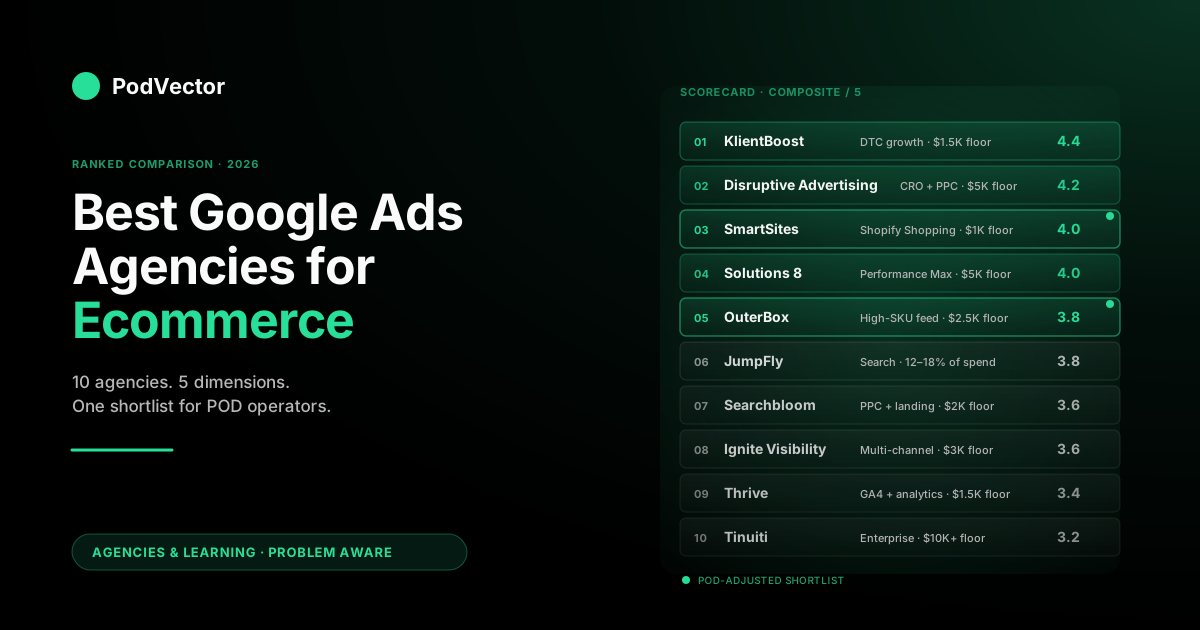
Quick Answer: The best Google Ads agencies for ecommerce in 2026 are the ones that own feed hygiene, Performance Max architecture, and attribution — not just the campaign dashboard. Ten agencies dominate the roundups: KlientBoost, Disruptive Advertising, SmartSites, Solutions 8, OuterBox, JumpFly, Searchbloom, Ignite Visibility, Thrive, and Tinuiti. Scored against the five dimensions that actually matter for an ecommerce buyer — minimum spend, ecommerce specialization, fee model, transparency, and proof of work — the top of the list shifts depending on your stage.
For a print-on-demand operator the relevant cuts are tighter: only four of the ten regularly take accounts with modest monthly ad budgets, only three have demonstrable Performance Max and Shopping feed depth on POD-style catalogs, and none reconciles ad-attributed revenue against per-order Printify or Printful supplier cost in their standard reporting. Below: the scorecard, the ten agency profiles, the POD-specific cut, and the four-question filter that turns this list into one signing decision.
How we scored: the five dimensions that separate ecommerce agencies
Most "best agencies" roundups score on brand authority, Clutch ratings, and review volume. Useful for SEO. Useless as a buying decision.
An agency with hundreds of five-star reviews and a high monthly minimum is irrelevant to a store doing $80K/year — and a five-star reputation built on B2B SaaS retainers tells you nothing about how a Performance Max campaign with 3,200 SKUs will perform.
The five dimensions below are the ones an ecommerce buyer actually pays for. They are scored 1–5, with 5 meaning the agency is a clear leader and 1 meaning the dimension is a known weakness. Composite is unweighted on purpose: every dimension is a potential deal-breaker, so averaging them surfaces the agencies that are merely good and demotes the ones that are great in one spot and broken in another.
- Minimum spend / retainer floor. Below what monthly ad budget will the agency decline the account, or insist on a project-based engagement that doesn't include ongoing optimization? This is the single most filtering dimension for sub-$50K-MRR ecommerce.
- Ecommerce specialization (depth, not headline). Almost every agency lists "ecommerce" as a service. The real test is feed quality: how many active Performance Max and Shopping accounts they manage, whether they have Merchant Center diagnostics in their standard onboarding, and whether their case studies cite ROAS for ecommerce specifically rather than "lead gen." The best ecommerce agencies do four things well: rebuild the Shopping feed, structure Performance Max with real asset groups, separate branded from non-branded search so reported ROAS stays honest, and optimize to contribution margin rather than platform ROAS.
- Fee model alignment. Flat retainer, percentage of spend, or hybrid. Each one creates different incentive distortions. A flat retainer rewards the agency for keeping accounts simple. A percentage-of-spend model rewards them for scaling spend even when ROAS would be better served by doing less. Hybrid is rare and usually the cleanest.
- Transparency. Do they ship dashboards you actually own, do they explain bidding and budget changes in writing, and will they hand back Google Ads MCC access on day one of offboarding without a fight? The answer to all three is "yes" much less often than agency websites suggest.
- Proof of work for ecommerce specifically. Named case studies with revenue, ROAS, and a baseline — not "increased ROAS by X%" without saying from what to what. The legible proof bar.
For deeper background on what each fee model actually looks like in a contract, our Google Ads services buyer's guide walks the contract structure side by side.
The 10-agency comparison at a glance
Quick-scan version. Detail and reasoning are in the per-agency profiles below.
| Agency | Best for | Min spend | Fee model | Composite (/5) |
|---|---|---|---|---|
| KlientBoost | DTC growth, creative-led testing | Low retainer tier | Flat retainer | 4.4 |
| Disruptive Advertising | Mid-market with CRO needs | Mid-tier retainer | Flat retainer | 4.2 |
| SmartSites | Shopify Shopping accounts | Low retainer tier | Flat retainer | 4.0 |
| Solutions 8 | Performance Max specialists | Mid-tier retainer | Flat retainer | 4.0 |
| OuterBox | High-SKU ecommerce scaling | Mid-low retainer | Flat retainer | 3.8 |
| JumpFly | Search-heavy, long-tenure accounts | % of spend | % of spend | 3.8 |
| Searchbloom | Integrated PPC + landing pages | Mid-low retainer | Flat retainer | 3.6 |
| Ignite Visibility | Multi-channel brands (Google + Meta + SEO) | Mid-low retainer | Hybrid | 3.6 |
| Thrive | SMBs needing analytics + GA4 setup | Low retainer tier | Flat retainer | 3.4 |
| Tinuiti | Enterprise ($1M+/mo spend) | Enterprise floor | % of spend | 3.2 |
"Composite" is the unweighted average of the five dimensions. It compresses information — read the profiles before signing anything. Retainer tiers are not published as fixed list prices by all agencies and can shift; get a current quote before budgeting.
The ten agencies, ranked and profiled
1. KlientBoost — DTC growth, creative-led testing
Best for: consumer brands doing meaningful monthly revenue who want creative volume tested aggressively against PPC.
Fee model: flat retainer in tiers tied to channels and spend bands. Specialization: creative-first PPC where ad copy and landing-page variants are tested faster than most competitors. The agency was founded on the thesis that bidding optimization has diminishing returns past a certain point and that creative is where unit economics actually move.
Where it scores high: creative iteration cadence, transparent dashboards, named DTC case studies, a floor that is lower than many peer agencies.
Where it scores low: ecommerce-specific feed depth is decent but not specialty (they are as known for SaaS as for DTC), and meaningful ongoing optimization typically sits in a higher tier than the entry-level retainer.
2. Disruptive Advertising — mid-market with CRO needs
Best for: ecommerce brands at scale who want PPC and conversion-rate optimization handled by the same team.
Fee model: flat retainer. Specialization: integrated CRO and PPC, with in-house landing-page and analytics pods. Strong for accounts where the bottleneck is post-click rather than the auction. Disruptive has retention depth, with a reported ninety-plus clients staying four years or more — a useful proxy for client satisfaction.
Where it scores high: proof of work depth, attribution rigor, transparency in reporting (they publish methodology). Their CRO pod is rare in the agency landscape — most agencies subcontract that work.
Where it scores low: the retainer floor cuts off most boutique-scale ecommerce; the firm is also wide enough across verticals that a POD-specific catalog isn't a daily fluency.
3. SmartSites — Shopify Shopping accounts
Best for: Shopify-native ecommerce brands wanting Google Shopping and Performance Max managed alongside organic SEO.
Fee model: flat retainer, with one of the lower legitimate floors on this list. Specialization: Premier Google Partner with deep Shopify-specific tracking work, GA4 implementation, and Merchant Center setup. Volume of small ecommerce accounts is high.
Where it scores high: accessible floor, Shopify ecosystem fluency, willingness to take small accounts seriously, named ecommerce case studies. SmartSites has earned recognition as a Clutch Top Agency and Inc. 5000 honoree (multiple times), with many client reviews highlighting strategy and reporting quality.
Where it scores low: account-manager turnover is the most common complaint surface; depth of strategic input depends heavily on which AM lands. Volume-based agencies live or die by this.
4. Solutions 8 — Performance Max specialists
Best for: ecommerce brands ready to scale Performance Max where the campaign type is doing the heaviest lift.
Fee model: flat retainer. Specialization: Performance Max as a primary practice area, with public-facing thought leadership (YouTube, podcast, training) that's a useful proxy for actual technical depth. The agency made its name on PMax before most competitors had a playbook.
Where it scores high: Performance Max specialization, published methodology, transparent reporting cadence. Shopping feed quality now decides most of PMax performance, and Solutions 8's feed-first approach reflects that reality more than most agencies on this list.
Where it scores low: the retainer floor is higher than entry-level agencies; if your catalog has fewer than roughly fifty active SKUs, PMax may not be where the leverage is and the specialty is wasted.
5. OuterBox — high-SKU ecommerce scaling
Best for: larger catalogs (1,000+ SKUs) where feed quality is the rate-limiting step.
Fee model: flat retainer. Specialization: ecommerce-only, which is rarer than the SERP suggests. They build their own Shopping feed audits and don't rely on default Merchant Center diagnostics. Strong for stores with messy product data.
Where it scores high: ecommerce specialization (it's literally all they do), feed depth, accessible floor relative to mid-tier peers.
Where it scores low: sales-cycle reports as long; the brand is less recognizable than KlientBoost or Disruptive, which sometimes correlates with thinner CRO-side capability.
6. JumpFly — search-heavy, long-tenure accounts
Best for: ecommerce buyers who want a single dedicated strategist for years rather than a pod that rotates account managers.
Fee model: percentage of spend. Specialization: search-heavy historically, with long-running ecommerce accounts and nearly two decades of independent paid-search experience — a rare stability signal in an industry with high churn.
Where it scores high: tenure stability, depth on Search and Shopping, transparent fee model (cost is a direct function of spend).
Where it scores low: percentage-of-spend pricing creates a structural incentive to scale spend; for a small POD store with thin margins this can quietly push against the operator's interests.
7. Searchbloom — integrated PPC + landing pages
Best for: brands that want PPC and landing-page development under one roof.
Fee model: flat retainer. Specialization: proprietary methodology that bundles ad management, CRO testing, and landing-page builds. The integrated model means fewer handoffs but a higher floor than pure PPC shops.
Where it scores high: integrated landing-page work (rare at this price point), published methodology, transparent reporting.
Where it scores low: the integration pitches as a feature, but if you already have a landing-page stack you don't need or want, you're paying for capability you won't use.
8. Ignite Visibility — multi-channel brands
Best for: brands running Google and Meta and SEO together who want one agency holding the whole stack.
Fee model: hybrid (flat base plus performance components on some engagements). Specialization: multi-channel integration; they're as known for SEO as for paid, which is a feature if you want one vendor and a bug if you want PPC depth specifically.
Where it scores high: breadth, hybrid fee model that aligns incentives more cleanly than pure flat or pure percentage, named ecommerce case studies.
Where it scores low: generalist depth — the firm covers so many channels that the dedicated PPC bench tends to be thinner per dollar than at a PPC-only agency.
9. Thrive Internet Marketing Agency — SMBs needing analytics + GA4 setup
Best for: small ecommerce brands that need Google Ads, GA4, and reporting infrastructure built at the same time.
Fee model: flat retainer. Specialization: a wide menu (PPC, SEO, social, email) with GA4 implementation as a real strength. Useful when measurement is broken before optimization can start.
Where it scores high: accessible floor, GA4 and analytics implementation that most peer agencies treat as someone else's problem.
Where it scores low: the breadth dilutes paid-search depth; account-manager assignment matters a lot here, and proof of work for ecommerce specifically is thinner than agencies higher on this list.
10. Tinuiti — enterprise ($1M+/mo spend)
Best for: ecommerce brands spending at enterprise scale, typically backed by private equity or operating at IPO-adjacent revenue.
Fee model: percentage of spend. Specialization: Tinuiti is widely cited as the largest independent performance marketing agency in the US, with a proprietary technology suite providing unified reporting across search, social, and marketplace channels. Their practice areas span Google, Meta, Amazon, retail media, and CTV.
Where it scores high: sophistication, proof of work at enterprise scale, named brand case studies across household-name DTC brands.
Where it scores low: the floor disqualifies essentially every operator reading this article. They appear on this list because they keep surfacing in SERP roundups, not because they are a realistic candidate for most ecommerce buyers.
What's changed in 2026: Performance Max, Demand Gen, and creative
Three structural shifts have reshuffled which agencies are actually worth hiring in 2026, and the SERP roundups largely miss all three.
Feed quality is now the dominant lever inside Performance Max. Most ecommerce revenue lives in Shopping and Performance Max, and Shopping feed quality decides the majority of PMax performance. The agencies that were winning on bidding tricks and campaign architecture in 2022 are no longer differentiated. What matters now is the quality of the product feed, the asset quality fed into PMax, and the creative testing infrastructure behind it.
Branded search inflation is the hidden ROAS lie. The best Google Ads agency for ecommerce DTC separates branded from non-branded search, because branded campaigns inflate reported ROAS on demand you already own. Optimizing to contribution margin beats optimizing to platform ROAS, since the dashboard number ignores your actual unit economics. Ask any candidate agency whether they separate branded from non-branded in their standard reporting — it is the fastest signal of whether their methodology is honest.
YouTube has become a first-class acquisition channel. Performance Max has consolidated campaign types while introducing new structural requirements. YouTube has shifted from an optional awareness play to a legitimate acquisition channel for brands that manage it properly. Agencies that treat YouTube as a separate awareness budget are misaligned with how the Google ecosystem actually works for ecommerce in 2026. Ask any candidate agency how they integrate YouTube assets with Shopping and PMax — it is a clean signal of whether their playbook is current.
Attribution has gotten harder, not easier. Attribution has become more important and more complicated as the customer journey across Google's properties has gotten more distributed. Probing questions to ask: does the agency use data-driven attribution? Have they run geo-holdout incrementality tests? Do they build media efficiency ratio (MER) reporting that sits above platform-reported ROAS? These were bonus capabilities in 2023; in 2026 they are table stakes for any agency worth a meaningful retainer.
The accountability gap after the click. If your Google Ads agency doesn't own your Shopify CRO, your feed hygiene, and your post-purchase attribution, you're paying for traffic into a system nobody is accountable for end-to-end. That accountability gap is where ecommerce brands lose margin — not in the bid strategy. These shifts matter for POD operators specifically: your checkout conversion rate is the downstream variable that the agency's feed and creative work feeds into — and no agency retainer covers that reconciliation for you.
Where the rankings break for print-on-demand
The composite ranking above is a reasonable read for ecommerce broadly. For a print-on-demand operator running Printify or Printful supply, three of the five dimensions get re-weighted — and the leaderboard reshuffles in ways the SERP roundups never surface.
Re-weighting #1: minimum spend matters more. A POD store at a modest revenue level cannot run a mid-tier or higher retainer plus meaningful ad spend without bleeding. That cuts the higher-floor agencies out of contention before specialization is even discussed. The list collapses to KlientBoost, SmartSites, OuterBox, Searchbloom, and Thrive at the accessible-floor end.
Re-weighting #2: feed depth is non-negotiable. POD catalogs are large and structurally messy — variant explosion, similar SKUs across product types, supplier-side title formatting that breaks Merchant Center if not cleaned. SmartSites and OuterBox are the two on the shortlist with demonstrable Shopping-feed depth at scale. KlientBoost handles Shopping but as one of many specialties; Searchbloom and Thrive are competent but generalist. Understanding your Shopify–Google Ads ROAS reporting integration before onboarding any agency is essential — without correct ValueTrack tokens in place, the entire feed attribution can return NULL, silently understating or overstating channel performance.
Re-weighting #3: per-order supplier cost. No agency on this list, at any tier, will reconcile ad-attributed revenue against the supplier-side cost on the matching Printify or Printful order in their standard reporting. The economics of POD — where one campaign can be profitable on tee variants and ruinous on hoodies because the supplier price differs — are invisible to retainer-grade reporting. For context on why that gap matters, see our breakdown of net profit margin benchmarks for ecommerce and our deep-dive on average checkout completion rates.
This is not a flaw in the agencies; it's outside the scope of every PPC engagement letter on the market. We've documented the gap in detail in who is the best Google Ads agency for ecommerce, which goes deeper on the supplier-cost reconciliation problem.
The POD-adjusted shortlist after these re-weightings is two: SmartSites at the small-account end (accessible floor, Shopping fluency) and OuterBox at the high-catalog end (feed depth, ecommerce-only focus). Either can run a clean Performance Max campaign on a Printify catalog. Neither will tell you the campaign was unprofitable on white tees and break-even on hoodies until you build that reconciliation outside the relationship.
Scaling ad spend on a POD catalog without increasing average order value is a common trap. Our guide on increasing AOV with AI covers the Shopify-side levers that compound what any agency delivers at the top of the funnel. Ad fatigue is another cost that never appears in an agency report — before handing budget to any agency, review your Printful integration costs in our Printful–Etsy integration cost breakdown and Printful membership cost breakdown so your margin math is correct before you brief the agency.
The retainer math at typical POD revenue
The retainers above are directional. The total cost of an agency engagement at typical POD revenue is the line item that the SERP roundups omit. According to Marketing LTB, retainers for Google Ads management at smaller-to-mid agencies typically begin around $3,000/month, with full-service packages running higher. Working through what those ranges mean for a POD operator:
- Store at low-to-mid revenue with modest ad spend. Even a low-tier retainer from the accessible-floor agencies on this list can consume a significant share of revenue once you add ad spend. POD net margins after Printify supply, Shopify, and payment processing are structurally thin. At small scale, the agency engagement can cost more than the operating margin it's optimizing. Our net profit margin benchmark gives you the comparison point.
- Store at mid-range revenue with moderate ad spend. A mid-low retainer starts to make sense if ROAS improvement from agency management meaningfully lifts above what you'd run unassisted. The headroom exists but is narrow — the agency math works only if the ROAS lift is material and demonstrable.
- Store at strong revenue with higher ad spend. Higher-tier agencies (Disruptive, Solutions 8) become defensible: scale is large enough that a meaningful ROAS lift covers the retainer with surplus. This is the first revenue band where a mid-market agency is a rational structural choice.
The broader argument — that agency engagements only become ROI-positive at a definable revenue floor — is laid out in our breakdown of when an agency is the right structural choice for an ecommerce operator.
When the right answer isn't on this list
Three structural alternatives live outside the agency category and beat the agency math at specific revenue bands. Worth naming explicitly because the SERP roundups never do.
Freelance specialist. A senior PPC freelancer with ecommerce experience typically charges hourly or on a managed monthly retainer well below agency floor. Lower cost, single accountable person, no AM rotation. Trade-off: no team behind them, vacation means no coverage, no built-in CRO or analytics pod.
In-house hire (part-time PPC contractor). A part-time contractor at limited weekly hours gives you focused attention rather than the fraction an agency AM allocates per account. Works once revenue is substantial enough to justify the hire. Below that, the contractor doesn't have enough hours of work to fill.
Self-managed with structured course or coaching. A one-time course (covered in our review of the best Google Ads courses for ecommerce) plus dedicated operator time per week outperforms a low-tier agency for smaller stores — because the operator actually understands their own catalog, supplier costs, and seasonal patterns better than any agency AM ever will. The margin context that makes self-managing ad decisions possible lives in our Printful membership cost breakdown and the companion Printful–Etsy integration cost breakdown.
For a deeper read on the full strategy stack — campaign structure, bidding, audience layering — independent of vendor choice, our complete Google Ads playbook for print-on-demand sellers is the operator's manual. And the cluster hub at Google Ads agencies and learning resources compares all four structural options (agency, freelancer, in-house, DIY) side by side.
The four-question filter that picks one
Ten agencies is too many to choose from. Run any candidate through these four questions and the list compresses to one — or to zero, in which case you're back to the alternatives above.
- What's our monthly ad spend, and does the agency's floor match? Anything below the agency's quoted minimum is a bad signal even if they say yes. They will deprioritize the account when a larger one needs attention. A Google Ads agency should ask about your sales cycle, profit margins, close rates, and budget before recommending campaign types or bid strategies. Confirm the floor before the sales call goes further.
- Will they show me a named ecommerce case study with revenue, ROAS, and a baseline? Not "we drove a large ROAS lift" without saying from what to what. The ones that have real proof don't need to be coy. If they hedge, the proof isn't there. The best Google Ads agency for ecommerce DTC separates branded from non-branded search, because branded campaigns inflate reported ROAS on demand you already own. A case study that doesn't break out branded vs. non-branded ROAS is not a legible proof.
- Who specifically will run the account, and how many other accounts do they currently manage? The answer is rarely under five and is sometimes over twenty. The number tells you how much real attention you'll get. A senior strategist on three accounts is a different relationship than a junior AM on twenty.
- What's the offboarding process if we leave in 90 days? Account ownership, dashboard transfer, MCC handoff. The agencies that get this question wrong on the sales call get it much wronger at offboarding. If they can't answer cleanly in five minutes, the relationship has the wrong defaults built in.
Most agencies pass two or three. The one that passes all four is the one to sign with. If none does, you have your answer about whether to go the agency route at all.
For more on attribution rigor — the part of the agency engagement most often broken in ways the agency itself can't see — our guide to Shopify–Google Ads ROAS and attribution for POD is the companion read. And for the upstream choice of which campaign types are even worth running, see the complete guide to Google Ad types for POD sellers.
If the broader read on how the SERP roundups score these agencies is useful, Marketing LTB's 10 best list is the cleanest synthesis among the major aggregators.
FAQs
Which Google Ads agency is best for a small POD store?
SmartSites at the floor end (lowest legitimate minimum on this list, Shopify Shopping fluency) is the most defensible match for stores at modest revenue. OuterBox is the choice once catalogs cross a thousand or more SKUs. At higher revenue, the mid-tier options (Disruptive, Solutions 8) become viable. Before picking either, confirm your Shopify–Google Ads attribution is clean — see our Shopify Google Ads ROAS reporting integration guide for the setup checklist.
How much should I budget for a Google Ads agency?
According to Marketing LTB, retainers for Google Ads management at mid-market agencies typically begin around $3,000/month, with full-service packages running higher. Plan for retainer plus ad spend together: if acquisition costs push above roughly a third of revenue, the engagement is structurally unprofitable regardless of how good the agency is. Our net profit margin benchmark gives you the ecommerce reference point to stress-test that math.
Are agencies that charge a percentage of spend better than flat-retainer ones?
They're more transparent in one sense — you always know the cost as a function of spend. But the percentage-of-spend model creates a structural incentive to scale spend whether or not it's the right move. Flat retainers reward the agency for keeping things simple. Hybrid models (rare) tend to align cleanest with operator incentives.
What's the difference between an agency on this list and a freelancer?
Agencies bring a team — analytics, creative, strategy, and CRO often live in different pods. Freelancers bring focus and lower cost. At smaller revenue, the freelancer math usually wins. At stronger revenue, the team begins to matter. Between, it depends on whether you have other support functions (analytics, CRO) already covered. Our guide on CRO techniques for ecommerce covers the post-click work that determines whether either arrangement actually moves revenue.
Will any agency on this list track Printify or Printful supplier cost against ad spend?
Not in their standard reporting. None of the ten reconcile per-order supplier cost against ad-attributed revenue. The reconciliation has to happen outside the agency relationship — typically in a spreadsheet, a BI tool, or an agentic system that pulls live data from Shopify, Printify, Printful, and Google Ads in one query. Our Etsy-to-Shopify data reconciliation guide touches on why cross-platform cost data is structurally hard to unify.
How long until an agency engagement starts showing results?
Realistic ramp is 60–90 days for account audit, restructure, and meaningful learning-phase data. Anyone promising results in 30 days is either selling, lying, or about to get lucky in ways that won't repeat.
What does a top agency do differently in 2026?
The agencies that win are the ones that rebuild the feed, structure PMax properly, keep branded reporting honest, and tie spend back to profit. Concretely: they build product feeds for Performance Max signal quality, test creative variants systematically, integrate YouTube with Shopping, and report on incrementality rather than platform-reported ROAS alone. The best Google Ads agency for ecommerce owns the full loop — feed hygiene, Performance Max architecture, Shopify CRO, and vendor-agnostic attribution — not just the campaign dashboard.
Want agency-grade analysis without the retainer?
Picking the right agency is one decision; getting insight into Performance Max performance, supplier-cost reconciliation, and margin by SKU is another — and most agencies don't include the second in any retainer. Victor connects to your Shopify, Printify, Printful, and Google Ads accounts and answers the questions an agency strategist would, with live data, on demand — then proposes and executes Shopify-side actions (repricing, discounts, collection management) with your approval.
Try Victor free