
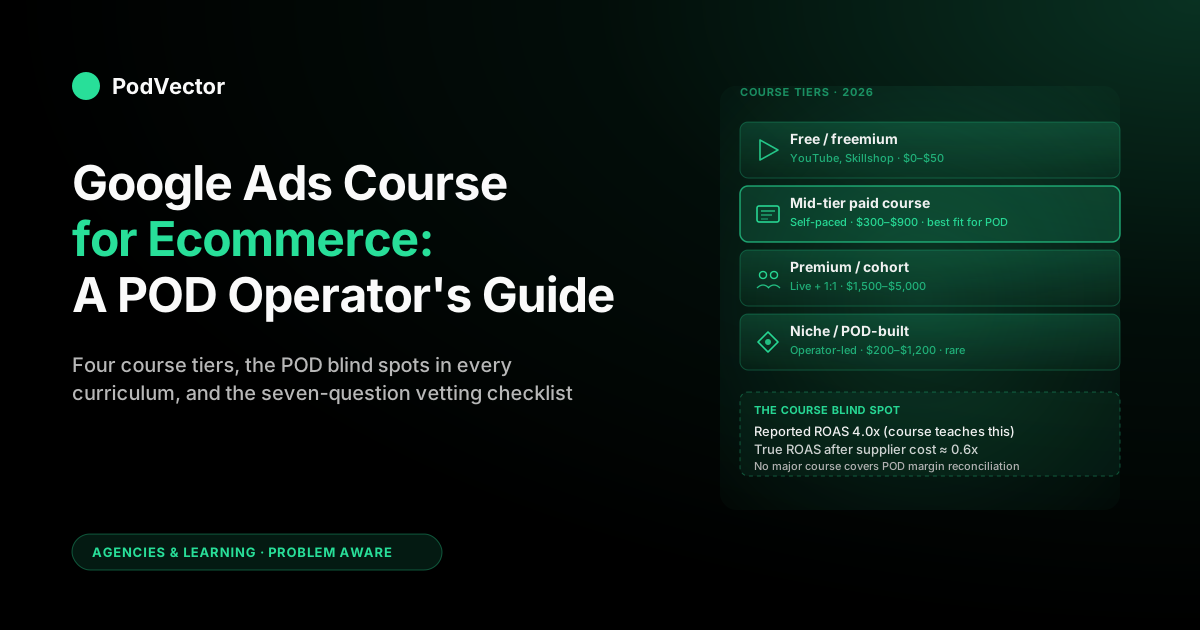
Quick Answer: A Google Ads for ecommerce course is a packaged training — usually $0–$2,000 of self-paced video plus templates — that teaches paid search, Shopping, and Performance Max for a generic DTC store. For most print-on-demand operators between $0 and $30K MRR, a $400–$800 mid-tier ecommerce course returns more than any other paid-acquisition investment, including a freelancer or agency.
The catch: nearly every course on the market assumes a fixed cost of goods, so the optimization advice they teach quietly stops working once Printify or Printful supplier costs collide with Google's bidding signals. This guide covers what each tier of course actually delivers, the four POD blind spots baked into generic ecommerce curricula, the framework for choosing a course that matches your stage, and how to extract enough value to outperform operators who spent ten times more on agency retainers.
What a Google Ads for ecommerce course actually teaches
An ecommerce-focused Google Ads course is a packaged training — typically a private member portal with 20–60 video lessons, downloadable templates, an SOP library, and some flavor of community access — built around the paid acquisition stack a Shopify or WooCommerce brand needs to scale. Generic Google Ads courses cover the platform; ecommerce courses narrow the lens to product feeds, Shopping campaigns, Performance Max for retail, conversion tracking through enhanced ecommerce, and the bidding strategies that actually work for a transactional catalog rather than lead-gen funnels.
The pitch is straightforward and frequently honest: for a fraction of one month of agency retainer, you get a senior practitioner's playbook on demand, with templates you keep forever. For a DTC apparel brand at $5K–$30K MRR — the demographic these courses are built for — the value is real. The instructor's twelve years of agency-side experience get distilled into 35 hours of structured material, and a motivated operator can credibly outperform a $3,000/month junior agency account manager within 60 days.
The structure is also why these courses systematically miss the print-on-demand reader. Every major Google Ads for ecommerce course in 2026 — including the well-regarded Store Growers ultimate guide that ranks alongside the paid offerings for this query — was built around fixed cost of goods.
Their bid strategy advice, their PMax structure, their "scale by raising target ROAS" recipe all assume a $30 product has roughly the same $8 supplier cost no matter which variant sells. POD breaks that assumption on the first $26 oversized hoodie that ships Printify Premium. The course is right; the recipe is wrong; the operator is the one paying the difference.
The 4 course tiers in 2026 (and where POD operators fit)
The ecommerce Google Ads course market in 2026 stratifies into four price-and-depth bands. Each one targets a different stage of operator, and only two consistently make sense for POD-shaped businesses without supplemental work.
Tier 1: Free and freemium — $0–$50
YouTube playlists from agency owners, Google's own Skillshop modules, the Grow with Google certificate, and a long tail of $9–$49 introductory Udemy courses. Coverage is uneven — strong on platform mechanics (how to create a campaign, how Smart Bidding signals work), weak on strategy (which campaign type to run when, how to read a search-term report decisively).
For a complete beginner who hasn't placed their first ad yet, a weekend of free content gets you to the "I can launch a basic Shopping campaign" baseline. For anyone past that baseline, the time cost of stitching fragmented content together exceeds the price of a paid course. POD operators sit in tier 1 only for the first two to four weeks of their education.
Tier 2: Mid-tier paid courses — $300–$900
The sweet spot for the vast majority of POD operators. Self-paced video curriculum from a single named instructor with five to fifteen years of ecommerce paid-acquisition experience, lifetime access, periodic updates as Google ships new features, downloadable spreadsheet templates, and usually a private community of a few hundred to a few thousand current students.
Pricing typically lands around $500–$700. The instructor has run hundreds of accounts; the lesson density is high; the templates are immediately useful.
The Store Growers Google Ads Success course at $599 and the eCom PPC Academy full package at $497 are the canonical examples; both are aimed at the brand operator. POD operators get 80–85% of the value out of either one and need to layer their own supplier-cost adjustments on the remaining 15%.
Tier 3: Premium / cohort-based — $1,500–$5,000
Live cohort programs (8–12 weeks), small group masterminds, certificate programs from formal institutes (CXL Institute lands here), and a handful of higher-touch packages that bundle one-on-one coaching calls with the curriculum. The eCom PPC Academy VIP at $3,997 is a good benchmark.
The pitch is that you're paying for accountability, real-time feedback, and direct access to the instructor — not just material. For POD operators above $30K MRR who have specific strategy questions and the cash flow to absorb the price, tier 3 occasionally makes sense. For operators below that level, the same dollars spent on freelancer hours produce better outcomes because the freelancer can actually look at your account.
Tier 4: Niche or operator-built courses — $200–$1,200
The smallest segment of the market and the one most worth finding for POD readers. Courses built by operators who specifically run print-on-demand stacks — Shopify + Printify, Shopify + Printful, Etsy print-on-demand bridges — and teach paid acquisition through that lens.
They cover variable supplier cost, design-pipeline-driven SKU rationalization, niche-specific keyword research, and the realities of trademark exposure on POD catalogs. The best of them are worth more per dollar than any tier 2 generalist course.
The hard part is sourcing them; they don't always rank on the head term "Google Ads for ecommerce course" because the search volume is too small. Operator forums and seven-figure POD networks are the highest-signal path.
What's in (and out of) a typical course
The bigger source of post-purchase regret than price is mismatched expectations about what a course actually covers. Most $500 mid-tier ecommerce courses follow a recognizable curriculum shape, and the gaps below that shape are remarkably consistent across providers.
Almost always included
- Account structure and campaign-type selection — when to run Search vs. Shopping vs. PMax, how to tier campaigns by intent, brand-versus-non-brand separation.
- Conversion tracking setup — installing the Google Ads tag through GTM, enhanced conversions, the differences between attribution models.
- Product feed fundamentals — Merchant Center setup, attribute requirements, common disapprovals, basic feed-rule transformations.
- Shopping campaign optimization — search-query reports, negative keywords, custom labels, basic priority-tier structure.
- Performance Max — asset group construction, audience signals, the search-themes feature, PMax versus standard Shopping debate.
- Bid strategies — Maximize Conversion Value, target ROAS, when to use each, when to switch.
- Templates and worksheets — usually 10–30 spreadsheets covering account audits, search-term cleanup, monthly review, budget allocation, A/B test logging.
- Lifetime access and update cadence — most reputable mid-tier courses ship 2–4 substantive updates per year as Google changes the platform.
Sometimes included (varies by course)
- Display, Demand Gen, and YouTube modules — the eCom PPC Academy includes them; many narrower courses don't.
- Server-side tracking and CAPI-style enhanced conversions — increasingly important post-iOS 14, but uneven coverage across courses.
- Landing page and CRO content — usually a single bonus module rather than depth coverage.
- Direct instructor access — community Q&A access is common; named instructor response is reserved for higher-tier packages.
- Industry-specific case studies — generally fashion, beauty, supplements, electronics. Almost never POD.
Almost never included (and easy to assume is included)
- Variable supplier cost reconciliation — no major ecommerce Google Ads course in 2026 teaches contribution-margin reporting against POD supplier rails.
- Trademark and IP exposure for print-on-demand catalogs — generic ecommerce courses do not cover the rapid-disapproval cycle that POD stores experience.
- Design-pipeline-driven SKU rationalization — courses teach you to scale winners; they don't teach you to systematically prune the long tail of fast-fading designs that defines POD catalogs.
- Multi-supplier comparison logic — when to route a SKU to Printify versus Printful versus Gelato based on margin, fulfillment time, and ad-attributed demand. Out of scope for every generalist course.
- P&L reconciliation against Google-reported revenue — courses teach you to read the platform; they do not teach you to verify the platform against your bank.
For the broader landscape — courses against agencies, freelancers, in-house hires, and tooling — see our complete Google Ads services buyer's guide for POD, which prices each option against the same margin math.
Where generic ecommerce courses fall short for POD
The blind spots aren't oversight — they're a function of what the courses are built to teach. A reasonable curriculum has to assume something about cost structure, and ecommerce instructors assume the cost structure most of their students have, which is fixed COGS. POD breaks four of those assumptions.
Blind spot 1: Reported ROAS as the optimization target
Every major course teaches you to optimize toward Google-reported ROAS — set a target ROAS, push it up to scale, drop it to acquire. For a DTC brand with $8 COGS on a $30 product, a 4.0x reported ROAS produces about $14.50 net per order — winning.
For a Printify hoodie at $18.50 supplier cost, $5.20 shipping, and a $1.95 platform fee, the same 4.0x reported ROAS leaves about $4.35 of contribution per $7.50 ad spend — a true ROAS of 0.58x. The course taught you to celebrate the 4.0x.
The bank balance disagrees. The lesson isn't wrong; the baseline it's calibrated against doesn't exist in your business.
Blind spot 2: Performance Max with mixed-margin SKUs
Courses teach PMax as a single-asset-group rocket ship: load the catalog, give it audience signals, let Google's bidder do the work. For a POD catalog with $4 contribution-margin tees and $12 contribution-margin posters and $26-cost premium hoodies all routed into one asset group, PMax pushes spend toward the highest-revenue SKUs, which are systematically the worst-margin ones.
The course shows you how to scale; the structure scales the wrong direction. The fix is asset-group segmentation by margin tier or niche, with explicit exclusions for thin-margin SKUs — but generic ecommerce courses don't teach margin-tier segmentation because their assumed reader doesn't have margin tiers.
Blind spot 3: Feed structure as a one-time setup
Mid-tier courses cover Merchant Center setup in detail and feed maintenance lightly. POD feeds need active SKU rationalization on a multi-week cadence: aggressively excluding thin-margin products from Shopping, prioritizing evergreen designs over fast-fading trending ones, aligning product titles to niche-specific search queries, and rebuilding custom labels as the catalog evolves with new design drops. A course can teach you the mechanics of a feed rule; it cannot teach you the operational discipline of pruning a 2,000-SKU POD catalog every month, because that workflow doesn't exist in the brands the course was written for.
Blind spot 4: The one-product-line assumption in trademark and policy modules
Courses cover Merchant Center disapprovals as a tactical chore — fix the issue, resubmit the feed, move on. POD catalogs experience a different volume and shape of disapproval risk: trademark sweeps that pull dozens of designs at once, restricted-content flags on niche slogans, repeated appeals that quietly degrade Merchant Center trust score.
A course doesn't teach you to design around this risk because the imaginary student isn't selling a 200-SKU pop-culture-adjacent catalog with monthly fresh drops. The chapter on disapprovals exists; it's just not the chapter you actually need.
The fix isn't to skip the course — the fix is to take the course knowing exactly which lessons need a POD overlay. The detailed treatment of why the measurement gap exists is in our complete guide to Google Ads ROAS and attribution for POD, and the operational counterpart sits in our complete Google Ads playbook for print-on-demand sellers.
When a course is the right next investment
Three scenarios where a $400–$800 mid-tier ecommerce Google Ads course is materially the highest-ROI dollars a POD operator can spend on paid acquisition.
Scenario 1: Pre-launch through $20K MRR — almost always the right call
Below $20K MRR, you do not have the ad spend to make any agency, freelancer, or specialist consultant economically rational. A $500 course pays for itself the first time you correctly debug a Shopping campaign that would have run at a loss for two months under a junior account manager. The opportunity cost is one weekend of focused study, plus the next 60 days of incremental practice; the alternative is paying $3,000–$5,000 monthly to outsource learning that compounds in your hands.
Scenario 2: $20K–$50K MRR with no internal Google Ads literacy
If you've grown to $20K–$50K MRR through Meta or organic and are now considering Google Ads for the first time, a course is the cheapest possible way to qualify yourself as the buyer of any future agency or freelancer engagement. Operators who can read a search-term report decisively get fundamentally better outcomes from agencies than operators who can't, regardless of how good the agency is. The course pays for itself in the agency-shopping process alone, before a single ad spends.
Scenario 3: Existing agency relationship that's underperforming
Sitting in a $4,000/month retainer where reported ROAS looks fine but contribution margin is flat or shrinking is the textbook situation where a course pays back inside one cycle. The course gives you the literacy to ask the agency the right questions, push back on bad campaign decisions, and make an evidence-based decision about whether to continue, restructure, or part ways. Most operators who burn out on agencies wish they'd taken a course before signing.
If none of these three describes your stage, the course money is better redirected. Above $50K MRR with internal Google Ads literacy already, the marginal hour of your time spent on a tier 2 curriculum probably yields less than the same hour spent on creative production, design pipeline, or supplier negotiation. For the head-to-head pricing of agencies versus courses against POD margin math specifically, the parallel deep-dive is the Google Ads agency for ecommerce guide for POD operators.
The 7-question POD-specific course vetting checklist
Most course sales pages are designed to make you feel inspired. The questions below are designed to make you informed.
Run all seven before you click checkout. The combination separates the courses that will compound for a POD operator from the ones that will leave you with thirty hours of generic content and a stack of templates that don't fit your business.
- Does the curriculum cover variable cost of goods, even briefly? Almost no generalist course does, but a few of the better ones nod at it in advanced modules. The presence of any acknowledgment is a strong signal — it tells you the instructor has at least seen a non-trivial cost structure. Total absence isn't disqualifying for a tier 2 course, but it raises the value of supplementing with POD-specific resources.
- What's the update cadence, and when was the last substantive update shipped? Google changes Performance Max and Smart Bidding behavior several times a year. A course whose latest update is from 2024 is teaching outdated tactics on PMax exclusions, search-themes signals, and brand campaigns. Look for an update log; if there isn't one, ask the instructor directly.
- How is the community moderated and how active is the instructor's participation? Most mid-tier courses include private community access, but the actual usefulness varies enormously — from a thriving daily forum where the instructor answers questions to a ghost town. Look at recent message volume, instructor post frequency, and the quality of student replies before paying.
- What's the refund policy and what's the actual refund rate? A 30-day money-back guarantee is table stakes; the genuinely confident courses extend it to 60 days or condition it on completed modules rather than blanket no-questions-asked. Ask in pre-purchase chat what percentage of buyers refund; reluctance to answer is a signal.
- How many of the case studies and templates are usable for a sub-$50K MRR store? Big-account case studies are aspirational; the reality of running $5K/month in ad spend is different from running $200K/month. Ask for a sample of student stories from operators in your revenue band before purchasing.
- What's the realistic time commitment to extract the value? A 35-hour course doesn't take 35 hours to deliver value — it usually takes 60–90 hours of viewing plus implementation. Course pages routinely understate this. If you don't have that time over the next 90 days, the course is a deferred expense, not an asset.
- Is the instructor still actively running accounts, or has the agency arm sunset? Courses age fast, and the best instructors are the ones who still ship campaigns weekly. Instructors who exited operations five years ago to teach full-time are usually a half-cycle behind on platform changes. LinkedIn and recent case studies are the easiest signal.
Red flags and green flags in course marketing
Patterns from POD operators who've bought multiple courses and tracked which ones produced returns. The signals don't predict outcomes perfectly, but the red flags reliably correlate with regretted purchases and the green flags reliably correlate with high-ROI investments.
Red flags
- "Make $10K/month with Google Ads" headlines. Outcome guarantees on course sales pages are sales theater. The instructors with serious credibility don't market this way.
- Sales page heavy on lifestyle imagery and light on curriculum detail. If you can't see the module titles, lesson counts, and rough lesson topics before paying, the course is being sold on aspiration rather than substance.
- Fake scarcity countdowns. "Doors close Friday" on an evergreen self-paced course resets every week; the urgency is manufactured. Either the course is open or it's a cohort with a real start date.
- Outdated screenshots. If the dashboard screenshots show the pre-2023 Google Ads UI or pre-PMax campaign types, the course material has not been refreshed in years.
- "Done-for-you" framing without specifics. Courses that promise plug-and-play scripts or templates that "do the work for you" are usually selling a fantasy. Real templates require fill-in and judgment.
- No named instructor or generic stock-photo "team" pages. The best ecommerce Google Ads courses are built around one or two operators with public track records. Anonymous courses or large-team-with-no-named-lead offerings are usually low-signal.
Green flags
- Public, current case studies with specific numbers. Real ad spend, real ROAS, recent timeframes, named brands or anonymized but auditable contexts.
- Detailed module breakdown on the sales page. Lesson titles, lesson counts, total runtime, sample lesson previews available without payment.
- Active community with recent activity. Look for daily or near-daily posts, instructor replies in the last week, and student-to-student technical help.
- Update log with timestamps. A "last updated April 2026" stamp on the curriculum page, ideally with a changelog of what changed.
- Honest acknowledgment of what the course doesn't cover. Instructors who say "this isn't a Meta Ads course, you'll need that elsewhere" are more credible than ones who claim to cover everything.
- Reasonable refund terms. 30-day blanket refund minimum, ideally tied to a "if you've completed module X and don't see value" condition that demonstrates confidence.
Course alternatives worth pricing first
The course math works for most POD operators below $30K MRR, but it isn't the only path and isn't always the right one. Two alternatives worth pricing before committing:
One-time audit from a specialist freelancer — $800–$2,500
For operators who already have an account running and want a senior practitioner's eyes on it, a one-time audit deliverable frequently produces more concrete near-term lift than a course. The audit identifies the three or four highest-impact changes specific to your account; the course teaches you the principles to find them yourself across the next year.
The audit is faster ROI; the course compounds. For a POD operator at $15K MRR who has 90 days of patience, the course is the better investment. For one at $40K MRR who needs a fix in 30 days, the audit is.
Free content plus structured self-study — $0 plus 80 hours
YouTube channels from agency owners (the canonical ones publish three to six substantive long-form videos a year), Google's official Skillshop, and the Store Growers blog archive collectively cover roughly 70% of what a $500 mid-tier course teaches. The trade-off is curation cost — you spend the price of the course in time stitching the content together, and you don't get the community or templates.
For operators who genuinely enjoy self-directed learning and have more time than money, the free path works. For everyone else, the $500 course is an obvious arbitrage.
For a head-to-head comparison of named agencies and how each holds up under POD margin analysis, see the planned best Google Ads agency for ecommerce comparison. For Shopify-specific agency considerations, the Shopify Google Ads agency guide is the parallel resource. The full agency-and-learning landscape sits in our agencies and learning hub, and the broader topic universe lives in our Google Ads for POD topic hub.
The 30/60/90-day plan for actually finishing a course
The dirty secret of paid courses is that completion rates hover under 20%. The operators who get the full return aren't smarter; they have a structure. A workable cadence for finishing a tier 2 ecommerce Google Ads course while running a POD store:
First 30 days: foundation — viewing plus baseline audit
Watch the first half of the curriculum (account structure, conversion tracking, feed setup, basic Shopping campaigns) and run a baseline audit of your existing account using the course's templates as you go. Don't change anything in production yet — the audit phase is about diagnosing what's actually happening. Document one to three concrete hypotheses for what to change once you've completed enough of the course to do it competently.
Days 31–60: implementation — small reversible changes
Complete the back half of the curriculum (PMax, bid strategies, advanced segmentation, reporting) and start shipping small reversible changes against your earlier hypotheses. One change per week is the right pace.
Document each change with hypothesis, date, expected outcome, and observed outcome — you're building the muscle for evidence-based account work, not racing to ship. Reported ROAS may move; layer your own supplier-cost calculation into the read so you're tracking true contribution rather than platform numbers.
Days 61–90: review — what worked, what to redesign
Aggregate the changes from days 31–60 against your contribution margin data. Categorize: changes that lifted true ROAS, changes that lifted reported ROAS but not true ROAS (these are the most important — they reveal where the course's recipe needs a POD overlay), and changes that didn't move either.
Build the personal SOP that codifies what you learned, including the supplier-cost overlay you developed yourself. This is the artifact that turns a $500 course into a $50,000-of-saved-agency-spend asset.
Day 91 and after
The course content stops compounding around month four — by that point you've extracted what's there. Decision: stay self-managed with periodic refreshes from updates, layer in a freelancer for specific gaps, or graduate to an agency if your spend has grown enough to justify it. The course paid for itself if you can answer "what changed in my account this quarter and what was the contribution-margin impact" in writing without help.
FAQs
How much does a Google Ads for ecommerce course cost in 2026?
Realistic 2026 ranges: free YouTube and platform-native content $0; mid-tier paid courses $300–$900 with the canonical examples landing around $497–$599; cohort-based and premium programs $1,500–$5,000; institutional certificates like CXL $1,500–$2,000. The mid-tier band is where 80% of POD operators belong. Anything above $1,500 should be evaluated against an equivalent dollar value of freelancer hours, which usually win at that price point because the freelancer can actually look at your account.
Is a Google Ads for ecommerce course worth it for a POD store doing under $30K MRR?
Yes — it's the highest-ROI paid-acquisition investment you can make at that stage. A $500 mid-tier course pays back the first time you correctly debug a Shopping campaign that would have run at a loss for two months.
The alternative — paying a $3,000–$5,000 monthly retainer to an agency — is mathematically irrational below $30K MRR for almost every POD store. The course teaches you the literacy to evaluate any future agency or freelancer relationship, which compounds for years.
Which Google Ads for ecommerce course is best for POD specifically?
No major generalist course is built specifically for POD. The most defensible path in 2026 is a tier 2 mid-priced course (Store Growers Google Ads Success at $599 or eCom PPC Academy at $497 are the canonical options) layered with POD-specific supplier-cost overlay work. A handful of POD-native AI employee courses exist in the $200–$1,200 band but rarely rank for the head term — operator forums and seven-figure POD networks are the highest-signal sourcing path.
How do I know if a Google Ads for ecommerce course covers what I actually need?
Three tests. First, scan the curriculum for any acknowledgment of variable cost of goods or contribution margin — most don't have it, but the presence is a strong positive signal. Second, look for an update log with recent dates; courses without recent updates are teaching outdated PMax and Smart Bidding tactics. Third, sample the community: active daily posting and instructor participation in the last week is a strong indicator that the course remains a living asset rather than archived content.
What's the difference between a Google Ads course and a Google Ads certification?
Certifications (Google's own Skillshop badges, the Grow with Google credential, CXL Institute) are credentials demonstrating familiarity with the platform; courses are training designed to make you operationally competent. Certifications are useful for freelancers and agency employees marketing themselves, less useful for store owners.
As a POD operator, you almost never need a certification — you need the operational competence the course provides. The exception is the Grow with Google certificate as a free entry-level credential if you're job-shopping.
Should I take a free course before paying for one?
For complete beginners: yes — invest two to four weeks in free content (YouTube playlists from named agency owners, Google's Skillshop modules) to confirm Google Ads is even the right channel for you before paying. For operators who've already placed ads: skip the free path and go straight to a tier 2 paid course. The time cost of stitching together fragmented free content exceeds the price of a $500 course several times over once you're past the absolute beginner stage.
Can a course replace hiring a Google Ads agency for ecommerce?
For most POD operators below $30K MRR, yes — and it should. The course gives you the operational competence to run accounts yourself at a stage where no agency retainer math works.
Above $30K–$50K MRR with confirmed unit economics, a course doesn't replace an agency — it makes you a much better agency client, which is a different and equally valuable thing. The framework for when an agency starts to make sense is in our parallel Google Ads agency for ecommerce guide for POD operators.
How long does it take to actually finish a Google Ads for ecommerce course?
The viewing time is usually 25–40 hours. The realistic implementation time — viewing plus running the templates against your account plus shipping changes plus measuring — is 60–90 hours over 60–90 days.
Course sales pages routinely understate this, which is part of why completion rates sit under 20%. Treating the course as a 90-day project with weekly time blocks is the difference between extracting full value and adding it to the pile of half-watched courses.
What's the role of AI in Google Ads ecommerce courses in 2026?
Google's campaign-side AI (Performance Max, Smart Bidding, responsive search ads) handles much of the tactical optimization that courses used to teach. The curriculum in 2026 has shifted accordingly — less time on bid management, more time on creative direction, feed engineering, asset-group structure, and exception handling.
The biggest open gap for POD operators specifically remains post-campaign analysis: reconciling Google-reported performance against actual supplier-adjusted profit. Courses don't yet teach this layer; the operators who build it themselves (whether self-built, with tooling, or via a POD-aware advisor) make better decisions across the board.
What if I bought a course and never finished it?
Common, and not as expensive as it feels — $500 of unfinished course is a recoverable mistake compared to $15,000 of unfinished agency retainer. Two paths back.
If the curriculum is still current (check the update log), block four weekends over the next 60 days and run the 30/60/90 framework above. If the curriculum is more than 18 months stale, accept the sunk cost and either rebuy a current alternative or move directly to a freelancer engagement. Don't try to grind through outdated material — the platform has changed too much.
Take the course. Then add the supplier-cost layer the course skipped.
Every reputable Google Ads for ecommerce course will teach you to optimize toward Google-reported ROAS — a number that, for POD operators, ignores Printify or Printful supplier cost, shipping, refunds, and platform fees. The course gives you the platform literacy; what's missing is the layer that reconciles platform numbers against your actual P&L. PodVector AI's AI employee, Victor, looks at your Shopify, Printify, Printful, and Google Ads data together and answers questions like "what did my Google Ads campaigns actually make this month after every cost" in plain English. Take the course, ship the changes, then make every decision against your real contribution margin instead of the platform's reported one.
Try Victor free