
Quick Answer: The AI ecommerce tools that actually pay back for a small business are Shopify Magic (free, built-in copy and image edits), Klaviyo or Omnisend (free tier email/SMS), Tidio (free chatbot), Canva Magic Studio (free ad creative), ChatGPT or Claude ($20/mo for everything else), and one margin-aware analytics tool — Triple Whale, Polar Analytics, or Victor by PodVector AI for print-on-demand operators. That stack runs $0–$45/month and covers email, support, content, creative, and analytics.
What most "best AI tools for ecommerce" lists get wrong for small businesses: they recommend mid-market tools (Jasper, Bloomreach, Klaviyo's $400 tier, Northbeam) that need $50K+ MRR before the subscription clears its own cost. This guide ranks each category by what actually pays back at $1K, $5K, and $20K MRR — with a POD-margin lens, because $24 shirts with $11 supplier cost don't have the gross-margin headroom to absorb $200/month software bills.
Why Small Businesses Need a Different Tool List
Open any "best AI tools for ecommerce in 2026" article — the Fin.ai 15-tool roundup, the Tidio 20-tool list, the Shopify 10-tool guide — and you'll find the same pattern: a categorized list of tools spanning $0/mo (Shopify Magic) to $1,000+/mo (Northbeam, Bloomreach), with no real distinction between which ones a $5K MRR store can afford and which need $500K ARR before the math works.
That ambiguity is the problem. A small business — call it a $1K–$30K monthly revenue store — has a marketing-and-tools budget of roughly 5–10% of GMV, which means $50–$3,000/month for everything: the email platform, the chatbot, the analytics, the design tool, the creative tool. A maximalist 15-tool stack at $1,800/month is a fast path to negative cash flow at that scale, and the tools that drive the most generic-roundup attention (enterprise CDPs, multi-touch attribution, conversational commerce video) are the worst offenders.
For print-on-demand operators specifically, the math is even tighter. A $24 shirt sourced from Printify at $11 cost leaves $13 of gross margin per unit before fees and shipping subsidies — call it $11 of contribution margin.
A $200/month tool needs to drive 18 incremental shirts per month just to clear the subscription, before you've made a single dollar of profit on it. Most "AI ecommerce tools for small business" advice ignores this entirely and recommends tools that quietly bleed POD operators dry.
What's left after filtering for "actually pays back at small business scale" is a much smaller list, organized by what each tool category does for a sub-$30K MRR store. For the broader pillar on every AI tool category in a POD stack, see the complete guide to AI tools for POD sellers.
For the marketing-specific subset — email, ads, SEO, personalization — the AI tools for ecommerce marketing guide goes deeper. The tools cluster hub indexes every comparison guide, and the AI analytics topic hub is where the margin-by-design question — the one most generic tools sidestep — is the focus.
The Scorecard: Tools That Actually Pay Back at Small Scale
Scores out of 10 on small-business axes — payback per dollar of subscription against typical $5K–$30K MRR economics, ease of setup without a developer, and whether a free or near-free tier exists for day one.
| Category | Best small-biz pick | Free tier | Starting paid tier | Setup difficulty | Payback at $5K MRR |
|---|---|---|---|---|---|
| Email & SMS | Klaviyo or Omnisend | Yes (250 contacts) | $16–$20/mo | Low | 10 |
| Customer support | Tidio | Yes (50 conversations) | $29/mo | Low | 9 |
| Content & copy | Shopify Magic + ChatGPT | Magic free; ChatGPT $0 | $20/mo (ChatGPT Plus) | Very low | 10 |
| Ad creative | Canva Magic Studio | Yes (generous) | $15/mo Pro | Low | 9 |
| Design generation | Ideogram or Midjourney | Ideogram yes | $8–$10/mo | Low | 8 (POD-specific) |
| Analytics | Shopify Analytics + Triple Whale or Victor | Shopify built-in; Victor beta | $129/mo (Triple Whale) | Medium | 7 |
| Enterprise CDPs | Skip | No | $1,500+/mo | High | 1 |
The picks below cover what each tool actually produces, where it earns its subscription at small-business scale, and the seam where it stops being the right tool and you should upgrade or replace.
Email and SMS: Klaviyo, Omnisend
Email and SMS are the highest-payback marketing category for any small ecommerce store, by a wide margin, because the audience is already paid for. Every customer who bought left an email address and a buying signal. Lifecycle automation puts that asset back to work without re-paying ad acquisition cost — repeat orders are roughly 4–6x more profitable per unit than first-touch paid orders because CAC is amortized over the lifetime, not the first transaction.
Klaviyo
Pricing: Free up to 250 contacts; $20/mo for 500; $45/mo for 1,500; scales with contact count.
Best for: Small ecommerce stores from day one through about $5M ARR.
Klaviyo is the email platform the Shopify mid-market runs on, and the 2026 AI features push it further into per-recipient personalization than most operators are using. The features that pay back fastest at small-business scale: AI-generated subject lines that A/B test live without manual setup, predictive lifetime-value segments (so you can stop blasting your top 10% with the same coupon as your last-30-days lookers), and abandoned-cart sequences that ship pre-built with reasonable defaults. Cost-per-order math: at the $20/mo tier, one extra repeat order per week clears the subscription with ~$8 of margin to spare on a typical $24 SKU.
Where Klaviyo is overkill at small-business scale: the high-end predictive features (ML-driven send time, AI segments, product-block personalization) need a few thousand contacts and a few months of order history to be useful. Under 500 contacts you're essentially paying for a glorified Mailchimp; the upgrade case sharpens past 1,000 contacts.
Omnisend
Pricing: Free up to 250 contacts and 500 emails/mo; $16/mo Standard; $59/mo Pro (includes SMS credits).
Best for: Small stores under $30K/month who want SMS bundled cheaper than Klaviyo's add-on.
Omnisend's pitch against Klaviyo is simpler workflows, included SMS, and a lower price ceiling for small contact lists. The AI features are narrower — subject line generation, send-time optimization, basic product recommendations — but for a sub-$30K/month store the gap doesn't matter; you're not running 12-step lifecycle journeys yet. Where Omnisend wins: SMS at scale costs about 30% less than Klaviyo when you factor in the SMS add-on, and the editor is faster to learn for an operator without an email-marketing background.
Decision rule: pick Klaviyo if you're already at $10K MRR or expect to be inside 6 months and want the predictive features ready. Pick Omnisend if you're under $5K MRR and SMS is a real channel for you (it usually isn't yet at that scale).
Customer Support: Tidio, Shopify Inbox, Gorgias Starter
For a small business, the customer support tool serves two jobs: deflect the repeated "where's my order" questions before they reach you, and stay open as a chat surface during the hours you're not at the desk. AI chatbots in 2026 are good enough at the first job to handle 60–80% of WISMO and product-availability questions on a small store; the second job is mostly about not missing leads.
Tidio
Pricing: Free up to 50 handled conversations/mo; $29/mo Starter; $59/mo Growth.
Best for: Small stores under $20K MRR that want a chatbot + live chat without the Gorgias price tag.
Tidio is the small-business default for AI chat in 2026. The free tier covers 50 handled conversations per month, which is enough for stores doing under 100 orders, and the $29/mo Starter tier opens up Lyro AI (their LLM-powered chatbot) at modest volumes.
For POD specifically, the right setup is to feed Lyro your Printify shipping windows, return policy, and size-chart info, and let it answer the standard 10 questions that hit every t-shirt store. The setup takes about an hour and saves 5–10 hours/month of manual response time once the bot is trained.
Shopify Inbox (free, built-in)
Pricing: Included with any Shopify plan.
Best for: Stores that need a basic chat surface and AI-suggested replies, no separate platform.
Shopify Inbox is the lightweight option built into the Shopify admin. It includes AI-suggested reply drafts (you click to send), automated FAQ responses, and a chat widget. It's not as smart as Tidio's Lyro at handling open-ended product questions, but it's free, it's already there, and for a store doing fewer than 30 chats/month it's the right answer until volume forces an upgrade.
Gorgias (Starter tier)
Pricing: $10/mo Starter (50 tickets/mo); $50/mo Basic (300 tickets); scales by ticket volume.
Best for: Stores past $20K MRR that need a real ticketing system with AI auto-responses.
Gorgias is the Shopify-native helpdesk that aggregates email, chat, social DMs, and order context into a unified inbox. The 2026 AI feature ("Auto-respond") drafts and sends replies to high-confidence questions without human review.
For small businesses the Starter tier at $10/mo is a no-brainer once you're getting more than 30 tickets/month — it consolidates channels and makes the Shopify order data clickable from inside every ticket. Tidio is friendlier for chat-heavy stores; Gorgias is better for ticket-heavy stores past Shopify Inbox's ceiling.
Content and Copy: Shopify Magic, ChatGPT, Jasper
Content and copy production is where AI has eaten the most ground for small businesses. The 2026 reality: a $20/mo ChatGPT Plus subscription plus the free Shopify Magic feature set covers product descriptions, blog posts, email subject lines, ad copy variations, and customer-service templates well enough that paid copy tools (Jasper, Copy.ai, Anyword) are an upgrade most small businesses don't need.
Shopify Magic (free)
Pricing: Included with any Shopify plan.
Best for: Every Shopify store. Use it before paying for any other copy tool.
Shopify Magic generates product descriptions from a list of features, edits product images (background removal, scene generation), drafts email subject lines, and writes store policies. The output quality is good enough for 80% of routine product copy, and because it's built directly into the Shopify admin there's zero integration work. For a small business with 50–500 product listings, Magic alone replaces what would otherwise be a $50/mo Jasper subscription for the first year of operation.
ChatGPT or Claude ($20/mo)
Pricing: $20/mo for ChatGPT Plus or Claude Pro.
Best for: Everything Shopify Magic doesn't cover — blog posts, ad copy, email body copy, customer-service drafts, brainstorming.
The general-purpose chat tools cover the long tail of small-business writing tasks at one flat $20/month subscription. They handle ad-hoc copy production, brainstorm campaigns, draft customer-service templates, and rough-cut SEO outlines well enough to replace several entry-level paid tools. They don't replace Klaviyo (no send infrastructure), Triple Whale (no data integration), or AdCreative.ai (no ad-spec image output), but they sit alongside cleanly and absorb everything else.
Jasper
Pricing: $49/mo Creator; $69/mo Pro.
Best for: Stores past $20K MRR producing 20+ new product listings a month with strict brand-voice requirements.
Jasper's brand-voice training is the differentiator versus generic ChatGPT for stores that need consistent on-brand listings across 100+ SKUs. Train it on 10 of your existing product descriptions, and every subsequent generation matches the cadence and vocabulary you've already established. For small businesses under $20K MRR, the $49/mo bill is hard to justify against a $20/mo ChatGPT Plus subscription that does 80% of the same job; the upgrade case sharpens once your catalog and brand-voice consistency become real operational concerns.
Ad and Design Creative: Canva Magic Studio, AdCreative.ai, Ideogram
Ad creative and product design generation are where small businesses have benefited the most from 2026 AI tooling. The cost of producing a static ad unit dropped from $50–$200 (freelance designer) to roughly $0.10 (AI generation), and the gap in conversion rate between AI and human creative for entry-level small-business ads is small enough that small operators should default to AI through their first $20K of total ad spend.
Canva Magic Studio (free tier + $15/mo Pro)
Pricing: Free with limits; $15/mo Pro (unlimited generations).
Best for: Small businesses producing static ad creative, social posts, and basic video without a designer.
Canva Magic Studio is the small-business creative default in 2026. Magic Design generates layouts from a prompt, Magic Edit modifies parts of an image without redoing it, Magic Switch resizes a single creative across all platform aspect ratios, and Magic Eraser removes backgrounds in one click.
For a small ecommerce business this is the difference between maintaining a regular social and ad cadence and falling behind because there's no time for design. The free tier covers a surprising amount; $15/mo Pro is the right upgrade once you're producing creative weekly.
One cheap companion worth naming: Photoroom (free tier; ~$10/mo Pro) is the fastest dedicated tool for product-photo cleanup — background removal, AI-generated lifestyle backdrops, and batch shadow/lighting fixes for mockup images. For a POD operator pulling flat Printify mockups, it turns a raw product render into a scroll-stopping ad image in under a minute, which Canva does too but Photoroom does faster at batch. Use whichever is already in your workflow; don't pay for both.
AdCreative.ai
Pricing: $39/mo Starter (10 downloads/mo); $109/mo Premium (50 downloads).
Best for: Small stores running their own Meta and Google ads at $500+/month spend.
AdCreative.ai is purpose-built for ad creative — it generates static and short-video ad units in your brand colors with copy variations in batches. Upload a product photo, give it a one-line description, and it produces 20+ variations across square, story, and feed formats. For small businesses spending less than $500/month on ads, Canva Magic Studio is enough; past that threshold AdCreative.ai's batch volume and ad-spec optimization are worth the upgrade.
Ideogram or Midjourney (POD-specific)
Pricing: Ideogram free + $8/mo Plus; Midjourney $10/mo Basic.
Best for: POD operators generating original t-shirt and merchandise designs.
For print-on-demand small businesses, design generation is its own category beyond general ad creative. Ideogram (better at text rendering on graphics, which matters for typography-heavy POD designs) and Midjourney (better at illustration and photorealism) are the two defaults.
The $8–$10/mo subscription replaces what would have been $30–$100 per design from a Fiverr designer, and the iteration speed (generate 10 variations in 5 minutes) lets a POD operator validate more designs against the market faster. For deeper coverage of POD-specific design tools, see the AI design tools for POD comparison.
Analytics: Shopify Analytics, Triple Whale, Polar, Victor
Analytics is the category where small businesses most often overbuy. Every "best AI tools for ecommerce" roundup recommends Triple Whale, Northbeam, Polar Analytics, Adobe Analytics, or some combination — none of which makes financial sense under $20K MRR, where Shopify's built-in analytics already covers the questions you can act on.
Shopify Analytics (free, built-in)
Pricing: Included with any Shopify plan.
Best for: Every store, day one through $20K MRR.
Shopify's built-in analytics covers traffic by source, conversion by channel, average order value, repeat-customer rate, and top products. The 2026 update added "Sidekick," an AI assistant that answers natural-language questions about your store performance ("which products had the highest conversion rate last week?"). For most small businesses this is enough — the data your business actually uses to make decisions is in the Shopify admin already.
Triple Whale
Pricing: $129/mo Founders; $349/mo Growth.
Best for: Small stores past $20K MRR running paid ads on more than one platform.
Triple Whale is the dominant attribution and analytics platform for Shopify DTC, and the 2026 release added an AI assistant ("Moby") that answers ad-performance questions in natural language. The value at small-business scale is the multi-channel attribution view — when you're running Meta, Google, and TikTok in parallel, knowing which platform actually drove an order matters. Below $20K MRR, the $129/mo subscription is hard to justify against Shopify's built-in attribution.
Polar Analytics
Pricing: $300/mo Starter; custom Enterprise.
Best for: Stores past $50K MRR who need a no-SQL BI layer over Shopify, Meta, and Google data.
Polar is a BI tool for ecommerce that pre-builds dashboards across Shopify, ad platforms, email, and customer support. The AI assistant answers questions in natural language across the full data stack. At small-business scale it's overkill; the right time to consider it is when you have 5+ data sources and a real need to slice across them in custom ways.
Victor (PodVector AI) — POD-specific
Pricing: Free during beta; pricing TBD post-launch.
Best for: Small POD operators on Shopify + Printify (or Printful) who want margin-by-design analytics without manual COGS configuration.
Victor is PodVector AI's AI employee built for print-on-demand sellers. Connect your Shopify store and your Printify or Printful account, and Victor pulls in your live orders, fulfillment status, and supplier costs. Then you can just ask him plain-English questions about margins and designs. Victor works differently from Triple Whale and Polar in two ways that matter for small POD stores. First, your supplier costs sync automatically from Printify and Printful, so you never upload costs by hand. Second, Victor looks at ad spend, order revenue, and supplier cost together for each design, not just for each ad campaign. That means a question like "which designs lost money on Meta last week after factoring shipping subsidies and refunds" is one quick question to Victor, instead of hours spent digging through spreadsheets.
Victor answers questions and acts on those answers — with your approval (pausing under-performing ad sets, flagging design-level pricing changes, recommending product-mix shifts) over 2026. For small POD operators it's the only analytics tool that doesn't require you to be past $20K MRR before the integration work pays back, because the integration work is essentially zero. For deeper coverage, see best AI tools for ecommerce data analysis.
What Small Businesses Should Skip
About a third of every "AI tools for ecommerce" roundup is irrelevant or actively wasteful at small-business scale. The categories below show up regularly in the SERP top 10 and almost never clear payback under $50K MRR.
- Enterprise CDPs (Bloomreach, Adobe, Segment + Engage): Built for catalog ecommerce with millions of SKUs and seven-figure marketing budgets. Starting price floors of $1,500+/month make the math hopeless until you're past $5M ARR.
- Standalone multi-touch attribution platforms (Northbeam, Rockerbox): The attribution-error gap they close is smaller than the noise in your data at sub-$50K MRR. Triple Whale's built-in attribution is already past the precision floor that matters.
- Conversational commerce video tools (Tolstoy, Firework): Built for video-heavy categories like beauty and apparel-with-fit. Most small ecommerce categories don't have enough video surface to justify the subscription.
- AI influencer-outreach platforms (Modash, Heepsy AI tier): The "AI" is mostly automated email scraping. Small businesses don't have the budget to support paid influencer programs at scale; UGC-style ad creative replaces this channel more cheaply.
- "AI store builder" platforms (Mixo, Shoplazza Store Builder): One-time tools that build a starter site from a prompt. Useful for week one of a new store; nothing about them is a recurring tool worth a subscription.
- Premium SEO content tools (Surfer Scale AI, MarketMuse) under $20K MRR: The 6–12 month payback curve doesn't suit small-business cash flow. Shopify Magic + ChatGPT covers the SEO copy job at $20/mo; reserve Surfer for the stage when content is a real channel.
- Standalone onsite-personalization and popup/CRO suites (Wisepops, Constructor, Tolstoy, Rebuy): Roundups push these as a distinct category, but at small-business scale the two jobs that matter — abandoned-cart recovery and product recommendations — are already inside Klaviyo's free-tier flows and Shopify's native "you may also like" blocks. A separate $19–$99/mo personalization tool needs more traffic than a sub-$20K MRR store has before its A/B tests reach significance. Add one only when onsite conversion is your bottleneck and you have the sessions to test against.
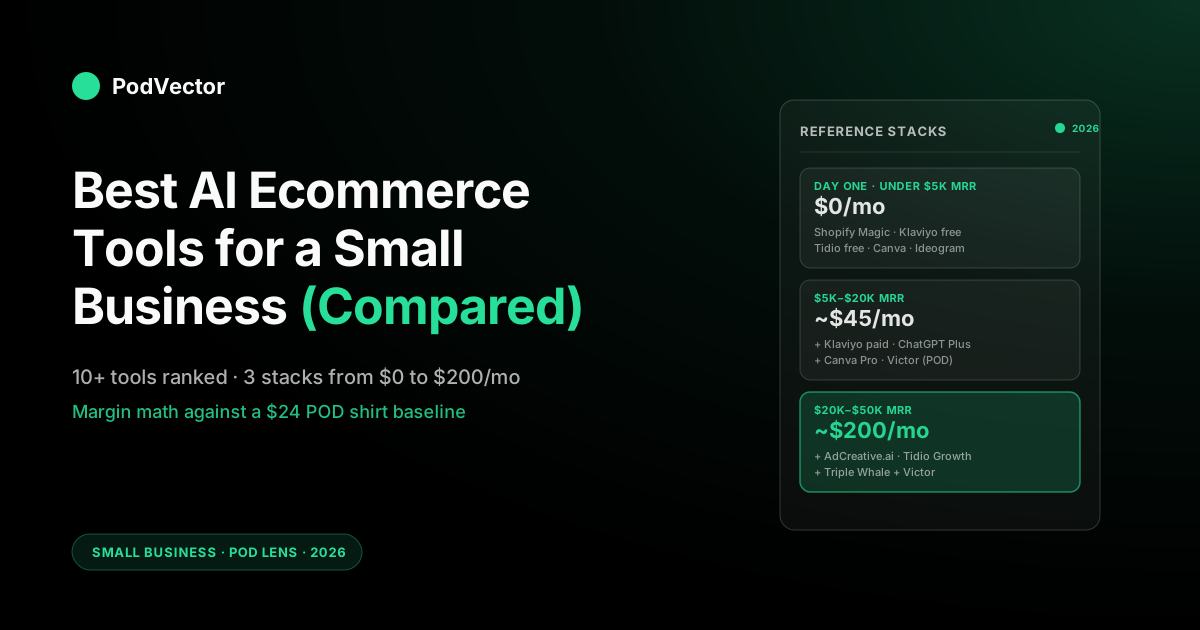
The $0/mo, $45/mo, and $200/mo Reference Stacks
The right tool stack depends entirely on store stage. The mistake small businesses make is reading a roundup and stacking the maximalist tool kit at $5K MRR — which produces a $600/month subscription bill against $1,300 of monthly gross margin. Three reference stacks by stage:
Stack 1: Day one to $5K MRR — $0/mo
- Email/SMS: Klaviyo free tier (up to 250 contacts) or Omnisend free tier
- Support: Shopify Inbox (free) or Tidio free tier (50 conversations/mo)
- Copy: Shopify Magic (free) for product copy, plus a free ChatGPT account
- Creative: Canva free tier
- Design (POD only): Ideogram free tier
- Analytics: Shopify Analytics built-in
Total: $0/month. The principle: keep the subscription floor at zero until ad spend or order volume forces an upgrade. This stack covers 80% of what a small store needs through its first 100 orders.
Stack 2: $5K to $20K MRR — $35–$45/mo
- Email/SMS: Klaviyo at $20/mo (500 contacts)
- Support: Tidio Starter $29/mo, or stay on Shopify Inbox + Gorgias Starter $10/mo
- Copy: Shopify Magic + ChatGPT Plus $20/mo
- Creative: Canva Pro $15/mo
- Design (POD only): Ideogram Plus $8/mo or Midjourney Basic $10/mo
- Analytics: Shopify Analytics + Victor (free during beta) for POD margin-by-design
Total: $35–$80/month depending on overlap. At $10K MRR with a 50% gross margin profile, this is roughly 0.5% of GMV — well within the budget that compounds into channel growth.
Stack 3: $20K to $50K MRR — $200–$280/mo
- Email/SMS: Klaviyo $45–$90/mo (1,500–3,000 contacts)
- Support: Tidio Growth $59/mo or Gorgias Basic $50/mo
- Copy: ChatGPT Plus $20/mo (Jasper still optional under $30K MRR)
- Creative: Canva Pro $15/mo + AdCreative.ai $39/mo Starter
- Design (POD only): Midjourney Standard $30/mo
- Analytics: Triple Whale Founders $129/mo + Victor for design-level POD margin
Total: $200–$280/month. The marginal subscription growth from Stack 2 to Stack 3 is mostly in analytics depth and ad-creative volume; everything else scales linearly with contacts and traffic. For a more granular marketing-tool breakdown across these stages, see the best AI tools for ecommerce comparison.
The POD-Specific Gap None of These Close
The tool stack above covers acquisition, retention, support, copy, creative, and the basics of analytics. What it doesn't cover — and where POD operators still spend most of their decision time — is the design-portfolio question: which of your 200 listed designs are actually compounding revenue, which are zero-volume for the third month running and need to be killed, and which are ad-paying but unit-margin-negative after Printify cost fluctuations.
None of the generalist small-business tools above answers that natively. Triple Whale gets close with manual COGS upload (most operators don't bother); Klaviyo can segment by best-selling product but not by design profitability; Canva and AdCreative.ai produce creative for whatever design you feed them without weighting which designs deserve the spend.
The gap is structural: ecommerce tools are organized around campaigns, audiences, and channels — POD's actual ROI surface is organized around designs and SKU variants. Closing that gap manually is what most POD operators do in spreadsheets, and it's the specific problem the complete POD-tools guide and best AI tools for small ecommerce stores 2026 walk through in more depth.
FAQs
What's the cheapest AI ecommerce stack for a brand-new small business?
Free, fully. Shopify Magic for copy and image edits, Klaviyo's free tier (up to 250 contacts) or Omnisend's free tier for email, Shopify Inbox or Tidio's free tier for chat, Canva's free tier for creative, Ideogram's free tier for design generation if you're doing POD, and Shopify Analytics built-in. Skip every paid tool until you're past 100 monthly orders or $1,000 of monthly ad spend, whichever hits first.
How do I know if an AI ecommerce tool will actually pay back?
Take the monthly subscription, divide by your average gross margin per order (revenue minus cost of goods minus payment fees), and that's the number of incremental orders the tool needs to drive or save you per month to clear its own cost. For a $24 POD shirt with $11 cost and $1 of fees, that's $12 of margin per unit — so a $109/mo tool needs 9 incremental orders/month. If you can't see a credible path to those incremental orders inside 60 days, skip the tool.
Is Shopify Magic enough, or do I need Jasper or Copy.ai?
For a small business under $20K MRR, Shopify Magic (free) plus ChatGPT Plus ($20/mo) covers 90% of what a paid copy tool would do. The upgrade to Jasper makes sense once you're producing 20+ new product listings a month and brand-voice consistency across SKUs becomes a real operational concern.
Should I use a chatbot or just answer customer questions myself?
If you're getting fewer than 5 customer questions per week, answer them yourself — the time investment to set up a chatbot isn't worth it yet. Past 5/week, install Tidio's free tier or Shopify Inbox and let the AI suggest replies. Past 30/week, the $29/mo Tidio Starter or $10/mo Gorgias Starter pays back within the first month from time saved.
Do I need a separate analytics tool, or is Shopify Analytics enough?
Shopify Analytics is enough until you're running paid ads on multiple platforms (Meta + Google + TikTok) and need to see attribution across them. That's typically the $20K MRR mark.
Below that, Shopify's built-in dashboards plus the new Sidekick AI assistant cover the questions you can actually act on. POD operators are the exception — margin-by-design analytics (Victor) is useful from day one because the question doesn't get easier with revenue, and Victor is free during beta.
What about ChatGPT or Claude as a general AI ecommerce tool?
For any small business, the general-purpose chat tools are worth a $20/month subscription independent of any of the above. They handle ad-hoc copy production, brainstorm campaigns, draft customer-service templates, and rough-cut SEO outlines well enough to replace several entry-level paid tools. They don't replace Klaviyo, Triple Whale, or AdCreative.ai, but they sit alongside cleanly and absorb everything else.
Are there AI ecommerce tools specifically for print-on-demand?
Yes — most are still emerging. Victor (by PodVector AI) is the only purpose-built AI agent for POD analytics with native Printify and Printful supplier-cost integration.
Generic tools (Triple Whale, Klaviyo, Tidio) work for POD with manual configuration, but the per-design profitability question that defines POD economics is structurally outside what they're built for. The AI analytics topic hub indexes every comparison guide where POD-specific analytics is the focus.
Want POD-native analytics that doesn't need $20K MRR to pay back?
Victor pulls live order, fulfillment, and supplier-cost data from Shopify + Printify and answers design-level margin questions in plain English — no spreadsheets, no manual cost tracking. Free during beta.
Try Victor free