
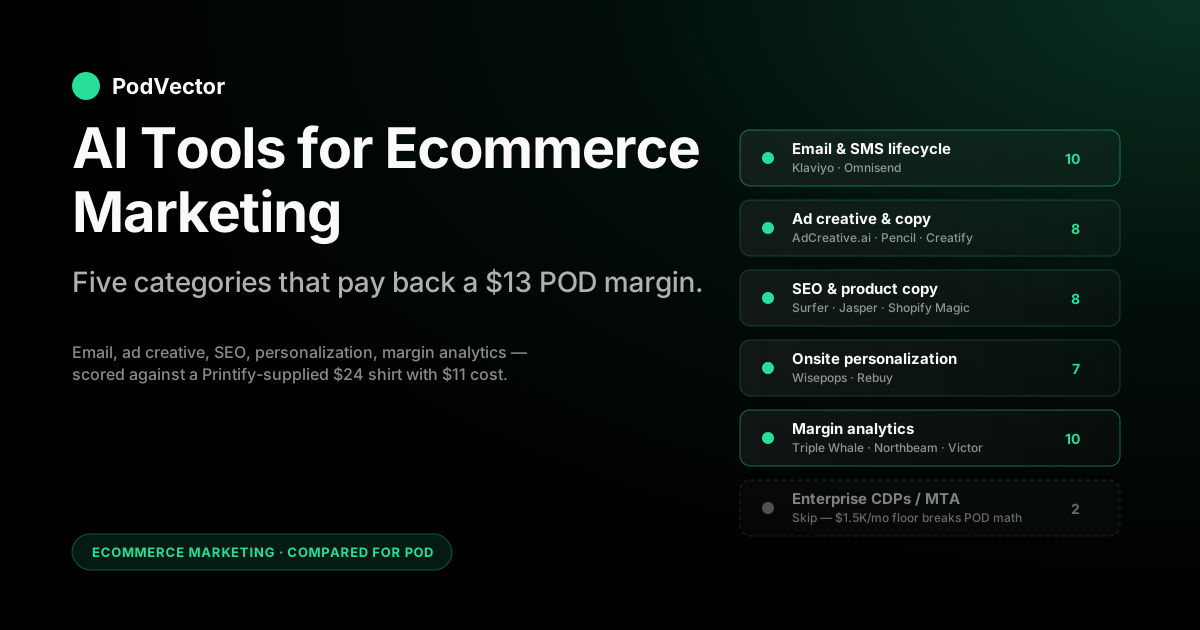
Quick Answer: The AI marketing categories that actually pay back for a print-on-demand operator are email and SMS lifecycle (Klaviyo, Omnisend), ad creative generation (AdCreative.ai, Pencil, Creatify), SEO and product copy (Surfer, Jasper, Shopify Magic), onsite personalization and recommendations (Wisepops, Rebuy), and marketing analytics with margin awareness (Triple Whale, Northbeam, Victor by PodVector AI). The categories most generic ecommerce-marketing roundups push hard — enterprise CDPs, multi-touch attribution platforms with four-figure monthly minimums, and conversational commerce video tools — almost never clear payback against a typical slim-margin POD unit.
This guide picks across each category through a POD lens: what the tool actually does for marketing, what it costs against a Printify-supplied shirt, and which 2026 tools are good at the marketing surface but blind to the design-level profit question that's the real ROI driver in print-on-demand.
Why "Ecommerce Marketing" Tools Map Differently for POD
Most "best AI tools for ecommerce marketing" lists treat the category as a single template — email, ads, SEO, personalization, customer support, analytics — and assume a unit-economics profile where gross margin is wide on a stocked SKU. The roundups that currently rank for the term all assume a brand where every dollar of revenue carries significant contribution profit, and where marketing-tool subscriptions round to noise against the upside. The 2026 versions of these lists have also widened to cover AI customer-support agents (Gorgias, Tidio's Lyro, Intercom Fin) and AI-driven product imagery (Photoroom, Canva, Adobe Firefly) as core marketing surfaces — both of which map differently for POD, covered below. They've also expanded into AI search and discovery — specifically, which platforms handle large-catalog depth without breaking, a category now prominently featured in current top-ranking comparisons.
POD breaks the wide-margin assumption. When a Printify-supplied shirt has an eleven-dollar supplier cost, before fees and shipping refunds you're looking at a thin gross before any marketing spend touches the unit.
The same subscription marketing tool that's effectively free money for a high-margin DTC brand needs to drive meaningful incremental shirts per month just to cover itself. A tool that promises a conversion lift may genuinely produce that lift and still net negative against your stack. Most "AI marketing tools for ecommerce" advice ignores this entirely.
What's left after that filter, and what actually compounds in a POD store, is a smaller set of tools across five marketing functions: email/SMS, ad creative, SEO/copy, onsite personalization, and analytics that can read margin per design rather than just revenue per click. This guide ranks tools inside each category through a POD operator's lens — what the cost-per-shirt math is, what the integration surface against Shopify + Printify looks like, and which tools earn their subscription at different revenue stages.
For the higher-altitude framing of how every AI category fits together in a POD stack, the complete guide to AI tools for POD sellers is the pillar. The tools cluster hub indexes every comparison guide on the site, and the AI analytics topic hub is where the margin-per-design question — the one most marketing tools don't touch — gets answered.
The Scorecard: Categories That Pay Back
Scores out of 10 on POD-specific axes — payback per dollar of subscription against a typical Printify-supplied unit-economic profile, Shopify + Printify integration depth, and whether the tool produces marketing output that can actually be evaluated at the per-design level.
| Category | Top picks | Payback for POD | Starting cost/mo | Integration with Shopify + Printify | Best for stage |
|---|---|---|---|---|---|
| Email & SMS lifecycle | Klaviyo, Omnisend | 10 | $0–$45 | Shopify native | Day one |
| Ad creative | AdCreative.ai, Pencil, Creatify | 8 | $25–$109 | Asset hand-off only | Past first ad campaign |
| SEO & product copy | Surfer, Jasper, Shopify Magic | 8 | $0–$89 | Shopify native (Magic); manual paste (Surfer) | Day one for copy; growing store for SEO |
| Onsite personalization | Wisepops, Rebuy | 7 | $0–$99 | Shopify native | Past 1,000 sessions/mo |
| AI customer support | Tidio Lyro, Gorgias, Intercom Fin | 8 | $0–$39 | Shopify native (Gorgias) | Day one (Lyro); higher volume (Gorgias) |
| AI search & discovery | Algolia, Nosto, AEO content | 5 | $0–$99 | Shopify app | Past 300+ listings |
| Marketing analytics | Triple Whale, Northbeam, Victor | 10 | $0–$199 | Native (Victor); paid integration (Triple Whale) | Past first consistent revenue month |
| Enterprise CDPs / MTA | Bloomreach, Adobe, Segment | 2 | $1,500+ | Possible but irrelevant | Skip until very large ARR |
The picks below cover what each tool actually produces for a POD marketing program, where it earns its subscription, and where the seam is between automation and the next decision the operator has to make manually.
Email and SMS Lifecycle: Klaviyo, Omnisend
Email and SMS are the highest-payback marketing category for a POD store, by a wide margin, for one reason: the audience is already paid for. Every customer that bought a shirt left an email address, a Shopify customer record, and a buying signal that's worth more than any cold ad impression.
Lifecycle automation puts that asset back to work without re-paying the ad acquisition cost. For a POD margin profile, email-driven repeat orders are substantially more profitable per unit than first-touch paid orders because the CAC is amortized over the lifetime, not the first transaction.
Klaviyo
Pricing: Free up to 250 contacts; $20/mo for 500; $45/mo for 1,500; scales with contact count.
Best for: POD stores from day one through growth into multi-million ARR.
Klaviyo is the email platform the Shopify mid-market runs on, and the 2026 AI features push it further into per-recipient personalization than most operators are using. The features that pay back fastest for POD: predictive lifetime-value segments (so you can stop blasting your top buyers with the same coupon as your newest lookers), AI-generated subject lines that A/B test live without manual setup, and product blocks that rearrange per recipient based on browsing history. Cost-per-shirt math: at $45/mo for 1,500 contacts, one extra repeat order per week clears the subscription with margin to spare — most POD stores reach that threshold by month two of active use.
Where Klaviyo falls short for POD specifically: the product-block AI orders by general engagement signal, not by per-design margin. A high-engagement low-margin design gets pushed harder than a high-margin niche hoodie just because the cheap shirt has more clicks. A POD operator who wants the email program to weight by margin still has to do the segmentation manually or layer in a separate tool that reads supplier cost data. For a full treatment of which metrics to prioritize when margin per design diverges from revenue, see the guide on how to get contribution margin for your store.
Omnisend
Pricing: Free up to 250 contacts and 500 emails/mo; $16/mo Standard; $59/mo Pro (includes SMS credits).
Best for: POD stores in earlier growth stages who want SMS bundled cheaper than Klaviyo's add-on.
Omnisend's pitch against Klaviyo is simpler workflows, included SMS, and a lower price ceiling for small contact lists. The AI features are narrower — subject line generation, send-time optimization, and basic product recommendations — but for a sub-$30K/month POD store the gap doesn't matter; you're not yet running 12-step lifecycle journeys. Where Omnisend wins: SMS at scale costs less than Klaviyo when you factor in the SMS add-on, and the editor is faster to learn for an operator without an email-marketing background.
Decision rule: pick Klaviyo if you're already generating consistent revenue and want the predictive features ready. Pick Omnisend if you're at an earlier stage and SMS is a real channel for you (most POD stores it isn't, yet).
Ad Creative and Copy: AdCreative.ai, Pencil, Creatify
Ad creative is where AI tools have eaten the most ground in 2026, and POD has a structural advantage here that most ecommerce verticals don't: every product is a graphic design, not a physical photograph. A POD store's ad creative is mostly mockups of a t-shirt or hoodie with a design printed on it, and AI mockup-and-creative tools handle that pattern unusually well. The gap between an AdCreative.ai output and a costly freelance designer for a Meta ad is small enough that POD operators with no in-house design ops should default to AI-generated creative through their early ad spend. To understand how ad frequency and fatigue interact with creative refresh decisions, see the guides on how to avoid ad fatigue and what is ad frequency.
AdCreative.ai
Pricing: $39/mo Starter (10 downloads/mo); $109/mo Premium (50 downloads); $249/mo Pro (250 downloads).
Best for: POD operators running their own Meta and Google ads without a designer.
AdCreative.ai generates static and short-video ad units in your brand colors, with copy variations, in batches. Upload your Printify mockup PNG, give it a one-line product description, and it produces 20+ variations across square, story, and feed formats.
For POD specifically the value is in volume: you can spin a new design's first ad set in minutes instead of hours, which means you can validate more designs against the ad market before committing to a full launch. Cost-per-shirt math: at $109/mo for 50 downloads, breaking even requires a handful of incremental shirts per month from creative the operator wouldn't have made — easily cleared if you're testing more than two designs/month.
Pencil
Pricing: $50/mo Pro (1,000 ad credits); $200/mo Pro Plus.
Best for: POD stores running Meta + TikTok in parallel that want short-video creative without a video editor.
Pencil's edge over AdCreative.ai is short-video. It generates 6–15-second product videos from your mockup plus a script, with motion graphics and stock B-roll layered in.
For TikTok-adjacent POD operators in the design-niche-meme category that's working well in 2026, this is the difference between running TikTok ads and not. The output is rougher than human-edited UGC video — the music timing is sometimes off, and the captions occasionally miss platform-spec — but it's good enough to test whether a design has motion appeal before you pay for a real UGC creator.
Creatify
Pricing: Free tier with limits; $39/mo Pro; $79/mo Business.
Best for: POD operators who want AI-avatar UGC-style ads at low cost.
Creatify generates UGC-style videos with AI avatars holding (or visually adjacent to) your product. The "creator" looks and sounds like a real person reviewing the shirt.
The legal/ethical question of whether to disclose AI avatars in ads is unresolved across most ad platforms in 2026 — Meta requires disclosure for synthetic media in political ads only, but TikTok's policy is in flux — so POD operators using Creatify should label outputs as AI-generated in caption to stay ahead of policy changes. The creative itself works: Creatify avatars cost a fraction of real UGC production, which is a clean win for low-budget POD ad testing.
Product image generation: Photoroom, Canva, Adobe Firefly
Pricing: Photoroom $13/mo Pro; Canva $15/mo Pro; Adobe Firefly $10–$30/mo.
Best for: POD operators who want lifestyle and scene imagery for product pages and ads without a photographer.
Every "best AI tools for ecommerce" list now carries a visual-asset category, and for POD the relevant job is narrow but real: turning a flat Printify mockup into a scene. Photoroom drops your mockup onto an AI-generated background (a folded tee on a wooden table, a hoodie on a model-shaped form), Canva Magic Studio handles batch resizing and on-brand layout for social, and Adobe Firefly generates the lifestyle backdrops when you want something more art-directed. None of these design the shirt — they stage a design you already have — so the payback is in PDP conversion and ad-thumbnail click-through, not in the underlying product. Cost-per-shirt math: at $13–$15/mo these clear with one or two incremental orders, which is why they belong in even the day-one stack. The one caution for POD: AI-generated backgrounds occasionally warp print detail or text on the design, so spot-check every scene before it goes live on a listing.
SEO and Product Copy: Surfer, Jasper, Shopify Magic
Organic search is the channel POD operators chronically underweight, mostly because the SERP for "graphic tee" or "funny mug" is brutal and the SEO payback curve is 6–12 months. But for niche-design POD stores — think dog breeds, professions, hobbies, fandoms — long-tail keyword targeting with AI-assisted content production is one of the few channels where you can build a defensible CAC advantage over the Etsy/Amazon-Merch competition. The trick is matching tool to the actual job: SEO planning is different from product-page copy, which is different from blog-post production.
Surfer
Pricing: $89/mo Essential; $179/mo Scale; $249/mo Scale AI.
Best for: POD operators committing to a content-marketing channel past their first consistent revenue milestones.
Surfer is the SEO planning tool — it analyzes the top 20 ranking pages for any keyword, extracts the structural pattern (word count, H2 coverage, entity inclusion, internal linking density), and gives you a content brief that, if followed, has a meaningful chance of ranking. For POD stores it's most useful for niche-cluster blog content ("best gifts for golf coaches," "funny shirts for nurses") where the SERP isn't fully owned by the marketplaces. The Scale AI tier writes a first draft from the brief; most operators outline manually and write the draft themselves because Surfer's draft tends to be generic.
Cost-per-shirt math: at $89/mo, you need a single ranking blog post to drive a handful of incremental shirts per month from organic search to break even. A well-targeted niche post on a long-tail keyword with modest monthly searches can clear that easily once it ranks; the question is the 4–6 month wait before it does.
Jasper
Pricing: $49/mo Creator; $69/mo Pro; custom Business.
Best for: POD operators producing high-volume product copy and ad copy who need brand consistency.
Jasper's brand-voice training is the differentiator versus generic AI chat for POD product-copy production. Train it on 10 of your existing product descriptions, and every subsequent generation matches the cadence and vocabulary you've already established.
For a store with 200+ designs across multiple variants, this is the difference between consistent on-brand listings and a Frankenstein store where every product page reads like a different writer. The 2026 Jasper update added structured-output mode that produces bulleted feature lists, sizing tables, and FAQ sections in one pass.
Shopify Magic
Pricing: Included with Shopify plans (no add-on cost).
Best for: POD operators on Shopify who haven't yet outgrown the built-in tooling.
Shopify Magic is free with any Shopify plan and handles product descriptions, email subject lines, and section copy without adding a subscription. The output quality lags Jasper meaningfully on tone control and is roughly comparable on raw description writing. For a POD operator at an early stage, Magic + a Klaviyo subject-line generator covers the majority of what a paid copy tool would do; the upgrade to Jasper makes sense once you're producing 20+ new product listings a month and can't tolerate inconsistent voice. Automating Shopify-side changes like bulk product updates pairs naturally with copy tooling — see how Shopify Admin API store-modification automation handles that layer.
Onsite Personalization: Wisepops, Rebuy
Onsite personalization — the popups, exit-intent offers, and dynamic product recommendations that show different content to different visitors — pays back differently for POD than for catalog ecommerce. POD stores typically have low session counts per design (a niche tee might get 80 sessions before its first sale), which means the AI personalization models have less behavioral data to work with per SKU. The tools that win here are the ones that work with low data volume by leaning on segment-level signals (referrer source, geo, device, cart contents) rather than per-product behavior.
Wisepops
Pricing: $49/mo for 50K pageviews; $99/mo for 200K; scales with traffic.
Best for: POD stores past 1,000 sessions/month that want AI-driven popup and on-site messaging.
Wisepops handles popups, banners, and embedded CTAs with AI-driven targeting that segments by visitor signal. For POD the highest-leverage use is the email-capture popup with offer customization — first-time visitors from a paid Meta ad get a discount offer that still leaves margin intact, while organic visitors from a long-tail keyword get a more measured "join the list, no discount" capture. The AI-driven A/B testing of popup timing and copy is the genuine 2026 add-on; manual setup takes about 20 minutes and the system optimizes from there. For the broader conversion-optimization framing these popups sit inside, see the guide on ecommerce checkout conversion rate optimization.
Rebuy
Pricing: $99/mo Starter; $249/mo Scale; $499/mo Pro.
Best for: POD stores with multi-design catalogs that want AI-recommended cross-sells in cart and PDP.
Rebuy is the Shopify-native AI recommendations engine — what's-in-cart upsells, post-purchase add-ons, and PDP "you might also like" with model-driven product picks. For POD the ROI shows up fastest in the cart upsell: when a customer adds a shirt, Rebuy can offer a coordinating second product (mug, sticker pack) at a small bump in AOV with relatively predictable take-rate.
The catch: at $99/mo entry, you need consistent upsold orders to break even each month — a threshold that isn't trivial for a store at lower revenue stages. Rebuy lands cleanly once you have meaningful catalog breadth and traffic volume; below that, the same job is done worse but free by Shopify's built-in recommendations.
AI Customer Support: Gorgias, Tidio Lyro, Intercom Fin
AI support agents are the category that's moved fastest in the 2026 roundups — resolution-based agents (Gorgias AI Agent, Tidio's Lyro, Intercom Fin) now close tickets end to end rather than just suggesting replies. The marketing relevance is real: most POD support volume is "where's my order" and "what size am I" — pre-purchase questions that, answered fast, convert hesitating buyers, and post-purchase questions that, answered well, drive the repeat order email/SMS can't earn on their own.
Tidio (Lyro)
Pricing: Free tier; Lyro AI from $39/mo (50 conversations).
Best for: POD stores at earlier revenue stages that want a cheap AI agent for WISMO and sizing questions.
Lyro answers from your help-center content and order data, and for a POD catalog the highest-leverage setup is feeding it your Printify shipping-time ranges and size charts so it resolves the two questions that make up most of your inbox. At $39/mo for 50 resolved conversations it clears against POD margin the moment it deflects the tickets you'd otherwise answer at 11pm.
Gorgias and Intercom Fin
Pricing: Gorgias from $10/mo base + per-resolution; Intercom Fin ~$0.99 per resolution.
Best for: POD stores with enough ticket volume to justify per-resolution pricing.
Gorgias is the Shopify-native support desk and its AI Agent resolves order-status, returns, and address-change tickets against live Shopify data; Intercom Fin prices purely per resolution, which is cleaner once you can forecast volume. Both are overkill at lower revenue stages where Lyro or a templated Shopify Inbox setup covers the load. Where all three fall short for POD is the same blind spot as the marketing tools below: they resolve the ticket but don't know that a spike in "print looks faded" complaints on one design is a supplier-quality signal that should pull that SKU from your ad spend.
AI Search and Discovery: Where AEO Fits POD
One of the subtopics now prominently featured in top-ranking 2026 comparisons is AI-driven discovery — both the on-site kind and the off-site kind. Most AI platforms are built for support volume, not catalog complexity. When your store carries thousands of SKUs, the problems that hurt conversion are discovery-related. On-site AI search tools like Algolia and Nosto use hybrid keyword-plus-vector search to surface the right design from a vague query. Off-site, the emerging discipline is answer-engine optimization (AEO): being the store an AI assistant cites when a shopper asks it to "find me a funny nurse shirt."
ChatGPT dominates AI referral traffic with the vast majority of all AI visits, followed by Perplexity and Google Gemini. Brands managing thousands to millions of SKUs need automated enrichment pipelines — not manual processes — to keep pace with AI shopping channels. For POD this splits cleanly by store size.
On-site AI search (Algolia, Nosto) only earns its keep once your catalog is large enough that visitors can't find a design by browsing — practically, past 300–500 active listings. Below that, Shopify's built-in search is fine and the subscription is dead weight. Catalog training depth and sync speed matter: the AI is only as good as what it knows. It should ingest your full catalog quickly and stay in sync automatically as products and prices change — and handle edge cases like out-of-stock items or promotional exclusions.
AEO is the more interesting play for POD. SKU-level catalog optimization for AI is the process of improving product metadata, structured data, copy, images, and catalog quality at the individual SKU level so AI systems like Rufus, Gemini, and ChatGPT can identify, match, and rank each product accurately. This is distinct from page-level SEO, which optimizes for a ranked link list rather than a quoted citation within an AI answer. Niche-design POD stores compete for long-tail intent ("matching family camping shirts," "gift for a retiring teacher") that AI assistants now answer directly.
A brand with 200 SKUs and thin data on 60% of them is invisible across most AI surfaces. The same well-structured niche content that wins the SEO section above — clear headings, specific entities, genuine answer text, complete product attributes — is what gets a store surfaced in AI answers. According to one industry snapshot, 26% of brands had zero mentions in AI Overviews, and 47% of brands still lack a deliberate generative engine optimization strategy. There's no single tool to buy to fix this for a small POD store; it's a content and metadata discipline, and it's why the SEO/content channel compounds rather than decays for POD. For the deeper treatment of how AI answer engines change organic visibility, see the AI analytics for print-on-demand guide.
For large-catalog POD operators — those with thousands of SKUs across many niches — a platform that claims credit for every sale made within days of a chat interaction isn't giving you a real number. Look for conservative, same-session attribution so you know what the AI actually drove. Tools in this space include Algolia (on-site search), Nosto (personalized discovery), and emerging GEO/AEO monitoring platforms like Profound and Nuwtonic for tracking AI citation share at the SKU level.
Marketing Analytics with Margin Awareness: Triple Whale, Northbeam, Victor
The analytics layer is where most generic "ecommerce marketing tools" roundups go wrong for POD. The recommended tools (Northbeam, Triple Whale, LayerFive, Adobe Analytics) all assume revenue is the headline metric and that "incremental revenue per dollar of ad spend" is the question to answer.
For POD that question is one layer too shallow — the right question is "incremental contribution margin per dollar of ad spend, by design," because two shirts that pull the same revenue can carry wildly different supplier costs and shipping subsidies. A marketing analytics tool that's blind to per-SKU supplier cost will systematically over-allocate spend to your low-margin items. For the underlying math, see the guide on how to get contribution margin for a POD store.
Triple Whale
Pricing: $129/mo Founders; $349/mo Growth; custom Pro.
Best for: POD stores past consistent monthly revenue who can configure per-SKU COGS manually.
Triple Whale is the dominant attribution and analytics platform for Shopify DTC, and the 2026 release added an AI assistant ("Moby") that answers ad-performance questions in natural language. For POD specifically, Triple Whale will work — but you have to manually configure per-SKU COGS for every Printify variant, and Printify cost changes (which happen periodically as suppliers re-price) don't sync automatically. Operators willing to maintain that mapping get genuinely useful margin-aware reporting; operators who skip the COGS setup get revenue-only attribution and lose most of the POD-specific signal.
Northbeam
Pricing: Custom, starts around $1,000/mo.
Best for: POD stores with substantial multi-channel ad spend.
Northbeam is media-mix-modeling software that does multi-touch attribution with more statistical rigor than Triple Whale's last-click + UTM model. For POD it's overkill until you're running paid spend across multiple channels at scale and the attribution-error gap matters more than the high monthly subscription. Below substantial ARR, the cost dominates the precision benefit.
Victor (PodVector AI)
Pricing: Free during beta; pricing TBD post-launch.
Best for: POD operators on Shopify + Printify (or Printful) who want the margin question answered without manual COGS configuration.
Victor is PodVector AI's AI employee, built just for print-on-demand sellers. Connect your Shopify store and your Printify or Printful account, and Victor can see your orders, your fulfillment status, and your supplier costs, plus your Meta Ads and Google Ads spend. You can ask him plain questions about margins and designs, and he answers in plain English. He works differently from tools like Triple Whale and Northbeam in two ways that matter for POD. First, Victor knows your supplier costs from Printify, Printful, and Gelato before you ever make a sale — no manual cost uploads needed. Second, he connects ad spend, order revenue, and supplier cost down to each design, not just each campaign. That means a question like "which designs lost money on Meta last week after factoring shipping subsidies and refunds" is one question to Victor, not a spreadsheet project.
Beyond reading your data, Victor proposes and — with your explicit approval — executes actions on Shopify: repricing a product to a target margin, bulk repricing across your store, creating discount and free-shipping offers, organizing products into collections, and reverting a price change. He reads Meta Ads and Google Ads and proposes moves on those surfaces, but ad-platform writes are executed by the merchant. For POD operators evaluating tools right now, the trade-off versus Triple Whale is: pay for Triple Whale's mature dashboarding and configure COGS yourself, or use Victor's POD-native query layer with the margin math handled for you and Shopify-side actions available with your approval. For cash-flow and capital planning that surfaces from better margin visibility, see how to get Shopify Capital and the Printify t-shirt cost and profit breakdown.
The Categories POD Operators Should Skip
About a third of every "AI tools for ecommerce marketing" roundup is irrelevant or actively wasteful at POD scale. The categories below show up regularly in the SERP top 10 and almost never clear payback against POD margin profiles.
- Enterprise CDPs (Bloomreach, Adobe, Segment + Engage): Built for catalog ecommerce with millions of SKUs and seven-figure marketing budgets. Starting price floors well above $1,000/month make the math hopeless until you're at very large ARR — and even then, the POD-specific supplier-cost question these tools don't answer remains unsolved.
- Conversational commerce video tools (Tolstoy, Firework): Built for video-heavy categories like beauty and apparel-with-fit. POD's product-photo-as-mockup pattern doesn't have enough video surface to justify the subscription.
- Standalone multi-touch attribution platforms at lower revenue stages: The attribution-error gap they close is smaller than the noise in your data at that scale. Triple Whale's built-in attribution is already past the precision floor that matters for most growing POD stores.
- AI influencer-outreach platforms: The "AI" is mostly automated email scraping. POD margins don't support paid influencer programs at scale; UGC-style ad creative (above) replaces this channel more cheaply.
- "AI store builder" platforms (Shoplazza Store Builder, Mixo): One-time tools that build a starter site from a prompt. Useful for week one of a new store; nothing about them is a recurring marketing tool.
Three Marketing Stacks by Store Stage
The right tool stack depends entirely on store stage. The mistake POD operators make is reading a roundup and stacking the maximalist tool kit at low revenue — which produces a subscription bill that can exceed a month's worth of gross margin. Three reference stacks by stage:
Stack 1: Day one to first consistent revenue
- Email/SMS: Klaviyo free tier (up to 250 contacts) or Omnisend free tier
- Ad creative: Canva Magic Studio (free) for static, AdCreative.ai $39/mo Starter only when you're spending meaningfully on ads
- Copy: Shopify Magic (free)
- Personalization: Shopify built-in recommendations (free)
- Analytics: Shopify Analytics + a free Victor account for margin sanity-checking
Total: $0–$39/month. The principle here is keep the subscription floor near zero until ad spend or order volume forces an upgrade.
Stack 2: Growing store — mid-range monthly revenue
- Email/SMS: Klaviyo at $20–$45/mo
- Ad creative: AdCreative.ai $109/mo + Pencil $50/mo when running short-video
- Copy: Jasper $49/mo Creator
- Personalization: Wisepops $49/mo (popups), Rebuy $99/mo (cart upsells)
- Analytics: Triple Whale Founders $129/mo or Victor (free during beta) for margin-by-design
Total: $370–$520/month. At a solid monthly revenue level with a healthy gross margin profile after fees, this typically represents a small percentage of GMV — well within the marketing-tool budget that compounds into channel growth.
Stack 3: Established store — high monthly revenue
- Email/SMS: Klaviyo, scaled by contact count
- Ad creative: AdCreative.ai Pro + Creatify $79/mo + retained UGC creator network
- Copy: Jasper $69/mo Pro + Surfer $89/mo for SEO content
- Personalization: Rebuy Scale $249/mo, Wisepops $99/mo
- Analytics: Triple Whale Growth $349/mo + Victor for design-level margin queries
Total tool cost at this stage scales primarily with Klaviyo contact count and the ad-creative volume you need; the marginal cost increase from the mid stack to here is mostly in analytics depth and creative throughput, with everything else scaling linearly with contacts and traffic.
Where AI Marketing Tools Still Don't Reach for POD
The marketing-tool stack above covers acquisition, retention, copy, creative, and the basics of analytics. What it doesn't cover — and where POD operators still spend most of their decision time — is the design-portfolio question: which of your listed designs are actually compounding revenue, which are zero-volume for the third month running and need to be killed, and which are ad-paying but unit-margin-negative after Printify cost fluctuations.
None of the marketing tools above answers that natively. Triple Whale comes closest with manual COGS upload; Klaviyo can segment by best-selling product but not by design profitability; AdCreative.ai produces creative for whatever design you feed it without weighting which designs deserve the spend.
The gap is structural: marketing tools are organized around campaigns, audiences, and channels — POD's actual ROI surface is organized around designs and SKU variants. Closing that gap manually is what most POD operators do in spreadsheets, and it's the specific problem AI analytics for print-on-demand is built to solve. For the employee capability — answering and acting on those answers — see agentic AI for ecommerce, applied to POD. And for the full Printify cost picture that underpins any design-level margin calculation, the Printify t-shirt cost and profit breakdown is the reference.
FAQs
What's the best free AI marketing tool for a brand-new POD store?
Klaviyo's free tier (up to 250 contacts), Shopify Magic for product copy, and Canva Magic Studio for ad creative cover the day-one stack at zero cost. Skip every paid tool until you're past a meaningful monthly ad spend or order threshold, whichever hits first.
Does Victor replace Triple Whale or Klaviyo?
No — Victor is a margin-aware analytics and action layer, not an email platform or a campaign manager. It complements Klaviyo (which handles the lifecycle email send) and overlaps partially with Triple Whale (which handles attribution dashboards). The gap Victor closes that neither of those handles is per-design profitability with live Printify/Printful cost data from completed orders, queryable in natural language — plus Shopify-side write actions (repricing, discounts, collections) that Victor can execute with your approval.
How do I evaluate whether an AI marketing tool will pay back for my POD store?
Take the monthly subscription, divide by your average gross margin per shirt (revenue minus supplier cost minus payment fees), and that's the number of incremental orders the tool needs to drive or save you per month. If you can't see a credible path to those incremental orders in the first 60 days, skip the tool. For help calculating that per-unit margin number precisely, see the guide on how to get contribution margin.
What about ChatGPT and other general-purpose AI chat tools for marketing?
For a POD operator, a general-purpose chat tool is worth a modest monthly subscription independent of any of the above. It handles ad-hoc copy production, brainstorms campaigns, drafts customer-service templates, and rough-cuts SEO outlines well enough to replace several entry-level paid tools at smaller stores. It doesn't replace Klaviyo (no send infrastructure), Triple Whale (no data integration), or AdCreative.ai (no ad-spec image output) but it sits alongside cleanly.
Are AI ad creative tools allowed on Meta and TikTok in 2026?
Yes for static and most video creative; disclosure requirements are tightening for synthetic-avatar UGC ads. Meta requires AI-generated content to be labeled in political ads only as of mid-2026, but TikTok's policy is broader and applies to all branded content using AI avatars. Best practice for POD: label any AI-avatar-based creative as AI-generated in caption regardless of platform requirement, both for compliance and because some audiences convert better when the AI angle is transparent.
How long should it take to see ROI from an AI marketing tool?
Email and SMS: 30 days. Ad creative: 14 days (you're testing the output against your existing creative baseline). SEO and content: 4–6 months. Personalization: 60 days. Analytics: hard to attribute directly — the payback is in better decisions, which compound. Any tool that hasn't moved a measurable metric inside its category's expected window probably isn't worth keeping.
Does Shopify Capital availability change once I have better margin visibility?
Indirectly, yes — Shopify Capital eligibility is based on your Shopify sales history, not your margin analytics. But having cleaner margin data helps you evaluate whether a capital offer makes sense to accept against your actual unit economics. See the guides on how to get Shopify Capital and does Shopify Capital check credit for the full picture.
Want margin-aware analytics built for POD without the manual COGS setup?
Victor reads your live orders, fulfillment status, and supplier costs from Shopify, Printify, Printful, Meta Ads, and Google Ads. He answers your margin and design questions in plain English, and suggests actions in Shopify, Google Ads, or Meta Ads that you approve in one click. No spreadsheets, no manual cost tracking, no guesswork. while it's in beta.
Try Victor free