
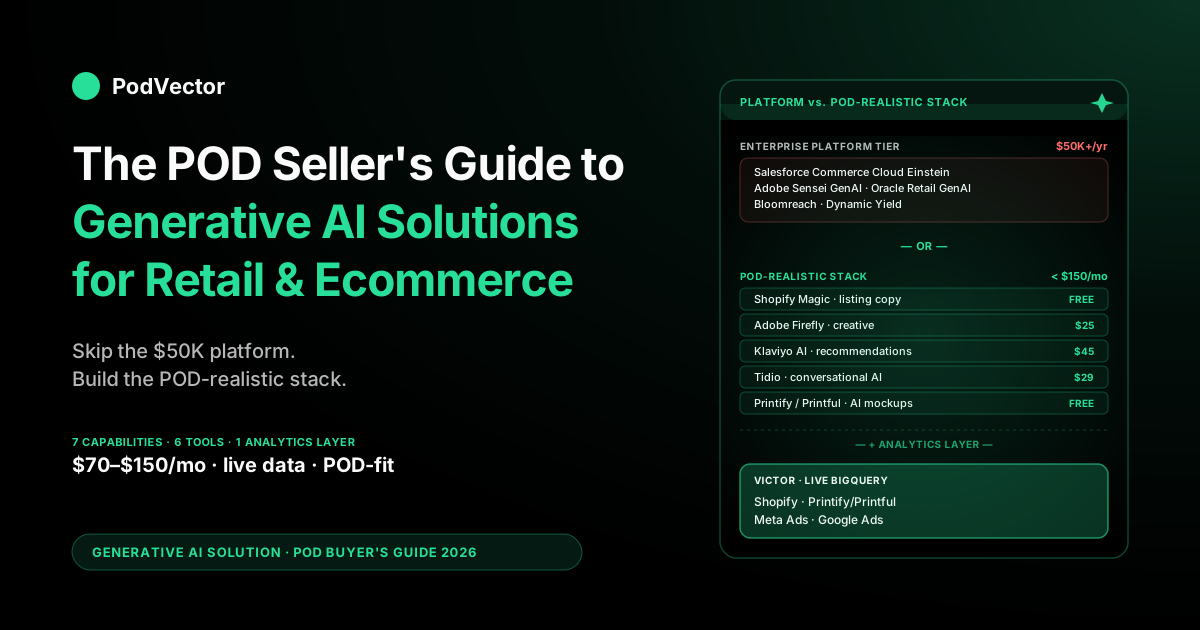
Quick Answer: A "generative AI solution for retail and ecommerce" is no longer one product — it's a capability stack with seven jobs: listing copy, mockup and creative, personalized recommendations, conversational shopping, visual search and try-on, predictive inventory, and an analytics layer that connects the rest to real margin. The enterprise vendors selling "platform" solutions (Salesforce Commerce Cloud Einstein, Adobe Sensei GenAI, Oracle Retail GenAI, Bloomreach, Dynamic Yield) are pricing for $50K+ contracts that don't fit a POD operator.
The realistic POD stack is six commodity point tools at $20–80/month each — Shopify Magic, Klaviyo AI, Tidio or Gorgias, Printify or Printful AI mockups, Adobe Firefly, and a recommendations engine — plus an analytics layer that reads live data across them. This guide maps each capability to the POD-specific decision, names the vendors worth shortlisting at the SMB price point, and explains the evaluation criteria that matter when your unit economics are Printify or Printful base cost plus your design margin.
What "generative AI solution for retail and ecommerce" actually means in 2026
The phrase started as enterprise-vendor marketing — Salesforce, Adobe, Oracle, IBM, and the consultancies all sell something they call a "generative AI solution for retail and ecommerce" — and the descriptions tend to be deliberately broad so that one platform appears to handle every use case at once. For a print-on-demand operator the broad framing is the trap. The real decision is which capabilities actually move POD revenue, in what order, at what price, and which capabilities to skip entirely because they don't match the unit economics of a store that doesn't hold inventory.
The capability list every credible vendor pitches under this label is the same seven items: listing copy generation, creative and mockup generation, personalized recommendations, conversational shopping (chat or voice), visual search and AI try-on, predictive inventory and demand forecasting, and a customer-data and analytics layer. The argument for "buy a platform" is that one vendor delivers all seven with shared data.
The category has the market-size numbers to match the hype: McKinsey estimates generative AI could add $400–660 billion in annual value to retail, and IHL Group projects it lifting retail sales 51% and gross margins 20% through 2029. Those figures are real — and they're aggregated across Walmart-scale operations with named flagship deployments (Walmart's vendor-negotiation bot, Carrefour's ChatGPT-based "Hopla" assistant, Sephora's Virtual Artist try-on, Newegg's AI review summaries). A POD store captures a sliver of that value, and only from the two or three capabilities that map to its actual workflow. The rest of the stat is someone else's business.
The argument for "buy six point tools" is that the platforms cost $50K to $500K per year and the point tools cost $20 to $80 each per month with broadly comparable per-capability quality. For a POD store the second argument wins almost every time.
This guide maps each of the seven capabilities to the POD-specific decision: what the capability does, which vendors actually fit the SMB price point, what to evaluate, and the gotcha that doesn't show up in the generic enterprise content. For the broader cluster see the POD seller's guide to gen AI for ecommerce and the POD seller's guide to generative AI for ecommerce; for the topic hub see the AI Analytics topic hub.
Enterprise platforms vs. the POD-realistic stack
The vendors selling "generative AI solution" as a platform are mostly priced out of POD. Salesforce Commerce Cloud Einstein starts in the high five figures per year and grows from there.
Adobe Sensei GenAI on Adobe Commerce assumes you're already on the Adobe Experience Cloud at six figures. Oracle Retail GenAI is for the Macy's-and-up tier.
Bloomreach Discovery and Dynamic Yield are typically deployed at $30K-$150K per year. None of these are wrong for the customer they're built for. They're wrong for a POD store running on Shopify with Printify or Printful supply.
The POD-realistic stack, which I'll spend most of this guide on, is six commodity tools that each handle one of the seven capabilities, plus an analytics layer that closes the loop. The price floor is roughly $150 per month for a store running serious volume; the ceiling sensible POD operators rarely cross is $400 per month. The capability quality at this price tier is, for most POD use cases, comparable to what the enterprise platforms deliver — the platforms win on data unification and on having one vendor on the phone, both of which matter less for a single-operator or small-team store than the brochures suggest.
The honest framing: the enterprise generative-AI-solution category exists because the largest retailers genuinely need data unification across a 100,000-SKU catalog, multiple geographies, and a media-buying organization. POD operators have a 200-SKU catalog, a single geography, and a media-buying setup that's one person and Meta Ads. The capability stack is the same; the platform overhead is what you don't need.
Two capabilities the generic content sells that POD should consciously skip
The enterprise "generative AI solution" content also pushes two use cases hard that don't earn their keep for a print-on-demand store. The first is dynamic pricing — real-time algorithmic price adjustment. It pays off for retailers with elastic demand and competitor-priced commodity SKUs; a POD store's price is set by base cost plus a design margin you control, and constant reprice churn just erodes the perceived value of the design. Set the margin deliberately and leave it. The second is sentiment and review analysis — summarizing customer feedback at scale. Genuinely useful at thousands of reviews a week; at POD review volume you'll read every review yourself faster than you'll configure the tool. Both are real generative-AI capabilities. Neither is a POD priority, and a vendor leading with them is selling to a buyer who isn't you.
Capability 1 — Listing copy and product description generation
The single highest-confidence early-ROI capability for a POD store is generative listing copy. A 15-design drop across five base products is 75 SKUs each requiring a title, description, alt text, and tag set. The hand-written version is a full focused day. The AI-augmented version is two to three hours of editing.
The vendors that fit POD pricing
The cheap default is Shopify Magic, free across every Shopify plan and reasonable enough that for under 50 SKUs in a drop the in-product Generate button is the fastest path. For volume above that, the cheaper pattern is feeding the design briefs into ChatGPT or Claude as a structured prompt and bulk-importing via CSV — the brand-voice work happens once at the prompt level rather than per-product. Jasper and Copy.ai are the dedicated marketing-content tools at $50-$100/month, useful if you need brand-voice training and team workflow, generally overkill for a solo operator. The Shopify-native approach is documented in the POD seller's guide to Shopify Magic AI features and the broader category in the POD seller's guide to AI content generation for ecommerce.
The POD-specific evaluation
The thing to evaluate is not the prose quality at the first generation — every modern tool clears that bar. The thing to evaluate is whether the tool can ingest a design brief and produce listing copy that talks about the design intent and the wearer (gift idea, occasion, fit) rather than a generic product description.
POD listings live or die on the design-and-audience match, not on the base product. Tools that only take "product attributes" as input and not "design context" produce listings that read like Etsy bot-spam.
Capability 2 — Creative and mockup generation
The second commoditized capability is image generation: design ideation, mockup generation, ad-creative variants, and lifestyle imagery for listings. This is where the vendor count is highest and the licensing footnote is most load-bearing.
The vendors that fit POD pricing
For design ideation: Midjourney v7 ($30/month) for the highest aesthetic quality, Ideogram ($20/month) when you need text rendered correctly inside a design, Adobe Firefly ($25/month) when commercial-use indemnification matters. For mockups specifically, both Printify and Printful have AI mockup generators inside the dashboard at no extra cost; the dedicated tools (Placeit, ARTSIO) sit at $15-30/month and produce 50+ lifestyle scenes per design.
For ad creative, AdCreative.ai at $39/month or Pencil generate Meta and Google variants from a brand kit. Detailed comparisons in best AI art generator for print on demand (compared).
The licensing footnote that isn't optional
Every generative-AI image tool has a different stance on commercial-use rights, training-data provenance, and the resulting copyright status of the output. For a POD store this is unusually load-bearing because your output is the product, not the marketing.
As of 2026 the safer defaults for production-grade POD work are Adobe Firefly (trained on licensed Adobe Stock; Adobe indemnifies enterprise output) and Ideogram's commercial tier. The riskier defaults — outputs whose commercial-use status is contested — are best treated as ideation only, with the production design redrawn by a human after the AI provided the concept. Etsy and Amazon Merch on Demand have both started rejecting listings whose imagery is clearly AI-generated and untransformed; the safe assumption is that the platforms will get stricter, not looser, through 2026.
Capability 3 — Personalized recommendations
AI product recommendations have been an ecommerce capability for a decade, but the generative-AI generation is materially different from older collaborative-filtering recommenders. The new tools generate the recommendation prose alongside the product selection — not just "you may also like" but "if you liked the Year of the Tiger crewneck, you'll probably want the matching heavyweight hoodie because [reason grounded in the catalog]." The prose layer is the thing that was hard at scale until 2024 and is now table stakes.
The vendors that fit POD pricing
The Shopify-native option — Shopify's AI recommendations — is included with the platform. It is competent for stores under $1M GMV and the price is right. Klaviyo AI bundles recommendations into the email and SMS workflow at $45+/month, and for POD stores running serious lifecycle email it's the highest-ROI add of the recommendation tier because the recommendation lives inside the channel that drives the open. Rebuy Engine at $99/month and LimeSpot at $20-150/month are the dedicated Shopify recommendation apps; both are reasonable, both have free trials worth running. The deeper review is in the POD seller's guide to AI personalization for ecommerce.
The POD-specific evaluation
Most recommendation engines are trained on first-party-retail behavior — repeat customers buying restock-able SKUs over time. POD doesn't have that pattern.
POD has high one-shot purchase rates, design-driven cohorts, and a long tail where most SKUs sell fewer than 20 units. The recommendation engines that work for POD are the ones that lean on attribute-similarity (design theme, base product, color family) rather than purchase-history collaborative filtering.
Test the engine on cold-start: will it recommend the right second design to a brand-new visitor based purely on the first product they viewed? If not, it's not POD-fit.
Capability 4 — Conversational shopping assistants
Generative-AI chat is the capability that vendors push hardest because it's the most photogenic. For POD it's a real but secondary capability — most POD orders convert without a conversation, the support volume is small enough to handle with templated email, and the gravity is in the email/SMS lifecycle rather than the live chat layer.
The vendors that fit POD pricing
For Shopify-native chat: Shopify Inbox with Shopify's AI assist is free, and it's the obvious starting point. The dedicated AI-chat platforms — Tidio at $29-100/month, Gorgias at $50+/month with the AI Agent add-on, Reamaze, Rep.ai, Manychat for social-commerce — are reasonable upgrades when chat volume justifies.
The price-quality sweet spot for a sub-$1M GMV POD store is Tidio or Shopify Inbox AI; the upgrade decision happens around $5K/month in support volume, not before. The full vendor map is in best AI chatbot for ecommerce (compared).
The POD-specific evaluation
The single highest-value question for a POD chatbot is "where is my order?" — POD shipping is multi-stage (production at Printify or Printful, then carrier handoff) and standard ecommerce chatbots routinely give the wrong answer because they only see Shopify's fulfillment status, not Printify's production status. The chatbot worth installing is one that integrates with the Printify or Printful API and can tell the customer that their order is in production at facility X and expected to ship in 2-4 business days. Chatbots that only see Shopify will tell your customer "your order is unfulfilled" and you'll get the support ticket anyway.
Capability 5 — Visual search and AI try-on
Visual search lets a customer upload an image and find similar products; AI try-on places the apparel design onto a model image. Both have been demoed for years and both finally crossed into production-quality in 2024-2025. The 2026 reality is that they matter for some POD niches and not for others.
The vendors that fit POD pricing
For visual search, Syte and ViSenze are the dedicated tools, priced for mid-market — generally not a POD fit. The realistic POD path is to optimize for the visual search inside Google Lens and Pinterest visual search, both of which are free entry points and increasingly important for POD discovery.
For try-on, Doji, Mirrorsize, and Aiuta are the production-ready vendors at $50-$300/month, with a meaningful conversion lift for premium-priced apparel and minimal lift for $20 graphic tees. The decision is niche-driven: does your average order value support the install, or not?
The POD-specific evaluation
Try-on tools mostly assume a clean garment-on-mannequin source image. POD designs are usually printed or embroidered onto a base garment, and the visual fidelity of the try-on is bounded by the source mockup quality. The honest read is that for POD apparel under $30 AOV the try-on capability is a "phase three" investment — install it after the analytics layer is in place and you can measure whether it's actually moving conversion on the SKU subset you tested it on.
Capability 6 — Predictive demand and forecasting
The capability the enterprise vendors weight most heavily — predictive inventory and demand forecasting — is the capability that matters least for POD. POD stores don't hold inventory. The Printify and Printful supply chain absorbs the demand-volatility problem that retail forecasting was invented to solve.
What POD operators actually need from "demand forecasting"
The POD-relevant version of forecasting is design-level demand prediction at the launch decision: which of the 30 designs in the queue should you produce mockups, listings, and ad creative for first, given limited time? That decision is more like "which keywords and design themes are trending in your niche" than the inventory-replenishment forecasting the platforms sell.
The tools that matter are EverBee, eRank, and Marmalead for Etsy-side trend research; Helium 10 and Jungle Scout for Amazon Merch-side; Google Trends for the broad signal. None of these are sold as "generative AI solutions" but they're the tools that solve the POD version of the forecasting problem. The detail is in the POD seller's guide to AI for personalization in ecommerce and the complete guide to AI analytics for print-on-demand.
The honest framing
If a vendor is pitching you a "generative AI solution for retail" with demand forecasting at the center of the value proposition, they're selling to a buyer who isn't you. POD demand forecasting is upstream of supply, not downstream of it.
Capability 7 — The analytics layer that ties it together
The last capability — and the one most POD operators skip — is the analytics layer that watches the other six and tells you which of them are actually paying for themselves. Without it, the typical POD operator ends up running three overlapping AI marketing apps that each automate 30% of the same workflow while none of them tell you whether the resulting orders are profitable after Printify or Printful base cost, ad spend, and platform fees.
Why most analytics tools don't fit POD
Standard ecommerce analytics — Triple Whale, Lifetimely, Polar Analytics — give you GMV, ad ROAS, and customer LTV. They don't reach into Printify or Printful for per-variant base cost, so they can't compute true per-order margin. The POD-specific gap is that two SKUs with identical retail price can have wildly different production costs (a Bella+Canvas tee at Printify vs. a Stanley/Stella heavyweight at Printful), and a generic dashboard treats them as the same.
What the layer should look like
The right analytics layer for a generative-AI POD stack pulls in: Shopify or BigCommerce orders, Printify and Printful production cost per variant, Meta Ads and Google Ads spend, and the campaign attribution that says which order came from the generative-AI campaign. Then it answers natural-language questions: "what's my margin on the Year of the Tiger drop after Printify cost and Meta Ads spend?" — without you exporting CSVs or building a dashboard.
This is where Victor, the AI employee PodVector AI is building, fits. Victor reads your live Shopify, Printify, Printful, Meta Ads, and Google Ads data and answers your margin and ad questions right in chat.
Today the answers are the product. The 2026-2027 roadmap is the same agent taking actions inside the connected accounts — pausing the unprofitable ad set, generating the listing-copy variant for the SKU that's underperforming, drafting the email to the cohort that hasn't bought in 60 days. The analytics layer is what closes the loop on the rest of the generative-AI stack.
A POD-specific evaluation checklist
The capability vendors will all show you a slick demo. The questions that decide whether the tool is POD-fit:
- Does it integrate with Printify or Printful, not just Shopify? Tools that only see Shopify miss half of the POD operational reality.
- Is the pricing under $100/month at your current GMV? Above that, the math has to work in dollars saved or revenue added per month, not in vibes.
- Does it work on cold-start? Most POD shoppers are first-time visitors with no purchase history; tools trained on repeat-buyer data underperform.
- Does the licensing on the output protect commercial use? For image generation specifically, this is the difference between a working business and a takedown notice.
- Can the analytics layer connect Printify or Printful base cost to Shopify revenue and Meta or Google ad spend? Without this, "ROI" is a guess.
- How does the tool fail? Every AI tool fails — the question is whether the failure mode is "boring listing" (recoverable) or "trademark violation in production" (recoverable only with a lawyer).
The four ways generative AI solutions quietly fail for POD
The platform-bundle trap
Buying a "platform" generative AI solution at $50K+ when the same capability stack is available as six commodity tools at $200/month total. The platform argument is data unification; the POD reality is you don't have enough data volume for unification to matter yet.
The on-brand-drift problem
AI-generated listing copy and ad creative drifts toward generic over time because the model averages toward the largest training-data cluster. The fix is a brand-voice doc reviewed quarterly and pasted into the prompt every time, not "set it and forget it" automation.
The Printify-Printful blind spot
Almost every generative-AI ecommerce tool optimizes for Shopify metrics and ignores the production-side variables — base cost, production lead time, facility-level fulfillment status. The result is recommendations and chatbots that are right about the front-end and wrong about the back-end. The mitigation is the analytics layer in Capability 7.
The agentic-action gap
Most "generative AI solutions" sold today answer questions or generate content. They don't take actions in your connected accounts. The 2026-2027 industry shift is from answer-only AI to action-taking AI, and the operators who set up the analytics layer first will be the ones whose AI can act when the action layer ships.
From answering questions to taking actions
The honest 2026 read on "generative AI solution for retail and ecommerce" is that the category is still mostly answering questions and generating content, not taking actions. The 2027 read is going to be different. The agentic shift — AI that doesn't just tell you "this ad set is underperforming" but pauses it, drafts the replacement creative, and reallocates the budget — is the trajectory the next eighteen months are pointing toward.
For a POD operator the practical implication is that the value of installing the analytics layer today is partly the answers it gives you today and partly the action surface it becomes once the agentic tier matures. Victor answers questions across your live Shopify, Printify, Printful, Meta, and Google data.
The roadmap is the same agent acting on those answers — and the operators who connected their data first are the ones whose agent has the context to act. For the cluster overview see the AI Overview cluster; for the agentic angle see agentic AI for ecommerce: what it looks like for POD sellers.
FAQs
What's the cheapest viable generative AI stack for a POD store?
Shopify Magic (free) for listing copy and Inbox AI, Printify or Printful native AI mockups (included), Klaviyo AI ($45/month) for personalized email recommendations, Adobe Firefly ($25/month) for commercial-use-safe creative, and the analytics layer connecting it all. Roughly $70-$150/month total for a starter stack.
Do I need an enterprise platform like Salesforce Commerce Cloud Einstein?
No, not until you're past $5M GMV with multi-channel complexity. Below that, the platform overhead costs more than the data-unification benefit it provides.
Which generative AI capability has the highest ROI for POD?
Listing copy generation, by a wide margin, because it scales linearly with SKU count and POD stores have a lot of SKUs. Operator-reported ROI is roughly 3.2× on AI content drafting in 2026.
Is generative AI safe for commercial POD use?
For text — yes, with editing. For images — only if you're using a tool with explicit commercial-use rights and training-data provenance (Adobe Firefly, Ideogram commercial tier). The Etsy and Amazon Merch platforms are tightening their AI-content policies through 2026.
Can generative AI replace my designer?
No. It can replace the "give me 20 variations" step where a human is slow, and the human still needs to do the curation and refinement pass. All-AI design output looks like all-AI design output and the audience notices.
How do I measure whether the AI tools are paying for themselves?
Per-SKU margin tracking: the same SKU before AI rollout vs. after, with Printify or Printful base cost subtracted from the Shopify revenue and ad spend allocated. Most generic ecommerce dashboards don't do this; the analytics layer in Capability 7 is what makes it possible.
What's next for generative AI in retail and ecommerce?
The shift from answer-and-content AI to action-taking AI agents — AI that doesn't just recommend the action but executes it inside your connected accounts. The 18-month horizon for production-grade agentic ecommerce AI is real, and the operators with their data already connected are the ones positioned to use it first.
Connect your POD data to an AI employee that already speaks Printify, Printful, Meta, and Google
Victor is the AI employee PodVector AI built for POD sellers. He reads your live Shopify, Printify, Printful, Meta Ads, and Google Ads data and answers your margin, ad spend, and design-performance questions in plain chat — no digging through exports or dashboards. He's the piece that keeps the rest of your AI tools honest about what's actually working.
Try Victor free