
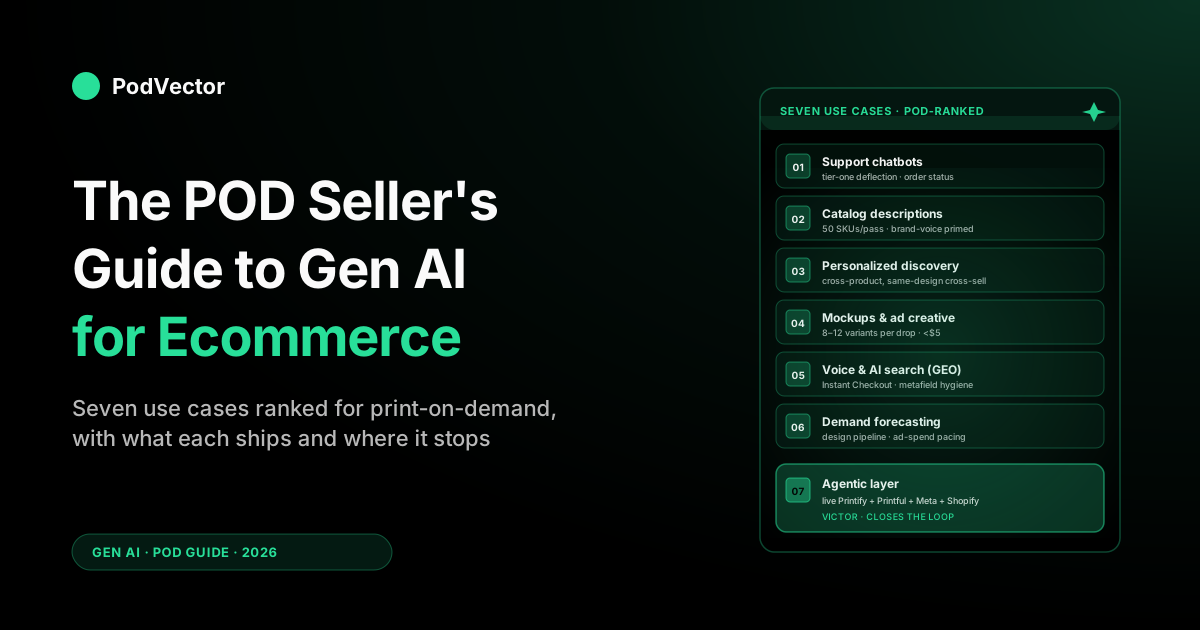
Quick Answer: Gen AI for ecommerce in 2026 has settled into seven use cases that actually pay back for a print-on-demand store: AI chatbots for tier-one support, bulk product descriptions, personalized product discovery, visual generation (mockups, ad creative, and virtual try-on), voice and visual search, demand forecasting and AI-driven pricing, and the agentic layer that turns generated content into action against live data.
The catch unique to POD is per-variant production cost — the same use cases that work for a DTC brand work differently for a store with 1,500 SKUs across eight Printify and Printful base products. Industry benchmarks put the upside at up to a 15% revenue lift and a 30% gain in marketing ROI, but those numbers assume the content layer is wired to real unit economics.
This guide covers each use case with what it ships, what it costs, where it breaks, and how POD operators sequence them.
What "gen AI for ecommerce" actually means
Gen AI — short for generative AI — is the category of models that produce new content from a prompt: text, images, audio, video, structured data. For an ecommerce store, that surface area maps to seven recurring jobs: writing copy, generating images, answering customer questions, ranking products for shoppers, predicting demand, optimizing prices, and (the 2026 step-change) executing multi-step workflows on the operator's behalf.
Most coverage of gen AI in ecommerce is enterprise-shaped. Akeneo's five-use-case writeup centers conversational commerce, merchandising, virtual try-on, search, and supply chain. Salesforce's 2026 ecommerce-AI roundup pushes the same list toward agentic commerce and conversational checkout, and McKinsey pegs the productivity opportunity at $660B annually across retail and CPG.
All useful, none of it written for a single operator running a 1,500-SKU print-on-demand store with thin per-variant margins.
This guide is. The seven use cases below are the same ones the enterprise coverage names — translated into what they cost, what they ship, and where they break for a POD seller specifically. If you want the tool-by-tool stack version of this conversation, the companion piece is the POD seller's guide to generative AI for ecommerce; this one is structured around the jobs, not the tools.
Why POD changes the gen AI ROI math
Three structural facts about print-on-demand decide which gen AI use cases pay back fastest, which ones quietly underdeliver, and which ones don't apply at all.
Wide catalog, narrow per-SKU revenue. A typical DTC brand has 30–80 SKUs each generating meaningful per-product revenue, which justifies hand-crafting every product page. A typical POD store has 200–2,000 SKUs across the same handful of designs replicated on tees, hoodies, mugs, totes, and posters, with most individual SKUs selling a handful of units a year. Bulk gen AI on the catalog is not a luxury — it's the only way the long tail ships at all.
Per-variant costs the platform doesn't see. Printify and Printful both charge per-variant production costs that change by base provider, plan tier, and shipping zone. Shopify sees the order; it doesn't see what the variant actually cost to fulfill.
Most gen AI tools cheerfully write copy or recommend products without knowing this — the gap between "AI that writes" and "AI that knows the unit economics" is wider in POD than in any other ecommerce model. The dedicated take on this gap lives in the complete guide to AI analytics for print-on-demand.
Continuous design drops, not seasonal collections. A new design every week, sometimes every day. Each drop needs descriptions across eight product types, a launch email, ad creative, social posts, and updated metafields.
Annualized, that's hundreds of marketing artifacts per operator. Gen AI is the only thing that makes the cadence sustainable; without it the schedule slows or the operator quits.
Those three facts re-rank the canonical use case list. Chatbots, which dominate enterprise gen AI coverage, sit lower for POD than for a DTC brand because POD support volume is more concentrated and lower per dollar of revenue.
Bulk descriptions and visual generation sit higher because the catalog cardinality is structurally higher. Forecasting sits in an awkward middle — useful, but only after the cost-tracking layer is solved. The use cases below are ranked roughly in order of leverage given those constraints.
The seven gen AI use cases that pay back for POD
Each section below covers what the use case ships, the typical tool fit, the realistic monthly cost, and the ceiling — the point at which a generative tool runs out and something else has to take over. The order is leverage-weighted for a single-operator POD store doing $5K–$100K a month.
1. AI-powered customer support chatbots
POD support clusters around three questions: where is my order, does this fit, can I get the design on a different product. AI chatbots handle all three at the tier-one level — answering directly when the question is well-scoped, deflecting to a human when it isn't. The 2026 baseline is conversational, multilingual, and aware of order status through the Shopify or BigCommerce backend.
For a POD store, the chatbot earns its keep on the order-status question alone. A buyer who pays $32 for a Printify hoodie expects the same SLA as a $200 DTC drop, and the production-then-ship lead time (5–14 days) generates a steady stream of "where is my order" messages that don't need a human. The leading apps — HeiChat, Rep AI, Tidio's Lyro — wire into the Shopify order timeline directly and resolve those tickets at 60–80% deflection.
Typical cost: $20–$80/month for low-volume stores, $100–$300/month for stores doing 1,000+ orders/month with branded support flows. Where it breaks: the moment a customer asks anything that depends on per-variant data the platform doesn't expose — "what's the actual print quality on the Comfort Colors tee versus the Bella+Canvas," "why was I refunded $4 less than I paid." Those need either a knowledge base the bot is trained on or a human escalation. The full chatbot landscape is in our comparison of the best AI chatbots for ecommerce, with the POD-specific lens in the POD seller's guide to conversational AI for ecommerce.
2. Catalog-scale product descriptions
The highest-volume gen AI job for POD, by an order of magnitude. A 1,500-SKU catalog where descriptions are templated or empty is a 1,500-page SEO leak. Generative models — ChatGPT, Claude, Gemini, plus the Shopify-native Magic — write paste-ready descriptions at 50–100 SKUs per pass once they're primed with brand voice samples.
The pattern that ships on a POD catalog: pre-load the chat with five descriptions you wrote yourself, supply the product attributes (title, type, colors, sizes, design concept, target buyer), and ask for fifty descriptions at 60–90 words each, plus a 155-character meta description. The output is paste-ready in 2–3 minutes; the human edit pass after takes another 10–15 minutes per batch and is what differentiates your catalog from the visibly-AI-generated competitor stores. Skipping the edit step is the most common reason a POD seller's "I added gen AI to my catalog" post-mortem ends in flat conversion.
For stores running 500+ empty description fields, the bulk Shopify apps (Yodel, Tinyalbert, Smart SEO) wrap this workflow into a one-click catalog pass. Brand-voice fidelity is lower than the manual primed approach, but the time savings on a true bulk first-pass outweigh the quality drop. Typical cost: $20/month for the chat workbench, plus $30–$60/month for a bulk app if catalog scale demands it. Where it breaks: when descriptions are written without seeing which SKUs actually sell.
A description-heavy long tail can rank for traffic that converts at zero margin once Printify cost is netted out — the content layer is blind to that, which is why a profit layer underneath matters. The full bulk-description workflow lives in the POD seller's guide to AI for ecommerce content creation.
3. Personalized product discovery
Gen AI has changed what personalization means in 2026. The 2022-vintage version was "show shoppers products from the same collection." The 2026 version uses LLMs to interpret browsing behavior, past purchases, and free-text inputs (search queries, support chats, product reviews) to surface products a static recommendation engine wouldn't have ranked for that buyer.
For a POD catalog, the leverage is highest at the design-then-product stage. A shopper looking at a "vintage fishing" tee has higher intent for the same design on a hoodie, a mug, and a tote than for an unrelated design on the same tee.
Static "customers also bought" misses this — the cross-product, same-design vector is the natural cross-sell, and an LLM-driven recommender catches it in a way collaborative filtering doesn't. Apps like Rebuy, LimeSpot, and Glood with their LLM-augmented modes ship this pattern out of the box.
The companion play is personalized email. A shopper who bought one design gets a launch email seeded with the new drops in the same niche; a shopper who browsed but didn't buy gets a different recovery sequence.
Klaviyo's AI features and Mailchimp's predictive segments handle this without a separate gen AI layer. Typical cost: $30–$120/month for the recommendation app, free-to-baseline for the email AI inside the platform you already pay for. Where it breaks: personalization is only as good as the data the model sees. POD stores that route ad traffic through a tracking layer with poor identity resolution (Meta-only attribution, no first-party ID) end up with a recommender that personalizes on cold starts. The deeper play here is in the POD seller's guide to AI for ecommerce personalization.
4. Visual and mockup generation
The most economically dramatic gen AI shift for POD. A mockup shoot that used to cost $50–$200 per design and take a week now produces twenty lifestyle scenes per design for under $5 in a single afternoon. The split that works: Printify's or Printful's native mockup generator handles the production-accurate flat lay (free, on-product, exact); Midjourney, DALL-E, and Sora handle the lifestyle and aspirational imagery the native generators don't ship; Canva or Figma handles the composite.
For ad creative specifically, gen AI changes the test cadence. A POD store running Meta ads on a new drop used to test 2–3 creative variants because each variant was hand-built.
With gen AI in the loop, 8–12 variants per drop is the new normal — different lifestyle backgrounds, different model demographics, different angle compositions. The variant count matters more than any single variant's quality; the algorithm finds the winner faster when the option set is wider.
Video is the 2026 frontier. Sora, Runway Gen-3, and Pika produce 10–30 second product videos from a still image and a prompt.
The output is uneven — some clips are ad-ready, most need re-runs — but the cost-per-clip is under $1 and the workflow is faster than booking a videographer. Most POD operators are using video gen AI for Reels and TikTok hooks, not yet for hero ad spend. Typical cost: $10–$30/month for Midjourney or DALL-E, $15–$50/month for video gen if the store advertises on short-form. Where it breaks: hands, text on shirts, and complex symmetry still misbehave often enough that print-file generation remains a human-in-the-loop job.
Virtual try-on is the visual sub-use-case the enterprise coverage now leads with — and POD apparel is its natural home. Gen AI now renders your design on a range of model body types, skin tones, and poses without a photoshoot, so a single "vintage fishing" tee shows on the buyer's likeness before they add to cart.
For POD the payoff is fewer "will this fit / how does it look on a real person" returns, which on a $32 hoodie is the difference between a profitable order and a loss. Try-on apps (Doris, 3DLOOK, the native Shopify AR viewers) handle the rendering; the input they need is the same clean mockup and product attributes the rest of this list already produces. Where it breaks: tight-pattern prints and back-of-garment designs still render unevenly, so treat it as a confidence boost on the hero angle, not a full 360.
AI generates the concept; a designer or you finalize the print file. The image-generation deep dive sits in the POD seller's guide to AI for ecommerce.
5. Voice and conversational search
The use case that gets undersold in most enterprise gen AI coverage and is becoming structurally important for POD specifically. Three distinct surfaces: (1) voice assistants on phones and smart speakers (Alexa, Siri, Google Assistant) where shoppers ask product questions out loud, (2) conversational AI search inside ChatGPT, Perplexity, and Google's AI Overviews where shoppers type free-form product questions and get a curated list back, and (3) visual search, where a shopper uploads a photo of a design or garment and the model returns the closest matches.
Visual search is the surface the current enterprise coverage (Salesforce, IBM) now leads with, and it favors POD's design-led catalog. A shopper who screenshots a "vintage fishing" graphic they saw elsewhere can land directly on your version — but only if your images carry descriptive alt text and your metafields name the design concept, colors, and style. Sparse image data means the model never connects the photo to your SKU.
The POD-specific reason this matters: ChatGPT Instant Checkout, launched in late 2025, lets shoppers complete purchases directly inside the chat. Stores with structured product feeds, populated metafields, and clear shipping turnaround information surface inside ChatGPT's product cards; stores with sparse data don't. The same descriptive hygiene that ranks a product on Google is the descriptive hygiene that surfaces it inside Instant Checkout — but the ceiling is higher in the chat surface because the product pool ChatGPT considers is structurally smaller than Google's.
Generative Engine Optimization (GEO) is the discipline that's emerged around this. The work is mostly the same as good ecommerce SEO — clear titles, specific descriptions, accurate tags, populated metafields, real reviews — applied to a wider set of surfaces. Medium's gen AI in ecommerce roundup covers the underlying mechanics; the POD-specific implementation pattern is to treat your Shopify metafields as the canonical product description for AI-surface discovery, not the human-readable HTML body. Typical cost: $0 (the work is structural, not tool-based) plus the time to populate metafields. Where it breaks: a long-tail catalog where 80% of SKUs have empty metafields will surface 20% of the catalog in AI search. The fix is a one-time bulk population run with a gen AI tool — same mechanic as bulk descriptions.
6. Demand and inventory forecasting
The use case that enterprise coverage frames as the killer app and that POD operators should treat with caution. Generative models trained on historical sales, search trends, and seasonality patterns predict which products will sell when, which feeds inventory ordering, ad spend pacing, and design pipeline planning.
For a traditional ecommerce store with held inventory, that math is high-stakes. Order too much and capital is tied up in unsold stock; order too little and stockouts cost revenue.
Forecasting saves real money. For a print-on-demand store, the inventory question disappears — Printify and Printful hold no inventory — and the forecasting use case shifts. What POD operators actually need is design-pipeline forecasting (which niches are trending, which design styles are saturating) and ad-spend pacing (which creatives to scale, which to cut).
Gen AI is useful for both, in a much narrower way than the enterprise framing suggests. Pasting your last 12 months of sales by design and asking ChatGPT to identify trend lines and saturation curves works well as a thinking aid; it does not work as a deterministic forecast.
The output is a hypothesis to test, not a number to plan against. Tools that integrate directly with Shopify and surface design-level performance trends (Daasity, Triple Whale's AI features, the analytics-native players) do this more reliably because they see the data continuously rather than from a paste. Typical cost: $0–$200/month depending on whether you bolt on a dedicated analytics layer or work from primed chats. Where it breaks: the moment forecasting needs to incorporate Printify or Printful production cost — which is when the question stops being "what will sell" and starts being "what will sell profitably." That's an agentic-analytics job, not a generative one. The deeper take on agent-driven analytics is in the complete guide to AI agents for ecommerce analytics.
Dynamic pricing is the optimization sub-use-case the current enterprise coverage (Salesforce, IBM, BCG) now leads with — gen AI repricing thousands of SKUs in real time against demand, competitor prices, and inventory signals. For POD it's the use case to treat with the most caution, because the input every consumer repricer is blind to is the one that decides whether a price is profitable: per-variant Printify and Printful production cost, which moves by base provider, plan tier, and shipping zone. A blind repricer that "optimizes" a $32 hoodie down to chase a competitor can quietly push it below its own fulfillment cost. The only safe POD repricing is margin-aware — and that means the pricing engine has to read live supplier cost, not just the Shopify retail price and a competitor feed. Same boundary as forecasting: gen AI proposes the move, but the decision needs the cost layer underneath it, which is an agentic-analytics job.
7. The agentic layer: gen AI that takes action
The 2026 step-change. The previous six use cases all describe gen AI generating output: a description, a chatbot reply, a recommendation, an image, a search answer, a forecast. The agentic layer describes gen AI taking action against your live data: reading orders, joining them to costs, drafting bulk updates, queuing ad pauses, scheduling inventory orders.
By mid-2026, AI tools for POD sellers are more than a chat window. Victor can act like a real helper: he checks your Printify costs against your Shopify orders, finds the products that are losing you money, writes new descriptions for better options, and lines up the price changes for you to approve with one click.
For the use cases above, the agentic layer is what closes the loops the generative-only versions leave open. A chatbot that today escalates "where is my order" to a human can tomorrow look up Printify's production status, calculate the realistic ETA, and respond.
A description workflow that today writes generic copy can tomorrow check which variants are highest-margin and emphasize those in the body. A forecasting tool that today produces a hypothesis can tomorrow execute the inventory or ad action that follows from it.
The PodVector AI positioning bet is that the agentic layer is where POD-specific AI lives. Victor today reads Printify and Printful invoices live, joins them to Shopify orders, layers in Meta and Google ad spend, and answers profit questions in plain English.
Asked "which variants on my Premium-tier Printify SKUs are losing money this month after Meta spend," ChatGPT explains how you'd figure that out; Victor returns the variants. The employee roadmap takes the obvious next step — Victor not just answering the question but executing the bulk update, queuing the ad pause, drafting the variant retire-list for approval. The full take on what this looks like for POD is in the POD seller's guide to AI solutions for ecommerce.
How POD operators sequence these in the first 90 days
The seven use cases above are not equally urgent. A workable order for a single-operator POD store, by week:
- Week 1 — descriptions. Pick one general-purpose chat (ChatGPT Plus or Claude Pro), build a primed prompt with five sample descriptions in your voice, run a one-pass cleanup of empty or templated descriptions across the catalog. Highest immediate ROI; sets the floor for everything that follows.
- Week 2 — visual content. Subscribe to one image generator (Midjourney is the safe default). Build a small library of lifestyle scenes per niche; reuse across drops. Replace the manual mockup-shoot line item from your monthly costs.
- Week 3 — chatbot. Install one chatbot app (HeiChat or Rep AI for most stores; Tidio's Lyro if you already use Tidio). Hook into Shopify order data, write three to five canned escalation flows, leave the rest to default behavior.
- Week 4 — metadata and GEO. Run a bulk metadata population pass (Tinyalbert or Smart SEO) so the AI-search surface picks up your products. This is the GEO investment that pays back across both Google and ChatGPT Instant Checkout.
- Weeks 5–8 — personalization and email. Turn on the AI features inside Klaviyo or Mailchimp. Install one recommendation app if cross-product, same-design recommendations aren't already firing.
- Weeks 9–12 — profit layer. Connect a tool that reads Printify, Printful, and ad spend live, so the descriptions you wrote, the ads you ran, and the recommendations you serve are all judged against unit economics rather than just revenue. This is the loop-closer for everything above.
Total monthly spend at the end of 90 days: $80–$200, depending on which volume tiers you're in. Total operator time saved per week: 6–10 hours. The payback is rarely smaller than that; it's frequently larger. The full vendor-by-vendor picture is in our comparison of the best AI for ecommerce.
Common gen AI mistakes POD sellers make
Treating generative output as finished work. Drafts are 80% there; the last 20% is the brand-specific edit. Skipping that step ships the same beige content every other AI-using seller is shipping. The edit is where the differentiation lives.
Stacking five overlapping AI apps when one would do. Each app is a separate subscription, a separate UI, and a separate point of failure. Pick the app that addresses your single biggest volume problem; do the rest in your general-purpose chat. Tool-switching overhead almost always exceeds the marginal model-quality gain.
Asking a generative tool for store-specific numbers. ChatGPT, Claude, Magic — none of them can see your store. Every answer they give about your data is a hallucination unless you pasted the data in seconds before, and that data is stale on the next order. Use them for the work that doesn't depend on live numbers; use a connected analytics tool for the work that does.
Building a chatbot before the support volume justifies one. A POD store doing 200 orders a month does not need a $200/month chatbot. Saved prompts in your general-purpose chat handle that volume tier; the chatbot earns its keep at 1,000+ orders/month or when support is the recurring bottleneck.
Generating mockups but not using them as ad variants. The cost gain from gen AI mockups is real; the value gain only lands if you're actually feeding the extra variants into your ad creative test cycle. Sellers who generate twenty lifestyle scenes and use one are leaving the leverage on the table.
Ignoring AI search and Instant Checkout because "my customers don't shop in chatbots yet." Today, mostly true. Eighteen months from today, less true. The cost of being listed is near zero; the cost of being late to the channel is being absent from a discovery surface competitors have ranking history in.
Confusing generative with agentic. Different categories with different jobs. Don't expect ChatGPT to answer profit questions; don't expect a profit agent to write your ad copy. Stack them, don't substitute.
FAQs
What is gen AI in ecommerce?
Gen AI in ecommerce refers to generative AI tools that produce content, recommendations, or actions for an online store — product descriptions, marketing emails, customer chat replies, mockups and visual content, personalized recommendations, demand forecasts, and (in 2026) agentic workflows that read live store data and execute multi-step actions. The category includes general-purpose chats (ChatGPT, Claude, Gemini), image generators (Midjourney, DALL-E, Sora), platform-native AI (Shopify Magic, Sidekick), and the third-party app ecosystem.
How is gen AI different from generative AI?
They mean the same thing — "gen AI" is just the shorthand. Both refer to AI models that generate new content (text, images, audio, video) from a prompt, as distinct from analytical AI that classifies, predicts, or recommends from existing data. The blur in 2026 is that gen AI models are increasingly used for analytical jobs too, so the category boundary is softer than it was in 2023.
What are the most common gen AI use cases for ecommerce?
Across enterprise and SMB ecommerce, seven recur: AI customer service chatbots, bulk product descriptions, personalized product discovery, visual generation (mockups, ad creative, and virtual try-on), voice and visual search, demand forecasting and dynamic pricing, and the emerging agentic layer that takes actions against live data. For print-on-demand specifically, descriptions and visual generation tend to deliver the highest ROI because the catalog cardinality is structurally higher than DTC.
Will gen AI work for a print-on-demand store the same way it works for DTC?
No, and the differences matter. POD has wider catalogs (200–2,000 SKUs vs 30–80), per-variant production costs that the platform doesn't see, and continuous design-drop cadence.
That re-ranks the use cases: bulk descriptions and visual generation are higher-leverage for POD; chatbots are lower-leverage at small order volumes; forecasting needs to account for production cost rather than inventory cost. The seven use cases work, but in different orders and at different scales than the enterprise gen AI literature implies.
Can gen AI see my Printify or Printful production costs?
No. Standalone generative tools (ChatGPT, Claude, Midjourney) and platform-native AI (Shopify Magic, Sidekick) have no native connection to Printify or Printful. You can paste data in for a one-off analysis, but it goes stale on the next order. Continuous, live access to production cost joined to Shopify orders and ad spend is an agentic-analytics job — a tool that connects directly to the supplier APIs, not a chat that depends on what you paste in.
How much should a POD seller budget for gen AI tools per month?
$50–$200/month for most single-operator POD stores. That covers one general-purpose chat ($20), one image generator ($10–$30), one bulk-content or SEO app ($30–$60), and a chatbot if support volume justifies it ($20–$80).
Stores past $50K/month in revenue tend to add a profit-analytics layer, moving the total toward $200–$400. Spending more without a corresponding revenue tier usually means tool sprawl, not real leverage.
What is generative engine optimization (GEO) and does it matter for POD?
GEO is the discipline of structuring content so it surfaces in AI-generated answers (ChatGPT, Perplexity, Google's AI Overviews), not just traditional search results. For POD, GEO mostly converges with good product hygiene: clear titles, specific descriptions, populated metafields, real reviews, transparent shipping turnaround.
The same investment that ranks a product on Google ranks it inside ChatGPT Instant Checkout. The surface area is wider in 2026 than it was in 2024.
Can gen AI predict which POD designs will sell?
It can produce hypotheses, not deterministic forecasts. Pasting 12 months of sales into a chat and asking for trend lines and saturation curves works well as a thinking aid; the output is a starting point you'd then test, not a number you'd plan inventory against. For continuous, data-grounded forecasting, the integration approach (Daasity, Triple Whale, or a Victor-style agentic analytics layer) is more reliable than primed chat sessions.
Can gen AI handle dynamic pricing for a POD store?
Only with the cost layer wired in. Gen AI repricing tools adjust retail prices in real time against demand, competitor feeds, and inventory — useful for held-inventory retailers, risky for print-on-demand. The reason: a consumer repricer sees your Shopify retail price but not your per-variant Printify or Printful production cost, so "optimizing" a price downward to match a competitor can push a SKU below what it costs you to fulfill. Margin-aware repricing — where the engine reads live supplier cost before it moves a price — is an agentic-analytics job, not a standalone generative one. Use gen AI to propose price tests; judge them against reconciled unit economics.
Are AI-generated product descriptions safe to publish on Shopify or Etsy?
Yes, with the standard caveat. Google and Shopify treat AI-generated content as acceptable when it's helpful, accurate, and meets the same quality bar as human content.
Etsy has stricter sourcing requirements (your design must be human-made, but your description can be AI-assisted). The risk is publishing low-effort, generic AI content at scale without a brand-specific edit pass — same rule that's always applied to human content.
What's the difference between gen AI and agentic AI for ecommerce?
Gen AI generates content — text, images, audio, recommendations. Agentic AI takes actions against live data — reads orders, joins them to costs, executes multi-step workflows.
The distinction matters because they answer different questions. Gen AI answers "write me a description for this product"; agentic AI answers "which products are losing money this month and what should I do about it." Most POD stores need both.
Generative for the content layer, agentic for the decision layer. The full picture across surfaces sits in our AI overview cluster, with the broader index on the AI analytics topic hub.
Gen AI ships the content. Victor closes the profit loop.
Gen AI is the right tool for the content surface of a print-on-demand store — descriptions at scale, drop emails, mockups, ad creative, support chat, GEO metadata. It cannot see your Printify production costs, your Printful shipping tiers, or your Meta and Google ad spend, which is where POD profit actually lives. Victor reads those systems live, joins them to your Shopify orders, and answers profit questions in plain English against the reconciled dataset. Pair gen AI for the writing, Victor for the decisions.
Try Victor free