
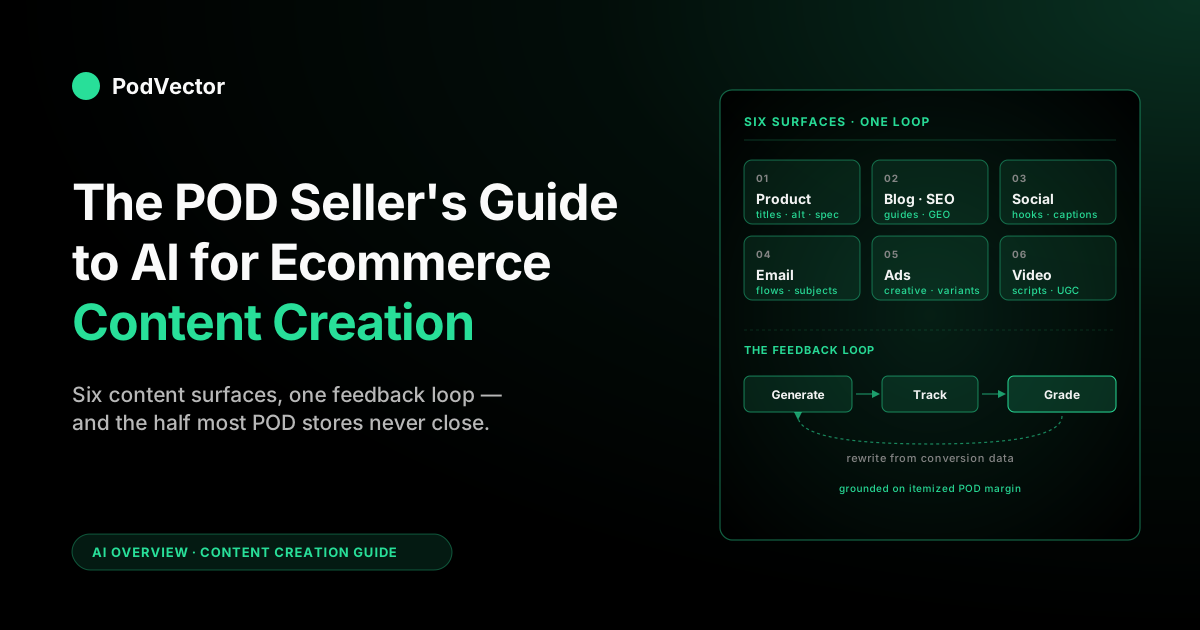
Quick Answer: AI for ecommerce content creation in 2026 is no longer "an AI writer" — it's a stack of generation, transformation, and grading tools that touch every surface a shopper sees: product pages, blog posts, social captions, email flows, ad copy, and short-form video scripts. For a print-on-demand operator running 300–2,000 designs across multiple suppliers, the question stops being "can AI write a description" and becomes "can AI produce consistent, on-brand content across six channels and tell me which version actually converted." That's the angle most generic 2026 guides skip, and it's the one this guide is built around.
What "AI for ecommerce content creation" actually means in 2026
Three years ago the phrase meant one thing: a tool that generated product descriptions or blog posts from a prompt. That category still exists and now sits at the bottom of a much larger stack. In 2026 "AI for ecommerce content creation" covers any system that produces, transforms, or grades any of the words, images, video, or audio that ends up in front of a shopper — from the product page to the meta ad to the post-purchase email to the TikTok hook.
The shift from "AI writer" to "AI content stack" is the most important thing to internalize before you spend money on a tool. The second wave of platforms — what Clarity Ventures' 2026 platform roundup describes as "multimodal" — pull written copy, image generation, video scripting, and voice into a single brand context. The third wave, just emerging, also reads back from store performance data and feeds the result into the next generation pass.
For an ecommerce operator, the working definition that survives contact with a real workflow is: any AI system that turns structured store data — products, orders, customers, ad performance — into channel-ready content, then tells you which version actually moved revenue. Generation alone is no longer the interesting part; it's been commoditized.
The grading and the loop are where the leverage lives in 2026. The broader category framing sits in the AI Overview cluster hub; the analytics-side anchor sits in the AI Analytics topic hub.
The six content surfaces AI now touches
Useful framing before you pick a tool. AI for ecommerce content creation isn't one workflow — it's six, each with its own intent, audience, and quality bar.
Product content
Titles, descriptions, alt text, FAQ blocks, product specs, structured data. The original AI use case for ecommerce and still the highest-volume surface for POD operators. The depth of how this changes for print-on-demand sits in the AI for ecommerce product content creation guide — variant fan-out, supplier-aware language, and locked-policy sections are the parts most generic tools miss.
Blog and SEO content
How-to articles, buying guides, comparison posts, glossary pages, listicles. Shorter than a few years ago, more structured, more answer-oriented because of generative-engine optimization (GEO). For POD sellers, this is the surface that drives top-of-funnel discovery — design-niche content that ranks for "[niche] gift ideas" and pulls cold traffic into the catalog.
Social content (organic)
Captions, hooks, carousel scripts, hashtag sets, comment-reply drafts, video voiceovers. The fastest-growing AI surface in ecommerce because the cadence demand is brutal — three platforms, daily posting, six format variants per asset is the modern social baseline. AI handles the repurposing-from-one-asset-to-five problem cleanly; it handles the original-creative-hook problem less cleanly.
Email and lifecycle content
Welcome flows, abandoned cart, post-purchase, browse abandonment, win-back, broadcast campaigns. AI now generates the full sequence — subject lines, preheaders, body copy, plain-text variants — from a campaign brief. The win is consistency at flow level rather than one-off email writing.
Ad creative and copy
Static and video ad scripts, primary text variants, headlines, descriptions, landing page hero copy. AI variant generation here is a force multiplier because Meta and Google both reward creative volume in 2026. The trap is generating ad copy that doesn't match the product page, which is where the conversion gap usually opens.
Video and short-form scripts
The newest surface and the one most operators are still figuring out. AI now writes TikTok hooks, generates Reels scripts from product features, drafts UGC-style voiceovers, and outputs YouTube Shorts plans. The quality threshold is still operator-dependent, but the script-and-hook generation work is genuinely faster than manual.
Most "best AI tools for ecommerce" lists cover one or two of these surfaces deeply and skim the rest. The honest answer is that no single tool wins all six in 2026 — most operators end up with a stack of two to four, and the integration between them is the thing that breaks first.
Why ecommerce content creation is different
Generic AI content guides — written for marketers, agencies, or content teams — assume a small number of pages, infrequent updates, and single-channel publishing. Ecommerce inverts every one of those assumptions, which is why the playbook has to be different.
Volume and update cadence
A typical ecommerce store is publishing more product pages, social posts, and ads in a month than most marketing blogs publish in a year. The bottleneck is rarely "write one good piece"; it's "write a thousand consistent pieces." This is the volume regime AI was structurally built for, and it's also the regime where bad AI content does the most invisible damage — generic copy on one page is a non-issue, generic copy on 800 pages is a search-visibility problem you only notice three months in.
Direct revenue attribution
Every piece of ecommerce content has a measurable revenue contribution. A blog post drove $X in attributed sessions.
An email subject line drove $Y in clicks-through to revenue. An ad headline produced $Z in conversion-value.
Generic content marketing operates on engagement metrics; ecommerce operates on revenue, which means content that doesn't convert is content that lost money. AI content that ships fast but converts poorly is a more expensive failure than slow human content that converted.
Multi-channel consistency
The same product needs a 60-character meta title, a 160-character meta description, a 300-word product description, a Pinterest pin caption, a Facebook ad headline, an email blurb, and a TikTok hook. Each surface has different length and tone constraints.
The operator needs all of them to read as the same brand. AI tools that generate each in isolation produce drift; tools that work from a single brand context produce coherence. The latter cost more and they pay for themselves on the consistency alone.
Structured data and GEO
Ecommerce content has to be machine-readable in a way generic content doesn't — product schema, FAQ schema, HowTo schema, review schema, breadcrumbs. Generative engine optimization (the practice of structuring content so AI search engines surface it) weights these surfaces heavily, and AI generation of structured data is genuinely faster than hand-coding it. The generative AI for ecommerce guide walks through this layer in more depth.
Why POD content has different constraints again
Even within ecommerce, print-on-demand is its own animal. Three structural reasons the playbook diverges further.
Catalog churn at design speed
A working POD operator adds five to fifty new designs per week, and each design fans out into 8–20 product variants. That's the publishing cadence the content workflow has to absorb.
The boutique-apparel-brand model assumed in most SaaS demos — quarterly drops, photographed product shoots, hand-written copy — doesn't survive contact with a real POD store. The volume forces AI; the volume also amplifies any AI failure mode.
Multi-supplier reality
Most operators run Printify and Printful in parallel for cost or quality reasons covered in the complete AI tools guide for POD sellers. The supplier choice changes shipping language, material descriptions, country-of-origin claims, and size-chart wording.
Generic AI content tools generate one description per product without knowing which supplier fulfills it. The result is wrong shipping language on half the catalog, which kills conversion at checkout when the shopper notices.
Margin sensitivity that punishes generic content
POD margins are tight. A $24 t-shirt with a $12 supplier cost and $4 ad spend leaves $8 of contribution margin.
That margin doesn't tolerate the cost-per-acquisition inflation that comes from generic, undifferentiated content. AI content that's "good enough for a wholesale brand" is rarely good enough for POD, where each conversion has to clear a higher bar to be profitable. The complete AI analytics guide for print-on-demand covers the math; the operational consequence is that POD content has to be tighter than other ecommerce content to stay in the green.
What AI handles well across surfaces
The honest list of where AI in 2026 is genuinely better than a tired solo operator at 11pm.
Volume work from structured input
This is the killer use case across every surface. Feed AI a structured prompt — design metadata, audience, tone, three required keywords, banned-words list — and it returns a clean asset for every variant, every channel, every cadence. The 50–80 hours per month a small operator was previously losing to copy work collapses to 4–8 hours of brief-writing and review.
Format transformation from one source asset
One product description becomes a Pinterest pin, an Instagram carousel script, a TikTok hook, an email subject line, a Google Shopping snippet, and a meta-ad headline. Doing this manually is grinding work; doing it with AI takes seconds and the consistency improves at multi-platform output because the source is the same. Repurposing is where the per-tool ROI math closes for most operators.
Variant generation for testing
Ten subject-line variants. Twenty ad-copy variants. Fifteen TikTok hook openings. Generating these manually is the bottleneck on creative testing; AI removes the bottleneck. The downstream win is data — more variants in test means faster signal on what actually wins, which closes the loop on creative strategy.
Alt text and structured data at catalog scale
Alt text is the most under-invested content surface in ecommerce. Most POD stores have thousands of product images with no alt text.
Modern multimodal models generate alt text directly from the image, optionally grounded on the product title. This ships an accessibility win, an SEO win, and a GEO win in a single pass. FAQ schema, HowTo schema, and review-snippet schema are similarly mechanical work AI handles well.
Translation and localization
Multi-language stores were prohibitively expensive to maintain at content level. AI translation for product content, descriptions, and email — with brand-voice grounding — is now usable for everything except policy and legal language. The unlock for POD is opening EU markets without committing to a localization team.
Audience and segment personalization
The capability most generic 2026 guides lead with: generating a different version of the same asset for a different audience — gift-buyers versus repeat customers, US versus EU, cold ad traffic versus email subscribers. AI produces segment-specific product blurbs, email variants, and ad angles from one design seed in seconds, which is work an operator could never do by hand at catalog scale. The caveat for POD is that personalization is only worth the spend once you can measure which segment-specific variant converted — generating ten audience versions and shipping them blind just multiplies the publish-and-forget problem. Personalization and grading are the same loop seen from two ends.
Content briefs and outlines for human writing
Where AI under-performs as a finisher, it over-performs as a starter. SERP analysis, outline generation, FAQ extraction, competitor-coverage gap analysis, and structured-brief writing are all faster with AI than without. The human writer ships better content from a strong AI brief than from a blank page.
Where AI quietly underperforms (and costs margin)
The losses are rarely visible at the moment. Bad AI content reads fine in isolation; the cost shows up as drift over months. Six failure modes worth knowing.
Generic, undifferentiated voice across the catalog
Default AI output reads the same on every brand: "Crafted with premium materials. The perfect addition to any wardrobe.
Whether you're heading out or staying in." Shoppers learned to skim past this in 2024. Worse, when the same generic voice appears across hundreds of pages on your site, search engines now recognize the pattern and discount it. The fix is brand-voice grounding, not switching models.
Hallucinated product specs and supplier facts
Ask a general-purpose model about a Bella+Canvas 3001 and it confidently invents the GSM, cotton percentage, country of origin, and "ringspun" claims that may or may not be true for the specific variant. When wrong claims end up on the product page, the cost compounds — refund + restocking impossibility + ad-spend wasted on the click. Never let generation happen without grounding on the supplier's actual spec sheet.
Channel mismatch between ad and product page
The Meta ad promises a "vintage retro fade." The product page describes a "modern, vibrant print." The conversion gap from this mismatch is enormous. AI ad-copy generators that read from the product description (instead of from the product title alone) avoid this. Most operators don't enforce that rule and pay for it in ad efficiency.
Keyword stuffing inherited from old training data
Many AI writers were trained on copywriting from the era when keyword density mattered. Left alone, the model still over-uses primary keywords, repeats brand terms unnaturally, and produces text that pattern-matches as "SEO content" to both shoppers and modern ranking systems. The fix is grounding on your existing well-performing pages, not relying on the model's defaults.
Drift on policy, legal, and shipping language
Return policies, IP claims, shipping zones, and care instructions need to be exact and consistent. AI happily rewords these unless you explicitly lock them. The fix is keeping policy text in non-AI fields or templating systems with locked sections that the generation step never touches.
Publish-and-forget with no feedback loop
The most expensive failure mode and the easiest to overlook. Content gets generated, shipped, and never graded against actual performance.
The second batch of content has the same flaws as the first. The stores compounding their content investment in 2026 are the ones reading conversion data back into the prompt; the stores that aren't are paying an AI subscription to publish content that may or may not be working and never knowing which is which.
The tools worth evaluating in 2026
Not exhaustive — opinionated. The tools that show up most often in real POD content stacks.
Catalog-grounded text generators
Hypotenuse AI is the one to beat for high-volume product description generation. It pulls from your existing catalog, learns brand voice from a sample, and handles bulk operations cleanly. Describely is the closer alternative with stronger Shopify-native workflow. Both are built for the operator with thousands of products, not the brand with fifty.
General-purpose writers used for blog and social
Jasper, Copy.ai, Writer, and ChatGPT (with the Shopify connector) cover the surfaces where structured catalog grounding matters less and brand voice matters more. The ChatGPT for Shopify guide covers the specific workflow when ChatGPT is the chosen tool.
Image and mockup AI
For the design itself: Midjourney, Ideogram, Adobe Firefly, DALL·E. For lifestyle mockups: Photoroom, Pebblely, and the Shopify-native mockup tools. The deeper comparison sits in the best AI art generator for print-on-demand comparison. Most operators run two tools — one for design, one for mockup — until orchestration matures.
Email and lifecycle AI
Klaviyo's AI features (subject-line generation, send-time optimization, content blocks) cover most POD operators. Omnisend offers similar functionality on the cheaper end. Standalone copywriting tools fill the gap on broadcast campaigns where flow-level grounding matters less.
Ad-copy and creative AI
Pencil, AdCreative.ai, and the new wave of generative ad platforms produce static and video ad variants from a product feed. Quality is now competitive with manual variant generation, and the sheer volume unlock matters more than any single ad's polish.
Shopify-native AI
Shopify Magic and the Sidekick suite cover the lowest-effort path for product descriptions, alt text, and section copy directly inside the admin. Quality is competitive with standalone tools for routine work. The longer comparison sits in the Shopify Magic features guide.
Operator-side AI that grades content performance
The gap most "best AI tools" lists miss. Generation is half the loop; the other half is knowing which generated content actually drove revenue and which didn't.
POD-aware analytics agents — Triple Whale's Moby for generic ecommerce, Victor for POD specifically — read live store data and answer "which of these descriptions, ads, and emails converted." This turns content from a one-way output into a feedback loop. More on this in the analytics-loop section.
A multi-surface content workflow that scales
The operational pattern that holds together at 1,000+ designs across six content surfaces without burning the operator out. Adjust to taste; the structure is the part that matters.
Step 1: lock the brand voice in a single source of truth
One document. Three to seven adjectives describing the voice.
A do-and-don't list with five examples each. Three reference samples that exemplify the voice — one product description, one ad copy, one email.
Banned phrases (the generic "perfect for any occasion" set). This document goes into every prompt. If you nail it once, never let an AI tool generate copy without it.
Step 2: design metadata is the input, not the product
Every design gets a metadata record before any product is created: theme, style, target audience, primary keyword, three secondary keywords, and a one-sentence description in your voice. This becomes the seed for every text and image asset across every surface. Skipping this step is what causes near-duplicate content across variants and channels.
Step 3: surface-specific generation from the same seed
Product descriptions, ad copy, social hooks, email blurbs, and blog content all generate from the same design metadata, with surface-specific instructions layered on top. The tool varies; the seed doesn't. The result is consistency that no amount of one-off generation produces.
Step 4: locked sections for policy, shipping, and legal
Return policy, IP language, shipping zones, care instructions, size charts, and any compliance-sensitive copy is templated and never regenerated. The AI fills the body around them. This is the failure mode most operators only catch after a refund dispute.
Step 5: human review on a sample, ship the rest
Review every tenth product description in detail. Spot-check the rest with a search-and-replace pass for known failure patterns ("perfect for any occasion," "crafted with premium," brand-name misspellings). Same pattern for social, ads, and email — sample-based review at a defined cadence beats the 100% review approach that doesn't survive month two.
Step 6: feedback from store performance back into the prompt
Once content is live, the analytics layer grades it against actual conversion and ad-efficiency data. Top-performing patterns get folded back into the brand-voice document. Under-performing patterns get added to the don't list. This is the loop that distinguishes serious POD content operations from the ones that publish and forget.
Holding brand voice across six surfaces
The hardest part of multi-surface AI content isn't generating volume — it's keeping the volume sounding like the same brand. The same survey data that powers the "AI content all sounds the same" objection also shows that well-grounded AI content is functionally indistinguishable from human content in blind tests. The variable is the grounding, not the model.
Three practices keep voice intact at scale. First, the brand voice document mentioned above is the floor — it goes into every prompt with no exceptions, regardless of surface.
Second, build a five-shot example pack: five samples you wrote yourself that exemplify the voice perfectly across different surfaces (one product description, one ad headline, one email subject line, one social caption, one blog opener). Append them to every prompt.
The model pattern-matches more reliably from examples than from instructions. Third, review and rotate the example pack quarterly so the voice evolves with the brand instead of fossilizing in 2026.
The operators who get this right tend to ship two to three times the volume of the operators who don't, with measurably stronger conversion on the resulting assets. The ones who skip the grounding ship faster for two weeks and watch search visibility, ad efficiency, and email engagement erode for the next three months.
Closing the loop: content → conversion → strategy
This is the section the SERP doesn't cover and the one most operators are leaving on the table. AI for ecommerce content creation is usually framed as a one-way pipeline: generate, ship, done.
The pipeline is incomplete. Without a feedback loop, you're spending an AI subscription to publish content that may or may not convert and never knowing which is which.
The loop, properly closed, has three stages. Generation produces the asset. Tracking captures which version converted, on which traffic source, against which itemized margin (supplier cost, shipping, fulfillment fees, ad spend). Analysis grades the asset and feeds the result back to the generation step — usually as updated brand-voice instructions, banned-phrase additions, or a refreshed example pack. The third stage is where most stacks fall apart, because it requires reading live data from Shopify, Printify, Printful, and the ad platforms together — and most analytics tools don't.
The deeper version of this argument lives in the AI for ecommerce overview, but the short version is: an analytics agent that reads itemized supplier costs and ad spend can answer "which of these AI-generated assets actually made money," which is the question that decides whether your content investment compounds or evaporates. The AI agents for ecommerce analytics guide covers the agentic side of how that loop closes; the AI for ecommerce business overview walks through the broader business case.
Today's analytics agents (Victor included) answer those questions on demand. The employee roadmap over the next 12–18 months is for the same agent to execute the rewrite — flag underperforming content, regenerate it with the updated voice, and push it back to the store and the ad platforms. The hand-off from "AI that writes" to "AI that decides what to rewrite, then writes" is where this category goes next.
Mistakes POD operators make with content AI
Treating "the AI did it" as the QA pass
Every shipped piece of content is a brand commitment. AI-generated content needs the same review threshold as the operator-written content it replaces, just at a different cadence (sample-based, not every asset). Skipping QA for speed is how the catalog drifts into generic-sounding within three months.
Buying every category instead of the missing one
An operator with great descriptions and bad ads buys another description tool. Pick the missing piece, not the more-of-the-same piece. The six surfaces are six different products with different ROI profiles.
Letting different surfaces drift apart
The product description says one thing, the ad says another, the email says a third. Each is fine in isolation; the cumulative effect on the shopper is incoherence and a conversion drag that's hard to attribute. Single-source-of-truth metadata fixes this; nothing else does.
Skipping image alt text because the platform doesn't enforce it
The most under-invested content surface in ecommerce and the easiest to fix at catalog scale with AI. GEO weights alt text more than it did 18 months ago. A one-time pass to backfill alt text across the entire catalog is one of the highest-ROI uses of AI in the store.
Generating ad copy that doesn't match the product page
The Meta ad promises a vintage print; the product page describes a modern design. The conversion gap is large and the fix is to feed the ad generator the actual product description, not just the title. Most generic AI ad tools take only the product title.
Never closing the loop
The biggest one. Content is generated, shipped, and never graded. Without a feedback path, the second batch has the same flaws as the first. The compounding stores are reading conversion data back into the prompt; the others are publishing into the dark.
FAQs
What's the best AI tool for ecommerce content creation in 2026?
There's no single answer because the category splits across six surfaces. For high-volume product descriptions, Hypotenuse AI and Describely lead.
For blog and social, Jasper, Copy.ai, and ChatGPT cover most use cases. For mockup and lifestyle imagery, Photoroom and Pebblely lead.
For email, Klaviyo's AI features are competitive. For ads, Pencil and AdCreative.ai lead.
For grading what worked, Triple Whale's Moby covers generic ecommerce and Victor covers POD with itemized Printify and Printful cost reconciliation. Most serious POD stores use one tool from at least three of those categories.
Can I run a POD store on 100% AI-generated content across every surface?
Technically yes; profitably no, without grounding. AI content with a strong brand-voice document, locked policy sections, single-source-of-truth design metadata, and sample-based human review is functionally indistinguishable from human-written content and absolutely scales to thousands of products and daily multi-platform publishing.
AI content with no grounding ships faster initially and erodes search visibility, ad efficiency, and email engagement over three to six months. The grounding is the work; the AI is the speed multiplier.
How do I keep AI from making all my ecommerce content sound the same?
Three layers, applied across every surface. First, a brand-voice document with adjectives, do-and-don't examples, and banned phrases — included in every prompt regardless of channel.
Second, a five-shot example pack covering different surfaces (product, ad, email, social, blog) — appended to every prompt. Third, periodic refresh of both based on which content actually convert in your store data. The model is not the variable; the grounding is.
Does AI-generated content hurt SEO?
Google's stated position since 2023 is that the source of content (human or AI) doesn't matter — the quality and helpfulness do. In practice, generic AI content does lose ranking, but not because it's AI; it's because it's generic.
Well-grounded, brand-specific AI content competes on the same footing as human-written content. The POD-specific risk is duplicate content across variants of the same design, which is an AI-amplified version of a problem that existed before AI.
How does AI handle the difference between writing for Etsy, Shopify, and TikTok?
Modern catalog-aware tools take channel as an input and adjust length, tone, and structure accordingly. Etsy listings reward keyword-rich titles and tag-stuffed descriptions; Shopify rewards cleaner product narratives; TikTok rewards short hooks with high attention density.
The brand-voice grounding stays constant across channels; the surface-specific instructions vary. Tools that don't take channel as an input produce content that reads like it was written for the wrong platform.
What's generative engine optimization (GEO) and how does it relate to content?
GEO is the practice of structuring content so AI search engines (Perplexity, ChatGPT shopping mode, Gemini, Google's AI Overview) surface your content in their answers. The mechanics overlap with traditional SEO but weight different surfaces — alt text, FAQ schema, product attributes, structured data, and answer-shaped content carry more weight than they did for traditional rank tracking. AI for ecommerce content creation now routinely produces all of these in one pass; tools that skip GEO surfaces leave visibility on the table.
How do I grade AI-generated content against revenue, not just engagement?
Engagement metrics (clicks, opens, time-on-page) are leading indicators; revenue is the only outcome that matters for a POD store. Grading content against revenue requires reading live data from Shopify, the supplier (Printify or Printful), and the ad platforms together — the supplier cost is what makes POD revenue analysis different from generic ecommerce.
Most analytics tools don't read supplier costs, which means they can't grade content on margin contribution. POD-aware analytics agents (Victor included) handle that reconciliation, which is what closes the content-to-revenue loop.
Will AI eventually replace ecommerce content creation entirely?
The generation step is already 80–90% AI in serious POD operations across most surfaces. The grounding, the QA, the brand-voice direction, the strategic decisions about which surfaces to invest in, and the loop-closing analysis are still human-driven and will be for the foreseeable future.
The next 12–18 months will see AI agents take on more of the analyze-then-rewrite loop — flagging underperforming descriptions, ads, and emails, regenerating them, and pushing the changes — but the operator still sets the brand and decides which signals matter. The trajectory is from "AI as a faster typist" to "AI as a reactive content team," not toward fully autonomous content.
Want the missing half of the AI content stack — the part that grades what converted?
Victor is PodVector AI's AI employee for POD sellers — it reads your live Printify, Printful, Shopify, and ad data and answers which AI-generated descriptions, ads, emails, and social content actually drove margin. No manual COGS entry. Victor turns those answers into rewrites — with your approval over the next 12 months.
Try Victor free