
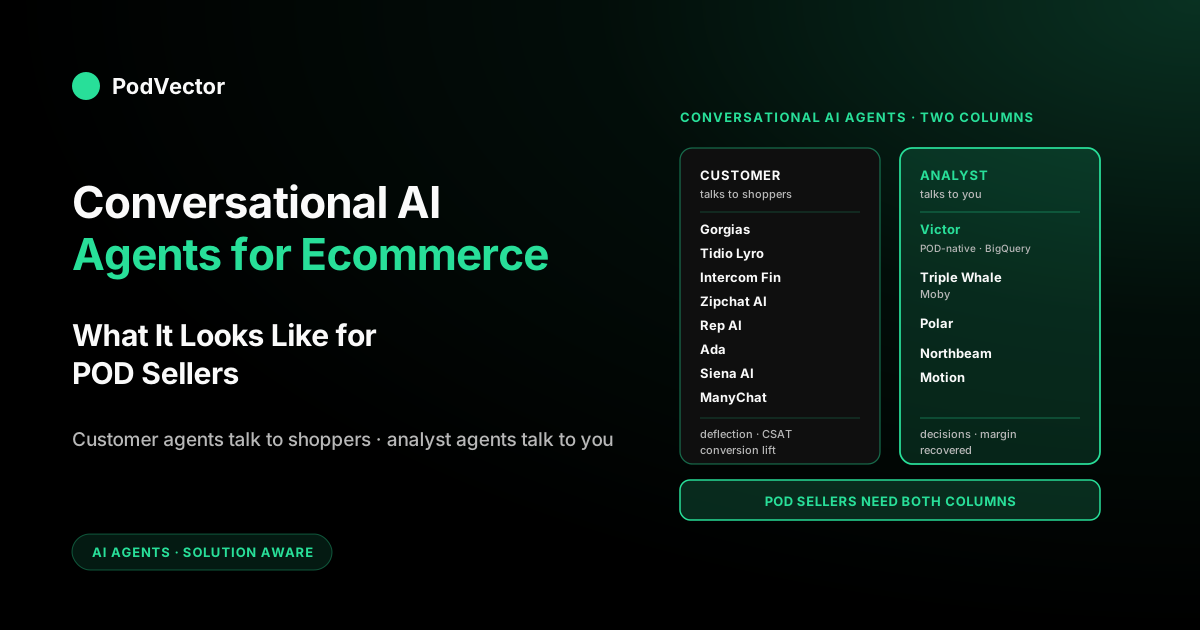
Quick Answer: A conversational AI agent for ecommerce is a chatbot that holds a real dialogue, looks up live data, takes actions on its own, and hands off cleanly when it can't — the four things a 2019-era scripted bot can't do. For a print-on-demand seller, the agents that matter split into two categories: customer-facing agents (Gorgias, Tidio Lyro, Intercom Fin, Zipchat, Ada, Siena) that talk to your shoppers, and AI employees (Victor, Triple Whale Moby, Polar) that talk to you about your business.
Most POD founders pick from one column and assume it covers the other. It doesn't. You need both, sized to MRR, with explicit Printify or Printful awareness wired in.
What "conversational AI agent" actually means in 2026
Three words doing a lot of work. Conversational is how it interfaces with a human — natural-language back-and-forth, not button menus or form fields. AI is what's behind the response — a large language model interpreting intent and generating an answer, not a hard-coded if/else tree. Agent is the part that's new since 2023 — the system can take actions on its own, not just answer questions. It can issue a refund, generate a discount code, look up an order, escalate a ticket, send a follow-up email, or pull a report — all inside the same conversation.
The category sits at the intersection of three older things: customer support chatbots (the scripted kind), conversational commerce assistants (the recommendation kind), and recent agentic systems built on tool-calling LLMs. When a vendor today ships a "conversational AI agent," they're claiming all three layers in one product. About half of them actually deliver on that claim.
Two newer dimensions widened the category in 2026. Voice — the same agent now handles spoken channels (phone, in-app voice), not just typed chat. Multimodal discovery — shoppers search by image or video, and the agent reasons over the visual, not just text. Google's Conversational Commerce agent on Vertex AI (a 2025 Gartner Magic Quadrant Leader for search and product discovery) is shipping image and video search; most storefront vendors are following. For a POD store, voice rarely matters yet, but visual discovery does — shoppers screenshot a design they like and ask "do you have this on a heavyweight tee?"
Adoption is no longer early: more than 60% of shoppers report having used conversational AI to shop, and Shopify stores running a mature conversational agent (Gorgias cites 2.5x) see materially higher conversion on engaged sessions. The question for a POD seller in 2026 isn't whether to deploy one — it's which two to deploy, and how to wire POD context into them.
The other half rebadged a 2021 chatbot with an LLM-powered fallback and called it agentic. Telling them apart before you sign is the whole point of this guide.
For the broader category framing — what makes a system "agentic" rather than just AI-flavored — see our guide to agentic AI for ecommerce and the complete guide to AI agents for ecommerce analytics.
Agent vs chatbot vs assistant — the distinctions that matter
The terms get used interchangeably in vendor marketing. They aren't interchangeable.
- Chatbot. Scripted decision tree. Hands off when it hits a question outside the script. The bar is "respond to a known input." 2019 technology with a 2024 paint job in most cases.
- AI chatbot. Same architecture, but the fallback branch is generated by an LLM instead of a static "I don't understand." Better than a pure script; still fundamentally reactive. Most "AI upgrade" releases from legacy vendors land here.
- Conversational AI assistant. Real LLM-driven dialogue with intent detection, multi-turn context, and grounded answers from your data. It can answer a wider range of questions accurately. It still mostly waits for the human to drive.
- Conversational AI agent. Everything an assistant does, plus tool-calling — the bot independently decides which APIs to invoke (order lookup, refund, discount code, ticket creation, calendar booking) inside the conversation, then reports the outcome. It can complete the task, not just describe how.
For a POD store, the practical difference shows up the moment a shopper says "my order hasn't arrived and it's been three weeks." A chatbot answers "please check your tracking link." An assistant answers "your order shipped on April 1; the tracking shows it cleared customs yesterday." An agent answers "I checked your order — it's stuck in customs. I've issued a $10 store credit, opened a replacement order with priority shipping, and emailed you the new tracking number." Same shopper, three different outcomes, three different repurchase rates.
The customer-facing conversational agents POD sellers shortlist
The shortlist any POD seller will encounter in 2026, drawn from coverage in Fin's roundup, Triple Whale's 2025 ranking, and Crescendo's applications guide — viewed through the POD-specific lens that those sources skip.
Gorgias AI Agent
Shopify-native helpdesk with the most mature conversational agent in the SMB-to-mid-market band. Resolves a meaningful share of tickets end-to-end via tool-calling — refunds, address updates, order lookups, return labels — instead of just deflecting.
Custom actions let you wire in Printify or Printful endpoints, which is mandatory for any POD store that wants accurate shipping ETAs. Pricing $60–$900+/month with AI resolutions metered. Best fit for POD stores doing $100k–$1M MRR.
Tidio Lyro
SMB-friendly platform where Lyro is the agentic layer. Lower price floor ($24–$750/month), forgiving flow builder for non-technical founders, decent multi-turn context on short conversations. Tool-calling exists but is shallower than Gorgias; custom action setup is rougher. Good fit for POD stores under $100k MRR that prioritize install speed over integration depth.
Intercom Fin
Enterprise-leaning support platform. Fin posts the highest deflection rates on large knowledge bases — partly because retrieval is strong, partly because Fin enforces strict grounding and will say "I don't know" instead of hallucinating.
Worth the look for POD brands over $500k MRR with a real help-center corpus. Shopify integration is shallower than Gorgias; expect engineering time on custom POD actions.
Zipchat AI
Shopify-specific conversational agent built post-LLM. Pulls real-time order data, generates discount codes, recommends products from your catalog, and executes tasks during the conversation. Resolution-based pricing. Strong choice for POD stores where the bot is expected to recover carts and close support questions in the same session.
Rep AI
Shopify-native conversational agent positioned as a sales assistant. Tuned for purchase-intent dialogues more than post-purchase support — converts browsing shoppers actively while still handling routine tickets. Often deployed alongside a helpdesk-first agent rather than instead of one.
Ada
Enterprise conversational agent with strong guardrails, compliance tooling, and multi-brand support. Overkill for a single-brand POD store; the right tool if you operate multiple storefronts under one company and need audit trails the SMB platforms don't ship. Six-figure annual commitment in practice.
Siena AI
Empathy-tuned conversational agent built specifically for ecommerce. The conversational quality is among the best in the category — replies feel less robotic than Gorgias or Tidio output.
Tool-calling is solid, integration list is growing, and pricing sits in the mid-tier. Worth a demo for POD brands that have built personality into their voice and don't want a flat support tone.
Netomi, ManyChat, Freshchat, Zendesk AI, Chatfuel, Shopify Inbox, HubSpot Chatflows
These appear across most 2026 roundups. Netomi is enterprise-leaning and overkill below mid-market.
ManyChat is best-in-class on Instagram, Messenger, WhatsApp, and SMS — right pick if your POD sales come primarily through social. Zendesk AI and Freshchat are bundled with broader CRM/support suites; the conversational layer is competent but rarely the reason to buy them on its own. HubSpot Chatflows is the same story inside HubSpot. Shopify Inbox is free, scripted, and fine as a placeholder until you outgrow it. Chatfuel's a Meta-channel option that overlaps heavily with ManyChat.
Platform-level entrants — Google's Conversational Commerce agent on Vertex AI and NiCE Cognigy — bring the strongest discovery and multimodal search, but they're built for retailers with engineering teams, not solo POD founders. Note them as where the category's discovery layer is heading; don't shortlist them for a sub-$1M store.
For side-by-side comparison rather than profile-by-profile review, see our best AI chatbot for ecommerce comparison. For the chatbot-specific framing, see our AI chatbot for ecommerce guide.
The AI employees POD sellers actually need too
Every roundup linked above covers customer-facing agents only. That's a category gap. The other half of the conversational AI agent market — the half a POD operator usually needs more — is AI employees.
An AI employee doesn't talk to your shoppers. It talks to you.
It lives in a Slack channel, a dashboard panel, or an embedded widget, and it answers questions about your business: which campaigns made money this week after Printify costs, which SKUs are losing margin at current promo pricing, what's the reorder rate on the heavyweight tee versus the lightweight one, why is yesterday's revenue flat against last Tuesday. Victor sees your orders, costs, ad spend and profit together, so he can answer these questions right away. This isn't a help center tool; it's built for the founder or ops lead, not support. The goal is decisions made and margin recovered, not ticket deflection.
The vendors here:
- Victor (PodVector AI). AI employee purpose-built for print-on-demand. Victor works out the true profit on every order by putting your Printify and Printful costs, your Shopify orders, and your Meta and Google ad spend side by side. Ask him "which campaign spent more than it earned last week after print and shipping cost?" and he answers in under ten seconds. He's a chat partner, but also an employee who can take action for you — with your approval — like pausing an underperforming ad or changing a product's price.
- Triple Whale Moby. Generalist DTC analyst agent inside the Triple Whale dashboard. Strong on Meta and Google attribution, weaker on POD-specific cost itemization (base cost, print method premium, shipping zone differences) because it doesn't pull from Printify or Printful directly.
- Polar Analytics. Conversational analytics for DTC ecommerce; similar coverage to Triple Whale, with a different attribution philosophy. Same POD blind spot.
- Motion / Northbeam. Both have shipped conversational AI employee layers. Strong attribution depth, no first-class POD cost model.
The usual failure mode: a POD founder reads that conversational AI agents lift ecommerce performance, installs Gorgias or Tidio, then wonders why the bot can't tell them which campaigns are profitable. It can't, because that's not its job.
The customer-facing bot sees catalog and order status; it doesn't see ad spend or itemized fulfillment cost. That's what the AI employee layer is for. More on that split in our complete guide to AI analytics for POD.
The seven use cases that earn ROI on a POD store
Not every conversational agent capability moves revenue equally. The seven use cases below are where POD sellers consistently see payback within 60 days.
1. Order status and shipping ETAs (with supplier awareness)
The single highest-volume support question. On a generic Shopify store, the answer is in the fulfillment field.
On a POD store, the fulfillment field is empty until Printify or Printful ships, which means the bot needs to call the supplier API for production status. Done right, this absorbs 40–60% of inbound tickets. Done wrong, the bot confidently misinforms the shopper and triggers a refund.
2. Sizing and fit guidance
Every POD blank fits differently. A conversational agent that knows which blank each SKU uses (Bella+Canvas 3001, Gildan 64000, Next Level 6210, AS Colour Staple) and surfaces the right size chart in the conversation reduces returns by 10–25% in the first quarter. Generic ecommerce agents don't have this context unless you add it.
3. Cart recovery during checkout hesitation
The agent pops in when the shopper has been on the checkout page for 30+ seconds without progressing. Offers to answer questions about shipping, returns, or pricing; can issue a small discount if the conversation indicates price sensitivity. Conversion lift typically 8–15% on engaged sessions.
4. Returns and exchanges (with print-defect routing)
POD orders don't come back to inventory. The agent has to distinguish a print defect (replacement order, no return shipment, photo evidence requested) from buyer's remorse (refund or store credit, often no return shipment either) and route each to the right policy. Generic platforms default to returnable-inventory logic and need a custom flow.
5. Product discovery and personalized recommendations
For a POD catalog over 200 SKUs, the agent acts as a stylist — "I'm looking for a heavyweight black hoodie with a small chest print, under $50." Conversational discovery converts higher than category browsing for shoppers who don't have a specific product in mind. The 2026 upgrade is multimodal: a shopper uploads or screenshots a design and asks "do you have anything like this?" and the agent matches it against your catalog visually. Octane AI and Rep AI specialize in conversational discovery; the platform-level agents (Vertex AI) lead on image-and-video search.
6. Post-purchase upsell and cross-sell
Two days after delivery, the agent follows up — asks how the shirt fits, suggests a matching color, offers a 10% discount on a repeat order. Soft, conversational, not the email-blast pattern. Repurchase lift varies wildly by category but 5–15% is typical.
7. Operator-side analytics (the AI employee column)
The conversational agent on the operator's side answers business questions in plain English. "Which Printify product had the highest contribution margin last month?" "Which Meta campaign returned more than $1.50 per dollar after print and shipping?" "Why did yesterday's profit drop?" This is what Victor was built for; no customer-facing platform does it.
What POD sellers need that mainstream agents don't ship
Print-on-demand sits inside ecommerce but runs on different plumbing. A conversational agent that looks fine on a Shopify demo will fail in predictable places on a POD store the moment a real shopper asks a real question:
- Supplier-aware shipping ETAs. The agent needs a custom action that reads Printify's or Printful's production status — not just Shopify's empty fulfillment field.
- Variant-aware sizing. The grounding layer needs to know which blank each SKU uses and which size chart to surface for "will a medium fit me?"
- Mockup-vs-reality honesty. POD mockups are CGI renders. An agent that proactively sets expectations about heather color drift and fabric hand outperforms one that over-promises.
- Print-method clarity. DTG, DTF, embroidery, sublimation, all-over print — different durability, color handling, washing behavior. The agent has to map each SKU to its method.
- Refund routing for made-to-order goods. Print defect vs buyer's remorse vs lost in transit — three different policies, one agent has to route them correctly.
- Itemized cost awareness on the operator side. Base cost, print cost, shipping, Shopify fees per order, ad spend by SKU. No customer-facing agent does this. Victor does, and that's why the operator side and customer side are different products.
None of the mainstream conversational agents (Gorgias, Tidio, Intercom, Zipchat, Ada, Siena, Botpress) ship with native Printify or Printful integration. The closest they get is generic Shopify fulfillment context.
That means for a POD merchant, the agent choice is partly about which platform's tool-calling and RAG surfaces are flexible enough to inject POD-specific data without a rebuild every quarter. For the cost-side breakdown that drives operator questions, see our complete guide to Printify costs and complete guide to Printful costs.
How to evaluate a conversational agent in ten minutes
Every vendor's landing page promises agentic AI. The fast way to catch the ones who don't deliver is a five-test demo protocol.
- The menu test. Send an ambiguous opener — "hi i need help with my order" — and see whether the bot responds with a button menu. If it does, it's a scripted bot with AI marketing. Move on.
- The pronoun test. Ask two consecutive questions where the second uses a pronoun — "What sizes does the navy hoodie come in?" then "Is it available in medium?" If the bot doesn't resolve "it" to the hoodie, multi-turn context is broken.
- The grounding test. Ask a question that requires reading data — "when does order 1028 ship?" Check whether the answer references the actual order record or generates plausible-sounding fiction.
- The tool-call test. Ask for an action — "can you give me a discount code for 15% off?" A real agent generates the code via a tool call. A non-agent tells you to contact support.
- The escalation test. Ask something the agent can't resolve — "my package was left in the rain and the print is bleeding." Watch the handoff. Good platforms attach full transcript and tool-call history to the human ticket. Bad ones hand off cold.
Ten minutes per platform. You'll eliminate three out of five before talking to sales. For deeper coverage of how the category is shifting from chat to action, see our guides to AI agents for ecommerce and AI agents for Shopify.
A four-week deployment plan for a POD store
What a realistic rollout looks like — not the "ten minutes to launch" the vendor pitches:
- Week 1 — data audit and platform pick. Audit your product descriptions for variant-awareness, size charts for accessibility, Printify/Printful connection cleanliness. Pick a platform from the shortlist above sized to your MRR. Install the app, connect integrations, import help content as a knowledge base. Don't enable the widget for live shoppers yet.
- Week 2 — flow and tone setup. Build the 5–10 most common conversation flows manually — sizing, shipping, order status, returns, design change requests. Tune the system prompt to match your brand voice. Run the five-test protocol against your own bot.
- Week 3 — POD-specific integration. Wire in Printify or Printful custom actions — production ETAs, defect refund routing, print-method explanations. Budget 1–2 engineering days. This is the work that differentiates your bot from every other Shopify store's.
- Week 4 — limited launch and monitor. Turn the widget on for 20% of traffic. Track conversion lift on engaged sessions, deflection rate, CSAT, and Lighthouse LCP daily. Fix the top three failure modes before scaling to 100%.
In parallel, install an AI employee on the operator side. The customer agent and the AI employee have nothing to do with each other operationally — different data, different surfaces, different rollout — so they can run in parallel without conflict.
Mistakes POD sellers make picking a conversational agent
- Buying on "AI" instead of agentic capability. Every chatbot vendor has an AI checkbox. Not all of them pass the tool-call test. Run it.
- Confusing the customer agent with an AI employee. Different buyers, different ROI math, different data. Don't expect the storefront bot to also answer your margin questions.
- Ignoring grounding depth. A strong model grounded on empty data loses to a weaker model grounded on rich data. 90% of evaluation should be on what data the platform can read.
- Assuming POD awareness is built in. It isn't. You'll build Printify/Printful integration via custom actions or RAG yourself.
- Optimizing for channel count. Every channel is a flow you maintain. Start on your website, get it right, then expand.
- Signing an annual contract before proving ROI. Every serious platform offers monthly. Use it for at least two months before signing for the discount.
- Ignoring Lighthouse impact. Every widget adds weight. Measure LCP before and after; if it regresses more than 0.3s, negotiate or switch.
FAQs
What's the difference between a conversational AI agent and a regular chatbot?
A regular chatbot follows a scripted decision tree and answers known inputs. A conversational AI agent uses an LLM to interpret intent, holds multi-turn context, looks up answers from your live data, and can take actions on its own via tool calls — refunds, discount codes, order updates, ticket creation. The shorthand: a chatbot describes how to do something; an agent does it.
Which conversational AI agent is best for a POD store on Shopify?
No single winner. For POD stores in the $50k–$500k MRR band, Gorgias has the deepest Shopify grounding plus a mature agent layer.
Tidio Lyro is friendlier under $100k MRR. Zipchat is worth a hard look if conversion lift is the main goal. Siena wins on conversational personality. None ship POD-aware out of the box; expect to wire in Printify or Printful via custom actions.
Do these agents work with Printify and Printful?
Not natively. Every major conversational agent integrates with Shopify; almost none integrate directly with Printify or Printful.
The workaround is to expose a custom API action — an endpoint you host that calls the supplier's API — and register it as a tool the agent can invoke mid-conversation. Gorgias, Tidio, Intercom, Zipchat, and Botpress all support this pattern. Setup is usually 1–2 engineering days.
How much should a POD store budget for a conversational AI agent?
$200–$500/month for the first year if you're in the $50k–$500k MRR range. Under $50k MRR, the $30–$100/month tier is fine for testing.
Over $500k MRR, expect $1,000+/month with AI resolutions priced by usage. Add another $50–$200/month for an AI employee on the operator side; that's a separate budget line.
Can a conversational AI agent replace my support team?
No, but it can absorb 50–80% of ticket volume — sizing, shipping, order status, routine returns. That lets a one-person support team handle the load that used to need three. The remaining 20–50% — defect claims, bulk orders, VIP conversations — still needs a human, with the agent funneling them in with full context attached.
Is Victor a conversational AI agent for ecommerce?
Yes, but on the operator side, not the shopper side. Victor is the AI employee for POD sellers. He sees your Printify and Printful costs, your Shopify orders, and your Meta and Google ad spend all together, so he can answer real business questions in plain English.
The conversational agent on your storefront talks to shoppers; Victor talks to you. Different products, different problems, both worth running.
How do I measure if a conversational AI agent is working?
Four metrics in priority order: conversion lift on engaged sessions (target 10%+ within 60 days), deflection rate (target 70%+ for routine flows), CSAT (target 4.2+/5), Lighthouse LCP impact (keep regression under 0.3s). For AI employees, the metric is decisions made per week — track how often the operator acts on what the agent surfaced.
Will a conversational AI agent help me on Instagram and WhatsApp?
Some platforms cover social natively — ManyChat is strongest there, Gorgias and Tidio have decent Instagram and Messenger reach, Intercom and Ada cover WhatsApp. Others are website-first. Decide which channels matter before picking, and expect depth on non-website channels to be lower than on your storefront widget unless the vendor is explicitly social-first.
Voice is the newer channel showing up in 2026 roundups — the same agent answering spoken phone or in-app queries. For most POD stores it's not worth paying for yet; text and social cover the volume. Revisit it only if you field meaningful phone support.
What's the employee roadmap for these platforms?
The current generation is conversational + tool-calling. The next generation is autonomous workflows — the agent acts without being asked.
On the customer side, that's proactive cart recovery, proactive defect outreach, proactive sizing nudges. On the operator side, that's automated bid adjustments, automated price changes, automated product unpublishing — the kind of decisions Victor today recommends and tomorrow will execute on the merchant's behalf.
Pick any agent for your shoppers. Pick Victor for your business.
Gorgias, Tidio, Intercom, Zipchat, Siena — any of them will hold a real conversation with your shoppers. None of them can tell you which campaigns made money this week after Printify costs, or which SKUs are eating your margin at current promo pricing. Victor does, in plain English. He pulls together your orders, your ad spend and your supplier costs, so he can give you a straight answer.
Try Victor free