
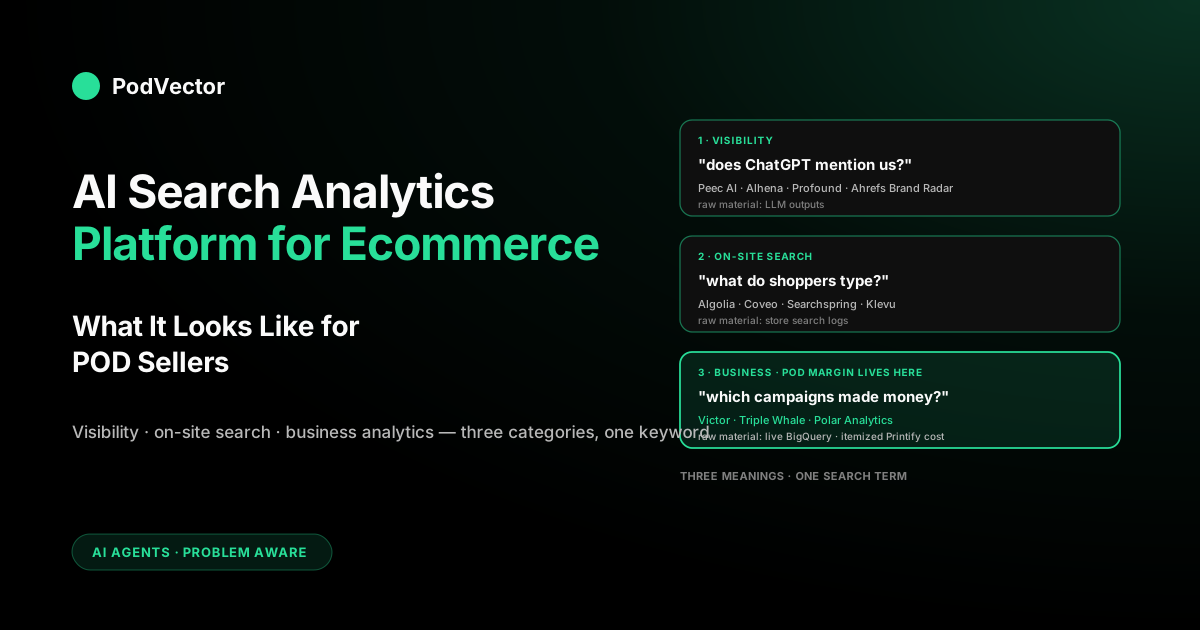
Quick Answer: "AI search analytics platform for ecommerce teams" is three different products hiding under one keyword. There's AI visibility analytics (how often your brand shows up in ChatGPT, the other major AI assistants, and Google AI Overviews — Peec AI, Alhena, Profound).
There's on-site AI search analytics (what shoppers type into your site search and whether it converts — Algolia, Coveo, Searchspring). And there's AI-driven business analytics (ask your warehouse a question in English and get a grounded answer back — Victor, Triple Whale Moby).
For a print-on-demand seller, the first two are interesting. The third is where the margin math lives, because POD survives on per-order profit that generic ecommerce analytics tools don't compute.
Three meanings, one search term — pin them down first
The first confusing thing about this category is that the top of the search results is split between three incompatible products. Peec AI, at the top, sells AI visibility tracking — it monitors whether your brand comes up when a shopper asks ChatGPT or another AI assistant "best wall art for a nursery." The Alhena listicle below it ranks ten tools in that same AI visibility category, specialized for ecommerce.
But in the same results, ExpertRec's guide is about on-site search analytics — what queries shoppers type into your store's search bar, how often they come up empty, which ones convert. And if you scroll further, Coveo, Algolia, and Searchspring show up selling a fourth thing, which is the product discovery layer itself.
The three are all legitimate products. They solve different problems.
Confusing them costs money, because the buying criteria, the integration work, and the metrics you should hold each vendor to are not transferable. A POD operator who buys an AI visibility tool expecting it to surface on-site search data will be angry in month two. The cleanest way to sort this out is to ask what each platform's raw material is:
- AI visibility analytics. Raw material: LLM outputs. The platform prompts ChatGPT, Copilot, the other major AI assistants, Google AI Overviews and AI Mode, and increasingly shopping agents like Amazon Rufus on a schedule, parses what comes back, and tells you whether your brand got mentioned, cited, or ignored. Peec AI, Alhena, Profound, Otterly, Promptwatch, Azoma, WorkDuo, Ahrefs Brand Radar all live here. The discipline this category optimizes for now has a name — answer engine optimization (AEO), the LLM-era cousin of SEO.
- On-site AI search analytics. Raw material: your store's search logs. The platform watches what shoppers type into the search box on your Shopify or BigCommerce site, clusters intent, flags zero-result queries, and measures conversion by search term. Algolia, Coveo, Searchspring, Klevu, ExpertRec, Constructor.io. Often bundled with the product discovery engine itself.
- AI business analytics. Raw material: your warehouse. The platform sits on top of Snowflake, Redshift, or an equivalent warehouse and lets you ask "which campaigns made money last week" in plain English, then runs the query against live data and gives you a grounded number back. Victor, Triple Whale Moby, Polar Analytics, and the Looker/Tableau AI extensions sit here.
The title keyword search traffic is dominated by the first, interest is rising for the third, and the second is a mature category that's been around since Searchspring launched in 2007. Each of the three sections below tells you what the platform actually does, what good looks like, and where the POD-specific gotchas are.
AI visibility analytics — tracking how LLMs talk about your brand
AI visibility analytics is the newest of the three. It exists because in the last eighteen months, a measurable share of product research — and now purchasing — moved from Google search to LLM chat. The numbers stopped being speculative: across Q4 2025, one analytics vendor's merchant base logged 424,000+ orders attributed to LLM referrals, against roughly 7,000 for all of 2024, and post-purchase surveys suggest the real figure is 2.5–3x higher because the referral header gets stripped. Roughly 97% of those AI-attributed orders trace back to ChatGPT.
The shopper-side numbers are just as stark: generative-AI referral traffic to retail sites is up around 4,700% year over year, and AI-referred shoppers convert at roughly 4x the site average (one widely-cited figure puts it at 12.3% vs 3.1%) because the model has pre-qualified them.
Shoppers who used to type "best gym shirt for men" into Google now ask ChatGPT, and the LLM returns a few brand names as suggestions. If your brand isn't on that list, you don't exist for that shopper. If you are, you get something close to a free qualified lead — the LLM has already filtered them down to brands it thinks match their intent.
The platforms in this category share a standard architecture. You give them a list of prompts your target shoppers might ask.
They run each prompt against the major LLMs on a schedule — typically daily. They parse the responses for brand mentions, sentiment, citations, and competitive context. They surface the results in a dashboard with trend lines: visibility score (how often you appear), share of voice (how often you appear vs competitors), and source attribution (which sites the LLM cited when it mentioned you).
The differences between the ten-ish vendors in this category are smaller than their marketing suggests. Peec AI emphasizes breadth of LLM coverage and a clean Looker Studio export.
Alhena emphasizes SKU-level tracking and revenue attribution, which matters more for stocked-inventory brands with a constrained catalog than it does for POD stores with hundreds of design SKUs. Profound goes deep on prompt engineering — it lets you run variations to see which framings your brand shows up in.
Otterly and Promptwatch are leaner alternatives at lower price points. Azoma and WorkDuo are the newer commerce-specific entrants — they track how your products get found, recommended, and compared across ChatGPT, Gemini, Google AI Mode, and Amazon Rufus, which is closer to what a seller actually cares about than generic brand-mention tracking. Ahrefs Brand Radar folds the same capability into the broader Ahrefs subscription you might already have.
For a POD seller, the honest evaluation is: AI visibility analytics is real, but it's early-stage for this category. The LLMs are more confident recommending brands with deep, durable content footprints — Nike, Allbirds, Warby Parker — than they are recommending any given POD store.
If your store is under 12 months old or has fewer than fifty indexed articles of supporting content, you'll spend $200–$500/month to confirm you're not ranking, which you already suspected. The tool earns its keep once you have something to protect or optimize.
If you have a niche POD store with strong organic or PR — a story brand that's gotten press, a creator-owned store with a social following — visibility analytics will tell you whether that authority is translating to LLM citations, and where competitors are stealing share. That's worth the subscription.
For ranked comparisons in this category, Triple Whale's roundup of the best AI search analytics tools for ecommerce is a current reference with the freshest LLM-referral data, and Alhena's ten-tool roundup covers Peec AI, Profound, Otterly, Authoritas, and the rest side-by-side. Then see our comparison at Best AI Search Analytics Tools for Ecommerce (Compared) for the POD-specific filter on top.
On-site AI search analytics — what shoppers type and what they buy
On-site AI search analytics is the oldest of the three categories and the most underrated for POD sellers with deep design catalogs. The raw material is your store's search log: every query a shopper types into your site's search box, in order, with outcome data (clicks, add-to-cart, purchase, bounce). The "AI" part is pattern recognition on top of that log — clustering semantically similar queries, spotting synonyms, identifying zero-result searches that actually have matching products, detecting misspellings, and surfacing intent shifts over time.
Algolia, Coveo, Searchspring, Klevu, ExpertRec, and newer entrants like Wizzy.ai all bundle on-site search analytics with the underlying search engine that powers your store's search UX — as do the enterprise-tier players (Constructor, Bloomreach, Google Vertex AI Search) whose annual contracts run into six figures and are overkill for any POD store. You can't really buy one without the other; the analytics depend on log access the engine generates. The entry-level options on Shopify — the default Shopify search, boost apps like Boost AI Search — have minimal analytics, which is part of why brands upgrade.
What on-site AI search analytics is good at, specifically:
- Finding money on the table. A zero-result query ("gift for dog mom") that returns nothing but matches five products with different keywords is a direct line between missed revenue and a one-line synonym edit. Any POD store with more than 200 SKUs has dozens of these.
- Surfacing intent before it shows up in sales. A sudden spike in "taylor swift" searches on a tour day, or "halloween" queries in late September, is a merchandising signal you'd see faster here than in your sales report.
- Ranking products by search intent, not popularity. The top-converting product for "retro sunset" might be a hoodie you deprioritized because it doesn't sell in aggregate. The search log shows the hoodie is what shoppers want when they type those words.
- Measuring what's hidden. Search is the most underrated conversion event on a POD store — a shopper who searches converts at 2–5x the baseline rate. Knowing how many of your search sessions are breaking is a direct-revenue metric most operators don't look at.
POD-specific gotchas in this category. One: design catalogs explode the synonym space.
A mug with an artwork called "Moonlit Pines" might get searched as "forest," "trees," "night," "camping," "evergreen" — all legitimate intent, all ambiguous. Most search engines ship with a general-retail synonym library that doesn't know these.
You'll spend time in the merchandising console teaching it. Two: the product-attribute taxonomy that on-site search relies on (size, color, gender, occasion) is often not cleanly populated in POD stores because Printify and Printful feed SKUs through without enforcing your own tagging.
The search engine is only as smart as the taxonomy you give it. Three: the ROI case for on-site search analytics gets stronger as your catalog grows.
Below 50 SKUs, the default Shopify search with a few manual synonym edits is enough. Between 50 and 500 SKUs, a paid search engine pays back. Above 500 SKUs, it's table stakes.
AI business analytics — asking your warehouse questions in English
The third meaning — the one with the highest leverage for a POD operator — is AI business analytics. This is the category where an AI employee like Victor already knows your orders, costs, and ad spend, so you can just type a plain question and get a real answer. "Which Meta campaigns had positive ROAS last week after Printify costs?" turns into a clear answer, with the numbers behind it, in seconds.
Why this matters specifically for POD: the unit economics of a POD store are the entire game, and they're hard. Revenue is easy.
Ad spend is easy. But the bit in the middle — itemized Printify or Printful fulfillment cost per order, shipping cost per order, transaction fees, Shopify app fees, refunds — has to be joined from four or five sources to get the real net margin per SKU, per campaign, per week.
Generic ecommerce analytics tools compute gross margin and call it done. That number is off by 40–60% for a POD store, because the production cost varies by SKU, sometimes by variant, and moves when suppliers raise prices.
A good AI business analytics platform for POD should do four things:
- Ground on itemized supplier costs. Not a blended margin assumption, not a CSV you uploaded six months ago. The live Printify or Printful order cost, per SKU, per variant, joined to the Shopify order it fulfilled.
- Query live data. Not a daily batch export. When an operator asks "what did today look like," the answer should reflect the last hour, not yesterday's 3 AM sync.
- Show the math. Victor should show you the numbers behind his answer, so you can check them yourself. Tools that give you a number without showing how they got it will eventually get it wrong, and you won't catch it until your margin report is off.
- Handle the POD-specific joins. Itemized ad spend from Meta and Google, joined to first-party Shopify order data, joined to Printify/Printful fulfillment rows, minus returns, minus transaction fees. If the agent can't do this join cleanly, the numbers will drift.
This is the category Victor lives in, specifically because generic ecommerce AI employees don't compute POD margins correctly by default. For the long-form version of this argument, see The Complete Guide to AI Analytics for Print-on-Demand and The Complete Guide to AI Agents for Ecommerce Analytics. The short version: if your analytics tool doesn't know what Printify charges you per variant today, the margin number it's showing you is decorative, not operational.
Why POD sellers need all three (but fund them in order)
A stocked-inventory DTC brand with a thirty-SKU catalog and eight-figure revenue can fund all three categories from day one and often does. A POD operator usually can't, and shouldn't try to. The sequence that pays back matters:
First: AI business analytics. Because you can't optimize anything until you know which SKUs, campaigns, and channels are actually making money after costs. This is where the margin math lives. Without it, the other two are optimizing against flawed signal.
Second: on-site AI search analytics. Once your catalog has the breadth to justify it (roughly 100+ SKUs or multiple design collections), on-site search becomes a direct revenue lever. The math is clean: search converts at a multiple of non-search, and search fixes are usually merchandising edits, not platform builds.
Third: AI visibility analytics. Only once you have content, authority, or a brand story worth monitoring. A brand-new POD store pays for AI visibility tools to be told it doesn't rank, which it knew. The tool earns its keep when you have something to defend or grow.
The mistake POD operators make in this category is funding in reverse. AI visibility analytics has louder marketing right now because it's new and VC-funded, so the category tools run a lot of content and ads.
The operator with ten SKUs and no organic traffic buys Peec AI first, spends six months confirming obscurity, and doesn't fund the analytics agent that would have told them their Printify cost structure is broken. Don't do this.
Buying criteria that actually matter for POD
Forget vendor feature matrices — most of them ship the same feature set with different names. These are the criteria that separate platforms that work on POD from the ones that work generically.
- Supplier-side integration. Does the platform talk to Printify and Printful directly, or does it assume you've uploaded a COGS CSV? The CSV path is fine until your supplier raises prices, at which point every margin number goes stale until someone uploads a new sheet. Live integration is worth a 20–40% premium.
- Shopify-native join. The platform's view of an order, an ad, a refund, and a fulfillment event should all resolve to the same Shopify order_id. Some vendors treat each as a separate entity with its own ID. Joining them later is where the margin errors creep in.
- Live data, not cached. Ask the vendor's sales rep how often their warehouse connector refreshes. If the answer is "every 24 hours" or "nightly batch," you're one day behind reality on everything. Live (sub-hour or streaming) is 2026-standard.
- Shows the math. Whether it's an AI visibility tool showing the prompts it ran, an on-site search tool showing what shoppers typed, or an analytics tool like Victor showing the numbers behind an answer — the tool should show its work. Tools that hide how they got an answer will eventually get it wrong.
- Honest about ecommerce vs POD. Tools that say "we work with ecommerce" without saying "and we've modeled made-to-order margins" are tools that haven't thought about POD specifically. The good POD vendors will name-drop made-to-order, Printify/Printful, variants, and supplier cost volatility without you prompting.
- Doesn't force you to rip out the rest of your stack. Platforms that require you to migrate your ad data, your site search, and your analytics into their walled garden are rarely worth it. The best AI search analytics platforms read from the tools you already use and add a thin layer of intelligence on top.
What each platform should pay back, with POD numbers
The accountability metrics aren't transferable across the three categories, so here's the specific pay-back math that each should hit before renewal.
AI visibility analytics. The honest ROI here is indirect and slow. You're not going to see a direct-revenue line item from appearing in ChatGPT's answer to a shopper prompt.
What you should see is: share-of-voice against named competitors rising over time, citation source diversity growing (more of your content surfaces getting cited by LLMs), and — longer term — organic search intent shifting to branded terms. Budget: $200–$800/month.
Worth it if your store has earned authority to protect. Not worth it for a new store under 12 months.
On-site AI search analytics. This is the fastest ROI of the three. Math: if your store does $100k/year and search sessions are 15% of sessions converting at 3x the non-search rate (both typical ranges), on-site search is responsible for roughly 35–45% of revenue.
A 10% lift on search conversion — achievable via synonym fixes, zero-result handling, and merchandising — is $3,500–$4,500/year in incremental revenue on that $100k base. Scales linearly with store size.
Budget: $100–$600/month. Payback window: typically under 60 days.
AI business analytics. The pay-back here is the decisions you make differently. A POD operator running Meta ads without per-SKU net margin data is routinely scaling unprofitable campaigns and starving profitable ones.
The typical shift once true unit economics are visible: 10–25% of ad budget reallocates within 30 days, and blended ROAS rises by a similar amount. On a $50k/month ad spend, that's $5k–$12k/month of margin recaptured.
Budget: $100–$500/month for the agent; the warehouse (warehouse) is usually a few dollars a month at POD data volumes. Payback window: first full reporting cycle.
For the broader landscape of analytics tools POD operators buy, see The Complete Guide to AI Tools for POD Sellers.
A realistic stack sequence for a POD operator
If you're building this from zero — say you just passed $10k/month revenue and are thinking about what analytics stack pays back — here's the order that works:
Month 1–2. Get your warehouse wired up. a warehouse is the default for POD because the Shopify, Meta, Google Ads, Printify, and Printful connectors all have mature paths into it. Use dbt or a managed ELT tool to land the raw data. Don't buy an analytics agent yet — you need clean data first.
Month 2–3. Add the AI business analytics layer. Victor, Triple Whale Moby, or Polar Analytics — whichever is cheapest for your data volume and has the POD-specific joins you need. This is the first real payback, because it's where the margin truth lives.
Month 3–6. If your catalog crosses 100 SKUs, upgrade your on-site search. Searchspring, Algolia, or Klevu depending on your platform. Baseline the search conversion rate before switching so you can measure lift. For related reading on how the agentic side of this works, see Agentic AI for Ecommerce and AI Agent for Ecommerce.
Month 6–12. Once you have an organic or PR story worth tracking, add AI visibility analytics. Peec AI or Alhena for ecommerce-specific coverage; Ahrefs Brand Radar if you're already paying for Ahrefs and want it consolidated. Set realistic expectations — you're monitoring a slow-moving signal.
For adjacent decisions on the operator side, see AI Inventory Forecasting Shopify for the hybrid-inventory case, and AI Agents for Ecommerce for the broader agent category overview.
The employee roadmap — analytics that also acts
The category is moving from reporting to action, fast. AI visibility tools that today surface your share-of-voice will tomorrow draft the content briefs that close the gap — Alhena and Profound are both building toward this.
On-site search platforms that today cluster queries will tomorrow auto-adjust synonym libraries and merchandise product grids without human approval — Klevu and Searchspring are both rolling this out. AI employees answer "which campaigns made money" and pause the losers in the ad platform directly — with your approval — Victor's roadmap sits here, and Triple Whale has announced similar direction.
The shift matters because the ROI math changes when the agent acts. Today, an AI business analytics tool pays back by shortening the analyst's time from question to answer from twenty minutes to twenty seconds.
Tomorrow, it pays back by making the decision and committing it while the operator is asleep. The gap between the two is the difference between a $200/month tool and a $2,000/month tool — and the category is moving fast enough that the platform you pick in 2026 should have a credible action roadmap, not just a reporting roadmap.
For POD specifically, the action-layer that'll matter most first is margin-protecting bid adjustments: the agent that lowers a Meta bid on a SKU whose Printify cost just went up, before the campaign spends another day losing money. Vendors that ship this capability first will own the category for POD in 2027. Ask prospective vendors what their 12-month action roadmap looks like; it's the single most predictive question you can ask.
FAQs
Is AI search analytics the same as SEO analytics?
No, and confusing them is how budgets get wasted. SEO analytics (Ahrefs, Semrush, Google Search Console) measures your visibility in traditional Google search results.
AI search analytics measures your visibility in AI-generated answers from ChatGPT, the other major AI assistants, and Google AI Overviews. They're related — the LLMs often cite pages that rank well organically — but the ranking signals, the prompts, and the metrics are different enough that an SEO tool won't tell you how you're doing in LLM chat. A tool like Ahrefs Brand Radar bridges both inside one subscription; most others cover one side only.
Do I need an AI search analytics platform if I'm under $10k/month revenue?
Honest answer: usually not. At that revenue, the question isn't "am I visible in AI search" — it's "am I making money per order." That's an AI business analytics question, not an AI visibility one. Fund the margin math first, then the visibility tools once you're at scale.
Will AI search (ChatGPT and other AI assistants) replace Google search for ecommerce?
Partially, not fully, and not evenly. Research and comparison queries are moving to LLMs fast — "best X for Y" style searches are 20–40% lower volume on Google than they were two years ago.
Transactional queries ("buy X") are still dominated by Google, because the LLM doesn't have the merchant infrastructure. For a POD store, the practical effect is: you need to be visible in LLM answers for your research-intent keywords, and you need paid and organic Google presence for your transactional ones. AI visibility analytics helps you track the first half.
Which is cheapest — AI visibility, on-site search analytics, or AI business analytics?
On-site search analytics is usually the cheapest at the entry level ($20–$50/month for Shopify apps like Boost or the baseline Algolia plan). AI business analytics is often cheap-to-free at low data volumes — Victor, Polar Analytics, and Triple Whale all have starter tiers. AI visibility analytics is the most expensive entry point — the floor is usually $200/month and goes up quickly as you add competitors or prompts to track.
How do I test an AI business analytics tool before committing?
Give it the same margin question a week before your monthly close and compare its number to what your close produces. If the platform answers within 5% of your closed number on the first try, it's grounded correctly.
If it's off by 15%+, dig into the joins — it's probably not handling Printify/Printful costs or a refund category correctly. Don't renew a platform whose numbers don't match your books.
Can one platform cover all three categories?
Not well, yet. Vendors pitch convergence — "unified AI analytics" — but the underlying raw materials are different enough that a platform good at one is rarely best-in-class at the others.
Peec AI and Alhena are AI visibility specialists; Searchspring and Coveo are on-site search specialists; Victor and Triple Whale are business analytics specialists. Over the next two to three years, expect consolidation around two platforms (visibility + business analytics merging; on-site search staying separate because it's tied to the product discovery engine). Today, budget for the first category you need and add the others in the sequence above.
What's the role of a warehouse (or Snowflake) in this stack?
For AI business analytics specifically, the warehouse is the substrate. The agent queries it.
All your data — Shopify, Printify, Printful, Meta, and Google — needs to be pulled into one place and kept up to date before an AI employee can be useful. A POD operator who skips this step and lets the AI pull from each source separately ends up with answers that don't line up, which is where the margin math breaks. Keeping everything connected costs very little at POD data volumes; the real work is making sure the numbers match up, not the plumbing.
Does this apply if I sell on Etsy, not Shopify?
Partially. Etsy keeps its data closed off, so there's a limit to what you can connect to other tools — Etsy doesn't share the same level of order and ad details that Shopify does.
On-site search analytics doesn't apply because Etsy owns the search. AI visibility analytics still works.
AI business analytics works for the slice Etsy does expose (orders, listings, Etsy Ads) but can't join in a Meta ad or Shopify SKU if you sell across platforms. POD sellers with mixed Etsy + Shopify presence get the most out of AI business analytics on the Shopify side; the Etsy side stays in Etsy's native analytics.
Victor acts on the margin truth — with your approval
Of the three meanings of "AI search analytics platform for ecommerce teams," the one that pays back first for a POD seller is the one grounded in itemized supplier costs, live connected data, and real net margin per product. Victor runs on that foundation — and doesn't stop at the number.
He finds the campaigns losing money after Printify costs and pauses them, shifts spend to the SKUs that actually net out, and updates Shopify and Printify/Printful ops — asking before each material move. No CSV uploads. No stale margin numbers. And let him run the ops the math points to.
Try Victor free