
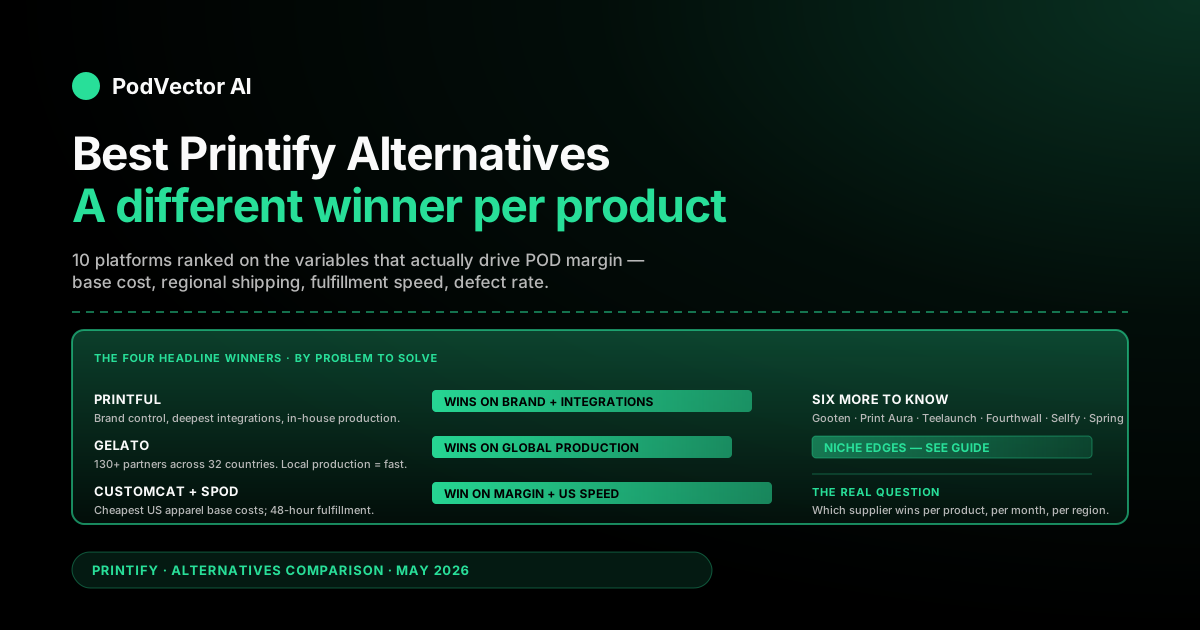
Quick Answer: The 10 best Printify alternatives in 2026 are Printful, Gelato, CustomCat, SPOD, Gooten, Print Aura, Teelaunch, Fourthwall, Sellfy, and Spring. Printful wins on integrations and quality, Gelato wins on global production, CustomCat wins on margin, SPOD wins on speed, and the rest cover specific edges (custom branding, storefront-in-a-box, social commerce).
There is no single "best" Printify alternative. There is only the one with the lowest landed cost on your specific catalog and the fewest fulfillment failures into your top destinations.
This guide walks the 10 options most POD operators actually consider in 2026, with pricing, integrations, fulfillment speed, and the one or two product categories each platform genuinely wins on.
Why sellers shop for Printify alternatives
Printify is the default for a reason — 900+ products, a Print Geek network, and the easiest Shopify install in the category. Sellers don't shop for alternatives because Printify is bad. They shop because one of four specific things broke.
The print provider lottery. Printify is a marketplace, not a producer. Quality, color accuracy, and fulfillment speed depend on which of the 100+ print partners ends up with your order. Two units of the same SKU can ship from two cities and look like two different products.
Margin compression on hero SKUs. Once a design starts moving 50+ units a month, the Printify base price plus Print Geek fee plus your platform's transaction cut starts looking expensive next to in-house producers like CustomCat or Printful.
International shipping. Printify routes most international orders from US facilities. By the time a hoodie reaches Germany, the customer paid $12 of shipping on a $35 garment, which kills both conversion and reorders.
Brand control. Printify offers limited custom packaging, no inside-label printing on most providers, and pack-in inserts only on a subset of partners. Sellers building real brands hit this ceiling around month six.
Most of this article is about which alternative solves which of those four problems. Skip to the platform that matches your reason for leaving.
How to evaluate a Printify alternative
The "best Printify alternative" comparisons online almost always rank by feature lists. That's the wrong frame. POD economics are determined by six variables, in roughly this order of margin impact.
Base cost per SKU. The blank plus print plus fulfillment fee. A $0.50 difference per unit becomes $250 on your first 500 orders. It's the largest single line in your P&L.
Shipping cost into your top three destinations. Not the average. The cost into the three countries that buy 70% of your volume. Gelato wins in Europe, CustomCat wins in the US, and the rest depend on your geography.
Fulfillment speed (advertised and actual). The advertised window is marketing. The actual window is what shows up in your tracking data after 200 orders. Most platforms slip 1–2 days against their published number; some slip 4–5.
Defect and reprint rate. Industry baseline is 2–4% returns or reprints. Anything above 5% on a single platform burns your margin and your support hours faster than any subscription fee.
Integration depth. Shopify, Etsy, WooCommerce, TikTok Shop, and Amazon coverage matters less than whether the integration syncs inventory, variants, and order status without manual nudging.
Subscription overhead. Most platforms have a free tier. The paid tiers only pay back at volume — usually 50+ orders a month — so don't subscribe before you have the volume.
The mistake most operators make is optimizing for the variable they can see on the marketing site (subscription price, product count) instead of the variables that actually drive margin (base cost, defect rate, regional shipping). Catalog-level cost modeling beats feature-list comparison every time.
The 10 best Printify alternatives in 2026
The list below is ordered by how often each platform shows up in active migration conversations from Printify, not by which is "best" in the abstract. Each entry covers what the platform genuinely wins at, where it fails, and the typical POD operator profile it fits.
1. Printful — Best for brand control and integrations
Printful is the most-named Printify alternative for a reason: it owns its production. Six in-house facilities across the US, Mexico, Latvia, Spain, and Japan, with no print-partner lottery. Two orders of the same SKU look like the same product, every time.
Pricing model: Free to start. Printful Growth ($24.99/month, waived above $12k/year) unlocks 20% off branding products and 7% off DTG, plus carrier-rate shipping discounts. Printful Business ($49.99/month) adds custom packaging, deeper discounts, and dedicated support.
Product range: 475+ products as of 2026 — apparel, accessories, home decor, wall art, and the strongest embroidery catalog in the category.
Integrations: Shopify, Etsy, WooCommerce, Wix, Squarespace, eBay, Amazon, TikTok Shop, BigCommerce, Wish, Storenvy, Square, Webflow, plus a clean REST API. The integration is the deepest in the POD market.
Fulfillment: 2–5 business days for printed apparel, 2–7 for embroidery. US standard transit is 3–4 business days; European orders out of the Riga facility land in 5–9 business days door to door.
Best for: Sellers who already cleared the "quality complaints from customers" mark on Printify and want one in-house production source. Brands using inside-label printing, custom pack-ins, or custom packaging. Anyone shipping more than 20% of volume to Europe.
Watch out for: Base prices run 15–30% above Printify on like-for-like SKUs. Margin math on $20-retail tees gets tight. The Growth subscription only pays back above ~50 orders a month.
2. Gelato — Best for global production
Gelato is the only platform in this comparison built around local production at global scale. 130+ partner facilities in 32 countries means a Berlin customer's order prints in Germany, ships from Germany, and arrives in 3–5 days for the same cost as a domestic US order.
Pricing model: Free tier, then Gelato+ ($24/month) for 50% off shipping and 10% off products, Gelato+ Gold ($119/month) for 50% off products on bulk. The subscription pays back fast for international sellers.
Product range: 200+ products, with the strongest wall art, posters, and photo book catalog in POD. Apparel range is good but narrower than Printful or Printify.
Integrations: Shopify, Etsy, WooCommerce, Wix, BigCommerce, Squarespace, Shopline, plus a robust API used by larger sellers and aggregators.
Fulfillment: 24–72 hours in most regions thanks to local production. Tracking is more reliable than Printify because there are fewer customs hops.
Best for: Sellers with 30%+ international revenue. Wall art and poster sellers. Anyone building a "made locally" brand story.
Watch out for: Apparel base costs are slightly above Printful and noticeably above CustomCat. Routing to the nearest facility is automatic but not always optimal — a Toronto order can still print in the US if the Canadian partner is at capacity.
3. CustomCat — Best for margin
CustomCat is the cheapest reputable POD platform in North America. A blank Gildan 5000 tee with a single-color DTG print runs $7.99 versus $9–11 on most competitors. Stack that across 1,000 orders and the margin difference is real money.
Pricing model: Free Lite plan, CustomCat Pro at $30/month for 20–40% off base prices. The Pro tier breaks even around 30 orders a month.
Product range: 550+ products, strong on apparel and drinkware, lighter on home decor and wall art.
Integrations: Shopify, Etsy, WooCommerce, BigCommerce, plus a CSV order import for everything else. Less polished than Printful but functional.
Fulfillment: 2–3 business days from Detroit. Genuinely fast — one of the few platforms that consistently beats its published window.
Best for: High-volume sellers running Facebook or TikTok ad accounts where the margin per unit determines whether the ad math works. Designs that move 100+ units a month.
Watch out for: US-only production. International shipping costs are punishing — international customers should not be your primary segment if you build on CustomCat. The Pro subscription is the only way to access the low prices most reviews quote.
4. SPOD — Best for fastest US fulfillment
SPOD (Spreadshirt Print On Demand) advertises 48-hour fulfillment and largely delivers on it. Two facilities (Pennsylvania, Nevada) cover the US in 3–5 business days door to door for most addresses.
Pricing model: No subscription fees. Base prices are mid-range — cheaper than Printful, comparable to Printify Premium.
Product range: 200+ products, mostly apparel and accessories. Lighter catalog than Printful or Printify.
Integrations: Shopify, WooCommerce, Magento, plus an API. The Shopify app is the most-used path.
Fulfillment: 48-hour production, 3–5 business day US transit. Speed is the headline.
Best for: Sellers whose customers complain about Printify's variable fulfillment windows. Anyone selling for event-driven occasions (birthdays, holidays) where speed converts directly to revenue.
Watch out for: Smaller catalog limits niche product sellers. International coverage exists via the parent Spreadshirt network but is less seamless than Gelato or Printful.
5. Gooten — Best for catalog breadth and accuracy
Gooten is the platform most often used by larger POD sellers (1,000+ orders/month) who outgrew Printify but found Printful too restrictive. 150+ products, a multi-routing system that swaps print partners if one is at capacity, and a 99% order-accuracy claim that holds up in operator forums.
Pricing model: No setup or monthly fees. Volume-tier discounts kick in automatically above 50 orders/month.
Product range: 150+ products including unusual SKUs (custom socks, jewelry, dog collars) that other platforms don't carry.
Integrations: Shopify, Etsy, WooCommerce, BigCommerce, plus a developer-friendly API used by larger sellers.
Fulfillment: 4–7 business days production, plus 3–5 day US transit. Slower than CustomCat or SPOD but more reliable.
Best for: Established POD operators ready to manage their own routing logic via API. Sellers with unusual product mixes that Printify doesn't carry.
Watch out for: No subscription tier means no discount lever to pull. The API is required for sellers who want true control — the storefront integrations are functional but basic.
6. Print Aura — Best for white-label and custom branding
Print Aura is the platform most often picked by sellers who want their POD supplier to be invisible. White-label everything: branded packing slips, your return address, custom inserts, neck-label printing on most apparel SKUs.
Pricing model: No subscription. Base prices comparable to mid-tier Printify. Branding services are à la carte.
Product range: 250+ products, apparel-heavy.
Integrations: Shopify, Etsy, WooCommerce, plus a CSV import. Less plug-and-play than the bigger platforms.
Fulfillment: 3–5 business days from New York. Average for the category.
Best for: Sellers building a real brand who want a customer unboxing experience that looks nothing like POD. Wholesale sellers who can't have a "shipped from Printify partner" packing slip.
Watch out for: The integration UX is older than the bigger competitors. Onboarding takes longer because branding setup is manual.
7. Teelaunch — Best for unusual product categories
Teelaunch is the long-tail-product POD platform. Earbuds, Bluetooth speakers, dog tags, jewelry, drinkware most platforms don't carry. The Shopify-first integration is one of the cleanest in POD.
Pricing model: No subscription. Base prices vary widely by category.
Product range: 300+ products including the largest tech-accessory POD catalog. Less competitive on basic apparel.
Integrations: Shopify-first, Etsy via the app store, no native WooCommerce.
Fulfillment: 3–7 business days production from US facilities. Tech-accessory SKUs trend slower than apparel.
Best for: Niche sellers whose catalog depends on a product Printify doesn't carry. Gift-market sellers who want one platform covering apparel and gift items.
Watch out for: Tech SKUs have a higher defect rate than apparel — budget for a 5–8% reprint rate, not the 2–3% you'd see on tees.
8. Fourthwall — Best storefront-in-a-box
Fourthwall is the only platform on this list that isn't purely a fulfillment service. It bundles POD with a hosted storefront, memberships, digital products, and creator-economy features. The blanks (AS Colour, Stanley/Stella) are premium.
Pricing model: No upfront subscription. Fourthwall takes a percentage of sales — comparable to Shopify + Printful when you account for everything.
Product range: 220+ POD products, plus tools for digital downloads, memberships, and physical product fulfillment.
Integrations: Native storefront — doesn't integrate with Shopify or Etsy. Standalone or nothing.
Fulfillment: 5–10 business days from EU and US facilities. Premium blanks add a couple of days versus Gildan-grade production.
Best for: Creators (YouTube, Twitch, TikTok) whose primary channel is their audience, not search or paid ads. Brands launching with premium blanks where the unit economics support $30+ retail tees.
Watch out for: You can't migrate to or from Fourthwall easily — the storefront, fulfillment, and analytics are bundled. It's a closed loop, not a swappable supplier.
9. Sellfy — Best all-in-one for digital + physical
Sellfy bundles a storefront builder, digital product sales, subscriptions, and POD fulfillment into one subscription. The POD catalog is narrower than dedicated platforms, but the bundling math works for solopreneurs.
Pricing model: $29–$159/month depending on volume. POD fulfillment costs are bundled into product pricing.
Product range: 100+ POD products, plus unlimited digital products and subscriptions.
Integrations: Standalone storefront. No Shopify or Etsy integration — you migrate your audience to Sellfy or you don't use it.
Fulfillment: 3–7 business days. Average for the category.
Best for: Sellers whose primary product is digital (courses, ebooks, presets) with POD as a secondary line. Creators who don't want to manage Shopify, a POD platform, and a payments processor separately.
Watch out for: Same lock-in as Fourthwall — Sellfy isn't a supplier you plug into your existing stack, it's a stack replacement.
10. Spring (formerly Teespring) — Best for social commerce
Spring's edge is the YouTube and TikTok integrations: products appear directly under videos, in TikTok Shop, and in creator-tagged Instagram posts without leaving the platform. The fulfillment is competent rather than exceptional.
Pricing model: No subscription. Spring takes a service fee — typically 15% on top of base costs — so retail markup math is tighter.
Product range: 180+ products, apparel-heavy with growing accessory coverage.
Integrations: YouTube Shopping, TikTok Shop, Twitch, Instagram, Facebook. No Shopify, no Etsy — Spring is the storefront.
Fulfillment: 5–10 business days. Slower than the leaders, comparable to Printify averages.
Best for: YouTube and TikTok creators where the audience converts in-feed, not on a separate Shopify storefront. Anyone whose distribution depends on a creator-platform algorithm.
Watch out for: The 15% service fee makes Spring meaningfully more expensive than a Printful + Shopify stack at scale. The trade is convenience and in-feed conversion, not margin.
Side-by-side comparison table
The table below summarizes the 10 alternatives on the variables that matter for migration decisions. Pricing reflects mid-2026 published rates.
| Platform | Best for | Subscription | Catalog | US fulfillment | Top integration |
|---|---|---|---|---|---|
| Printful | Brand control + integrations | $0–$49.99/mo | 475+ | 2–5 biz days | Shopify, Etsy, all major |
| Gelato | Global production | $0–$119/mo | 200+ | 24–72 hrs (local) | Shopify, Etsy |
| CustomCat | Margin / high volume | $0–$30/mo | 550+ | 2–3 biz days | Shopify, Etsy |
| SPOD | Fastest US speed | Free | 200+ | 48 hrs production | Shopify |
| Gooten | Scaled API operators | Free | 150+ | 4–7 biz days | API-first |
| Print Aura | White-label branding | Free | 250+ | 3–5 biz days | Shopify, Etsy |
| Teelaunch | Unusual SKUs / tech | Free | 300+ | 3–7 biz days | Shopify |
| Fourthwall | Creator storefronts | % of sales | 220+ | 5–10 biz days | Standalone |
| Sellfy | Digital + physical bundle | $29–$159/mo | 100+ | 3–7 biz days | Standalone |
| Spring | Social commerce | 15% fee | 180+ | 5–10 biz days | YouTube, TikTok |
Two things stand out from this table. First, no platform wins on more than two variables — every choice trades something. Second, the subscription line is the smallest cost in your P&L; ignore it as a decision driver and optimize on base cost plus shipping plus defect rate.
The per-product profitability problem
Here's the inconvenient truth every comparison guide skips: the "best Printify alternative" is different for every product in your catalog.
A unisex Gildan 5000 tee with a single-color print? CustomCat wins by $1.50/unit. The same design on an embroidered hat? Printful wins because their embroidery catalog is deeper. A poster shipping to Germany? Gelato wins because it prints locally. A bundle of digital + physical merch sold to a YouTube audience? Spring or Fourthwall win on conversion, not unit cost.
The mistake most operators make is picking one alternative and routing everything through it. The right move is multi-supplier: Printful for embroidery, CustomCat for high-volume tees, Gelato for international, Teelaunch for tech accessories. Each SKU lives where it's most profitable.
The objection is always operational: "I can't manage four supplier relationships, four integrations, four reconciliation flows." Until recently that was true. Modern POD operations connect every supplier into a single data layer and let an AI agent answer the question "which supplier would be more profitable for product X this month?" on demand, with real numbers from your actual order history.
That's the bet behind Victor, the AI agent built for POD operators — covered briefly in the CTA below. The broader point stands either way: the supplier choice is per-product, not per-store.
How to switch suppliers without breaking your store
If you've decided to migrate part of your catalog away from Printify, the operational checklist is short but unforgiving.
1. Order samples first. Pick the three SKUs that drive 70% of your revenue. Order one from your current platform and one from each shortlisted alternative. Compare in person, not from product photos. Color, hand feel, and print quality vary more than the marketing pages suggest.
2. Migrate one SKU at a time, not the whole catalog. Pull a top-selling design, set it up on the new supplier, and route 100% of that one SKU's orders for 30 days. Watch defect rate, support tickets, and customer reviews. If the new supplier holds up, migrate the next SKU.
3. Keep Printify connected. Don't disconnect the old integration until the new platform has 90+ days of clean data. Suppliers slip in month two. The ability to fail back to Printify on a problem SKU is worth the integration overhead.
4. Recalculate retail prices. A $2/unit cost difference upstream might mean your retail price needs to change. Most operators forget this step and burn the cost savings on outdated price points.
5. Update product page shipping copy. Different suppliers have different fulfillment windows. The "ships in 2–5 business days" copy you wrote for Printify might be wrong on a Gelato local-production order (faster) or a Gooten order (slower). Honest shipping windows convert better than aggressive ones, and they cut support load in half.
Sister-cluster reading worth bookmarking before you switch: cheaper than Printify: which is best for POD sellers for a cost-only deep-dive, better than Printify: which is best for POD sellers for a quality-only comparison, and Bonfire vs Printify for the specific case of fundraising and group-order use cases. The full cluster lives at Printify comparison, and the broader topic hub at Printify on PodVector AI. For the tooling side of any switch, the complete guide to Printify tools and mockups covers what carries across to the new platform and what doesn't, and the complete guide to Printify costs, fees, and discounts establishes the cost baseline you're trying to beat. For external comparison context, Printful's own roundup of Printify alternatives and Michael Essek's long-running 11 best POD companies guide cover the same field with different editorial angles.
FAQs
What is the best Printify alternative overall?
There isn't one. Printful wins on integrations and brand control, Gelato wins on global production, CustomCat wins on margin, and SPOD wins on US speed. The "best" alternative depends on which of Printify's specific weaknesses you're trying to fix.
Is any Printify alternative cheaper than Printify?
Yes — CustomCat is consistently cheaper on apparel base costs, often by $1–$2 per unit on high-volume SKUs. Gooten beats Printify on certain unusual SKUs but matches or exceeds it on tees. SPOD is comparable. Most other alternatives (Printful, Gelato, Fourthwall) trade higher base costs for quality, integrations, or geography.
Which Printify alternative is best for Etsy sellers?
Printful has the deepest Etsy integration with inventory sync, variant mapping, and order status push. Gelato is a close second with cleaner international fulfillment. CustomCat works on Etsy but the integration is functional rather than polished. Print Aura is the pick if your Etsy brand needs white-label packaging.
Which Printify alternative is best for international shipping?
Gelato. Local production in 32 countries means a German order prints in Germany, ships in 3–5 days, and costs the same as a domestic US order on the same SKU. Printful's six-facility network is the runner-up. Every other platform on this list ships internationally from US facilities and pays the customs and transit cost for it.
Can I use Printify and an alternative at the same time?
Yes, and most scaled operators do. Connect both to your storefront and route different products through different suppliers. Shopify supports multiple POD apps simultaneously. The operational challenge is reconciliation — tracking which orders shipped from which supplier across two analytics dashboards. A unified data warehouse or an AI agent that reads both supplier feeds solves this.
How do I know if a Printify alternative is actually cheaper for my catalog?
Pull your last 90 days of Printify orders by SKU and quantity. Pull the same SKUs from the candidate alternative's pricing page. Calculate the total landed cost (base + shipping) on identical order volume. Most operators discover the answer varies by SKU — a single "cheapest supplier" rarely exists across an entire catalog.
Do Printify alternatives integrate with TikTok Shop?
Printful is the only major Printify alternative with a native TikTok Shop integration in mid-2026. Gelato, CustomCat, and Gooten can be wired up via third-party connectors. Spring has TikTok Shop as a primary channel but requires migrating your storefront to Spring rather than connecting an existing one.
What is the fastest Printify alternative for US shipping?
SPOD advertises 48-hour production and delivers on it in most order audits. CustomCat is a close second at 2–3 business days. Printful runs 2–5 business days but is more consistent than its lower bound suggests. Gooten is the slowest of the major alternatives at 4–7 business days.
Are Printify alternatives worth it for a side-hustle seller doing under 50 orders a month?
Usually no. Below 50 orders/month, the subscription tiers don't pay back and the operational overhead of a second integration eats into the time you saved. Stick with Printify, or migrate to a free-tier alternative (SPOD, Gooten, Print Aura) where the only cost is the base price difference per unit.
The supplier question isn't "which platform." It's "which supplier per product."
You have 200 SKUs across Printify, Printful, Gelato, and Gooten. You don't know which design would make 30% more margin on a different supplier this month. You don't have time to model it in a spreadsheet.
Victor is the AI agent that reads your live POD data warehouse — every supplier feed, every storefront, every ad account — and answers questions in plain English. "Which products would be more profitable on Printful than Printify this month?" Answer in 10 seconds, with real numbers from your real order history.
Connect your stores and suppliers and the per-supplier-per-product question stops being a Sunday afternoon spreadsheet. — and find out which alternative is actually winning on your catalog this month.
Try Victor free