
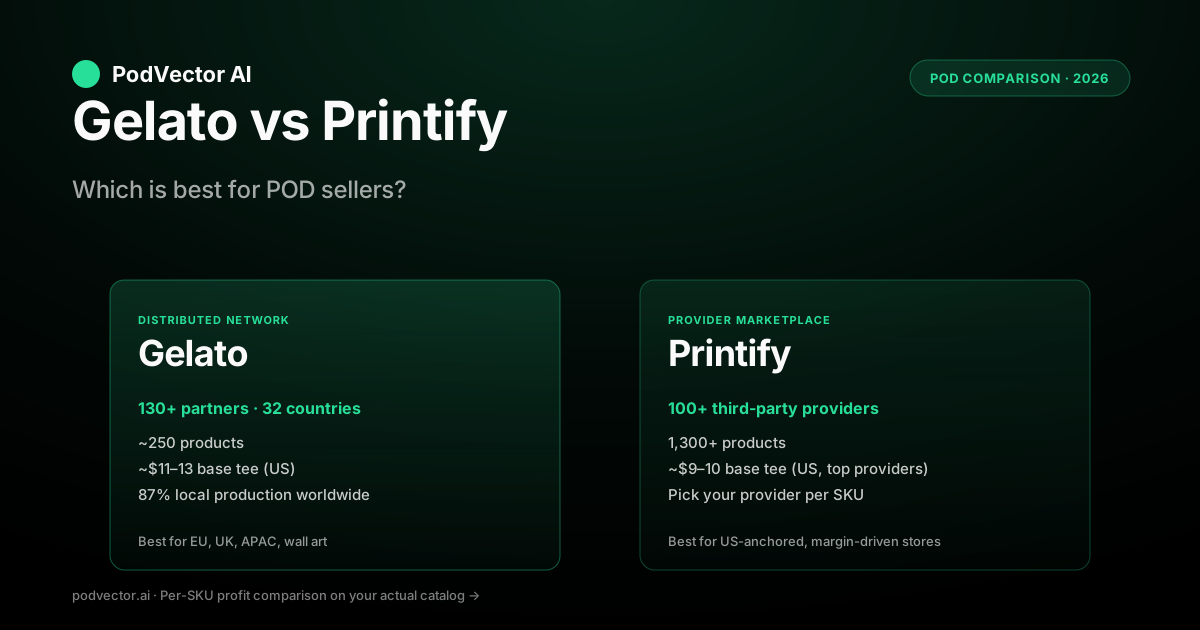
Quick Answer: Gelato and Printify both fulfill print-on-demand orders for stores on Shopify, Etsy, WooCommerce, and Wix — but the production model behind each one is what changes your margin. Printify is a marketplace of 100+ third-party providers competing on price, with the lowest base unit costs on US orders. Gelato is a software-coordinated network of 130+ partners across 32 countries that prints close to the buyer.
Pick Printify if you sell mostly to US buyers, your catalog is price-sensitive, and you are comfortable doing the provider vetting yourself. Pick Gelato if a meaningful share of your orders ships outside the US — local production cuts shipping cost and refund rates more than the monthly fee ever costs.
Beyond that, the right supplier depends on your actual catalog: which SKUs sell, which countries they ship to, and which provider has the lowest landed cost on each. That answer is the one this article works toward.
The Gelato-vs-Printify decision in 60 seconds
Both platforms run a similar surface model. You upload a design, list a product on your store, and they print and ship when an order comes in.
What changes underneath is who runs the press and where it sits. Printify routes each order to one of 100+ third-party providers you pre-select per product. Gelato sends the order file to whichever local production partner is closest to the buyer.
That single architectural choice cascades through base cost, shipping speed, quality consistency, and branding control. The right pick depends on which trade-off matches your store.
One pricing note that changed in 2026: according to Printify's official announcement, the Printify Premium monthly price rose from $29 to $39 on February 17, 2026, while the annual plan held at $299/year. If you are still on monthly billing, that gap matters when comparing subscription costs against Gelato.
Side-by-side snapshot table
Use this for orientation. Each row hides nuance the sections below unpack.
| Dimension | Gelato | Printify |
|---|---|---|
| Production model | Distributed network (130+ partners, 32 countries) | Marketplace of 100+ third-party providers |
| Monthly fee (as of Aug 2026) | Free; Gelato+ ~$24/mo monthly; ~$20/mo annual | Free; Premium $39/mo monthly or $24.99/mo annual ($299/yr) |
| Catalog size | 250+ products | 1,300+ products |
| Native integrations | Shopify, Etsy, WooCommerce, Wix, BigCommerce, Squarespace, Storenvy, Magento + API | Shopify, Etsy, WooCommerce, Wix, eBay, Squarespace, BigCommerce, PrestaShop, Walmart, TikTok Shop + API |
| Strongest geography | EU, UK, APAC, multi-region brands | US (top providers) |
| Branded packaging | Available on Gelato+ and above | Provider-dependent — limited |
| Quality consistency | Medium-high (audited partners) | Variable (depends on provider chosen per SKU) |
Production model: marketplace vs distributed network
Marketing pages compete on logos and pricing tables. The thing that actually determines your margin and refund rate is the production architecture each platform sits on top of.
Gelato: distributed software-coordinated network
Gelato does not own the presses. It runs routing software on top of 130+ vetted print partners across 32 countries, sending each order to whichever local production partner is closest to the buyer.
The model is more like an airline alliance than a single carrier. Quality controls are enforced by Gelato's onboarding and audit processes, so consistency is high but not as tight as a single owned chain.
The win is shipping cost and speed for international orders, especially in Europe, the UK, Australia, and Japan. A buyer in Germany gets their order from a German printer — not from the US. Producing close to the buyer is also why Gelato leans on a lower-emissions story in its marketing: shorter transit means less freight per order, which matters if your brand sells on sustainability.
Printify: open marketplace
Printify is the looser model. It hosts 100+ independent print providers, each with their own facility, equipment, base prices, shipping rates, and lead times, and lets you pick which one fulfills each product.
According to Merch Titans, Printify's provider competition drives US base costs meaningfully lower than Gelato on most product categories. That is also why Printify's quality is the most variable: a Bella+Canvas 3001 tee from Monster Digital prints differently than the same SKU from SwiftPOD.
The vetting work is on you. The reward is the lowest sticker price in the category, especially on apparel and mugs shipping inside the US.
Pricing, base costs, and subscription tiers
Subscription fees are the small lever; base costs are the big one. That said, a significant pricing event in early 2026 changed the calculus for month-to-month sellers.
The February 2026 Printify Premium price increase
According to Printify's official announcement (as reported by mydesigns.io and chayaani.com), the Premium monthly price rose from $29 to $39 on February 17, 2026 — a 34% increase — while the annual plan stayed locked at $299/year (roughly $24.99/month). If you are on monthly billing, switching to annual is now the highest-leverage pricing move available without changing your plan.
Printify Premium gives up to 20% off most product base costs (up to 33% on select new items), according to Printful's comparison of the two platforms. According to mydesigns.io, the discount pays for itself at roughly 17 orders per month on average product base costs.
Gelato subscription tiers
According to Printful's published comparison, Gelato+ costs $23.99/month or $19.99/month billed annually, and provides up to 25% off product prices along with access to advanced design tools including Personalization Studio and Magic Mockups. According to Hack'celeration's hands-on test, Gelato splits its discount story across two tiers — Gelato+ for software and product discounts, and Gelato Gold for shipping discounts — so sellers comparing a single price often miss that maximum savings may require both tiers.
Both platforms offer a free plan. The paid plans cut base unit costs across the catalog and unlock branding or workflow features.
Base costs in practice
According to chayaani.com's 2026 three-way comparison, Printify has the lowest t-shirt base cost among major POD platforms, with Gelato competitive in certain regions. According to Merch Titans, Printify's provider competition drives US base costs meaningfully lower than Gelato on most product categories.
The pattern flips outside the US. On the same apparel shipping to a European buyer, Gelato's local partner often beats Printify on landed cost once shipping is included, and Printify's US-only providers stop being competitive entirely for international routes.
The fee that nobody quotes
Refund and reprint rate is the silent line item on every supplier comparison. Suppliers with longer transit times take more "where is my order" tickets, more lost-package claims, and more refund requests than suppliers with local production.
Most operators do not track this until it lands in the books. At that point it has already eaten the supposed base-cost savings, and the comparison spreadsheet from month one was the wrong tool. For a deeper look at how this connects to overall margin health, see our net profit margin benchmark for POD stores.
Catalog size and product range
Printify's catalog is the broadest by raw count. According to printondemandbusiness.com, Printify offers 1,300+ products as of 2025–2026, including most apparel, accessories, drinkware, home goods, and pet products you would expect.
Most of that breadth is duplicate SKUs across providers — the same Bella+Canvas 3001 listed by multiple different providers — but the long tail does include items Gelato skips entirely.
According to Printful's comparison, Gelato offers 250+ custom products, with a strong focus on apparel, wall art, and stationery. Gelato's catalog skews toward items that benefit from local production: wall art, photo books, calendars, mugs, and apparel. Gelato leans into product categories where shipping a printed product internationally is genuinely uneconomical.
According to branvas.com's 2026 comparison, wall art and paper products are where Gelato is considered the industry standard, while apparel is where Printify wins on selection — offering a wider range of blanks (Comfort Colors, Bella+Canvas, Gildan) and print techniques including DTG, embroidery, and all-over print.
If your store sells niche items (pet products, non-standard packaging, specialty accessories), Printify usually has the SKU and Gelato usually does not. If your store sells wall art or calendars to an international audience, Gelato's catalog is purpose-built for that.
Print quality and consistency
Gelato runs an audited partner network with standardized print specs. The same apparel item should look broadly the same whether it was produced in Latvia, Spain, or Japan. Consistency is the design goal. Gelato also flags DPI issues, color profile mismatches, and bleed problems at upload, which catches quality issues before they become refunds.
According to chayaani.com's 2026 comparison, Gelato's quality is generally high — especially for paper products like posters and canvas prints — and a product printed locally has fewer transit touchpoints and fewer shipping damage incidents.
Printify's quality is provider-dependent. According to printondemandbusiness.com, Printify gives you more control over quality (you can switch providers or select premium garments) while Gelato gives more consistency (all partners are audited against the same standard). According to branvas.com, quality control is a known pain point on Printify, with sellers reporting inconsistent prints when using different providers.
The practical implication: on Printify you need to order samples from every provider you list, every time. On Gelato you can trust the network-level standard and skip per-partner sampling once you have validated the baseline. According to printondemandbusiness.com, both platforms make sample orders easy and offer discounts on them.
Shipping speed by region
Shipping speed is downstream of where the product is printed. The architectural choice each platform made determines transit time.
United States
Both fulfill US orders out of US facilities, so transit times are similar. Printify's top US providers are competitive because production is concentrated in high-volume facilities.
European Union and UK
Gelato wins, and it is not close. According to chayaani.com's 2026 three-way comparison, a UK seller using Gelato's UK facility ships to UK customers in 2–4 days, while the same seller on Printify would ship from a US partner in 7–12 days. Local production from partners in Germany, Latvia, the UK, Spain, France, and the Netherlands keeps transit short for most EU buyers.
Printify's EU production is provider-dependent. Some Printify providers do print in the EU; many do not, and orders ship from the US. On a transatlantic order the difference in both time and shipping cost is significant.
APAC, LATAM, and rest of world
Gelato wins again on the strength of Australian, Japanese, and Brazilian partners. According to Merch Titans, Gelato wins for international shipping speed with production facilities in 32 countries. Printify is rarely the right call outside North America for the same reason — most of its provider network is US-based, and shipping a hoodie from Texas to Tokyo destroys margin and delivery time.
Integrations with Shopify, Etsy, and other channels
Both integrate with the platforms that matter — Shopify, Etsy, WooCommerce, Wix, Squarespace, BigCommerce, and the rest of the long tail. The headline list is not the differentiator. What changes between them is what the integration actually does once it is connected.
Gelato integrations
Gelato's Shopify, Etsy, WooCommerce, Wix, BigCommerce, Squarespace, Storenvy, and Magento connections cover essentially the same channels. The integration includes automatic product publishing, variant sync, and a regional shipping profile that maps Gelato's local rates onto your store's shipping settings.
The notable strength is Etsy. Gelato lets you publish straight to Etsy with category, tags, and SEO copy fields filled in from inside the product editor. Listing creation is fast.
The notable weakness is the smaller native app surface relative to Printify. There is no Amazon native app and no Walmart native app.
Printify integrations
Printify integrates natively with Shopify, Etsy, WooCommerce, Wix, eBay, Squarespace, BigCommerce, PrestaShop, Walmart, and TikTok Shop. The selection is the broadest in the category.
Walmart and TikTok Shop in particular are channels where Gelato is weaker. If you sell on either, Printify is the more practical choice.
The catch is that Printify's integration sits on top of a marketplace, so the integration's reliability is partly downstream of which provider you picked. If your chosen provider goes out of stock, Printify can route to a backup provider only if you set that up in advance.
Webhooks and order data
Gelato pushes order lifecycle events (created, production started, fulfilled, shipped) to your store with low latency. Tracking numbers populate the Shopify or Etsy order automatically.
Printify's webhooks fire from the chosen provider, so behavior varies. Top providers push status updates reliably; lower-tier ones can be slower or skip events entirely. If your store relies on order webhooks for analytics or downstream automation, the provider you pick on Printify directly affects data quality.
Branded packaging and white-label options
Gelato adds branded packaging on the Gelato+ tier and above. Coverage includes custom packing slips, branded inserts on most SKUs, and the option to remove Gelato branding entirely. According to Printful's comparison, additional charges apply for branding add-ons like neck labels and packaging inserts depending on plan and product.
Neck labels and inside-collar branding are not available on every SKU, depending on which partner produces the order. The coverage is improving but not yet uniform across the network.
Printify's branding depends on the chosen provider. Some top providers offer custom packing slips and branded inserts; others ship in plain packaging with a generic slip.
If branding matters, Printify is the more painful path. You have to verify each provider individually, and switching providers can change whether a SKU still supports branded packaging.
Customer support and operator experience
Gelato runs email and chat support during business hours across regions, with a separate enterprise support track on the higher plans. Issues route to a single team that can see the order end-to-end across the partner network, which keeps ticket resolution centralized even though production is distributed.
Printify's support is provider-mediated. Printify's own team handles platform issues quickly, but anything related to the actual order — production delays, quality, lost packages — often involves passing the ticket to the chosen provider, which adds latency.
For day-to-day operator experience, both are good. The gap shows up when something goes wrong: Gelato can resolve a failed print without you knowing which partner was involved; Printify usually requires you to track down the provider yourself.
Pick X if Y
The shorthand most operators end up using.
Pick Gelato if
You sell internationally, especially in Europe, the UK, Australia, or Japan, or your catalog skews toward wall art, photo books, calendars, or mugs. The shipping cost and refund rate savings on international orders typically pay for the higher subscription tier within the first set of orders. According to Hack'celeration's test, Gelato's subscription undercuts Printify Premium on both billing modes, and it includes unlimited stores at entry.
You also pick Gelato if quality consistency matters to your brand and you do not want to vet individual print partners. The network-level standard is enforced for you. Gelato also includes built-in personalization tools (Personalization Studio) that Printify does not offer natively.
Pick Printify if
You sell mostly to US buyers, your catalog is price-sensitive, and you are comfortable doing the provider vetting yourself. The base cost advantage on US orders is real and meaningful at volume — according to Merch Titans, Printify's provider competition drives US base costs measurably lower than Gelato on most product categories.
You also pick Printify if your catalog needs items Gelato does not stock (most niche accessories, pet products, specialty drinkware), or if you sell on Walmart or TikTok Shop, where Printify's native integrations are deeper. If you are on monthly Premium billing, the February 2026 price increase makes switching to annual billing the most impactful near-term margin move. For a broader view of Printify's competitive set, see alternatives to Printify and the more app-focused apps like Printify roundup. The Zazzle vs Printify piece is the right read if marketplace-style POD is on the table.
Running Gelato alongside Printify
Most sellers past significant monthly order volume run two suppliers in parallel — one for the geography their primary market sits in, one for everything else. Gelato + Printify is the most common geography pairing.
The split is usually managed inside Shopify by routing rules. The order's shipping country determines which supplier the order draft is created with: Printify for US orders, Gelato for everything else.
The operational cost of running two suppliers is real. Reconciling refunds, reprints, and inventory across two systems takes more time than running one. The math only pays off when the per-SKU savings on the second supplier exceed the operational overhead, which usually starts being true at meaningful monthly volume.
If you want a third option in the comparison, the Printify topic hub and the broader Printify comparison hub cover the full competitive landscape. For an external decision framework that walks the same trade-offs, Merch Titans' Printify vs Gelato breakdown is the cleanest of the public write-ups.
The comparison most sellers actually need
Side-by-side feature tables answer the wrong question. The right question is: across the SKUs my store actually sells, in the countries my buyers actually live in, which supplier produces the highest profit per order after base cost, shipping, payment fees, and refund rate?
That answer is different for every catalog. A Florida-based unisex tee brand selling primarily to the US Southeast lands on Printify. A Berlin-based wall art store shipping the majority of orders inside the EU lands on Gelato. A Toronto-based premium hoodie brand splitting US and EU lands on one of each, routed by destination.
The right supplier is downstream of your data, not downstream of which review article ranks highest on Google. The supplier comparison you actually want is the one computed against your own orders, not a generic one. For context on what healthy margins actually look like once supplier costs are accounted for, see our net profit margin benchmark and our look at average checkout completion rates — two benchmarks that often expose where suppliers are silently hurting your numbers.
That is the gap PodVector AI sits in. Victor — PodVector AI's AI employee — connects to your Shopify store, your Printify and Printful accounts, and your ad platforms, and lets you ask in plain English: which supplier is actually more profitable for my catalog? The answer comes back as an itemized per-SKU view, computed against your live order history and current supplier costs as they flow through completed orders. Once you see where margin is leaking, Victor can propose and execute Shopify-side fixes — repricing your worst-margin SKUs, updating your free-shipping threshold, or bulk-updating prices — after you approve each move. For a full picture of what Victor does, see how PodVector works for POD sellers.
FAQs
Which is cheaper — Gelato or Printify?
On base unit cost in the US, Printify's top providers are cheaper — according to Merch Titans, Printify's provider competition drives US base costs meaningfully lower than Gelato on most product categories. Once you factor in international shipping and refund rates, Gelato often wins on landed cost outside the US even though Printify's sticker price is lower.
Did Printify raise its prices in 2026?
Yes. According to Printify's official announcement, the Premium monthly price rose from $29 to $39 on February 17, 2026 — a 34% increase, per chayaani.com's reporting. The annual plan stayed at $299/year (about $24.99/month). If you are still on monthly billing, switching to annual is the clearest near-term margin improvement available.
Can I use Gelato and Printify together on one Shopify store?
Yes. Both install as separate Shopify apps and manage their own product variants and order routing. The work is reconciling reporting across two systems — most sellers do this by tagging Shopify orders with the supplier name and exporting to a single sheet or warehouse.
Which integrates best with Etsy?
Both integrate natively with Etsy. Gelato's Etsy publishing flow is the most streamlined for filling out tags, categories, and SEO copy from inside the editor. Printify's Etsy integration is more basic but is the cheapest to operate at low volume.
Which has better print quality?
Gelato has the more consistent print quality because every partner in its network is audited against the same standard. According to printondemandbusiness.com, Printify gives more control over quality while Gelato gives more consistency. Printify's print quality varies by provider — top providers match Gelato, lower-tier providers do not. The variance is the cost of Printify's lower sticker price.
Which is faster for international shipping?
Gelato is faster on essentially every non-US route. According to chayaani.com's 2026 comparison, a UK seller using Gelato's UK facility ships to UK customers in 2–4 days, while the same order from Printify's US-based partners takes 7–12 days. Gelato's 32-country production footprint makes this advantage consistent across Europe, APAC, and parts of LATAM.
Is Gelato or Printify better for beginners?
Gelato is more forgiving for a first-time POD seller because the network-level quality standard means fewer surprises. Printify is fine for beginners willing to order samples from each provider before listing, but the operational tax is real if you skip that step.
Does Printify have lower shipping costs than Gelato?
For US-to-US orders the two are roughly comparable. For international orders Gelato is almost always cheaper because the order is produced inside the destination region, and shorter routes are cheaper to ship.
Do both offer branded packaging?
Gelato offers branded packaging on Gelato+ and above with reasonable coverage across SKUs, though according to Printful's comparison, additional charges apply for certain branding add-ons like neck labels and packaging inserts. Printify's branding is provider-dependent and inconsistent — some providers support it, many do not, and switching providers can break the branding setup.
How do I decide between Gelato and Printify in Europe?
If your EU orders are concentrated in Germany, the UK, France, the Nordics, and Italy, Gelato's local production usually wins on landed cost and delivery time by a meaningful margin. According to printondemandbusiness.com, Gelato is a clear winner for non-US shipping speed and overall global reach, built for international sellers with its 32-country production footprint. Printify is rarely the right call for EU orders unless your store is US-anchored and the EU is a minor share of revenue.
Can I see this comparison applied to my own store?
Yes — this is what we built PodVector AI for. Connect your Shopify store and your Printify (or Printful) account, and Victor reads your live order history to surface per-SKU cost and margin so you can compare it directly against the base-cost figures in this article. When he finds a move worth making — say, repricing your worst-margin SKUs or raising your free-shipping threshold — he proposes it as an approval card showing old and new values, and executes it on Shopify only after you approve. For more on how to squeeze margin from your current supplier setup, see our guides on increasing AOV with AI and CRO techniques for POD stores.
Stop guessing which supplier is more profitable.
Victor — PodVector AI's AI employee — connects to your Shopify store and Printify (or Printful) account, reads your live order data, and surfaces per-SKU margin so you can see exactly where each supplier wins or loses for your catalog. When the data points to a fix — repricing a SKU, adjusting your free-shipping threshold, bulk-updating prices — Victor proposes it as an approval card showing old and new values. You approve. He executes it on Shopify with a full audit trail.
Try Victor free