
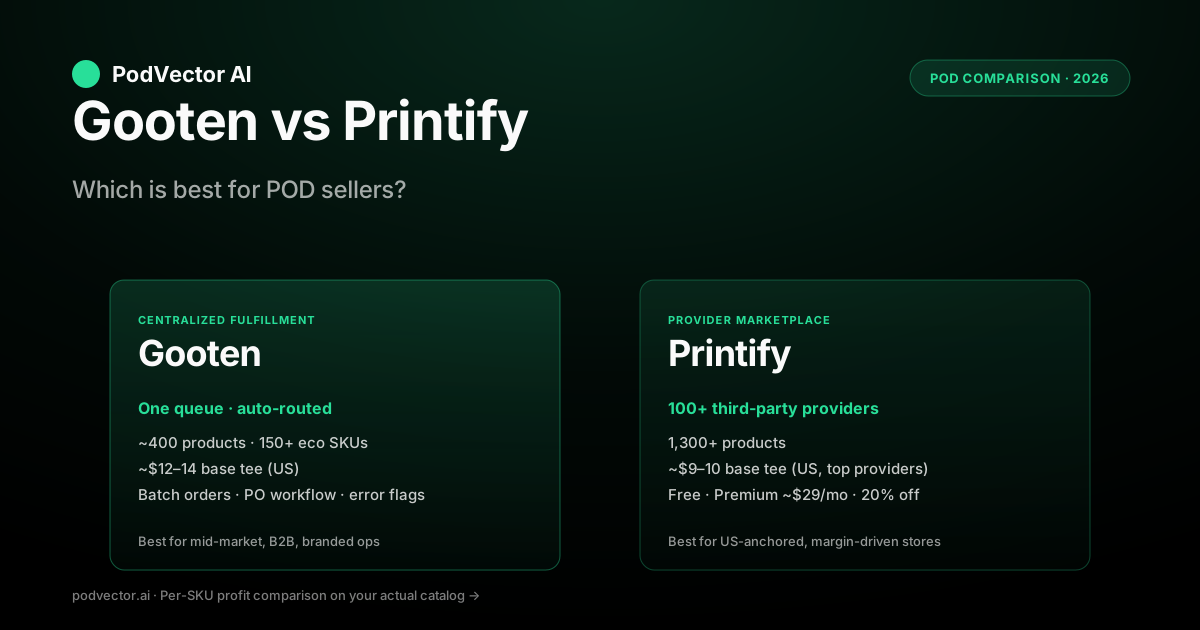
Quick Answer: Gooten and Printify both fulfill print-on-demand orders for stores on Shopify, Etsy, and WooCommerce — but they sit on opposite sides of one design choice. Printify is a marketplace of 100+ independent providers competing on base price, with the lowest unit costs in the category. Gooten is a centralized fulfillment platform that submits one order to its own routing layer and handles production behind the scenes.
Pick Printify if you are price-driven, comfortable picking and vetting providers per SKU, and your store is US-anchored. Pick Gooten if you want a single workflow with batch ordering, error flagging, and enterprise-grade reliability — and you are willing to pay a higher base cost for it.
The right answer for your store sits underneath both options: which SKUs you sell, where buyers live, and which supplier delivers the highest per-order profit after every fee. That is the comparison this article works toward.
The Gooten-vs-Printify decision in 60 seconds
Both platforms cover the same surface job. You upload a design, list a product on your store, and they print and ship when an order comes in.
What changes is what sits between your store and the press. Printify routes each order to a third-party provider you picked when you created the product. Gooten accepts the order into a centralized queue and handles routing, production, and error flagging inside its own system.
That choice cascades through base cost, workflow complexity, quality consistency, and how much operational tax you carry per order. The right pick depends on which trade-off matches your store.
Side-by-side snapshot table
Use this for orientation. Each row hides nuance the sections below unpack.
| Dimension | Gooten | Printify |
|---|---|---|
| Production model | Centralized fulfillment platform with internal routing | Marketplace of 90+ third-party providers |
| Monthly fee | Free — no paid tier | Free; Premium ~$29/mo; Enterprise custom |
| Base unit cost (Bella+Canvas 3001 tee, US) | ~$12–14 | ~$9–10 (top providers) |
| Catalog size | ~400 products | 900+ products |
| Fulfillment network | 30+ manufacturers across 70+ locations | 90+ providers across 100+ locations |
| Print methods | DTG, DTF, sublimation, embroidery, woven | DTG, DTF, UV, all-over print, sublimation |
| Eco-friendly catalog | 150+ sustainable SKUs | Provider-dependent — limited |
| Native integrations | Shopify, Etsy, WooCommerce, BigCommerce, Wix, Storenvy, Magento, Squarespace + API | Shopify, Etsy, WooCommerce, Wix, eBay, Squarespace, BigCommerce, Walmart, TikTok Shop + API |
| Strongest geography | US, with international routing through partners | US (top providers) |
| Branded packaging | Available on most SKUs | Provider-dependent — limited |
| Workflow features | Batch ordering, workflow tags, error flagging, PO management | Per-product provider selection, manual reorder flow |
| Quality consistency | High (single platform, audited partners) | Variable (depends on chosen provider) |
Production model: marketplace vs centralized routing
Marketing pages compete on logos and pricing tables. The thing that determines your margin and refund rate is the production architecture each platform sits on.
Gooten: centralized fulfillment with internal routing
Gooten does not run an open marketplace. It operates more like a single fulfillment company that happens to use a network of audited partners underneath, with the routing layer hidden from you.
You submit one order to Gooten. Gooten decides which facility prints it, where it ships from, and how to handle exceptions. If a partner runs out of stock or has a press issue, Gooten reroutes without involving you.
This is the model that gets enterprises and mid-market sellers to pick Gooten over the cheaper alternatives. Predictability and operational consistency, not the lowest sticker price, are the win.
Printify: open marketplace
Printify is the looser model. It hosts 90+ independent print providers across 100+ locations, each with their own facility, equipment, base prices, shipping rates, and lead times, and lets you pick which one fulfills each product.
That is how Printify hits the lowest base costs in the table above. It is also why Printify's quality and reliability are the most variable — a Bella+Canvas 3001 tee from Monster Digital prints differently than the same SKU from SwiftPOD.
The vetting work is on you. The reward is the lowest sticker price in the category, especially on apparel and mugs shipping inside the US.
Pricing, base costs, and the subscription question
This is the dimension where the two platforms diverge most clearly. The headline number favors Printify; the operational math is more nuanced.
Subscription tiers
Gooten charges nothing per month. There is no paid tier that unlocks discounts — every seller pays the same base costs on the same plan.
Printify offers Premium at ~$29/month, which unlocks a flat ~20% discount across most SKUs. The Premium plan typically pays for itself past 20 orders per month. For a deeper breakdown of when Premium pays off, see the Printify Premium subscription cost breakdown, and if you are stacking a discount on top, the Printify Premium promo code guide covers the current offers.
Base costs in practice
On a Bella+Canvas 3001 tee shipping to a US buyer, Printify's top providers come in around $9–10. Gooten's US fulfillment runs $12–14 on the same SKU.
The pattern holds across categories. Printify tees span roughly $9–34, hoodies $18–62, and mugs $4–19; Gooten tees run about $8–37, hoodies $19–116, and mugs $5–18. The ranges overlap at the low end, but Printify's floor is lower on the SKUs most POD stores sell most.
The gap is meaningful at volume. One thousand tees a month on Printify Premium can save $3–5K versus Gooten on base cost alone.
The flip side is the operational savings Gooten claims. Their pitch — centralized order management, automatic rerouting on partner issues, fewer support tickets — is harder to put a number on, but mid-market sellers running 5,000+ orders a month say it shaves real headcount off the operations team.
The fee that nobody quotes
Refund and reprint rate is the silent line item on every supplier comparison. Suppliers that hand off problems to you take more "where is my order" tickets, more reprint requests, and more refund losses than suppliers that absorb the routing complexity.
Gooten's centralized model absorbs more of this overhead. Printify's marketplace pushes it back onto you — when a provider runs out of stock or misses a deadline, you are the one switching providers and re-uploading designs.
Most operators do not track this gap until it lands in the books. By then it has already eaten the supposed base-cost savings.
Catalog breadth and product range
Printify's catalog is the broadest by raw count. The 900+ products span most apparel, accessories, drinkware, home goods, and pet products you would expect.
Most of that breadth is duplicate SKUs across providers — the same Bella+Canvas 3001 listed by eight different providers — but the long tail does include items Gooten skips entirely.
Gooten's ~400 products is more curated. The lineup leans into apparel, wall art, drinkware, pet products, and home goods, with a deliberate slice of premium and sustainable SKUs that Printify rarely matches.
Gooten's 150+ eco-friendly catalog is the clearest catalog-level differentiator. If your brand sells on sustainability, Gooten has tagged organic and recycled-material SKUs ready to list; Printify can offer some equivalents but coverage is provider-by-provider.
Print quality and consistency
Gooten runs a single quality standard across its fulfillment partners, with the same press specs, file requirements, and color profiles enforced platform-wide. The same SKU produced in two different facilities should look broadly the same.
Consistency is the design goal. Gooten also catches DPI issues, color profile mismatches, and bleed problems before the order reaches production, which removes a class of refund triggers entirely.
Printify's quality is provider-dependent. Top providers — Monster Digital, Duplium, SwiftPOD, Awkward Styles — are reliably good. Lower-tier providers can produce noticeably worse prints, and switching providers requires manually re-publishing the product to your store.
The practical implication: on Printify you need to order samples from every provider you list, every time. On Gooten you can trust the platform-level standard and skip per-partner sampling once you have validated the baseline SKU.
Print methods both platforms run
The underlying print techniques are similar. Both run direct-to-garment (DTG — ink printed straight onto the fabric), direct-to-film (DTF — a transfer pressed onto the garment), and dye-sublimation for all-over prints.
Gooten adds embroidery and woven techniques on more of its apparel line by default. Printify offers UV printing on hard goods and all-over-print on cut-and-sew items, but which method you get depends on the provider you pick — the same SKU can be DTG at one facility and DTF at another.
Shipping speed and fulfillment locations
Shipping speed is downstream of where the product is printed. Both platforms fulfill out of US facilities by default, with international routing handled differently.
United States
Both fulfill US orders out of US facilities, so transit times are similar — typically 2–5 business days after production. Printify's top US providers are slightly faster on average because production is concentrated in fewer high-volume facilities. Gooten's averages are competitive but vary slightly by SKU type.
International orders
Both platforms route some international orders through partners outside the US, but neither matches the depth of a true distributed-production network. Gooten's international coverage focuses on Canada, the UK, the EU, and Australia through partner facilities.
If a meaningful share of your orders ships outside the US, you may be looking at the wrong comparison entirely. The platforms purpose-built for international fulfillment are different category leaders — see Gelato vs Printify for the closest international-focused alternative.
The transit-time tradeoff
Gooten's centralized model occasionally inserts an extra day of routing between order placement and production start, because the system is choosing which facility prints the order. Printify hands the order directly to the provider you picked, so production starts faster.
The end-to-end delivery time often comes out similar — Gooten's routing is fast — but the per-order timeline is more variable on Gooten and more predictable on Printify.
Integrations with Shopify, Etsy, and other channels
Both integrate with the channels that matter — Shopify, Etsy, WooCommerce, Wix, BigCommerce, Squarespace, and the rest of the long tail. The headline list is not the differentiator. What changes is what the integration does once it is connected.
Gooten integrations
Gooten's Shopify, Etsy, WooCommerce, BigCommerce, Wix, Storenvy, Magento, and Squarespace connections cover the same channels Printify does, plus an API and SDK that get used by larger sellers building custom workflows.
The notable strength is the enterprise-grade API. Gooten is the more practical choice if you are running a custom storefront, headless commerce, or a multi-brand operation that needs programmatic order submission with workflow tags.
The notable weakness is the absence of native Walmart and TikTok Shop apps. Sellers on either channel typically pick Printify for that reason.
Printify integrations
Printify integrates natively with Shopify, Etsy, WooCommerce, Wix, eBay, Squarespace, BigCommerce, PrestaShop, Walmart, and TikTok Shop. The selection is the broadest in the category.
Walmart and TikTok Shop in particular are channels where Gooten has no native app. If you sell on either, Printify is the more practical choice without much further analysis.
The catch is that Printify's integration sits on top of a marketplace, so the integration's reliability is partly downstream of which provider you picked. If your chosen provider goes out of stock, Printify can route to a backup only if you set that up in advance.
Backend workflow and operator experience
This is the dimension Gooten leans on hardest in its marketing, and the difference is real once you cross past hobbyist volume.
Gooten's workflow tools
Gooten gives you batch order management, custom workflow tags, error flagging, and purchase-order tooling out of the box. If you are running campaigns, seasonal pushes, or B2B fulfillment alongside DTC, the workflow surface is purpose-built for that pattern.
The dashboard treats orders as a queue you manage rather than as one-offs you process. Errors surface in a single feed, and reroutes happen without you re-touching the order.
Printify's workflow tools
Printify's dashboard is built around the per-product provider selection model. You manage orders one at a time, with provider issues surfaced as red flags on individual orders.
For a single-operator store or a small team, that works fine. For a 10+ person operations team or a multi-brand seller, Printify's interface forces more manual tracking than Gooten does.
This dimension is the cleanest reason to pick Gooten over Printify even at a higher base cost: the headcount savings on a 5,000+ order/month operation can exceed the base cost premium.
Branded packaging and white-label options
Gooten supports branded packing slips, branded inserts, and custom hang tags on most SKUs in its catalog. Coverage is the most uniform among free-tier print-on-demand platforms.
Neck labels and inside-collar branding are available on Gooten's apparel SKUs by request, not as a self-serve feature on every product. The branding workflow is more enterprise-flavored — you contact Gooten to set it up rather than toggling it from the product editor.
Printify's branding depends on the chosen provider. Some top providers offer custom packing slips and branded inserts; others ship in plain Printify packaging with a generic slip.
The per-item add-on costs run close. Printify neck labels start around $0.55 and packaging inserts from about $0.15 on providers that support them. Gooten's neck labels run roughly $2, with custom packing slips free — so Gooten's uniform coverage costs a little more per unit but you never have to check whether a given SKU supports it.
If branding matters, Gooten is the lower-friction path. You verify it once, and the coverage holds across your catalog. On Printify you have to verify each provider individually, and switching providers can change whether a SKU still supports branded packaging.
Customer support and merchant reviews
Support is where the two models show their split again. Printify offers 24/7 chat and email support, and top providers respond fast — but when a problem is a provider's fault, resolution runs through Printify as the middle layer between you and the facility.
Gooten leans on account-managed and ticket-based support, weighted toward its mid-market and enterprise sellers. Because Gooten owns the routing, a production issue is Gooten's to fix, not yours to escalate to a specific partner.
Merchant reviews track the models. Printify scores well on ease of use and catalog on public review sites, with the most common complaint being provider inconsistency. Gooten draws fewer reviews overall but rates highly on reliability and operational fit for larger stores. For a fuller side-by-side of both platforms' support and tooling, Teeinblue's Gooten vs Printify comparison walks the same dimensions in more depth.
Pick X if Y
The shorthand most operators end up using.
Pick Gooten if
You run a mid-market or enterprise operation, your team manages orders in batches, and operational consistency matters more than the lowest sticker price. The workflow tools and centralized routing reduce headcount-equivalent cost in ways that compound past 5,000 orders a month.
You also pick Gooten if branded packaging, sustainability-tagged catalog, or a custom API integration are non-negotiables. The platform is purpose-built for sellers who treat fulfillment as part of the brand, not just a cost line.
Pick Printify if
You sell mostly to US buyers, your catalog is price-sensitive, and you are comfortable doing the provider vetting yourself. The base cost savings on US orders are real and meaningful at volume, especially on the Premium plan.
You also pick Printify if you need items Gooten does not stock (most niche accessories, pet products, specialty drinkware) or if you sell on Walmart or TikTok Shop. For a broader competitive view, see other companies like Printify, and the Fourthwall vs Printify piece is the right read if creator-storefront features are on the table.
Running Gooten alongside Printify
Most sellers past 1,000 orders a month run two suppliers in parallel. The two dimensions most operators split on are catalog (one supplier for apparel, another for home goods) and workflow (Gooten for B2B and bulk; Printify for DTC and one-offs).
The split usually lives inside Shopify as routing rules. Order type or product tag decides which supplier the order draft is created with — Gooten for batch and B2B; Printify for direct-to-consumer.
The operational cost of running two suppliers is real. Reconciling refunds, reprints, and inventory across two systems takes more time than running one. The math only pays off when the per-segment savings on the second supplier exceed the operational overhead, which usually starts being true past four-figure monthly volume.
If you want a third option in the comparison, the Printify topic hub and the broader Printify comparison hub cover the full competitive landscape. For an external decision framework that walks the same trade-offs, Print on Demand Business's Printify vs Gooten breakdown is the cleanest of the public write-ups.
The comparison most sellers actually need
Side-by-side feature tables answer the wrong question. The right question is: across the SKUs my store actually sells, in the countries my buyers actually live in, which supplier produces the highest profit per order after base cost, shipping, payment fees, and refund rate?
That answer is different for every catalog. A Phoenix-based unisex tee brand selling 90% to the US Southwest lands on Printify Premium. A Brooklyn-based premium apparel brand running bulk B2B fulfillment lands on Gooten. A Denver-based dual-channel seller splitting DTC and wholesale lands on one of each, routed by order type.
The right supplier is downstream of your data, not downstream of which review article ranks highest on Google. The supplier comparison you actually want is the one computed against your own orders, not a generic one.
That is the gap PodVector AI sits in. Victor — PodVector AI's AI business employee — connects to your Shopify store, your Printify and Printful accounts, and your Meta and Google ad accounts, and runs the ops on top of them. You ask in plain English: which supplier would be more profitable for my products?
Victor computes the per-SKU answer against your live order history and current supplier base costs, then goes a step further: it proposes the specific supplier switches worth making and, once you approve, updates the listings and routing on Shopify for you — with a full audit trail. It runs the change, not just the report.
FAQs
Which is cheaper — Gooten or Printify?
On base unit cost in the US, Printify's top providers are cheaper by roughly $2–4 per apparel unit, and Printify Premium widens the gap. Once you factor in Gooten's lower refund rate and centralized routing overhead savings, the landed-cost gap shrinks but Printify still wins on raw sticker price.
Can I use Gooten and Printify together on one Shopify store?
Yes. Both install as separate Shopify apps and manage their own product variants and order routing. The work is reconciling reporting across two systems — most sellers do this by tagging Shopify orders with the supplier name and exporting to a single sheet or warehouse.
Which is better for Etsy sellers?
Both integrate natively with Etsy. Printify's Etsy integration is the cheapest to operate at low volume, and Printify's Premium plan often pays off faster on price-sensitive Etsy SKUs. Gooten's Etsy connection works well but the higher base cost is harder to absorb on Etsy's tighter margins.
Which has better print quality?
Gooten has the more consistent print quality because every partner in its network is held to one platform-wide standard. Printify's print quality varies by provider — top providers match Gooten, lower-tier providers do not. The variance is the cost of Printify's cheaper sticker price.
Is Gooten or Printify better for beginners?
Printify is the more forgiving entry point because the free plan, lower base costs, and larger catalog all reduce risk on the first 100 orders. Gooten is better for beginners with bulk or B2B intent, where the workflow tools earn their keep early.
Does Gooten charge a subscription?
No. Gooten has no paid tier — every seller pays the same base costs. Printify Premium at ~$29/month is the equivalent lever there, and it unlocks a flat ~20% discount across most SKUs.
Which is better for enterprise or large sellers?
Gooten is the more common pick at enterprise scale. The centralized routing, batch order tools, workflow tags, and PO management remove operational headcount that adds up fast past 5,000 orders a month. Printify's Enterprise tier exists but is less workflow-focused.
Do both offer branded packaging?
Gooten offers branded packing slips, inserts, and hang tags on most SKUs by default. Printify's branding is provider-dependent and inconsistent — some providers support it, many do not, and switching providers can break the branding setup.
Which is better for sustainability-focused brands?
Gooten has the deeper sustainable catalog with 150+ eco-friendly SKUs tagged as such. Printify can offer equivalents through specific providers but coverage is provider-by-provider, and you have to verify materials and certifications individually.
Can I see this comparison applied to my own store?
Yes — this is what we built PodVector AI for. Connect your Shopify store and Printify account, and Victor compares your live SKUs and order history against benchmark supplier pricing, proposes the switches that win margin, and — once you approve — makes the changes on Shopify for you.
Stop guessing which supplier is more profitable.
Victor — PodVector AI's AI business employee — connects to your Shopify store and Printify account, computes per-SKU landed cost on your live order history, and proposes the switches that win you margin. You ask in plain English. He proposes the action. You approve. He executes it on Shopify with a full audit trail.
Try Victor free