
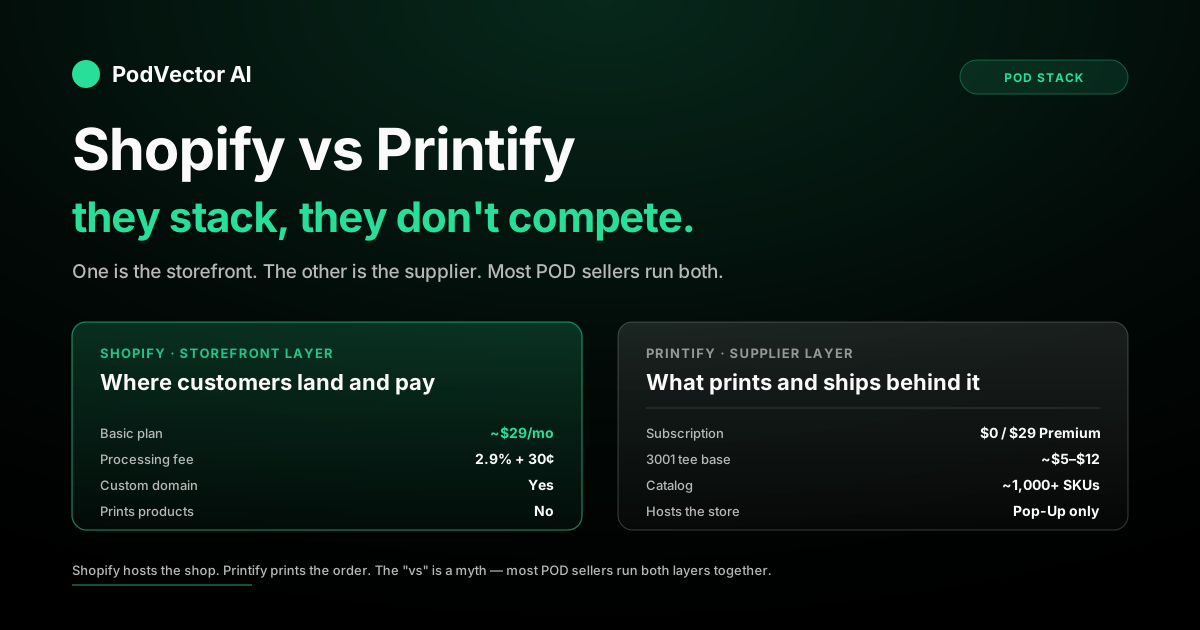
Quick Answer: Shopify and Printify aren't competitors — they do different jobs. Shopify is the storefront where shoppers buy. Printify is the supplier that prints and ships.
For most print-on-demand sellers, the right answer is both: Shopify hosts your store, Printify fulfills the orders behind the scenes. Skip Shopify only if you're testing with Printify's free Pop-Up Store or selling exclusively on Etsy, eBay, or TikTok Shop.
The core difference (and why "vs" is misleading)
Most "Shopify vs Printify" comparisons frame these as two options you choose between. That framing is wrong — and it costs new POD sellers real money.
Shopify is an ecommerce platform. It's the website where customers land, browse, add to cart, and pay you.
Printify is a print-on-demand supplier network. It's the back office that takes your design, prints it on a t-shirt or mug, and ships the package to your customer.
You don't pick one or the other any more than a restaurant picks "dining room vs kitchen." Most POD sellers run both — Shopify on the front, Printify on the back. Asking which is "best" usually means you're asking the wrong question.
The right question: do I need a full Shopify store, or can I get away with Printify's free Pop-Up Store (or selling only on marketplaces like Etsy)? That's the real fork in the road.
What Shopify actually does
Shopify is a hosted ecommerce platform. You pay a monthly fee, and in return you get a complete storefront — domain, themes, checkout, payments, analytics, marketing tools, and an app marketplace.
Think of it as a turnkey website builder built specifically for selling physical goods. You don't write code, you don't host servers, and you don't piece together a payment processor.
What Shopify gives you that matters for POD:
- A real custom domain like yourstore.com — not a sub-page on someone else's marketplace
- Built-in checkout that converts well on mobile (Shopify cites checkout conversion rates ~15% above competing platforms)
- Payment processing through Shopify Payments, with optional Stripe/PayPal add-ons
- An app store with thousands of integrations — including Printify, Printful, and other POD suppliers
- Email and abandoned-cart automation baked into the platform
Shopify doesn't print or ship anything. It's a storefront. You still need a supplier — and that's where Printify comes in.
What Printify actually does
Printify is a print-on-demand network. You upload a design, pick a product (t-shirt, hoodie, mug, poster, etc.), and Printify routes the order to one of its print providers when a customer buys.
You never touch inventory. You don't print, pack, or ship — Printify's network of print partners does all of that. Your only job is design, listing, and marketing.
What Printify gives you:
- Access to 900+ products from a network of 200+ global print providers
- A mockup generator so you can preview designs on products before publishing
- Integration with major storefronts: Shopify, Etsy, eBay, TikTok Shop, WooCommerce, Wix, Squarespace, and more
- A free Pop-Up Store — a basic Printify-hosted storefront if you don't want a full Shopify site yet
- Printify Premium ($39/mo as of Feb 2026, or $299/yr — about $25/mo — billed annually) — gives you up to 20% off base product costs on most items
Printify isn't a storefront in any serious sense. The Pop-Up Store is a starter tool, not a brand. If you want a custom domain, real branding, or any meaningful conversion optimization, you'll outgrow it fast.
Real monthly costs — the itemized math
The "free vs paid" framing obscures the real economics. Let's break down what you actually pay each month under three scenarios.
Scenario A: Printify Pop-Up Store only (no Shopify)
- Printify subscription: $0 (free tier)
- Pop-Up Store: $0
- Base product cost per item: paid only when you sell
- Transaction fees: Stripe/PayPal standard rates (~2.9% + $0.30)
Total fixed cost: $0/mo. Right for absolute beginners testing a single design idea. Not right for anyone serious about brand.
Scenario B: Shopify Basic + Printify free tier (typical starter)
- Shopify Basic: $39/mo billed monthly, or $29/mo billed annually (after the $1/mo intro promo for the first 3 months)
- Printify: $0/mo
- Shopify Payments transaction fee: 2.9% + $0.30 per sale
- Additional Shopify Payments percentage when using third-party processors: 2% (Basic plan)
- Domain: ~$14/yr
Total fixed cost: ~$29–$39/mo + transaction fees. This is the most common starting setup for serious POD sellers. If you only need to sell through social links or a "buy" button rather than a full storefront, Shopify's Starter plan at $5/mo is a cheaper entry point — but it gives you no standalone themed store, so most sellers outgrow it quickly.
Scenario C: Shopify Basic + Printify Premium (margin-optimized)
- Shopify Basic: $39/mo ($29/mo billed annually)
- Printify Premium: $39/mo ($299/yr — about $25/mo — billed annually)
- Up to 20% off base product costs on most items
- Same transaction fees as Scenario B
Total fixed cost: ~$54–$78/mo + transaction fees (lower end if you pay both annually). Premium pays for itself once you're moving roughly 40–60 units a month, depending on margin per item — fewer if you take the annual ~$25/mo rate.
The unit economics that actually matter
Fixed costs are easy to compare. Unit margin is harder — and it's where most POD sellers lose money without realizing it.
A typical Bella+Canvas 3001 t-shirt on Printify costs roughly $9–$12 base + ~$5 shipping. If you sell for $25, your gross is about $8 per shirt. Subtract Shopify's transaction fee (~$0.95 on $25), ad costs (often $5–$10 per sale at scale), and you're frequently at breakeven or worse.
This is why the "Shopify vs Printify" framing matters less than: are you tracking real margin per SKU and supplier? Most sellers don't, and they don't know which products are actually profitable.
One thing the cost math hides: Printify routes the same product to different print providers, and print quality and color saturation vary noticeably between them. Order a sample of any product before you list it — the cheapest provider isn't always the one whose prints hold up, and a wave of returns wipes out a thin POD margin fast. Shipping speed varies by provider too; some US providers hit 2-business-day delivery while others run a week or more.
How they work together (the 90% case)
The standard POD setup looks like this:
- You install the Printify app from the Shopify App Store
- You design products in Printify's mockup generator and push them to your Shopify catalog
- Customers browse and buy on your Shopify storefront at your domain
- Shopify sends the order to Printify automatically
- Printify routes the order to the nearest available print provider
- The print provider produces and ships directly to the customer with your branding (where supported)
Setup takes under an hour. There's no manual order forwarding, no inventory to manage, and no spreadsheet juggling between platforms.
This is the workflow 90% of serious POD sellers use. The friction is essentially zero once it's set up. For a deeper walkthrough of every integration option, see our complete guide to Printify integrations.
When Shopify alone makes sense
Shopify without Printify makes sense if:
- You're selling non-POD products (digital downloads, dropshipped goods from AliExpress, your own inventory)
- You're using a different POD supplier — Printful, Gelato, SPOD, or a niche specialist (embroidery, custom packaging, ceramics)
- You want to mix POD with non-POD products in one store
Shopify integrates with every major POD supplier, so Printify isn't required. The decision usually comes down to product range, fulfillment speed, and unit costs — and Printify isn't always the winner. Compare Fourthwall vs Printify or browse the broader pool of companies like Printify to see how alternatives stack up.
When Printify alone makes sense
Printify without Shopify makes sense in three cases:
1. You're testing an idea with zero budget. Use the Pop-Up Store, run $20 of ads, and see if anything sticks. If a design sells, you graduate to Shopify within a few weeks.
2. You sell exclusively on marketplaces. Etsy, eBay, and TikTok Shop integrate directly with Printify. If you have no plans to drive traffic to a branded site, you don't need Shopify.
3. You're already on WooCommerce, Wix, or Squarespace. Printify integrates with all of these. Shopify isn't the only host that works.
The rest of the time — if you want a real brand, a real domain, and real conversion optimization — Shopify earns its monthly fee.
A decision framework for POD sellers
Skip the feature checklist. The real decision tree is shorter:
Selling on Etsy/eBay/TikTok only? Printify alone, free tier.
Want a branded site, no budget yet? Printify Pop-Up Store as a 4-week sanity check, then upgrade.
Ready to build a real brand? Shopify + Printify free tier. Add Premium when you're moving 30+ units/month consistently.
Doing $5K+ revenue/month? Shopify + Printify Premium, and start tracking per-SKU margin obsessively. Look at Printify alternatives for products where another supplier has better unit economics.
Most beginners overthink the platform choice and underthink the unit economics. The platform decision is reversible; a bad cost basis on a hot SKU bleeds margin for months before you notice.
Operator checklist before you commit
Before signing up for either tool, get clear answers to these questions:
- Where will my traffic come from? Ads → Shopify usually. Organic Etsy → Printify alone may work.
- What's my target price point? Sub-$20 products struggle to absorb Shopify's monthly fee at low volume.
- How will I track margin per SKU? Shopify's analytics show revenue, not margin. You need to subtract POD base cost, shipping, transaction fees, and ad cost per order.
- Which suppliers cover my product mix? Printify is broad but not exhaustive. Some niches (premium embroidery, ceramics, specialty paper) have better dedicated suppliers.
- Have I ordered a sample? Print quality and shipping speed vary by Printify provider. Buy one of your own products before listing it — returns from a low-quality print eat a POD margin alive.
- What's my breakeven point on Shopify Basic? At $39/mo ($29 annual) and $5 margin per shirt, you need roughly 6–8 shirts/month to cover the platform alone — before ads, taxes, or anything else.
For a full breakdown of how Printify works end-to-end — accounts, products, pricing tiers, integrations — see the complete Printify guide.
For a deeper SERP-tested comparison that pairs well with this one, StyleFactory's Printify vs Shopify breakdown goes deep on theme and app ecosystem differences.
FAQs
Is Printify the same as Shopify?
No. Shopify is a storefront platform — the website your customers visit. Printify is a print-on-demand supplier — it prints and ships products. They serve different roles in the same business, which is why most POD sellers use both together.
Can I sell on Printify without Shopify?
Yes. Printify offers a free Pop-Up Store, plus integrations with Etsy, eBay, TikTok Shop, WooCommerce, Wix, and Squarespace. Shopify is the most popular host for serious sellers, but it's not the only option.
Is Shopify more expensive than Printify?
Shopify Basic is $39/month billed monthly ($29/month if you pay annually), and Shopify also has a $5/month Starter plan for link/social selling. Printify is free with no monthly cost on its starter tier; you only pay for products when customers buy. Printify Premium adds $39/month ($299/year, about $25/month annually) for discounted base product costs. The cheapest setup is Printify alone with a Pop-Up Store at $0/mo fixed.
Do I need Printify Premium to make money on POD?
Not at the start. Premium becomes worth it once you're moving roughly 40–60 units per month — the 20% base-cost discount on most products typically covers the $39/mo subscription somewhere in that range (fewer units if you take the $299/yr annual rate of about $25/mo), depending on which products dominate your mix.
Which is better for beginners — Shopify or Printify?
Printify alone with a free Pop-Up Store is the lowest-risk way to test a POD idea. Once you've validated demand for a design, upgrading to Shopify lets you build a real brand and run paid ads more effectively.
Can Printify replace Shopify entirely?
For hobbyists and marketplace-only sellers, yes. The Pop-Up Store handles checkout and order routing. For anyone building a brand, running paid ads, or scaling past a few hundred dollars in monthly revenue, the Pop-Up Store's limitations (no custom domain, minimal design control, weak analytics) make Shopify the better long-term home.
How do I integrate Printify with Shopify?
Install the Printify app from the Shopify App Store, connect your Printify account, design products in Printify's mockup generator, and publish them to your Shopify catalog. Orders flow to Printify automatically — no manual steps once it's set up. Total setup time: under an hour.
Does Shopify charge transaction fees on top of Printify costs?
Shopify charges 2.9% + $0.30 per transaction on Shopify Payments (Basic plan). If you use a third-party payment processor like Stripe or PayPal directly, Shopify adds an extra 2% on top. Printify's base product cost and shipping are separate — those come out of your gross margin.
Know your real margin per SKU and supplier
Most POD sellers can't answer a simple question: which products and suppliers are actually profitable after every fee? Shopify shows revenue. Printify shows base cost. Neither shows true margin per SKU once ads, transaction fees, and shipping are netted out.
Victor is an AI employee for POD sellers. Ask Victor "which supplier would be more profitable for my products?" or "what's my real margin on each SKU after ad spend?" and get an answer with live numbers — not a spreadsheet you have to build yourself.
Try Victor free