
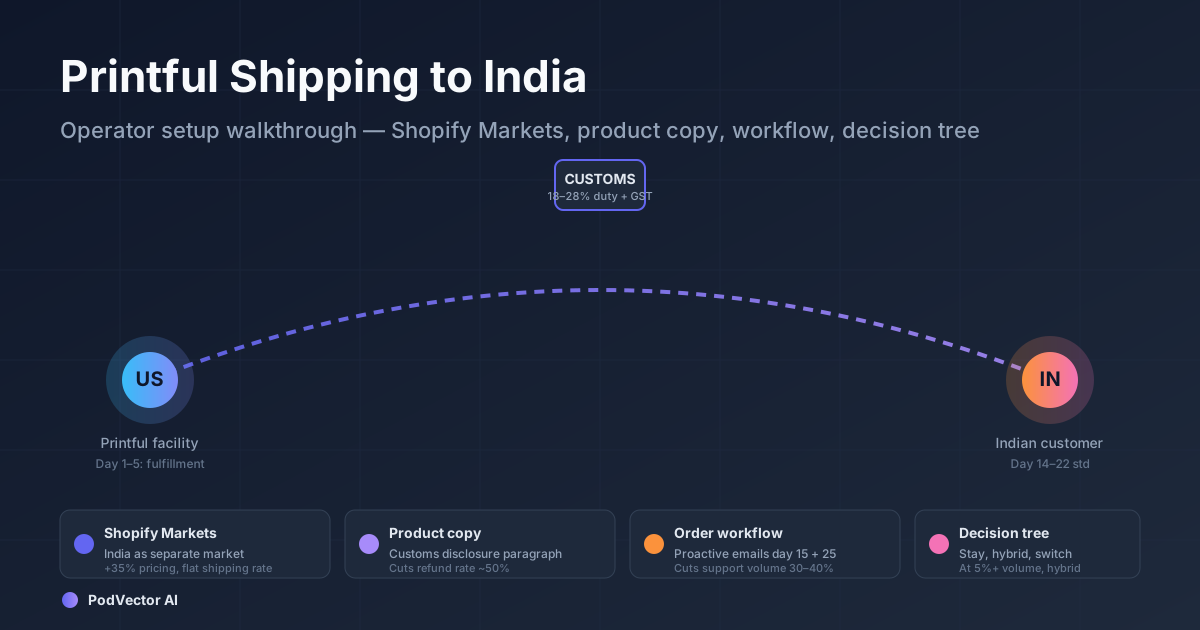
Quick Answer: Yes, Printful ships to India through its "Worldwide" zone, but the default setup most sellers run will quietly lose money on Indian orders. Standard shipping lands in 10–28 business days door to door at roughly $11.99 for the first T-shirt, and the Indian customer pays another ~18–28% in customs and GST at delivery that Printful never collects.
This is the operator-setup walkthrough — what to configure in Shopify, what to write on the product page, how to handle the order when it lands, and when to stop and switch to a local Indian provider instead.
For the underlying cost numbers and customs math, the Printful India shipping economics breakdown covers them in detail. This article assumes you've seen those numbers and want to actually ship the orders.
Before you turn India on: three checks
Most stores serving India through Printful never made an active decision to do it — India was just on by default because the store accepted all countries. That's the source of most India-related margin leak.
Run three checks before you keep India turned on:
1. Are you actually getting India orders? Pull your last 12 months of orders by country. If India is under 1% of order volume and you're not actively marketing there, the simplest move is to turn India off in the Shopify shipping zone. The configuration time to do India right is not worth it for a handful of orders.
2. If India is 1–5% of volume, are those orders profitable? Most aren't, because the default US-tuned shipping price under-quotes the Worldwide-zone rate. You're either eating the difference or your customer is paying surprise duties and refunding. Either way, the per-order economics are negative until you reprice.
3. If India is 5%+ of volume, are you sure Printful is the right fulfillment partner? At that volume, a local Indian POD provider (Qikink, Printrove, Blinkstore, OOWIA) almost always wins on cost, speed, and customs avoidance. See the decision tree below.
Shopify Markets setup for India
Shopify Markets is the right tool for serving India distinctly from your US/EU customers. The configuration is straightforward but easy to miss steps on.
Create India as its own Market. In Shopify Admin → Settings → Markets, add India as a separate market (not bundled into "International"). This gives India its own pricing rules, currency, and shipping rate table.
Set India pricing 30–50% higher than your US store. The bump covers the Worldwide-zone shipping delta plus the customs absorption if you choose to prepay. A T-shirt at $25 in the US should be $32–38 in your India market. Use Shopify's "Adjust prices" feature with a +35% rule against your base catalog.
Configure shipping zones. Add India to its own shipping zone. Set a flat-rate of $14 for first item / $7 each additional, or build in a small buffer ($16/$8) if you want to absorb minor rate fluctuations. Don't use "Calculated rates from Printful" for India — the live calculator works, but the user-perceived shipping line at $11.99 reads more expensive than a baked-in $14 with "free shipping over $X" framing.
Pick a currency strategy. Either charge USD across all markets (simpler, but Indian customers see foreign-currency conversion on their card statement and bank fees) or charge INR via Shopify Payments multi-currency (cleaner UX, slightly worse exchange rate). Most sub-5%-India stores stay on USD; India-focused stores should charge INR.
Tax settings. Don't try to collect Indian GST at checkout through Shopify — you're not an Indian GST-registered business, and the customer pays IGST on import anyway. Leave India tax as "not collected" and disclose import duty separately in product copy (see next section).
Product-page copy that prevents refund tickets
The single highest-leverage thing you can do for Indian Printful orders is one paragraph on the product page. Customs surprise is the #1 driver of India refund requests and 1-star reviews — and it's entirely preventable with disclosure.
Add this block to the product description or shipping info section for any product sold to India:
Shipping to India: Standard delivery takes 14–22 business days door to door, including Indian customs clearance. Express delivery (1–3 business days carrier transit) is available at checkout for an additional fee. Indian customers should expect approximately 18–28% in customs duty and GST on delivery, paid in cash to the courier. These charges are set by Indian customs and are not collected by our store.
That paragraph does four jobs at once:
- Sets the right transit-time expectation (14–22 business days), avoiding the day-15 "where's my order" ticket
- Discloses the duty bracket so the customer isn't surprised on delivery
- Pre-positions express as an upgrade path (some customers will self-select up)
- Names the customs authority as the charging party, which prevents the "you didn't tell me" refund argument
Operator-reported numbers on this disclosure: refund-request rate on India orders drops by roughly half, and 1-star reviews citing customs surprise drop to near zero. The conversion-rate hit from the disclosure is usually under 5% — meaningful, but smaller than the support-and-refund cost it prevents.
What happens when an Indian order comes in
Walk through the actual sequence of events on an Indian Printful order, so you know what to watch for and where to set automated alerts.
Day 0 — Order received. Printful auto-pulls the order from Shopify, routes to the closest fulfillment facility (usually a US facility for India). Order moves to "In production" within a few hours during business days.
Day 1–5 — Fulfillment. Printing, pressing, packing. Indian orders aren't prioritized differently from US orders. A multi-item order may split across facilities — watch the order detail for "ships in 2 packages" notes that change the per-package customs treatment.
Day 3–7 — Hand-off to carrier. For standard, the order goes to a mail consolidator (Asendia, USPS International, etc.) that batches Indian shipments for the international leg. Tracking shows "shipment information received" but no movement for 1–3 days while the batch fills.
Day 5–15 — International transit. Air freight to a major Indian gateway (Delhi, Mumbai, Bangalore, Chennai). Tracking goes silent for most of this leg under standard shipping. Don't reply to "where is my order" tickets during this window with "it's lost" — it's almost always still in transit.
Day 12–18 — Indian customs clearance. Parcel enters Indian customs at the destination airport. Most clear in 1–4 business days; some get held for documentation requests (PAN card, KYC) on higher-value parcels. The carrier or India Post contacts the recipient directly for documentation — there's nothing you can do as the seller to speed this up.
Day 14–24 — India Post / domestic courier handoff. Once cleared, the parcel moves to India Post or a domestic courier (DTDC, Blue Dart) for last-mile delivery. Tracking often updates only once or twice in this leg.
Day 18–28 — Delivery and duty collection. Recipient pays customs duty and GST in cash to the delivery person, then receives the parcel. This is where customer experience makes or breaks — pre-disclosed duties go fine, undisclosed ones generate chargebacks.
Set automated alerts in your support tool at day 15 (proactive "your order is in transit" email with the customs-duty reminder) and day 25 (proactive "if you haven't received your order, please check with your local courier" email). Both proactive emails cut inbound support volume on India orders by 30–40%.
When to push express on India orders
Standard shipping is the default and works for the majority of Indian orders. But there are three specific cases where steering the customer toward express at checkout is the right call.
Order value over $60. The express premium ($30–60) is a smaller share of the cart. More importantly, higher-value parcels are more likely to get held in Indian customs for documentation — and express's end-to-end DHL/FedEx tracking gives the customer a clear path to resolve the hold themselves. Standard shipments at high value often disappear into India Post and generate the worst support tickets.
Time-sensitive products. Wedding gifts, event merchandise, holiday-deadline items. The 6–8 business day express window is the only realistic option; standard's 14–22 days will miss the date. Add an express upsell module to the cart for product categories where this matters.
Repeat customers. Customers who've ordered from you before are more sensitive to the experience than first-time buyers. Express's reliable tracking and faster delivery keeps the relationship intact in a way that another 21-day wait does not.
For everything else, standard works. Don't push express as the default — the price gap is large enough that it tanks conversion on price-sensitive single-item orders, which are most of the volume.
Support ticket templates for India-specific issues
Three ticket types account for roughly 85% of India-related support volume. Pre-written templates cut your handle time and keep the tone consistent.
"Where is my order?" (received between day 10 and day 18). Reply: confirm tracking number, note that the order is in international transit or Indian customs, give the expected delivery window in calendar days from today, and remind them of the customs duty due on delivery. Don't speculate about delays; the order is almost always tracking normally.
"I had to pay customs duty / I didn't expect this charge." Reply: thank them for paying, acknowledge that Indian customs charges are unavoidable for cross-border orders, reference the disclosure on the product page or in their order confirmation. Do not refund the duty — it's not a service-failure refund and refunding sets a precedent that breaks the unit economics. If they leave a poor review, respond publicly with the same explanation; future readers see the disclosure was in place.
"My order arrived damaged / wrong item." Same process as US orders — open a Printful support ticket with photos, request a reprint. Indian reprints take another 14–22 business days and double the original shipping cost from a P&L perspective. Build the higher reprint cost into your India pricing buffer.
For the underlying breakdown of why Indian carriers behave this way and what it means for cost, see the Printful printing and shipping handoff guide. For carrier-level transit detail across regions, the Printful holiday shipping deadlines guide covers the date-sensitive cases.
Decision tree: stay on Printful or switch to a local provider
The honest answer for most stores is some hybrid setup. Use this decision tree to figure out which side you're on.
India is under 1% of order volume: stay on Printful. Configure the disclosure copy, set the India shipping rate buffer, and don't think about it again. The configuration overhead of a second provider isn't worth it. If you're a Printful Growth or Plus member, the per-order shipping discount narrows the Worldwide-zone gap further — see the Printful membership cost breakdown and the Printful membership pricing breakdown for which tier breaks even at what volume.
India is 1–5% of order volume, US-anchored brand: stay on Printful, but with the full setup walked through above — Shopify Markets, pricing buffer, customs disclosure, proactive email cadence. India will be a thin-margin segment but won't lose you money.
India is 5–15% of order volume: hybrid. Keep Printful for your main US/EU catalog and add a local Indian POD provider (Qikink, Printrove, Blinkstore) for India-only SKUs. Route India orders to the local provider via Shopify Markets routing. The break-even point — where the cost savings on India orders cover the operational overhead of running two providers — usually lands around 5–8% of volume.
India is over 15% of order volume: switch the India segment fully to a local provider. Printful's Worldwide-zone economics don't recover at scale; you're leaving meaningful margin on the table every month you don't switch. Many sellers in this bracket also discover they should be running an India-specific brand or product line, separate from the US/EU catalog. Indian POD provider OOWIA's print-on-demand-in-India primer covers the local-fulfillment side of this trade-off from the other direction.
India-focused brand from day one: don't use Printful at all. Start with a local Indian provider. Printful is built for global stores serving Indian customers occasionally, not for stores whose primary market is India.
For the per-region comparison of Printful's other shipping tiers, the US vs EU shipping breakdown shows what a dedicated region looks like. The Printful shipping cluster hub indexes the full set of shipping articles, and the Printful topic hub covers pricing, taxes, and product specifics across the platform.
How to track whether India is actually profitable
The reason India-segment margin drifts negative without anyone noticing is that aggregate "International" reporting buckets India in with everything else. India typically runs the worst per-order economics of any country a US-anchored store serves, but it's averaged out by better-performing markets like Canada or Australia.
The numbers you need to track separately for India:
- Gross margin per India order: retail price − Printful base cost − Printful shipping cost − any India-specific marketing spend, broken out as a country dimension
- Refund rate per India order: refunds issued ÷ orders shipped, by country
- Late-delivery rate: orders delivered beyond your quoted window ÷ orders shipped, by country (requires joining tracking data with order data)
- Support ticket rate: tickets opened ÷ orders shipped, by country (requires joining support tool data with order data)
- Customs-duty refund requests: a flag on tickets specifically about duty surprise, by month
Spreadsheets handle the first one. The rest require joining Printful order data, Shopify order data, tracking data, and support ticket data — four different sources with different shapes and update cadences. That's the kind of question a unified data layer answers naturally and a spreadsheet answers badly.
A live data warehouse fed by Printful, your store, your carrier tracking, and your support tool surfaces "India gross margin per order, by month" or "India refund rate vs US refund rate this quarter" without a manual export-and-pivot cycle. An AI employee on top of that answers the same questions in plain English, so the operator doesn't need to write SQL or own the join logic.
Without that separate visibility, India quietly drifts. With it, you get the signal that triggers the decision-tree branch — stay, hybrid, or switch — before you've spent six months losing money on a segment you couldn't see.
FAQs
How do I configure Shopify to ship Printful orders to India correctly?
Create India as its own Shopify Market. Set product pricing 30–50% higher than your US store to cover Worldwide-zone shipping and any customs absorption. Configure a flat shipping rate of $14 first item / $7 each additional. Leave India tax as "not collected" — the customer pays IGST on import directly. Add the customs disclosure paragraph to product descriptions so the duty isn't a surprise on delivery.
Do I need to register for Indian GST to sell into India via Printful?
No. You're a foreign business shipping into India; the import duty and IGST are collected by Indian customs from the recipient at delivery, not by you at checkout. You don't need an Indian GST registration. You should disclose the duty in product copy so customers aren't surprised.
Should I offer free shipping on India orders?
Only if you've baked the $12–16 shipping cost into the product price. A genuinely free-shipping promotion at US pricing levels will lose money on every India order. If you set India pricing 30–50% above US pricing, "free shipping" works as a marketing line because the cost is in the product.
How do I handle a customer who refuses to pay customs duty on delivery?
The parcel returns to Printful as undeliverable. Printful charges a return fee (typically $5–10) and doesn't refund the original shipping. You're out the product cost, original shipping, and return fee — usually $20–30 per incident. Pre-disclosure cuts this to near zero. If it still happens, the standard policy is no refund (the disclosure was in place), but flag the customer for an internal block on future orders.
Is express shipping to India ever worth offering as the only option?
For luxury or time-sensitive product categories, yes — wedding gifts, event merchandise, premium-priced items. The $30–60 express premium reads as reasonable on a $80+ cart and the 6–8 business day delivery is genuinely competitive with local Indian alternatives. For standard apparel at $20–35 retail, express as the only option tanks conversion.
Can I use Printful's order-routing feature to send India orders to a local provider automatically?
Not directly through Printful, but yes through Shopify Markets + a second fulfillment app. Configure your Indian provider (Qikink, Printrove, Blinkstore) as a second fulfillment service in Shopify, then use Shopify's location-based routing to send India-zone orders there while Printful handles everything else. This is the cleanest hybrid setup for stores at 5–15% India volume.
What's the worst case delivery time I should plan for?
30 business days door to door for standard shipping is the realistic worst case during peak periods (Diwali, monsoon-impacted regions, customs backlogs). Quote 14–22 business days as the standard window but build your support team's escalation trigger at day 30. Below day 30, almost every "lost" order is still moving.
Why is the existing PodVector AI article on Printful India shipping different from this one?
The Printful India shipping economics teardown covers the cost structure, customs math, and margin analysis in detail. This article is the practical setup walkthrough — what to configure in Shopify, what to write on product pages, how to handle the order workflow, and how to decide when to switch providers. Read both if you're serious about India: the economics article tells you what you're dealing with, this one tells you how to operate inside those constraints.
How do I know if India is actually profitable for my store?
Calculate gross margin per India order (retail − Printful base cost − Printful shipping cost − any India marketing spend), refund rate by country, late-delivery rate by country, and support ticket rate by country. Aggregate "International" reporting hides India underneath better-performing markets like Canada and Australia. Per-country tracking is the only way to know if India is paying for itself.
India quietly drifts negative when "International" reporting averages it with Canada and Australia.
Per-country margin, refund rate, late-delivery rate, and support ticket volume — the four numbers that tell you whether India is paying for itself — live in four different tools. Printful has the shipping cost. Shopify has the retail price. The carrier has the delivery timestamps. Your support tool has the ticket tags. Pulling them together every month for an India-specific view is the kind of work that doesn't happen.
Victor connects your Printful, store, and support data into a live data warehouse and answers questions like "what's my India gross margin this quarter?" or "which countries are losing me money?" in plain English. The drift becomes visible before it becomes a problem.
Try Victor free