
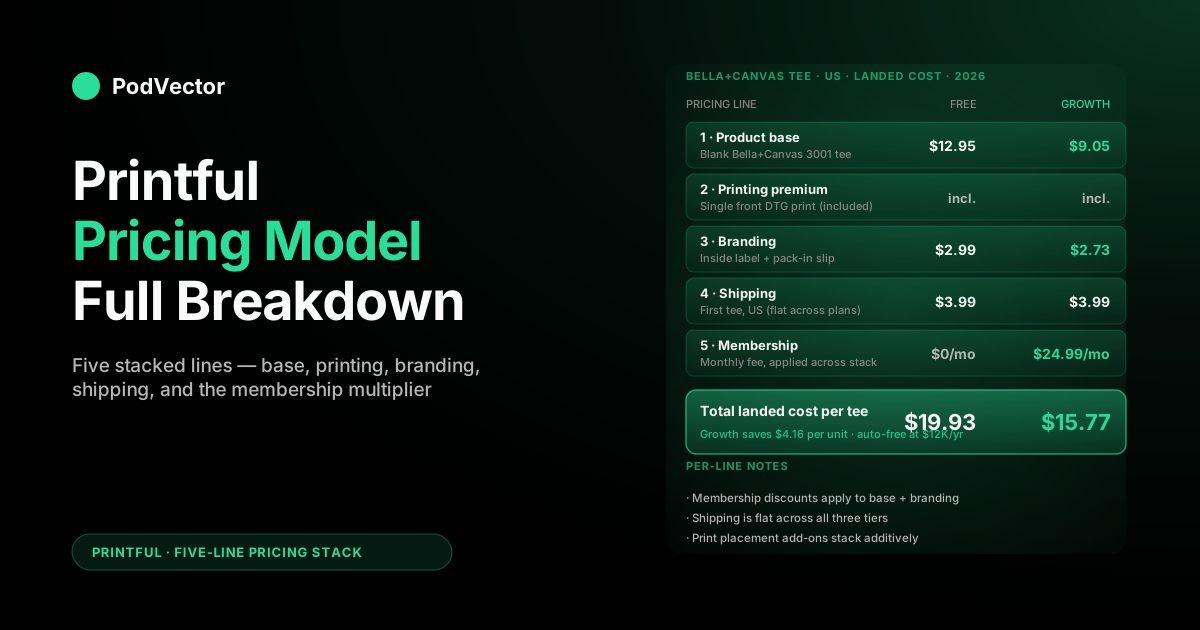
Quick Answer: Printful's pricing model has five stacked lines — product base price, printing technique premium, branding and customization add-ons, shipping, and an optional membership multiplier. Every order you ship pays at least three of them; the line stack — not the headline base price — is what sets your real per-unit cost.
A typical Bella+Canvas 3001 tee in the US lands at $12.95 base + $3.99 shipping on the Free plan, dropping to roughly $9.05 + $3.99 on Growth's 33% discount. Branded labels, additional print placements, and embroidery digitization stack on top.
This guide walks every line of the model, shows how they compound on a worked example, and explains where most POD sellers leak margin without realizing it.
How the Printful pricing model works
Printful runs a pay-as-you-go model with a layered fee structure. You pay nothing until a customer places an order — then Printful charges you the unit cost on a per-order basis and ships directly to your customer.
"Unit cost" is doing a lot of work in that sentence. The real number is a stack of five lines, each set independently and each interacting with the others. The official tier sheet lives on the Printful pricing page — we cross-reference it where helpful.
This guide sits in our Printful costs and charges cluster, part of the broader Printful topic hub. The angle here is the whole stack, not any one line.
| Pricing line | What you pay for | Range on a US Bella+Canvas tee |
|---|---|---|
| Product base price | The blank garment, mug, or canvas | $9.05–$13.50 |
| Printing technique premium | Surcharge for DTG, DTF, embroidery, or AOP | Included in base for DTG; +$2.20–$5.25 for extra placements |
| Branding and customization | Labels, slips, pack-ins, premium images | $0.50–$3.48 per unit |
| Shipping | Carrier and zone-based fee | $3.99 first US tee, $2.00 each add'l |
| Membership multiplier | Subscription fee, applied across the stack | $0 / $24.99 / $49.99 per month |
The trap is treating the model like a single price. Two stores selling the same Bella+Canvas tee at the same retail price can have wildly different margins — because one is on Growth with no branded labels, and the other is on Free with inside labels and a pack-in slip.
The five stacked lines
Every Printful order pays at least three lines: product base, shipping, and any printing premium baked into the catalog price. The other two — branding and membership — are opt-in but compound the math fast.
The order they apply in matters. Membership discounts apply to base price and branding fees, not to shipping or digitization. Shipping rates are flat per zone regardless of membership. Branding fees are discounted by 9–13% on paid tiers but never go away.
The next five sections walk each line individually. The worked example below stacks all five on a single SKU so you can see how the numbers compound.
Line 1: Product base price
The base price is the blank-product cost before any print, label, or shipping. It's the line Printful's catalog page shows first.
2026 base prices for the most-shipped Printful SKUs, on the Free plan:
| Product | Free base price | Growth base price |
|---|---|---|
| Bella+Canvas 3001 t-shirt | $12.95 | $9.05 |
| Gildan 18500 hoodie | $26.50 | $19.95 |
| Champion S700 hoodie | $31.95 | $24.05 |
| 11oz ceramic mug | $8.95 | $8.95 |
| iPhone tough case | $16.95 | $16.95 |
| Canvas print 12×16 | $26.50 | $25.18 |
Two patterns to notice. Apparel base prices drop sharply on Growth — Bella+Canvas tees fall about 30%, hoodies fall 20–25%. Hard goods barely move. Mugs and phone cases get no membership discount at all.
For a SKU-level deep dive on the most-shipped tee, see our Bella+Canvas 3001 base cost breakdown or the broader Printful t-shirt base price breakdown. They walk size-up fees and color premiums on the same catalog.
Line 2: Printing technique premium
Printful runs four printing techniques, each with a different cost profile. The base price you see in the catalog already includes the default technique and a single front print placement.
DTG (direct-to-garment) — the default for tees, the cheapest, and the technique you'll pay for unless you opt out. Front print included in the base. Back print adds $5.25. Sleeve or pocket print adds $2.20.
DTF (direct-to-film) — used for poly-blend tees, performance wear, and any garment that DTG can't print on cleanly. Same surcharge schedule as DTG for additional placements.
Embroidery — used for caps, polos, and any structured garment where stitched logos beat printed ones. Embroidery has a one-time digitization fee per design ($2.95–$6.50), then a per-placement charge. For a deep dive on the SKU pricing here, see our Bella+Canvas 3001 full cost breakdown.
AOP (all-over print) — used for cut-and-sew apparel where the print covers the entire panel. Higher base price than DTG because it's a different garment construction. No additional-placement fees — the print is the construction.
| Printing line | Cost | Notes |
|---|---|---|
| Default front print (DTG/DTF) | Included in base | One placement, max 14"×16" |
| Back print | +$5.25 | Per unit, second placement |
| Sleeve or pocket print | +$2.20 | Per unit, per placement |
| Embroidery digitization | $2.95–$6.50 one-time | Per design, lifetime |
| Embroidery production | Varies by stitch count | Embedded in catalog price |
| Premium image / Getty asset | +$1.00 per image / placement / unit | Per unit, recurring |
The line most stores underestimate: premium images. If your design uses a Getty or premium-stock element loaded through Printful's design tool, that $1 charges per unit, per placement. A two-sided design with one premium image on each side adds $2 to every order you ship for the life of the SKU.
Line 3: Branding and customization add-ons
Branding is the line that turns a generic POD product into a branded one. It's also the line with the most operator regret — branded labels feel cheap individually and stack into real money fast.
| Branding line | Free plan | Growth (9% off) | Business (13% off) |
|---|---|---|---|
| Inside label (printed) | $2.49 | $2.27 | $2.17 |
| Outside label (printed) | $2.49 | $2.27 | $2.17 |
| Sewn-in woven label | $3.95 | $3.59 | $3.44 |
| Pack-in slip | $0.50 | $0.46 | $0.44 |
| Custom shipping label | $0.49 | $0.45 | $0.43 |
| Branded mailer (when available) | $2.49 | $2.27 | $2.17 |
A fully branded tee — inside label, pack-in slip, branded mailer — adds roughly $5.50 per unit on Free and $5.00 on Growth. On a $24.95 retail tee with $12.95 base and $3.99 shipping, that branding line is the difference between a 28% margin and an 8% margin.
Branding is the line that most justifies upgrading from Free to Growth (or Growth to Business), but only if you're shipping enough branded units to amortize the subscription. The break-even math is in our Bella+Canvas 3001 full cost breakdown.
Line 4: Shipping
Shipping is the line membership does not touch. Every plan pays the same shipping rates — the discounts apply to base price and branding, not to the carrier fee.
2026 US shipping rates for the most common product categories:
| Product | First item | Each additional |
|---|---|---|
| T-shirt / tank | $3.99 | $2.00 |
| Long sleeve / sweatshirt | $4.69 | $2.30 |
| Hoodie | $5.49 | $3.00 |
| 11oz mug | $4.99 | $2.30 |
| Phone case | $3.99 | $1.65 |
| Canvas print 12×16 | $7.99 | $3.49 |
Shipping outside the US runs significantly higher. Canada averages $8.29 first tee, EU $4.79 first tee, Asia-Pacific $7.99–$10.99 depending on country. For the full zone table on tees, see our Printful USA t-shirt shipping rates breakdown.
Delivery time is the other shipping variable. Production averages 2–5 business days, then carrier transit on top. For the full timing breakdown across product categories, see our Printful shipping time guide.
Line 5: Membership tier multiplier
Membership is the only Printful pricing line you pay before you ship a unit. It's also the line that multiplies across every order — the discount applies to base price and branding for every unit you sell.
| Tier | Monthly fee | Product discount | Branding discount | Sample discount |
|---|---|---|---|---|
| Free | $0 | 0% | 0% | 20% |
| Growth | $24.99 (auto-free at $12K/yr) | Up to 33% apparel | 9% | 25% |
| Business | $49.99 | Up to 33% apparel | 13% | 25% |
The two facts most operators miss. The "up to 33%" product discount is structurally an apparel discount — mugs, phone cases, and stickers get 0% off on Growth. And the auto-free trigger at $12K/year sales means Growth costs you nothing once your store crosses that revenue threshold.
For a deeper dive on tier choice and break-even math, see our Printful t-shirt base price breakdown — it walks the discount applied per Free vs Growth unit on the most-shipped catalog SKU.
Worked example: a Bella+Canvas tee, end to end
Here's the full pricing model stacked on a single SKU. White Bella+Canvas 3001 tee, size L, single front DTG print, shipped to a US customer with an inside label and a pack-in slip.
| Pricing line | Free plan | Growth plan |
|---|---|---|
| Product base price | $12.95 | $9.05 |
| Default DTG front print | Included | Included |
| Inside label | $2.49 | $2.27 |
| Pack-in slip | $0.50 | $0.46 |
| Shipping (first tee, US) | $3.99 | $3.99 |
| Total landed cost | $19.93 | $15.77 |
At a $29.95 retail price, that's a 33% margin on Free and a 47% margin on Growth — before payment processing fees, your ad spend, and any returns. The Growth discount adds $4.16 to your margin on every tee.
Across 100 tees a month, that's $416 in monthly savings against a $24.99 subscription. Across 500 tees a month, it's $2,080.
The same SKU with a back print and an outside label adds another $5.25 + $2.27 to the Growth math, pushing landed cost to $23.29 and margin to 22%. That's the line stack working against you when you don't watch it.
How the lines interact
The pricing lines don't apply independently — they compound. Three interaction rules to keep in your head.
Membership multiplies base and branding, not shipping. Growth's 33% discount on a $12.95 tee saves $3.90. Growth's 9% discount on a $2.49 label saves $0.22. Growth saves nothing on the $3.99 shipping line.
Printing premiums stack additively, not multiplicatively. A back print is $5.25 on Free, $5.25 on Growth. Membership doesn't discount print placements — only base prices and branding. The same goes for embroidery digitization.
Currency conversion compounds across every line. If you bill in EUR or GBP, your bank's exchange rate hits the base, the branding, the shipping, and the membership fee individually. Run the worked example in your bill currency — the per-unit landed cost will differ by 1–4% from the USD math.
Where most POD sellers leak margin
The pricing model is publicly documented. The leaks are quiet, gradual, and almost always come from the same five places.
Premium image fees. $1 per unit, per placement, for any Getty or premium asset in your design. A store running a 100-tee/month SKU with one premium image leaks $1,200 a year. Audit your design files before launching any new SKU.
Additional print placements added during refresh. A SKU launched as a single front print gets a back print added during a "refresh." The base SKU now costs $5.25 more per unit and your margin model wasn't updated.
Address-correction reships. A bad address triggers a reship at full base + shipping. Printful charges $6.99–$9.99 per US tee incident. Stores running 200+ orders/month average 4–8 of these monthly.
Sample orders over the monthly cap. Free and paid plans cap discounted sample orders at one per month with three products. The fifth, sixth, and seventh sample order of the month pay full base price plus full shipping.
The discount-mix shift. You launch a new mug SKU and your apparel-to-hard-goods ratio drops below 60%. Suddenly Growth's product discount covers a smaller share of your catalog, and the membership pays back at a lower rate without anyone telling you.
Each one is small individually. Stacked across 12 months and a moving product mix, they can erase 5–10 percentage points of margin.
Tracking the full stack against revenue
The Printful invoice shows every line — base, printing, branding, shipping, membership — but it shows them per order, not per SKU per month. To see the real margin on each SKU, you need to roll the lines up and pair them with your storefront's retail prices.
Most operators run this in a spreadsheet. That works at a 5-SKU storefront with stable pricing. It breaks the moment you launch a new SKU, change a print placement, or shift your apparel-to-hard-goods ratio mid-quarter.
This is the gap PodVector AI closes. Victor connects your Shopify and Printful order data into a live data warehouse, computes the full landed cost per SKU per month, and answers questions like "which SKUs drop below margin after fulfillment fees stack?" or "did the back-print refresh on SKU-042 still pay back at current retail?"
The POD operating playbook plus a live data layer means the pricing-model math stops being a quarterly guess and starts being a daily fact. That's the difference between a margin spreadsheet that's two months stale and one that updates every time you ship an order.
FAQs
How does Printful's pricing model actually work?
Printful uses a pay-as-you-go model with five stacked lines: product base price, printing technique premium, branding and customization add-ons, shipping, and an optional monthly membership fee. You pay nothing until a customer orders — then Printful charges per order across these lines and ships directly to the customer. The membership discount, when active, applies to the base and branding lines only.
Is Printful free to use?
Yes, the Free tier is $0/month and gives you full catalog access, unlimited stores, and pay-as-you-go fulfillment. You pay only when a customer orders. Paid tiers (Growth at $24.99/month, Business at $49.99/month) add product and branding discounts on top of the free catalog access.
Does Printful charge a setup fee?
No setup fee for the account, the catalog, or store integrations. The only one-time fees are embroidery digitization ($2.95–$6.50 per design) and any sample orders you place before launch. Setup is genuinely free.
What's the cheapest way to use Printful's pricing model?
Stay on Free until you're shipping 9+ apparel units a month, then upgrade to Growth. Avoid branding add-ons until your retail price supports them — every label or pack-in slip adds $0.50–$3.95 per unit. Use single front prints (included in base) rather than additional placements until volume justifies them.
Does the membership discount apply to shipping?
No. Shipping rates are flat across Free, Growth, and Business — the membership discount applies to base price and branding only. A $3.99 first-tee US shipping rate is identical on every plan.
How much does a fully branded Printful tee cost?
On the Free plan, a Bella+Canvas 3001 tee with an inside label, outside label, and pack-in slip lands at $18.43 base + $3.99 shipping = $22.42 total. On Growth, the same configuration drops to $14.05 + $3.99 = $18.04. The branding line is the heaviest single cost after the base price.
Does Printful's pricing model differ for international stores?
Base prices, membership fees, and branding fees are global in USD. Shipping costs differ by destination zone — Canada averages $8.29 first tee, EU $4.79, Asia-Pacific $7.99–$10.99. If your store bills in a non-USD currency, your bank's exchange rate hits every line of the stack.
What's the difference between Printful's pricing model and Printify's?
Same pay-as-you-go structure, different line stack. Printify uses a print-provider marketplace where base prices vary by provider, while Printful is single-source. Printify Premium is a flat $29/month with a flat 20% catalog discount; Printful Growth is $24.99/month with up to 33% off apparel but 0% off hard goods. For an apparel-heavy store, Printful's model is cheaper. For a mug-and-print store, Printify's model is cheaper.
Are there hidden fees in Printful's pricing model?
Nothing technically hidden — every line is published — but four lines surprise new sellers: premium image fees ($1/unit/placement for Getty assets), additional print placements (+$2.20 sleeve, +$5.25 back), embroidery digitization ($2.95–$6.50 one-time), and address-correction reships ($6.99–$9.99 per US tee). None of these show up in the catalog base price.
How do I track the full Printful pricing stack against my retail prices?
The Printful invoice itemizes every line per order. To see real per-SKU margin, sum the lines monthly and pair with your storefront's retail price. A spreadsheet works at low SKU count. At 50+ SKUs or shifting product mix, a live data layer — Victor's approach, or rolling your own on Snowflake, Databricks, or Redshift — lets you watch margin daily and catch SKUs that fall below threshold before they erode the quarter.
Stop guessing where your Printful margin actually lands
The pricing model is five stacked lines. Every order pays at least three of them. The line stack — not the headline base price — is what sets your real per-unit cost.
Victor reads every line of every Printful invoice live, computes the landed margin per SKU, and answers questions like "which SKUs drop below margin after fulfillment fees stack?" or "did the branded-label upgrade still pay back this month?" Then he proposes the next pricing or SKU action and executes it on your approval. And see your real Printful margin by SKU.
Try Victor free