
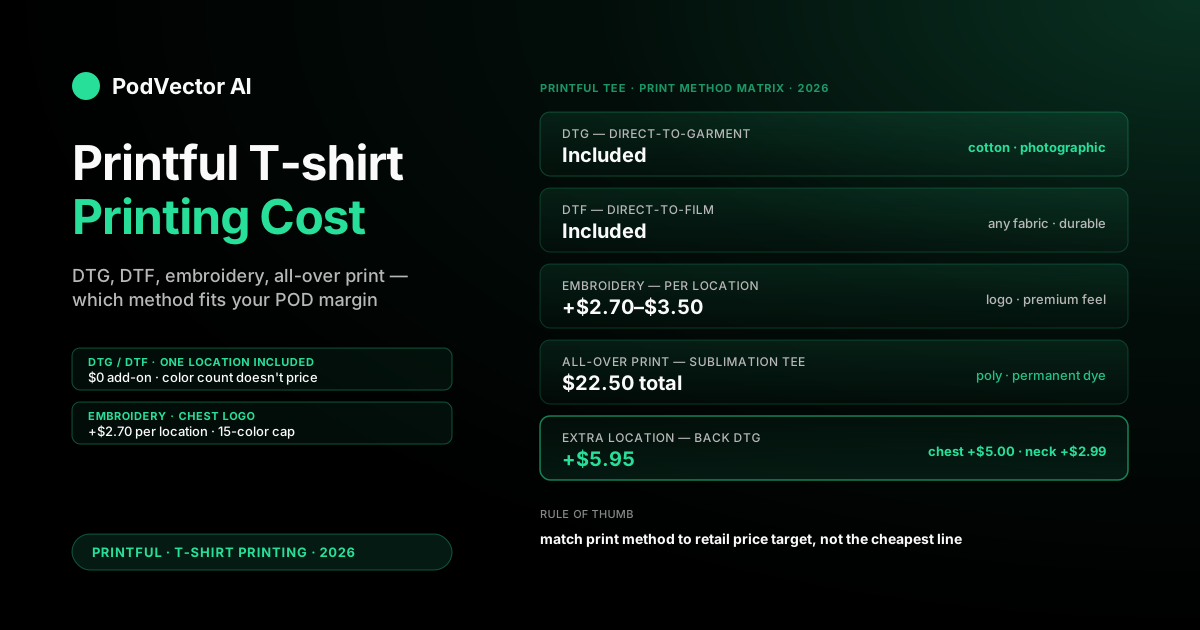
Quick Answer: Printful's t-shirt printing cost is included in the base garment price for one DTG or DTF print on one location. You only pay extra when you add locations, upgrade to embroidery, or pick all-over print.
Add a back DTG print and you'll pay +$5.95. Switch to embroidery and add +$2.70–$3.50 per location. All-over print (sublimation) runs +$5–$10 on top of a poly-blend base. Color count doesn't matter on DTG — a 100-color design prints at the same cost as a one-color design.
This breakdown covers every print-method price line, why "free print included" misleads new POD sellers, and how to pick a print method that actually fits your margin target.
What Printful actually charges for printing
Printful's pricing page advertises "one DTG print included with the base." That's true. It's also the single biggest source of confusion for new POD sellers building a margin spreadsheet.
What "included" actually means: when you buy a Gildan 5000 unisex tee for $6.95, that price already covers DTG ink, labor, and one print on one location (typically the front). You aren't paying a separate "print fee" line on top.
You only pay incremental print cost in four cases:
- You add a second print location (back, sleeve, neck label)
- You upgrade the included DTG print to embroidery
- You pick an all-over print (sublimation) tee
- You use DTF on a tee model that lists DTF as a paid upgrade rather than the default
The rest of this guide breaks each of those down with current 2026 rates and where they typically bite POD margin.
DTG (direct-to-garment) printing cost
DTG is Printful's default print method on cotton and cotton-blend tees. The cost is included in the base garment price for one front-location print, on every standard tee Printful offers.
That includes:
- Gildan 5000 Heavy Cotton: $6.95 base (front DTG included)
- Gildan 64000 Softstyle: $10.50 base (front DTG included)
- Bella + Canvas 3001 Jersey: $11.75 base (front DTG included)
- Comfort Colors 1717: $14.95 base (front DTG included)
DTG print quality is photographic. It handles unlimited colors, gradients, and fine detail — none of which add to the per-tee cost. A one-color logo and a 100-color photo print at the same price on the same garment.
The DTG trade-off is durability and feel. Print sits in a thin layer on the cotton; after 30–50 home washes you'll see fade. It's not a defect — it's how the method works. POD operators positioning at premium ($30+ retail) generally accept that trade because customers don't wash daily.
The other DTG quirk: it prints poorly on dark synthetic blends. White DTG ink on a dark poly tee is the most common "why does my print look chalky" reason in Printful support tickets. Switch to DTF or pick a cotton-heavy garment to dodge that problem.
DTF (direct-to-film) printing cost
DTF is the newer print method — film transfers heat-pressed onto the garment. On most Printful tees, DTF is also included in the base price as an alternative to DTG.
What DTF gets you that DTG doesn't:
- Works on cotton, poly, blends, and tri-blends — no fabric-specific limits
- Solid color vibrancy on dark garments without the chalky-white-ink issue
- Better wash durability (~75–100 cycles vs DTG's ~30–50)
The trade-off: DTF print has a slightly heavier hand-feel than DTG. You'll feel the transfer layer when you run your thumb over the print. Customers don't usually notice on tees, but it's the reason high-end fashion-leaning brands stick with DTG.
One pricing edge case: on some specialty tees (oversized, tri-blends, premium fashion fits), DTF carries a $2.00–$3.50 surcharge over DTG. Check the product page line "Print method" before assuming parity.
For the broader pricing context across all Printful product types, see our Printful pricing and fees breakdown.
Embroidery printing cost
Embroidery is the most expensive print upgrade on Printful tees. It's also the one POD sellers most often under-price for.
| Embroidery location | Cost on tee | Stitch limit |
|---|---|---|
| Left chest / pocket | +$2.70 | Up to 15,000 stitches |
| Back (full) | +$3.50 | Up to 20,000 stitches |
| Sleeve (per sleeve) | +$2.70 | Up to 8,000 stitches |
The stitch limit matters more than the line implies. Designs that exceed the cap get rejected or routed to a higher-tier price (Printful quotes case by case, but expect +$1–$2 per location).
Embroidery also caps color counts — Printful supports up to 15 thread colors per design. Most logos use 1–3, so this rarely binds. Photo-realistic designs simply don't translate; embroidery is a logo/illustration method.
The economics question every POD seller should run: does embroidery move retail price by more than $2.70? The answer for branded merch (band tees, sports merch, corporate gifts) is almost always yes — buyers perceive embroidery as premium and accept $35–$45 retail vs $25 for DTG. For generic illustration designs, the answer is usually no, and you're eating the upgrade cost from margin.
All-over print (sublimation) cost
All-over print uses dye sublimation on polyester fabric. The design covers the entire garment, edge to edge. It's the only Printful method that fully wraps the shirt.
Pricing is garment-specific because the base tees that support all-over print are different SKUs:
| All-over tee model | Total price (garment + AOP) | Vs DTG equivalent |
|---|---|---|
| Unisex AOP tee (Subliminator) | $22.50 | +$10.75 vs DTG basic |
| Women's AOP cut-and-sew tee | $28.95 | +$17.20 vs DTG basic |
| Men's premium AOP crewneck | $24.50 | +$12.75 vs DTG basic |
The all-over premium is real — sublimation is dye-bonded permanently into the polyester fiber, so prints don't crack, fade, or peel. You can wash an AOP tee 200+ times without visible degradation.
The trade-off: polyester. AOP tees feel like polyester, not cotton, which limits the customer segment. Activewear, festival merch, and gen-Z streetwear convert well on AOP; classic apparel brands rarely use it.
Retail pricing on AOP needs to absorb the higher landed cost. A $22.50 cost tee priced at $30 retail leaves you $7.50 gross before shipping and fees — not viable for ad-supported acquisition. Most AOP-first sellers price at $35–$45.
Print location surcharges (front, back, sleeve, neck)
The most under-discussed line in Printful's pricing: every print location beyond the first is its own surcharge. Even on DTG, where the print method is "free."
| Location | DTG / DTF surcharge | Embroidery surcharge |
|---|---|---|
| Front (large) | Included | n/a (use chest or back) |
| Back (full) | +$5.95 | +$3.50 |
| Left chest / pocket | +$5.00 | +$2.70 |
| Sleeve (per sleeve) | +$2.50 | +$2.70 |
| Inside-neck label | +$2.99 | n/a |
| Outside-neck label | +$2.49 | +$1.99 |
The neck-label upcharge is the line POD sellers most often forget to bake into retail. Replacing Gildan's neck tag with your own brand label costs $2.99 inside or $2.49 outside. That's a clean margin hit if you're positioning as a premium brand and never raised retail to cover it.
A front-and-back DTG Bella + Canvas with a custom neck tag costs you: $11.75 + $5.95 + $2.99 = $20.69 before shipping. That's a 76% cost increase over the single-location version, and most sellers price it $3–$5 above the single-location SKU, not $9.
For the per-base-tee breakdown, see our Printful t-shirt base cost breakdown.
Does color count or coverage change print cost?
For DTG and DTF: no. Printful doesn't charge per color or per square inch of coverage. A black-text-only design and a full-photographic design print at the same per-tee price.
This matters because it inverts a habit POD sellers carry over from screen printing. Screen-print quotes scale with color count — every additional color is a new screen and a setup charge. DTG breaks that mental model.
For embroidery: color count is capped at 15 threads, but doesn't change price. Stitch count is the gating factor — exceed 15,000 stitches on a chest design and you may be re-quoted into a higher tier.
For all-over print: coverage doesn't matter because sublimation prints the entire garment regardless. The price is the same whether your design covers 10% or 100% of the fabric.
The practical implication: do not constrain your designs for cost reasons unless you're using embroidery. DTG and DTF reward maximalism — sellers who treat their tee like a canvas (full photographic prints, gradients, complex illustration) often convert at higher AOV than minimalist designs because perceived value scales with visual complexity.
Growth membership impact on print cost
Printful's Growth membership costs $24.99/month and discounts garment prices by roughly 20%. The discount applies to the base price, which includes the standard one-location DTG/DTF print.
What Growth does not discount:
- Additional print location surcharges (back, sleeve, neck)
- Embroidery upgrade fees
- All-over print premiums
- Shipping rates
If your designs lean heavily on a single front-print configuration, Growth lowers your print-inclusive cost meaningfully. A Gildan 5000 at $6.95 drops to ~$5.56 with one DTG front print still included.
If your designs heavily use multi-location prints, embroidery, or AOP, Growth saves less per tee because most of your print cost lives in surcharges that aren't discounted. A front-and-back Bella + Canvas tee drops $2.35 with Growth, not the headline 20%.
Full membership math in our Printful poster pricing breakdown (the membership applies identically to posters and tees).
Hidden print costs most POD sellers miss
The line items above are Printful's published rates. The fees below are the ones that quietly chew margin and don't show up on the pricing page.
Print proof / sample orders. Mocking up a design on screen is one thing; seeing how the actual ink lays on the actual garment is another. Most POD operators spend $50–$200 on sample orders per design family. That cost amortizes over the design's lifetime but rarely makes it into a cost-of-goods column.
Reprint rate on misprints. Printful reprints free if their print is defective — wrong size, bad alignment, color mismatch. But "the print looks darker than my mockup" usually doesn't qualify. Operators see 2–4% of orders trigger customer complaints they end up eating, costing the full reprint and reshipping.
Color calibration variance. The same PNG uploaded to Printful prints slightly different in California vs Latvia vs Australia. Each fulfillment center has its own DTG fleet with its own calibration. Sellers who never sample-order from each region routinely get customer complaints they can't reproduce in testing.
White underbase on dark tees. DTG needs a white underbase printed first before color ink on dark garments. Printful doesn't bill this as a separate line, but it doubles print time and is the reason dark-tee print quality tends to be more variable than light-tee print quality.
Digitization fee for embroidery. Some designs require manual digitization (converting the vector to a stitch file). Printful's standard digitization is included, but complex designs over 15,000 stitches get bumped to a "custom embroidery" quote process — expect $5–$15 one-time per design.
Picking a print method to fit your margin target
The right print method isn't the cheapest. It's the one that hits your retail price target with the right margin.
Three POD configurations and the print method that works for each:
Configuration 1: $22 retail tee, paid traffic (Facebook / Google Ads)
Cost ceiling: $11–$12 landed for 50% gross margin (after fees and ads).
Print method: DTG on Gildan 5000. Total landed ~$10.94. Anything heavier (back print, embroidery) breaks the margin.
Configuration 2: $30 retail tee, organic (Etsy, TikTok, SEO)
Cost ceiling: $15–$17 landed for 45% gross margin.
Print method: DTG on Gildan 64000 or Bella + Canvas, single-location. Total landed $14.49–$15.74. Premium tee feel justifies the higher retail.
Configuration 3: $40+ retail tee, brand merch (band tees, corporate, premium positioning)
Cost ceiling: $20–$22 landed for 50% gross margin.
Print method: DTG front + embroidery chest logo + custom neck label on Bella + Canvas. Total landed $21.13. Customer pays for perceived premium; embroidery does the lifting.
The cheap-print trap: sellers default to Gildan 5000 + front DTG for everything because it's the lowest landed cost. But that locks you out of $35+ retail because the customer can feel that they're holding a $7 tee. Aligning print method to perceived value is how POD operators get above $25 AOV.
Printful vs Printify printing cost
Printify often advertises lower per-tee print prices because it routes through third-party print providers, each with their own pricing. Monster Digital, SwiftPOD, and Dimona Tee all sit on Printify at $0.50–$2.00 below Printful's equivalent line.
The print-cost math gets more complex on Printify:
- Printify usually quotes per-print rather than "first location included." A Gildan 5000 with one DTG print on Printify is often listed at "$5.92 garment + $4.50 print = $10.42 total" rather than Printful's "$6.95 all-in."
- Print quality varies by provider. The same design printed at Monster Digital and at SwiftPOD can look different.
- Printify Premium ($39.99/month) discounts both garment and print components, often netting cheaper per-tee than Printful Growth.
For most POD sellers focused on consistency and zero-thought reordering, Printful's bundled price wins. For sellers willing to manage provider quality variance in exchange for $1–$2 per tee, Printify wins.
For the head-to-head, see our coverage of Merch Titans' POD methods guide alongside the wider Printful costs and charges hub.
Per-SKU live margin tracking
Every print cost in this guide is current as of May 2026. They won't be by August. Printful adjusts base prices quarterly, shipping rates monthly, and surcharges whenever fulfillment economics shift.
The standard POD response is a margin spreadsheet — manually updated, usually three weeks stale, and silently wrong on the SKUs that re-priced last week. Most sellers find out the hard way: a profit-and-loss report two months later showing one design line ran negative through a full ad cycle.
That's where Victor — PodVector AI's AI business employee — comes in. Victor connects to your Shopify and Printful accounts, ingests every order with its itemized cost stack (base garment, print method, locations, shipping) into a live data warehouse, and answers questions like:
- "Which SKUs dropped below 35% margin after Printful's last price change?"
- "What's my actual landed cost per unit on the back-print DTG designs, weighted by shipping region?"
- "If I switch the 'Mountain Range' tee from DTG to embroidery and raise retail to $38, what's projected monthly profit at current order volume?"
And Victor doesn't just answer. He proposes specific actions — "your 'Mountain Range' tee is netting $1.80 after embroidery and fees; here's a $38 retail target that hits 42% margin" — and executes them on Shopify when you approve. Every proposal includes the math, the alternatives, and an audit trail you can reverse anytime.
What separates Victor from a dashboard or a generic AI chatbot: (1) a POD playbook baked into the agent (profit-leak audits, margin benchmarks, sub-agents for CFO-level questions), (2) your live store and fulfillment data unified in one warehouse, (3) the ability to act on your store directly — not just report.
For broader Printful operational context, see our complete Printful review and the Printful shipping calculator guide, or browse the full Printful topic hub.
FAQs
Does Printful charge extra for the print on a t-shirt?
One DTG or DTF print on one location is included in the base garment price. You only pay extra for additional locations (back, sleeve, neck), embroidery upgrades, or all-over print.
How much does DTG printing cost on Printful?
DTG printing is included in the base garment price for one front-location print on all standard tees. The cost shows up only as the garment price — $6.95 for Gildan 5000, $11.75 for Bella + Canvas 3001 — with the print bundled in.
How much does embroidery cost on a Printful t-shirt?
Embroidery adds +$2.70 for a chest or sleeve location and +$3.50 for a back location. Each location prices separately, and you can mix embroidery with DTG on the same tee if you want a chest logo plus a back graphic.
Does Printful charge per color on t-shirts?
No — DTG and DTF print at the same cost regardless of color count. A one-color logo and a 100-color photo print at the same per-tee price. Embroidery caps at 15 thread colors but doesn't price by count.
What is the cheapest print method on Printful?
DTG and DTF tied — both come included in the base garment price on most tees. The cheapest landed cost is a Gildan 5000 with front DTG: $6.95 + $3.99 US shipping = $10.94.
How much does an all-over print t-shirt cost on Printful?
All-over print (sublimation) tees start at $22.50 for the unisex model and go up to $28.95 for women's cut-and-sew styles. The premium covers the polyester garment plus full-coverage sublimation print.
Why does my Printful t-shirt cost more than the listed base price?
The three most common reasons: (1) you added a print location (back, sleeve, neck), (2) you're on a larger size (2XL/3XL surcharges), or (3) the design used embroidery on a location that defaulted to DTG. Check the SKU's order detail line for the itemized cost breakdown.
Track your Printful print cost per SKU — live, not in a spreadsheet.
Print fees change. Surcharges shift. Your spreadsheet drifts wrong the moment Printful adjusts a single base price. Victor — PodVector AI's AI business operator — ingests every Printful order with itemized garment + print + location + shipping cost into a live data warehouse, shows you per-SKU landed cost in real time, and flags SKUs that drop below your target margin before the month closes. He'll also propose and execute the print-method or retail-price changes that fix them.
Try Victor free