
Quick Answer: Printful t-shirt pricing has two sides: what Printful charges you per unit (base $7.95–$22.50, Free plan; ~30% less on Growth) and what you should charge your customers at retail. Most POD tees clear margin at a $24.95–$34.95 retail tag, depending on SKU tier.
The cheapest US tee (Gildan 5000) starts at $7.95 base. The most popular tee (Bella+Canvas 3001) is $12.95 on Free and $9.05 on Growth. Premium organic and tri-blend tees run $17.50–$22.50.
This guide walks both sides — Printful's pricing to you and the retail-pricing strategy that survives Meta and Google ad costs in 2026.
What "Printful t-shirt pricing" actually means
When POD operators search "Printful t-shirt pricing," they usually mean one of two things — and the two questions need different answers.
The first question is the cost side: what does Printful charge me to fulfill a tee. That number lives in the catalog and changes a couple of times a year.
The second question is the retail side: what should I charge my customers on a Printful-fulfilled tee. That number depends on the SKU, the niche, and — most importantly in 2026 — your ad cost.
Most pricing guides cover one side and skip the other. This one walks both because you can't set a retail tag without knowing your cost, and you can't evaluate the cost without knowing whether your retail tag can absorb it.
What Printful charges you per tee
Printful bundles three things into a single catalog price: the blank garment, one DTG (direct-to-garment) print on the front, and the handling work to pick, pack, and ship. That bundling makes catalog prices look high on first read, but it's an apples-to-apples line once you compare landed cost.
Here are the 2026 US catalog prices for the tee SKUs that actually drive POD volume, sized M with one front print:
| SKU | Free plan base | Growth plan base | Typical retail range |
|---|---|---|---|
| Gildan 5000 Heavy Cotton | $7.95 | $5.55 | $19.95–$24.95 |
| Gildan 64000 Softstyle | $9.50 | $6.65 | $21.95–$26.95 |
| Bella+Canvas 3001 Unisex Staple | $12.95 | $9.05 | $24.95–$29.95 |
| Bella+Canvas 3413 Tri-blend | $17.50 | $12.25 | $32.95–$39.95 |
| Champion T425 Heritage | $18.95 | $13.25 | $34.95–$42.95 |
| Stanley/Stella Creator Organic | $22.50 | $15.75 | $36.95–$44.95 |
The Free-plan column is what you pay before signing up for a paid tier. The Growth-plan column reflects the ~30% apparel discount that ships with the $24.99/mo Growth subscription (free at $12k trailing annual sales).
Three lines do not live inside the catalog price:
- Shipping — US first tee $3.99, each additional $1.25
- Size upcharges on 2XL+ — $2.00–$5.50 depending on SKU and size
- Extra print placements — back $5.95, sleeve $2.95, label $0.99–$2.49
We walk every one of those lines in detail in our Printful pricing t-shirt cost breakdown and the deeper Printful and Printify t-shirt base cost comparison. For the broader pricing picture across the catalog, see our Printful print-on-demand pricing breakdown.
The pricing formula POD sellers actually need
Printful's own pricing guide uses the standard retail formula:
Retail price = Total cost × (1 + desired margin)
That's correct as far as it goes, but it's missing the line that breaks POD margins in 2026: ad cost. In a world where most Printful stores acquire customers through Meta or Google ads, the formula that actually predicts profit is:
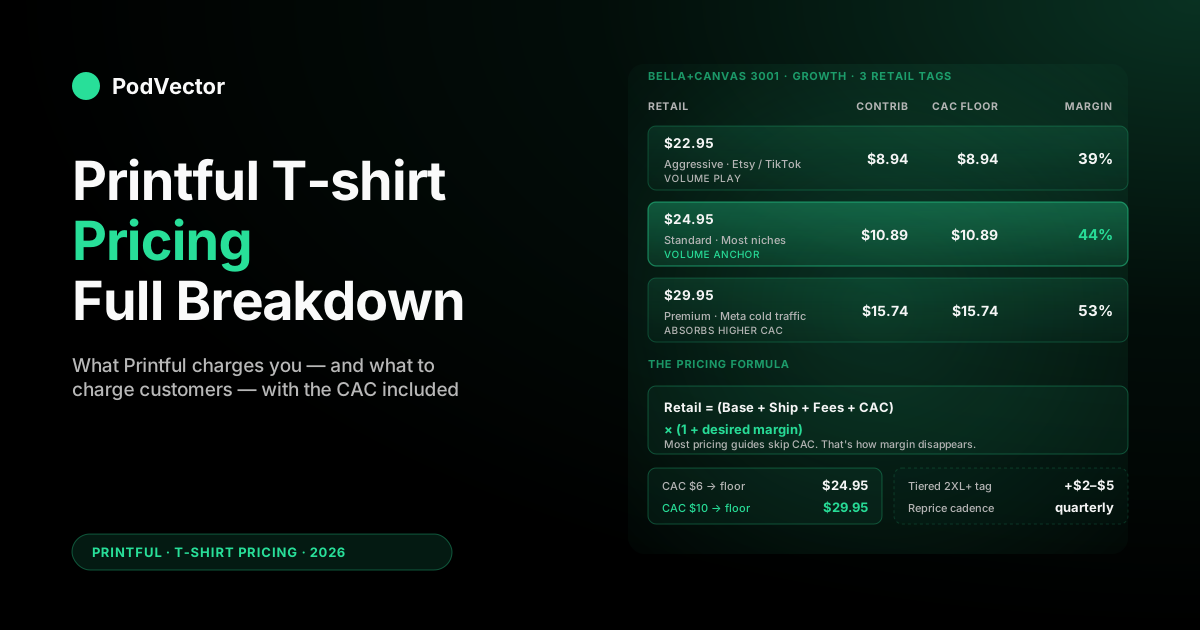
Retail price = (Base cost + shipping + payment fees + CAC) × (1 + desired margin)
CAC (customer acquisition cost) is what you spent on ads to land the order. Skipping it from the formula is how POD stores end up with healthy "gross margin" numbers and a zero net at the end of the month.
For a real Bella+Canvas 3001 on the Growth plan, the costs roll up to:
- Base: $9.05
- US shipping: $3.99
- Payment fees (Shopify, 2.9% + $0.30 on $24.95): $1.02
- CAC (typical apparel niche): $7.00–$12.00
- Total cost to deliver one customer: $21.06–$26.06
At a $24.95 retail tag, you're either thin or upside-down before product cost is even paid. That's why Bella+Canvas 3001 tees in competitive niches now anchor at $27.95–$29.95, not the $19.95 that worked five years ago.
Strategy 1: Margin-based pricing
Margin-based pricing starts from your cost and works up. Pick a target margin (typically 30–40% contribution margin for POD apparel), then back-calculate the retail tag.
For a Gildan 5000 on Growth at $5.55 base, with $3.99 shipping and roughly $1.00 in payment fees, your delivered cost-of-goods is $10.54. A 40% contribution margin formula sets retail at:
$10.54 ÷ (1 − 0.40) = $17.57
Round up to the next price-anchor point — typically $19.95 — and you've got a Gildan 5000 retail price that holds margin in low-CAC niches.
The same math on a Bella+Canvas 3001 (delivered cost $14.06) hits $23.43, which rounds to $24.95.
The same math on a Bella+Canvas tri-blend (delivered cost $17.26) hits $28.77 — which rounds to $29.95 but still leaves only $11.69 contribution before CAC. In a $10 CAC niche, that's a $1.69-per-order net. One return wipes out twenty orders of net profit.
This is the structural reason POD operators outgrow the tri-blend tier unless they're in a niche where customers will pay $34.95+ for a softer tee.
Strategy 2: Market-based pricing
Market-based pricing starts from the price point your niche already accepts, then works backward to see whether the SKU clears margin at that price.
Take a "funny cat" tee niche. The competitive set on Etsy, Amazon Merch, and dedicated cat-tee stores anchors retail at $22.95–$24.95. That ceiling is set by buyer expectation, not by your cost structure.
Working backward at $24.95 retail, 30% contribution margin requires delivered cost ≤ $17.46. A Bella+Canvas 3001 at $14.06 delivered cost fits. A tri-blend at $17.26 fits exactly — leaving zero room for CAC. Most cat-tee stores anchor on the Bella+Canvas 3001, not because it's the prettiest tee but because it's the only SKU that survives the niche's retail ceiling.
Market-based pricing is the right starting point in any niche where customers have a clear price reference — design-on-tee niches, fan tees, hobbyist tees. Margin-based pricing is the right starting point in niches with no clear reference price — luxury streetwear, specialty workwear, technical apparel — where you set the anchor.
Strategy 3: Tiered pricing on sizes and SKUs
The single biggest pricing leak we see in POD-tee stores is flat retail pricing across sizes. The 2XL+ size upcharges on a Bella+Canvas 3001 are $2.50–$6.50 — but most stores keep the retail tag flat at $24.95 across S–5XL.
The math: if 12% of your orders are 2XL+ at a $2.50 upcharge, your blended COGS rises by $0.30 per order across the full catalog. That's 1.2% of contribution margin gone, every order, before any other line moves.
The fix is tiered retail pricing matched to the upcharge:
| Size | Flat retail | Tiered retail | Extra margin recovered |
|---|---|---|---|
| S–XL | $24.95 | $24.95 | — |
| 2XL | $24.95 | $26.95 | +$2.00 |
| 3XL | $24.95 | $27.95 | +$3.00 |
| 4XL | $24.95 | $29.95 | +$5.00 |
Most Shopify themes and the Printful sync handle size-based pricing automatically. The work is one-time setup. The margin recovery compounds across every order forever.
The same logic applies across SKUs. If your "premium tri-blend" tag is the same as your "basic Bella+Canvas" tag, you're either underpricing the tri-blend or overpricing the basic. The Printful base prices tell you the cost spread; the retail tags should reflect it.
Three retail tags worked end-to-end
Same Bella+Canvas 3001 SKU, same Growth plan, same US fulfillment — three different retail tags and how they land:
$22.95 retail (aggressive)
- Revenue: $22.95
- Base cost: $9.05
- Shipping: $3.99
- Payment fees: $0.97
- Contribution before CAC: $8.94 (39%)
- Break-even CAC: $8.94
- Net at $5 CAC: $3.94 per order (17%)
$24.95 retail (standard)
- Revenue: $24.95
- Base cost: $9.05
- Shipping: $3.99
- Payment fees: $1.02
- Contribution before CAC: $10.89 (44%)
- Break-even CAC: $10.89
- Net at $8 CAC: $2.89 per order (12%)
$29.95 retail (premium)
- Revenue: $29.95
- Base cost: $9.05
- Shipping: $3.99
- Payment fees: $1.17
- Contribution before CAC: $15.74 (53%)
- Break-even CAC: $15.74
- Net at $12 CAC: $3.74 per order (12%)
Three retail tags, same SKU. The aggressive tag ($22.95) gets the highest conversion rate but the thinnest absolute net dollars. The premium tag ($29.95) gets the lowest conversion rate but tolerates the highest CAC.
Which one wins depends entirely on the niche's price elasticity. There's no universal "right" Printful tee retail price — only a right price for a specific niche, design, and traffic source. The discipline is testing all three with a real ad spend, not picking one from a blog post.
How ad cost moves your minimum retail price
Every POD store has a retail floor — the price below which the SKU cannot survive its own ad cost. The floor moves with your CAC, not with Printful's base price.
For a Bella+Canvas 3001 on Growth, the floor at different CAC levels:
| CAC (typical niche) | Retail floor (30% margin) | Suggested retail tag |
|---|---|---|
| $3 (organic-heavy) | $18.95 | $19.95 |
| $6 (Etsy / TikTok Shop) | $22.95 | $24.95 |
| $10 (Meta cold traffic) | $27.95 | $29.95 |
| $15 (Google Shopping competitive) | $32.95 | $34.95 |
This is why two stores selling the exact same Printful SKU end up with completely different retail tags. The niche, the channel, and the ad market dictate the floor — not the SKU.
The most common 2026 margin error is keeping a 2021-era retail tag while Meta and Google CAC has roughly doubled. A $19.95 Bella+Canvas tee that worked in 2021 at $4 CAC is structurally unprofitable in 2026 at $9 CAC. The fix is not "cut ad spend" — it's repricing.
When to reprice your catalog
Repricing isn't a one-time exercise. Three signals tell you it's time to revisit your tee retail tags:
Signal 1: Printful raised base prices. Printful adjusted apparel base prices 0.4–2.4% in February 2026 and pushes another adjustment most years. If your catalog hasn't been re-checked since the last announcement, your margin model is using stale numbers.
Signal 2: Your CAC has drifted up by 20%+ over a rolling quarter. A $7 CAC creeping to $9 CAC across 60 days erodes net margin from the bottom. The fix is repricing the catalog, not absorbing the increase.
Signal 3: A SKU's return rate is materially above your store average. Returns are pure margin loss — base cost, shipping, payment fees, and CAC all sunk. A SKU with a 6% return rate against a 3% store average is functionally costing you 3% more per order, and the retail tag should reflect that.
Most POD operators reprice annually at best. Stores that reprice quarterly — even by $1–$2 per SKU — typically run 4–6 points of margin above stores that don't.
Tracking tee pricing across your catalog
Single-SKU pricing math is straightforward. Catalog-wide pricing math is where it gets hard. A POD store with 80 tee SKUs across 4 brand tiers, 6 sizes, and 3 placement variants has hundreds of cost-retail pairs to keep current.
Most stores try to do this in a spreadsheet. It works at 10 SKUs. At 50 it starts breaking. At 100+ it's stale within a week.
The structural fix is keeping cost and retail in a unified data layer — your Shopify product catalog, your Printful invoice line items, and your payment processor fees all flowing into one place, refreshed continuously. That's the difference between knowing "my Bella+Canvas margin is around 40%" and knowing "SKU PV-3001-BLK-M dropped from 41% to 28% margin this week after a Printful base adjustment."
PodVector AI's Victor agent connects the Shopify webhook stream, the Printful itemized invoice feed, and the payment processor fee data into a single live data warehouse for your store. You can ask Victor questions like "which tee SKUs dropped below 30% margin this month?" and get a live answer with the specific SKUs called out. Victor can then propose specific Shopify actions in response — price changes on the underwater SKUs, a free-shipping threshold to drive bundling — and execute them on your approval, with full audit trail.
For the wider Printful catalog picture, see our Printful topic hub and the broader Costs & Charges cluster. For shipping economics that affect your retail floor, work through our Printful drop shipping times and costs guide. For the quality side of the value equation, the Printful t-shirt quality review is worth a read before locking in your premium-tier retail tag. Printful's own t-shirt pricing calculator guide is a useful complement.
FAQs
How much does Printful charge for a t-shirt?
Printful's 2026 t-shirt prices range from $7.95 (Gildan 5000) to $22.50 (Stanley/Stella organic) on the Free plan. The most-sold Bella+Canvas 3001 is $12.95 on Free and $9.05 on Growth. That's the catalog price for sizes S–XL, US fulfillment, one front print — shipping, size upcharges, and extra placements are separate lines.
What's a good retail price for a Printful t-shirt?
For a Bella+Canvas 3001 on Growth, $24.95–$29.95 retail clears a healthy 40%+ contribution margin before ad cost. The right tag depends on your CAC: $24.95 works at $6 CAC, $29.95 works at $10 CAC, $34.95+ holds up at $15 CAC.
How do I calculate Printful t-shirt profit?
The formula is retail price − (base cost + shipping + payment fees + CAC). On a $24.95 Bella+Canvas 3001 with $9.05 base, $3.99 shipping, $1.02 payment fees, and $8 CAC, your net is $2.89 per order — a 12% net margin. Skip the CAC line and you'll think you're running 44% margin when you're really running 12%.
Why is Printful more expensive than Printify?
On a same-SKU comparison (Bella+Canvas 3001, US fulfillment), Growth-plan Printful is within $0.30 of Printify's Premium-plan equivalent. Printful looks more expensive on the Free plan because Printify routes through third-party print providers with separate fulfillment fees. On the paid tiers, the per-unit landed cost is essentially identical.
Should I charge more for 2XL+ sizes?
Yes. Printful's size upcharges on 2XL+ are $2.00–$5.50 depending on SKU. If you keep retail flat across sizes, you're subsidizing every 2XL+ order from S–XL margin. Tiered retail pricing (e.g. +$2 on 2XL, +$3 on 3XL) recovers the upcharge automatically and most Shopify themes support it natively.
How often should I update my Printful tee retail prices?
Quarterly is the sweet spot. Printful base prices adjust at least once a year (sometimes twice), CAC drifts continuously, and SKU-level return rates change with your design mix. Stores that reprice quarterly typically run 4–6 points of margin above stores that reprice annually.
Does the Growth plan really pay for itself?
Yes — at 7 tees per month or more. The Growth plan saves roughly $3.90 per Bella+Canvas 3001 ($12.95 → $9.05). At the $24.99/mo fee, you break even at 7 tees. Almost any active store crosses that threshold, and Growth becomes free entirely at $12k trailing annual sales.
What's the cheapest Printful tee for high-margin pricing?
The Gildan 5000 at $7.95 Free / $5.55 Growth. It's a budget-tier blank — heavier weight, less soft hand-feel than Bella+Canvas — but the low base gives the most room for retail markup in price-sensitive niches. At $19.95 retail, you can clear 40% contribution margin even on Free.
Stop pricing tees from a spreadsheet
Catalog base is one number. Real margin is base + shipping + payment fees + CAC, refreshed continuously across every SKU in your catalog. Most POD stores discover their margin problems in arrears — at the end of a quarter, after burning ad spend on SKUs that were underwater the whole time.
PodVector AI's Victor agent connects your Shopify orders, Printful invoices, and payment fees into a live data warehouse, then surfaces which tee SKUs dropped below margin and proposes specific Shopify actions to fix it — price changes, free-shipping thresholds, BXGY discounts — all executable on your approval.
Try Victor free