
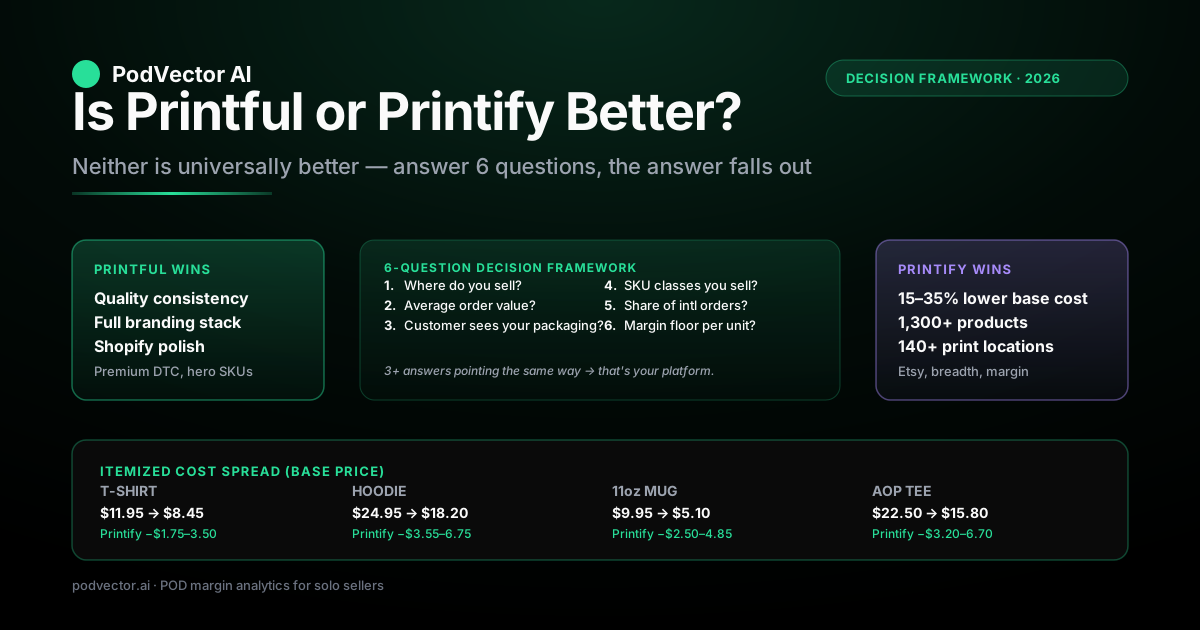
Quick Answer: Neither is universally better. Printify wins on cost across most SKU classes (15–35% cheaper base prices), product breadth (1,300+ vs ~370), and international reach. Printful wins on quality consistency, branding depth, and integration polish.
If your store is single-niche apparel where unboxing matters, Printful's in-house production usually pays back the premium. If you sell across categories — apparel + drinkware + home goods — or your margin is under $8/unit, Printify's marketplace model is the right default.
Most sellers above 30 orders/month end up using both, picking the platform per SKU rather than per store. The Nov 2024 acquisition has not changed this calculus 18 months in.
The honest answer: it depends on what you're optimizing
Every "Printful vs Printify" article picks a winner at the top and then spends 5,000 words walking it back. The honest version: ask what your binding constraint is.
If your binding constraint is per-unit margin — you're selling under $30 ASP, fighting Etsy's race to the bottom, or running paid ads where every dollar of COGS comes out of CAC — Printify is structurally better. Lower base costs across nearly every SKU.
If your binding constraint is brand experience — premium DTC, repeat customers, custom packaging, the unboxing video matters — Printful is structurally better. In-house production means the third hoodie looks like the first.
If your binding constraint is category breadth — you sell apparel and home goods and drinkware in one store — Printify wins by default. The marketplace catalog covers more.
So "better" is the wrong question. The right question is: which constraint is binding right now? Then this comparison gets easy.
At-a-glance comparison
| Dimension | Printful | Printify |
|---|---|---|
| Catalog size | ~370 products | ~1,300 products |
| Production model | In-house (8 facilities) | Marketplace (90+ providers) |
| Average base cost | Higher (premium) | 15–35% lower |
| Quality consistency | High and predictable | Provider-dependent |
| Branding stack | Labels, packaging, inserts | Limited, provider-dependent |
| Membership | Growth $24.99/mo (up to 33% off) | Premium $39/mo (20% off, 10+ stores) |
| Print locations | 8 facilities, 6 countries | 140+ locations worldwide |
| Best for | Branded DTC, premium apparel | Marketplaces, breadth, margin |
Itemized cost: t-shirt, hoodie, mug, AOP
The "Printify is cheaper" headline is technically true but hides where the gap actually shows up. Below is a typical price spread across four SKU classes, comparing standard catalog defaults at retail-ready spec.
| Product | Printful base | Printify base | Spread |
|---|---|---|---|
| Unisex t-shirt (Bella+Canvas 3001) | $11.95 | $8.45–$10.20 | $1.75–$3.50 |
| Heavy hoodie (Gildan 18500) | $24.95 | $18.20–$21.40 | $3.55–$6.75 |
| 11 oz ceramic mug | $9.95 | $5.10–$7.45 | $2.50–$4.85 |
| All-over print tee | $22.50 | $15.80–$19.30 | $3.20–$6.70 |
Two patterns matter here. First, the gap widens on commodity items (mugs, basic tees) and narrows on premium ones (heavyweight hoodies, AOP). Printful's pricing is more competitive at the top of the catalog than the bottom.
Second, Printify's range reflects provider choice. The low end is Monster Digital or Awkward Styles. The high end is Sensaria or Print Geek — closer to Printful's quality at a smaller discount. Pick by quality tier, not by lowest price.
Memberships flip the math further. Printful Growth at $24.99/mo gives up to 33% off select products and breaks even around 12–15 orders. Printify Premium at $39/mo unlocks 20% off and supports 10+ stores — better when you run multiple Etsy or Shopify shops. For full math on each tier, our Printful membership benefits guide walks through the breakeven point on different order volumes.
Print quality and consistency
Printful prints in-house at eight facilities. Same equipment, same QA process, same ink stack. The result: the 50th order looks like the first. For a brand running paid acquisition where return rates kill margin, that consistency is worth real money.
Printify ships to 90+ third-party providers. Quality is a function of which provider you pick. Top-tier providers (Sensaria, Print Geek, OPT, Monster Digital for some products) are competitive with Printful. Bottom-tier providers are visibly worse — washed-out colors, off-center placement, occasionally the wrong shirt.
The fix on Printify is simple: order samples from any provider before publishing the SKU. Most experienced sellers maintain a short list of approved providers per product class and ignore the rest. Skipping samples is where Printify gets its bad reputation.
For DTG (direct-to-garment) on dark colors, Printful holds a clearer edge. Their pretreatment process is more uniform than the marketplace average. On AOP (all-over print) and sublimation, the gap narrows — Printify's specialist providers like Bags of Love or MWW On Demand are equivalent.
Product catalog: when 1,300+ matters
The 370-vs-1,300 product gap sounds decisive but mostly resolves into "which SKU classes are deeply represented." Printful covers apparel, drinkware, hats, bags, and a thin selection of home goods. Printify covers all of those plus jewelry, pet products, swimwear, dog beds, shower curtains, jigsaw puzzles, holiday ornaments, and dozens of other niches.
If you sell branded t-shirts and hoodies under one design system, you'll never use 90% of Printify's catalog. Printful's curated set is fine.
If you build seasonal collections (Halloween, Christmas, Father's Day) or your brand is "we make weird stuff for cat people," the breadth matters. Printful will block you on items that don't exist in their catalog.
This is also where Printify's 90+ providers help structurally — when one provider drops a product, others usually carry it. Printful single-sources, so a discontinued blank means the SKU is gone.
Branding and customer experience
Printful is the clear winner here, by a wider margin than the cost gap goes the other way.
What Printful offers that Printify largely doesn't: inside-label printing, custom hangtags, branded packing slips, custom packaging boxes, branded stickers, custom inserts, scan-trigger QR codes on packaging. The full unboxing surface is yours to control.
Printify offers some of these on some providers, but it's piecemeal. Inside labels are available on a subset of providers; custom packaging is essentially absent; insert cards work for a few but not most.
For a marketplace-only store (Etsy, Amazon Merch), this gap costs you nothing — those customers don't expect branded packaging, and the marketplace controls the experience anyway. For a DTC brand running paid traffic and chasing repeat purchases, branding is what makes the second order possible.
If brand consistency is a Stage-2 priority for you, the comparison breakdown of both platforms' branding stacks goes deeper.
Integrations and store fit
Both platforms cover the major channels: Shopify, Etsy, WooCommerce, eBay, Amazon, TikTok Shop, Wix, Squarespace, BigCommerce. The differentiation is in how cleanly each plays with each platform.
Printful tends to be smoother on Shopify and Squarespace. The product sync is faster, the variant mapping is more reliable, and order routing rarely breaks. For a Shopify-first DTC store, Printful is the lower-friction default.
Printify is smoother on Etsy. The Etsy Pop-up Stores feature, automatic SEO suggestions, and Printify's Etsy-specific pricing tools are built for that channel. If Etsy is your primary, Printify is the default.
For multi-channel sellers, both will work — but matching platform to channel saves operational pain. Sellers who run cross-channel often end up with Printful for Shopify and Printify for Etsy in the same business.
Shipping speed and international reach
Printful's eight facilities sit in the US (3), Mexico, Canada, UK, Spain, and Latvia. Order routing is automatic — a UK customer's order ships from Latvia or Spain, not from Charlotte. Average production time: 2–5 business days. International shipping is fast and reliable but expensive.
Printify's 140+ providers blanket far more geography but routing is more manual — you assign each SKU to a primary provider, with fallback. Production times vary from 2 days (top-tier) to 7+ days (lower-tier). International shipping costs are typically lower than Printful's because there's usually a local provider.
For a US-only seller, the gap is small. For a seller with 30%+ international orders, Printify's reach often wins on landed cost. For a seller obsessed with delivery time on a premium product, Printful's predictability wins.
The 2024 merger, 18 months in
Printful and Printify announced a merger in November 2024 that would create the largest POD platform in the world. As of May 2026, both still operate as separate brands with separate dashboards, separate pricing, and separate integrations.
What has changed: shared back-office optimizations, some standardized API behavior, and a roadmap signal that the platforms will share product catalogs. What hasn't changed: the seller experience. You still pick one or the other (or both) the same way you did pre-merger.
Don't make a platform decision based on the merger. The integration is multi-year and the operational reality 18 months in is "two products under one parent." Our merger guide for POD sellers covers what's actually changed in the dashboards and what to expect through 2027.
6-question decision framework
Skip the feature comparisons. Answer these six and the answer falls out.
1. Where do you sell? Etsy-primary → Printify. Shopify DTC → Printful (or both). Multi-channel → both, picked per channel.
2. What's your average order value? Under $25 → Printify (margin sensitivity dominates). $25–$50 → either. Over $50 → Printful (premium positioning, brand consistency).
3. Does your customer see "your" packaging? Yes (DTC) → Printful. No (marketplaces) → Printify.
4. How many SKU classes do you sell? One or two (apparel only) → either. Three or more (apparel + drinkware + home + accessories) → Printify, by catalog necessity.
5. What share of orders ships internationally? Under 20% → Printful is fine. 20%+ → Printify's print-local network often wins on landed cost.
6. What's your contribution margin floor? Under $8/unit → Printify (cost gap moves the needle). Above $12/unit → either (the cost gap is rounding error against your CAC).
Three or more answers pointing the same direction → that's your platform. Mixed answers → run both, segmented by SKU.
The hybrid play most sellers settle on
Past the hobby threshold, "Printful or Printify" stops being either/or. Most sellers above 30 orders/month run both, segmented by product type or channel.
The common pattern: Printful for the hero SKUs (the brand-defining hoodie, the signature t-shirt), Printify for the long tail (mugs, accessories, seasonal items, niche home goods). Printful for Shopify orders, Printify for Etsy. Printful for premium drops, Printify for evergreen catalog items.
The setup cost is real — two dashboards, two billing relationships, two sample workflows. But the margin recovery on commodity SKUs typically pays back within a month. The decision walkthrough comparing both as primary platforms includes the breakeven math on running both vs picking one.
For sellers comparing more than two POD platforms, our three-way comparison with Gelato and the Gooten vs Printful vs Printify breakdown add the next two most-considered alternatives. For everything in the broader Printful topic, see our Printful topic hub and Printful cluster index.
For external context, Shopify's own Printful vs Printify guide covers the same comparison from the channel perspective and is worth reading alongside this one.
FAQs
Which has better print quality, Printful or Printify?
Printful has more consistent quality because it controls production end-to-end. Printify can match or exceed Printful's quality on top-tier providers (Sensaria, Print Geek, OPT) but the marketplace average is lower. The fix is simple: order samples from any provider before publishing the SKU.
Is Printify cheaper than Printful?
Yes, on most SKUs — typically 15–35% cheaper at the base. The gap is widest on commodity items (mugs, basic tees) and narrowest on premium products (heavyweight hoodies, AOP). Memberships shift the math: Printful Growth saves up to 33% on select items, Printify Premium saves 20% across the catalog.
Can I use both Printful and Printify on the same store?
Yes. Most sellers above hobby volume do exactly this, segmenting by SKU type or channel. Both platforms integrate with Shopify, Etsy, WooCommerce, and the major marketplaces in parallel — fulfillment routes per product, not per store.
Did the 2024 Printful-Printify merger change anything?
Operationally, almost nothing as of mid-2026. Both platforms still have separate dashboards, separate pricing, separate integrations. Roadmap hints at eventual catalog sharing but no consolidation has shipped. Make platform decisions on current product capabilities, not merger speculation.
Which is better for Etsy sellers specifically?
Printify, by a clear margin. The Etsy integration is tighter, the Pop-up Stores feature is built for marketplaces, and Etsy customers don't expect branded packaging — so Printful's branding edge doesn't apply. Printify's lower base costs also matter more on Etsy because of the platform's price-sensitive buyer base.
Which is better for high-volume DTC brands?
Usually Printful as the primary, with Printify as a secondary for non-hero SKUs. High-volume DTC depends on brand consistency and unboxing experience, both of which Printful does materially better. The margin gap on hero SKUs is small enough to absorb at scale.
Are Printful and Printify the only options?
No. Gelato, Gooten, SPOD, and Apliiq are credible alternatives depending on category and geography. Gelato is strong for international print-local. Gooten's catalog is similar to Printify's but the integration polish is closer to Printful. See our three-way comparisons for direct head-to-heads.
Pick the platform with data, not vibes
The "Printful vs Printify" debate is worth ten minutes of your week. Tracking actual per-order net margin across both platforms is worth ten times that. Victor is the AI operator that sits on top of your Printful and Printify data alongside your Shopify orders, your ad spend, and your fee structure — answering "which platform is making me more money on which SKUs" in plain English. And see your real per-platform margin in 24 hours.
Try Victor free