
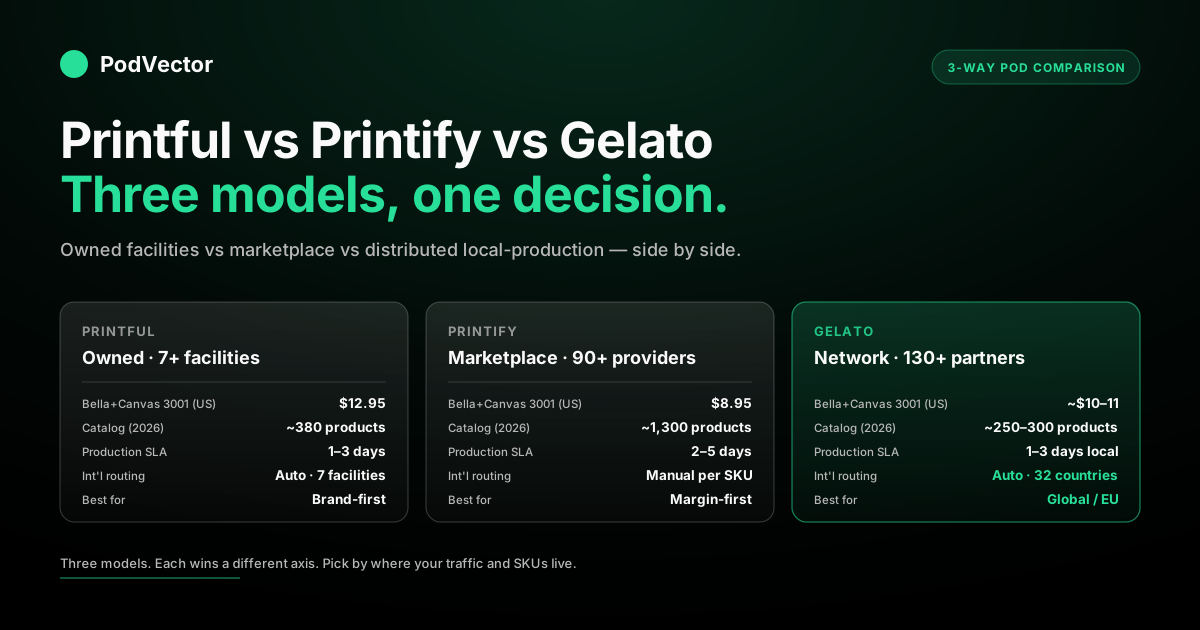
Quick Answer: A correct Printful vs Printify vs Gelato comparison runs on three different production models — owned facilities, third-party marketplace, and distributed local-network — not just three brand names. Each model dominates on a different axis.
Printful wins on brand consistency. Printify wins on per-SKU base cost and catalog breadth. Gelato wins on international shipping and local production for non-US customers. None of the three wins on every axis.
Below is the side-by-side framework — model, pricing, catalog, quality, fulfillment, integrations, branding — plus the per-SKU profitability question no platform-level comparison can answer.
The three production models explained
The single fact that explains every other difference between these three: they don't run the same production model.
Printful owns its facilities. Roughly seven owned print and embroidery centers across the US, EU (Riga and Barcelona), Mexico, Japan, Australia, and Canada. Every order routes through a Printful-run building with Printful-trained staff and Printful-owned machines. Quality control is one set of standards applied uniformly.
Printify is a third-party marketplace. When a customer orders, Printify routes the line item to whichever provider you picked when listing the product — Monster Digital, SwiftPOD, Drive Fulfillment, Dimona, and roughly 90 others across 140+ locations. Providers compete on base price inside the catalog. The marketplace doesn't enforce a quality floor; the seller does.
Gelato runs a distributed local-production network. Roughly 140+ partner facilities in 32 countries, but with one critical difference from Printify: Gelato's routing is automatic. When a UK customer orders, Gelato sends the job to a UK printer. When an Australian customer orders the same SKU, Gelato routes it to an Australian printer. The seller doesn't pick a provider per listing — Gelato's dynamic routing (its own term for fully algorithmic, buyer-location-based assignment) matches each order to the nearest qualified facility on the fly.
Each model is the right answer to a different question. Owned facilities maximize consistency at the cost of catalog breadth. Marketplaces maximize catalog and base-cost flexibility at the cost of variance. Distributed local-production minimizes international shipping at the cost of giving up some per-provider price competition.
Side-by-side snapshot table
Every axis is unpacked in its own section below. This is the 30-second version.
| Axis | Printful | Printify | Gelato |
|---|---|---|---|
| Model | Owned facilities (~7) | Marketplace (~90 providers) | Distributed network (~140 partners, 32 countries) |
| Bella+Canvas 3001 tee, US base | $12.95 | $8.95 (Premium) / $10.95 (Free) | ~$10–11 (varies by region) |
| Subscription | Growth $24.99/mo, up to 33% off | Premium $29/mo ($24.99/mo billed annually), up to 20% off | Gelato+ $29.99/mo (~$19.99/mo billed annually), ~10–30% off |
| Catalog (2026) | ~380 products | ~1,300 products | ~250–300 products, deep wall art and stationery |
| Median production SLA | 1–3 business days | 2–5 business days (provider-dependent) | 1–3 business days locally |
| International routing | Auto across 7+ owned facilities | Manual — list SKUs through multiple regional providers | Auto across 140+ partner facilities |
| Quality consistency | High and uniform | Variable — depends on provider | Medium-high, partner-dependent but auto-vetted |
| Branding inserts | Native across all orders | Provider-specific, partial coverage | Partial — packing slips wide, inserts limited |
| Best for | Brand-first, paid-social-heavy US/EU stores | Margin-first, broad catalog, organic Etsy | Global/EU-weighted stores, wall art and stationery focus |
Pricing and subscription tiers
Pricing is the axis sellers fixate on first. We'll cover it properly here, then move on — because the cheapest base cost is rarely the most profitable supplier.
Base costs, head-to-head
On the benchmark Bella+Canvas 3001 tee shipping in the US:
- Printful (no subscription): $12.95
- Printful Growth ($24.99/mo, up to 33% off): ~$9.50
- Printify Free: $10.95
- Printify Premium ($29/mo, or $24.99/mo billed annually, up to 20% off): $8.95
- Gelato Free: ~$10–11 (US region)
- Gelato+ ($29.99/mo, ~$19.99/mo billed annually): ~$8.50–9.50 (US region, top-tier discount)
Printify Premium is the cheapest on this SKU. Gelato+ Gold lands in roughly the same band but with a higher monthly fee to unlock. Printful's discounted price sits in the middle. The gap widens on heavier garments — Gildan 18500 hoodies run $5–7 cheaper on a top-tier Printify provider than Printful equivalents, with Gelato somewhere between depending on region.
Subscription math
All three plans cost roughly the same monthly fee at the top tier. The break-even unit count differs because the discount percentages differ.
- Printful Growth recovers its $24.99 in roughly 8 tee-equivalents per month at 33% off.
- Printify Premium recovers $24.99 in roughly 12 tee-equivalents per month at 20% off.
- Gelato+ recovers its monthly fee somewhere between those — the discount tier you pick determines exactly where.
Below those volumes, all three plans cost more than they save. Above those volumes, the discount compounds and is the right call for any seller doing meaningful weekly orders.
The all-in cost most comparisons skip
Sticker price is one line in your unit P&L. The full picture includes shipping (paid by customer or by you, varies by region), platform fees, refund allowance for defects, and ad spend amortized per order.
A $2 base-cost win can disappear if the provider's defect rate is 3 points higher, or if shipping to your top customer region costs $3 more. Gelato's distributed network often wins the all-in math even when it loses on base price, because the per-region shipping savings stack up across thousands of orders. For the line-by-line Printful breakdown, see the Printful vs Printify cost comparison.
Product catalog
Catalog size and shape differ meaningfully across all three.
Printful (~380 products): standard apparel (tees, hoodies, sweatshirts, hats), drinkware, basic wall art, embroidered goods. Every SKU is reviewed and mockup-tested by Printful's in-house team before listing. The curation reduces decision overhead — you're picking from a known-good list.
Printify (~1,300 products): roughly 3.4x the Printful catalog. Strong in all-over-print apparel (bombers, leggings, swimwear), framed canvas at unusual sizes, ceramic mugs from multiple makers, pet products, phone cases, niche home goods. The breadth introduces a new question per SKU: which of the providers offering this product handles it best?
Gelato (~250–300 products): the smallest catalog of the three, but with the deepest coverage in wall art (canvas, framed prints, posters), photo books, calendars, mugs, and stationery. Gelato also has solid apparel coverage but the catalog skew is clearly toward print-on-paper-and-canvas categories where its local-print model produces the biggest customer-experience advantage.
For sellers building tight brand-led apparel lines, Printful's catalog is enough. For sellers running broad catalog tests, Printify's breadth is decisive. For sellers whose top categories are wall art, calendars, or stationery sold internationally, Gelato's local-production advantage on heavy or fragile items is hard to beat.
Print quality and consistency
All three platforms produce quality work in 2026. The right framing isn't "which prints better" — it's "which is more consistent for the customer-experience profile you need."
Printful runs the same Kornit Atlas and Avalanche printers, the same garment-prep workflow, and the same QA pass across every owned facility. A Riga-printed shirt and a Charlotte-printed shirt come out within tight tolerances on color, ink saturation, and placement. Uniform quality is the brand-builder's case for paying more.
Printify's quality is provider-specific. Top-tier providers — Monster Digital, SwiftPOD on premium tier, Drive Fulfillment for embroidery — produce work indistinguishable from Printful's. Lower-tier providers in the same catalog produce visibly worse output: ink that cracks after two washes, off-axis placement, color drift between runs. Provider-selection discipline is mandatory, not optional.
Gelato sits between the two on this axis. The partner network is auto-vetted by Gelato (no seller-side provider screening required), and quality at the median partner is solid. Variance is lower than Printify's wide range but higher than Printful's tight uniformity. The trade is consistency for global reach.
Defect-rate variance compounds in unit economics. Printful publishes a 0.24% reshipment rate and runs a roughly 1% practical reprint rate that stays stable across orders. Printify's reprint rate ranges from 1% (top-tier providers) to 4–5% (lower-tier providers). Gelato's hovers around 1–2% across the network. On a paid-social store running 1,000 orders a month, the gap between 1% and 4% is $300–$600 of margin a month, plus the customer-experience hit.
Fulfillment and shipping
Production speed and shipping cost are two halves of the same axis. This is where Gelato earns its place in the conversation.
Production SLA
Printful publishes 1–3 business days and hits it consistently across owned facilities. Order placed Monday morning ships Wednesday afternoon for the median US order.
Printify publishes 2–5 business days. The actual experience depends on the provider — SwiftPOD and Monster Digital regularly hit 1–2 day production, lower-tier providers run 4–6 business days, and Q4 spikes push some providers to 7+ days.
Gelato publishes 1–3 business days locally and hits it consistently across the partner network. Production speed at the partner facility nearest to the customer is the model's whole point.
Regional routing — the deciding factor
This is where the three models diverge sharply.
Printful auto-routes each order to the nearest owned facility (US East, US West, EU/Riga, EU/Spain, MX, JP, AUS, CA). For a US-heavy store, 60–80% of orders ship domestically with no setup work. For an EU-weighted store, EU orders ship from Riga or Barcelona automatically.
Printify routes each order to whichever provider you picked when listing the product. If you listed a tee through a US provider and the order ships to Germany, that order goes international — slow and expensive — unless you also listed the same SKU through a Printify EU provider. Doing this right unlocks meaningfully better international economics; doing it lazily produces the opposite.
Gelato auto-routes across 140+ partner facilities in 32 countries. ~90% of orders are produced locally to the customer. UK customers get UK-printed goods. Australian customers get Australian-printed goods. The seller doesn't list the SKU through multiple regional providers — Gelato does the routing on every order.
For US-only stores, the routing difference is small. For stores with meaningful EU, UK, AU, or Canadian traffic, Gelato's advantage is structural. Local production cuts shipping time from 8–15 days to 3–6 days and shipping cost by 40–60% on international orders, with roughly 90% of Gelato orders produced locally to the customer.
Customs, duties, and the split-shipment trap
The hidden cost of cross-border POD is the part most comparisons skip: customs. A cross-border order can sit 3–7 extra days in VAT/duty processing, and the buyer can get hit with a surprise handling fee or a border hold that turns into a refund request. Because Gelato produces inside the customer's country on most international orders, the parcel never crosses a border — no duty, no customs delay, no surprise fee. That's the part of the "international economics" advantage that doesn't show up in a base-cost table. EU sellers also face concrete 2026 rule changes — VAT thresholds, packaging-compliance regimes like Germany's, and tightening customs-duty treatment on low-value imports — that all favor in-country production.
Printify's manual routing creates a related trap: a multi-line order whose SKUs were listed through different providers ships as multiple parcels from multiple locations. The customer pays (or perceives) more shipping, gets staggered deliveries, and on international orders each parcel clears customs separately. Avoiding it means deliberately listing related SKUs through a single provider — more setup discipline than most sellers apply.
Integrations and storefronts
All three integrate natively with Shopify, Etsy, WooCommerce, eBay, TikTok Shop, Wix, and Squarespace. All three push order line items, product variants, and fulfillment status back to the storefront automatically.
Printful has the tightest Shopify integration of the three — fewer edge cases on variant sync, faster fulfillment status updates, cleaner mockup generation. The mockup generator is the unsung hero of paid social: better mockups drive higher conversion at the same ad spend.
Printify keeps pace on Shopify, Etsy, and WooCommerce. Longer-tail integrations (Squarespace, Wix, smaller marketplaces) show rough edges more often but aren't deal-breakers for most sellers.
Gelato integrates cleanly with Shopify, Etsy, WooCommerce, Wix, and Squarespace, with strong support for international currency display and VAT handling — useful for EU-weighted stores where multi-currency pricing is part of the conversion math.
Branding and customization
Printful's branding options are the deepest and apply uniformly. Custom packing slips, branded stickers, branded inside-collar labels, and pack-in marketing inserts work on every order regardless of which Printful facility fulfills it. The "feels like a real brand, not a POD store" experience is on rails.
Printify's branding options are provider-specific. Some providers support packing slips with your logo; some don't. Inside-collar relabeling is available on premium providers like Monster Digital but isn't a catalog-wide feature.
Gelato sits in the middle. Custom packing slips with your logo are supported across the network. Inserts and inside-collar relabeling are partner-dependent and harder to verify per order. For a wall-art-heavy store where the branded experience is the print itself and the packaging, Gelato's offering is enough. For a fashion brand where the inside-collar label is part of the product, Printful is still the cleanest answer.
Pros and cons summary
Printful — pros
- Consistent quality across every order, every facility, every SKU.
- Tighter Shopify, Etsy, and TikTok Shop integrations with cleaner mockups.
- Native branded inserts, packing slips, and inside-collar relabel on every order.
- Auto-routing across 7+ owned facilities — minimal seller config.
- Lower defect and reprint rate, which matters disproportionately on paid social.
Printful — cons
- Base costs run $1–7 higher than Printify per garment depending on category.
- Smaller catalog (~380 products) — limited all-over print, fewer non-apparel SKUs.
- Subscription discount helps but doesn't fully close the gap with Printify Premium.
Printify — pros
- Lower base costs, especially on Premium tier — meaningful margin lift per order.
- ~1,300 product catalog with deep coverage of all-over print, framed canvas, ceramics, pet products.
- Multi-provider network lets you route per region for cheaper international shipping (with setup work).
- Top-tier providers match Printful's quality at lower cost.
Printify — cons
- Quality varies by provider — sample-ordering discipline is mandatory.
- Branding inserts and inside-collar relabel are provider-specific and partial.
- International routing requires the seller to list SKUs through multiple providers.
- Defect rates on lower-tier providers can run 3–5%, silently killing paid-social unit economics.
Gelato — pros
- Auto-local production across 140+ partner facilities in 32 countries — ~90% of orders printed locally.
- Best international shipping economics by a wide margin for non-US-heavy stores.
- Strong wall art, framed prints, photo books, calendars, and stationery — categories where local production saves on heavy or fragile shipping.
- Multi-currency and VAT-aware integrations for EU-weighted sellers.
- Consistent quality across the partner network — auto-vetted, no seller-side screening required.
Gelato — cons
- Smaller apparel catalog than Printify; not the right pick for all-over-print or trend-driven SKUs.
- Branding inserts are partial — Printful is still cleaner if collar labels and pack-ins are part of the brand.
- Base prices on US apparel sit in the middle — not the cheapest, not the most consistent.
- Subscription discounts kick in higher than Printful Growth or Printify Premium for casual sellers.
Decision matrix: pick X if Y
The framework collapses cleanly into decision rules.
Pick Printful if:
- You're building a long-term brand where customer-experience consistency is part of the product.
- Your traffic is US-weighted, or split US + EU only, and you want auto-routing with zero per-SKU setup.
- Your product mix lives in apparel + drinkware + wall art and you don't need exotic SKUs.
- You run paid social where return rates above 5% kill the unit economics.
Pick Printify if:
- You're optimizing for margin and willing to do per-provider sample-ordering.
- Your product mix needs catalog breadth Printful and Gelato don't cover — all-over print, niche home goods, pet products.
- You run organic Etsy or TikTok Shop where unit economics are thin and $2–4 per order matters.
Pick Gelato if:
- Your traffic is global or EU/UK/AU-weighted and shipping cost is killing your international conversion.
- Your top product categories are wall art, framed canvas, photo books, calendars, or stationery — where local production wins on heavy/fragile shipping.
- You sell into EU markets where VAT-aware multi-currency pricing matters at checkout.
- You'd rather not maintain per-region provider listings the way Printify requires.
Run two of them if:
- Your store has 15+ SKUs and the optimal supplier varies by garment, region, or season.
- You want supplier diversification — single-supplier outages have been a real risk in 2024–2026.
The two-supplier combination most operators converge on in 2026 is Printful + Gelato (US-and-brand + international-network) or Printify + Gelato (margin-on-apparel + international-shipping). See the broader Printful vs Printify comparison for the two-platform decision when Gelato isn't in the mix.
What the Printful–Printify merger means for Gelato
In late 2024, Printful and Printify announced plans to merge as equal partners under a single parent company. As of mid-2026, both platforms continue operating separately under their existing brand names with separate dashboards, separate catalogs, and separate pricing.
The merger doesn't change today's three-way comparison. Existing accounts on both Printful and Printify continue running unchanged. New sellers in 2026 still pick based on the trade-offs above.
What it does change is Gelato's strategic role. If Printful and Printify eventually consolidate operations, the value of running on a non-merged third supplier increases as a hedge. Several POD operators are explicitly piloting Gelato in 2026 for exactly this reason — supplier diversification against a future single combined Printful-Printify entity. Read the deeper Printful comparison context in our Printful vs Printify comparison reviews.
The per-SKU profitability question
Every comparison guide above — including this one — treats the choice as platform-level. That framing produces a platform-level answer: pick A for brand, B for margin, C for international.
The actual question every POD seller has to answer is per-SKU. On your Bella+Canvas 3001 in heather grey, shipping to your top region, with your ad-blended customer acquisition cost, which supplier produces a higher contribution dollar per order? The answer flips by garment, region, volume, and season.
None of the public comparison articles fill this gap. They quote averages — $4 base-cost difference, 99% accuracy, 1–3 day fulfillment — and stop there. Your P&L runs on specifics, not averages.
Closing the gap takes three pieces working together. Every order's supplier-charged cost has to flow into a single source of truth alongside revenue, ad cost, refunds, and processor fees. The math has to run per-SKU and per-supplier so a tee that's profitable on Printify and a wall print that's profitable on Gelato both show up clearly. The answer has to surface fast enough to act on — switching a single SKU's supplier weekly is high-leverage if the data is fresh, useless if it's a quarter old.
This is the architecture PodVector AI built Victor on — a unified data warehouse that ingests Shopify, Printful, Printify, Meta, and Google per-order data, then lets you ask "which supplier is more profitable on my hoodies in EU shipments?" in plain English. The answer isn't always Printful or always Printify. The answer is per-SKU, and a POD seller without per-SKU supplier data is guessing on the most expensive lever in the business.
For the cost-side picture across membership tiers — which is where most of the per-unit margin shifts hide — see the Printful membership cost full breakdown and the deeper membership cost benefits breakdown.
FAQs
What's the cleanest one-line Printful vs Printify vs Gelato comparison?
Printful is owned facilities with consistent quality at a higher base cost. Printify is a marketplace with lower base costs and quality that depends on which provider you pick. Gelato is a distributed local-production network that wins on international shipping for non-US-heavy stores. All three integrate with Shopify, Etsy, and TikTok Shop.
Which is best for EU-based sellers?
Gelato by default. The 32-country partner network means most EU orders ship domestically inside the EU rather than from a single hub. Printful is the strong second — Riga and Barcelona facilities cover EU traffic well — but Gelato's wider footprint matters once your traffic spreads across the UK, Nordics, and southern Europe.
Which is cheapest for a Bella+Canvas tee?
Printify Premium at $8.95 wins on US apparel. Gelato+ Gold lands close. Printful Growth comes in around $9.50. On a per-SKU US-shipping basis, Printify Premium is the cheapest of the three.
Which is best for wall art and framed prints?
Gelato. Local production matters most on heavy or fragile items where international shipping costs are punishing. A framed 24x36" canvas shipped from US to UK costs $40+ on Printful or Printify; the same print produced in a UK partner facility on Gelato ships locally at a fraction of the cost.
Can I run two or three of these in the same store?
Yes. All three apps run in Shopify without conflict, and you can route different SKUs to different suppliers based on margin, geography, or quality requirements. The added work is per-supplier mockup generation and per-supplier sample ordering. Most established POD sellers run two suppliers; the most common pairings in 2026 are Printful + Gelato or Printify + Gelato.
Which has the best Etsy integration?
Printful and Printify both have mature Etsy integrations and either works for organic Etsy stores. Gelato's Etsy integration is solid but newer — fewer edge cases on US apparel, occasional friction on international product variants. For new Etsy sellers prioritizing ship-on-time scoring, Printful's tighter SLA wins by a small margin.
Does the 2024 Printful–Printify merger change which platform I should pick?
Not yet. Both platforms continue operating separately as of 2026 — separate accounts, separate dashboards, separate pricing. Pick based on current trade-offs. The merger does increase the case for piloting Gelato as a non-merged third supplier for diversification.
Which is the easiest for a new POD seller?
Printful. The owned-facility model means zero per-SKU provider research, the mockup generator is the cleanest of the three, and the all-in customer experience is most predictable. The price premium is real but the learning curve is shortest.
Which is best for international shipping?
Gelato by a wide margin. ~90% of orders produced locally to the customer changes the international economics structurally, not marginally. Printful is second — auto-routing across 7+ facilities is strong but covers fewer countries. Printify is third unless the seller does meaningful per-region provider listing work.
Stop comparing platforms. Compare suppliers per SKU.
The right Printful or Printify answer changes by garment, region, and season. Spreadsheet comparisons go stale within weeks. Victor pulls every Printful and Printify order, every supplier-charged cost, every ad spend, and every refund into one live data layer — then lets you ask "which supplier is more profitable on my hoodies shipping to the UK?" in plain English. POD-native unit economics, no spreadsheets.
Try Victor freeFor an independent operator's framing of the same three-way trade-off, the Bootstrapping Ecommerce comparison covers similar ground from a long-time POD operator's perspective. The full Printful comparison cluster lives at the Printful comparison hub, and the broader Printful topic at the Printful topic hub.