
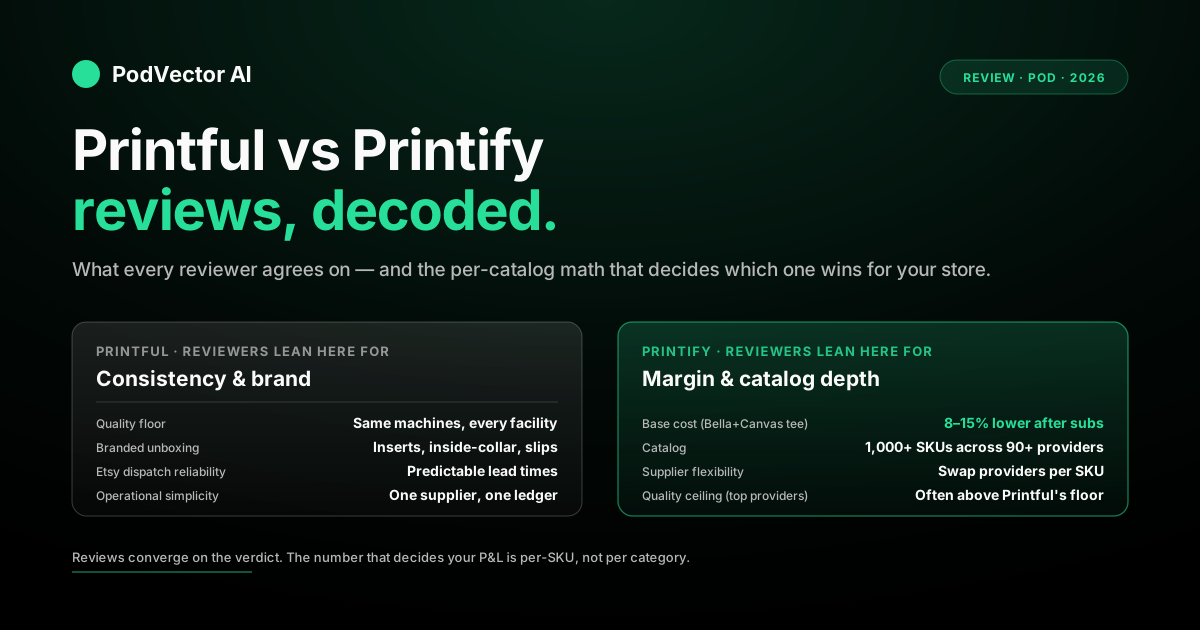
Quick Answer: Read ten Printful vs Printify reviews and a clean pattern emerges. Printful wins on quality consistency, branding, and operational simplicity. Printify wins on base cost, catalog breadth, and supplier flexibility.
Almost every reviewer in 2026 nudges undecided sellers toward Printify on margin grounds, then qualifies the recommendation for brand-led stores. That is correct as a default, and wrong as a verdict — because "best" depends on which SKUs you actually sell and which channels actually pay.
Below: what the reviews agree on, where they fight, and how to convert their generic ranking into a per-catalog decision your P&L will recognize.
What every Printful vs Printify review agrees on
If you read the top reviews back to back, the disagreements feel sharper than they are. Strip out the editorial voice and the conclusions converge.
The convergence points are worth stating up front, because everything else in the comparison is a tradeoff inside this consensus.
- Printful is more expensive, more consistent, and easier to brand. Same machines, same procedures, same look across regions.
- Printify is cheaper on base cost and catalog-wider, with variance. The variance comes from running on a marketplace of independent providers, not a single fulfillment network.
- Neither one is "better" in the abstract. The right pick depends on margin headroom, brand sensitivity, and how much operational risk you can absorb.
- Most 2026 reviewers nudge new sellers toward Printify. Margins are tight, the quality gap has narrowed, and starting capital matters.
- Brand-led stores still lean Printful. Returns, reviews, and lifetime value sit downstream of consistency.
That is the floor. The real review fight happens above it — how heavily to weight margin against control, and what to do when both matter.
Two business models, not two suppliers
The most useful frame in any Printful vs Printify review is not "platform A vs platform B." It is two different business models that happen to share a category.
Printful runs its own fulfillment. Owned facilities in the US, Mexico, Latvia, Spain, the UK, Canada, Australia, and Japan. Same equipment, same staff, same QA across regions. When a Printful order looks bad, Printful owns the problem.
Printify runs a marketplace. Roughly 90+ independent print providers across dozens of countries plug into Printify's catalog. You pick the provider per product. Quality, speed, and stock depend on which provider you chose, not on Printify itself.
One 2026 wrinkle worth clearing up before you read another review: Printful and Printify announced a merger in November 2024 and now sit under common ownership. In practice, nothing about the tradeoff changed — the two platforms still run as fully independent products, with separate catalogs, separate pricing, separate dashboards, and separate fulfillment. You still choose between an owned network and a marketplace. Any review implying the merger collapsed them into one product is out of date.
Once you internalize this, the rest of the review falls out. Printful's pricing premium pays for vertical integration. Printify's lower prices pay for marketplace risk. Neither is wrong. They are the same tradeoff every category eventually offers.
Pricing and margins: what the reviews get right
The pricing comparison is where reviews start to feel repetitive, but the headline holds up.
On comparable Bella+Canvas 3001 unisex tees, Printify base costs typically run 15–30% lower than Printful's standard pricing, depending on which provider you select. On AOP (all-over-print) and specialty items the gap can widen further, because Printful's in-house facilities are not optimized for every niche format.
Two adjustments most reviews skip:
- Printful Growth ($24.99/mo at most recent pricing, and free once annual sales clear $12K). Members get up to roughly 33% off, which closes 20–30% of the gap on apparel basics. If your volume justifies it, the per-tee math gets close to Printify Premium on some SKUs.
- Printify Premium (about $29/mo, higher on newer plan tiers). Adds another roughly 20% discount across all suppliers. Most serious Printify sellers run it the moment monthly volume covers the subscription.
One 2026 update most older reviews still miss: Printful pushed through catalog-wide base-price cuts in the 6–9% range, which quietly narrowed the gap the standard comparisons still quote. After both subscriptions, Printify usually still wins on raw base cost by 8–15% on apparel and more on accessories — but the gap is smaller than a 2024-era review will tell you. That is the margin story almost every review tells, and it is broadly correct in direction, stale in magnitude.
What reviews skip: shipping. Printify shipping rates from US providers are often higher than Printful's, especially for second and third items in the same order. By the time a 3-item order lands at the customer, the "Printify is cheaper" gap is meaningfully smaller than the base-cost comparison suggests. For a deeper dive on the apparel cost stack, see our breakdown of Printful's Bella+Canvas 3001 cost.
Print quality: consistent vs variable
Quality is where reviewers stop agreeing politely.
Printful's reputation in 2026 is "rarely amazing, rarely bad." DTG print density is solid. Color matching is reasonable. Hand-feel is fine. The ceiling is not the highest in the category, but the floor is high enough that you can ship without sampling every SKU. The number reviewers keep citing is Printful's reshipment rate — roughly 0.2% for quality issues, a figure Printify does not publish because no single number could describe a marketplace of independent providers.
Printify is harder to summarize because Printify itself does not print anything. Monster Digital, SwiftPOD, District Photo, ArtGun, Drive Fulfillment, and Print Geek all show up in Printify reviews — and they all print differently. Reviewers who tested top-rated Printify providers often rate their quality above Printful's. Reviewers who tested random providers got mixed results.
The actionable takeaway every honest Printify reviewer eventually lands on: provider selection is a skill. You sort by rating, you check production-time and reprint-rate numbers, you order samples, you assign your top SKUs to your top providers. Sellers who do this scale on Printify happily. Sellers who don't churn off it.
If you are not willing to manage providers, Printful's consistency is genuinely worth the premium. If you are, Printify's ceiling can be higher than Printful's at lower cost.
Catalog: 340 curated vs 1,000+ negotiable
Printful's catalog has grown past 340 toward the 500 mark in 2026, depending on how you count variants. Apparel-heavy, with home, accessories, stationery, and a growing wall-art lineup. Curated means a buyer chose every SKU.
Printify's catalog is over 1,000 products across the marketplace — some 2026 reviews now cite 1,300+. Apparel, accessories, home, drinkware, kitchenware, jewelry, pet products, niche regional items, and a long tail of specialty formats. Many SKUs are available from multiple providers at different prices and quality levels.
Reviews tend to call this a Printify win, and on raw count it is. But the catalog comparison is more useful when you flip it:
- If your store stays in apparel and core accessories, Printful's catalog is probably enough, and consistency wins.
- If your store expands into niches — pet products, kitchenware, drinkware lines with specific shapes, religious or seasonal items — Printify's catalog is the only realistic source.
- If your store experiments aggressively, Printify's depth is an asset by itself. Testing 20 product ideas is faster when 18 of them are already in the catalog.
For sellers running deep apparel comparisons across more than two suppliers, our Printful vs Printify vs Gelato breakdown covers a third option that changes the math, especially in Europe.
Shipping speed and fulfillment
Production speed is closer than reviews used to make it sound.
Printful's quoted average is around 2–5 business days in fulfillment, with regional facilities improving median speeds on US and EU orders since 2024. Printify's production speed depends entirely on the provider; top-rated providers like Monster Digital and SwiftPOD now match Printful's medians, while mid-tier providers can drift past a week during seasonal peaks.
Shipping speed comes down to provider location and carrier. Both platforms cover most major regions reasonably well. Both struggle with international orders during Q4. The difference is the variance — Printful's variance is narrow, Printify's depends on your provider choices.
If you are running a brand where shipping promises matter (Etsy especially watches dispatch times), Printful's predictability is worth real money. If you are running margin-led offers where customers price-in standard POD lead times, Printify's top-rated providers are competitive.
Branding, inserts, and packaging
This is where Printful's lead is least disputed in any review.
Printful offers branded packing slips, custom pack-ins, inside-collar prints, sleeve prints, branded stickers, branded labels on select garments, and full white-label fulfillment. The setup is consistent because the fulfillment is centralized.
Printify's branding options vary by provider. Some support custom packing slips and pack-ins. Many don't. Inside-collar and inside-neck options are inconsistent. The branding floor is lower because no two providers offer exactly the same set.
For a brand-led store, this is often the deciding factor in a Printful vs Printify review — and it should be. Margin gains from Printify can disappear quickly if your refund rate climbs because unboxing experience feels generic.
Integrations and channel fit
Both platforms cover the major sales channels. Shopify, Etsy, WooCommerce, eBay, Amazon (with limits), TikTok Shop, BigCommerce, Wix, Squarespace.
Two differences that matter:
- Etsy. Both work. Printful's consistency makes it slightly safer for Etsy's strict shipping-time enforcement. Printify with a top-rated provider performs equivalently, but the bar for "good enough" is higher.
- Amazon Merch on Demand sellers using Printful or Printify as a secondary supplier. Both are workable. Printful's quality consistency is preferred when you don't want to babysit; Printify's catalog depth wins for category expansion.
If you sell on Shopify and use Printify as a backbone, our Printful vs Printify vs Shopify comparison covers the integration tradeoffs in detail. For a wider supplier set including Gelato and Redbubble alongside Printful and Printify, see our four-way comparison.
The question no review answers: which is more profitable for your catalog
Here is the gap in every review you have read.
Reviewers compare base costs on a Bella+Canvas 3001 tee. They compare a hoodie. They compare a mug. They report margin in the abstract.
You don't sell "a tee." You sell your SKUs at your mix, through your channels, at your spend levels — and the answer to "which platform is more profitable" is buried inside that data.
A worked example. Say two stores both run Printful. Same Bella+Canvas 3001 base cost. Different P&L outcomes.
- Store A: 60% AOV is a single-tee order. 30% repurchase. Mostly Meta-paid traffic at $14 CPA. Tee dominates the SKU mix. Switching to Printify saves $3.40/order on average. Annual margin lift: meaningful.
- Store B: 70% AOV is a 2–3 item order, often mixed (tee + sweatshirt + sticker). 45% repurchase. Heavy on branded unboxing for retention. Switching to Printify saves $2.10/order on tees but adds $1.80/order in second-item shipping and lifts refunds by 1.4 points because branded inserts disappear. Annual margin lift: roughly zero, with downside variance.
Same review. Same numbers. Different answer.
This is the per-catalog math reviewers can't do, because they don't see your store. Your Shopify order data does. Your ad platform spend data does. Your refunds and reviews do. The decision is a P&L modeling exercise, not a base-cost lookup.
This is the gap Victor, our AI business operator for POD stores, was built to close. Victor connects directly to your Shopify, Printify or Printful, and ad platforms, models the platform switch against your actual order mix, shipping zones, and refund history, and surfaces a recommendation with the math attached. When the answer is "switch" or "split your catalog," Victor proposes the specific actions — repricing, collection updates, discounts — and executes them on your approval. The full action ledger logs every change for audit. That is the difference between a review and a decision.
When the reviews point to Printful
The Printful recommendation lands when one of these is true for your store:
- Brand matters more than base cost. Inside-collar prints, branded packing slips, custom pack-ins, and consistent unboxing protect lifetime value.
- You sell on Etsy and cannot afford dispatch-time variance.
- You are early-stage and can't manage providers. Printful's floor is higher; you ship without sampling.
- Your catalog is apparel-heavy and within Printful's curated range. The catalog limitation isn't a limitation if your SKU set already fits.
- Refunds, replacements, and chargebacks matter more than per-unit margin. A centralized fulfillment owner makes recovery cleaner.
When the reviews point to Printify
The Printify recommendation lands when one of these is true:
- Margin is the constraint. Premium subscription locked in, top-rated providers selected, branded inserts not the differentiator.
- Catalog depth matters. You sell beyond apparel basics — kitchen, drinkware, pet, niche regional formats.
- You are willing to manage providers. Sorting, sampling, swapping when a provider degrades, all part of the workflow.
- You experiment aggressively. Testing 20 product ideas against trends is faster when 18 are already in the catalog.
- You operate in regions where Printful is thin. Printify's marketplace gives you provider options Printful's owned facilities can't always match.
When the right answer is "use both"
The frame most reviews miss: this is not a binary.
Many serious POD sellers in 2026 run both. Printful for hero SKUs where consistency and branding move the needle. Printify for catalog expansion, niche tests, and price-sensitive lines. The platforms are not mutually exclusive — they live alongside each other on the same Shopify store.
The reason this gets underweighted in reviews is that it complicates the conclusion. "Pick A or B" is cleaner copy. "Audit which SKUs belong where" is the actual operator move.
The split usually falls along three lines:
- By margin sensitivity. SKUs with thin margins go to Printify. SKUs with brand premium go to Printful.
- By return risk. Sized apparel and color-sensitive prints favor Printful's consistency. Items where size and color matter less can sit on Printify.
- By channel. Etsy listings often live on Printful for dispatch reliability. Shopify-only SKUs split based on margin headroom.
If your gut says split but you don't know where to draw the lines, the cleanest way to do it is to model both options against your own data, not the reviewer's hypothetical store. For a sharper variant that includes a third supplier in the split, see Printful vs Printify vs Gelato vs Redbubble.
For deeper component-level pricing context behind these comparisons, our Bella+Canvas 3001 base cost breakdown and the broader Printful comparison cluster or Printful topic hub are useful next reads. A solid third-party reference is Merch Titans' Printful vs Printify comparison.
FAQs
Didn't Printful and Printify merge? Does the comparison still matter?
They announced a merger in November 2024 and now share ownership, but they still operate as two independent platforms with separate catalogs, pricing, dashboards, and fulfillment. The choice is unchanged: Printful's owned network versus Printify's provider marketplace.
Treat any review that describes them as a single merged product as out of date. Nothing about the day-to-day decision collapsed.
Is Printful or Printify better for beginners?
Printful for most beginners. The floor is higher, the consistency is better, and you can ship without sampling every SKU. The margin penalty is real but absorbable at low volume.
Printify becomes the better default once you are willing to sort providers, order samples, and swap when a provider degrades. That is a skill, not a setting.
Which has better print quality in 2026?
Printful is more consistent. Printify's ceiling is often higher with top-rated providers — and lower with random ones.
If you can manage provider selection, Printify wins on quality at lower base cost. If you can't, Printful wins on quality by default.
Can I use Printful and Printify on the same Shopify store?
Yes. Both integrate with Shopify. Sellers commonly assign products to whichever supplier fits the SKU best — Printful for hero items and branded apparel, Printify for catalog depth and margin-sensitive lines.
The Shopify storefront is supplier-agnostic. Customers don't see the split; you do.
Does Printify always have cheaper base costs than Printful?
On most apparel basics, yes — usually 8–15% after subscriptions, sometimes more on accessories.
On specialty formats and AOP items the gap varies. Once shipping is added to a 2–3 item order, the gap narrows further. Base-cost ranking is not the same as P&L ranking.
Which is better for branded stores?
Printful, clearly. Branded packing slips, inside-collar prints, custom pack-ins, and consistent unboxing all favor a single-fulfillment-owner model.
Printify's branding options vary by provider, with no consistent floor across the marketplace. Brand-led stores typically lean Printful even when Printify's base cost wins on paper.
How do I decide if my catalog is more profitable on Printful or Printify?
Model both options against your actual order data, not a generic Bella+Canvas tee. Pull your SKU mix, AOV, shipping zone distribution, and refund rates. Re-cost each SKU at the other supplier's pricing and project the margin shift.
Most stores don't do this because the spreadsheet work is painful. It is also where the real answer lives — and what Victor automates for the POD operators we work with.
Model the platform decision against your own catalog
Reviews can tell you which supplier wins in the abstract. Your P&L decides which one wins for your store. Victor connects to your Shopify, Printify or Printful, and ad platforms, models the platform switch against your actual SKUs and order mix, and proposes the specific actions — repricing, collection updates, discounts — to ship the decision. Approval-gated, audit-logged, no guessing.
Try Victor free